
July 14, 2026
The Hidden Mechanics of Alumina Supply Shocks and Why One Refinery's Return Changes Everything
Most metals markets price in risk gradually, accumulating uncertainty across weeks or months as geopolitical tensions build. But alumina supply disruptions operate differently. Because alumina sits at the precise midpoint of the aluminium production chain, a refinery outage does not merely inconvenience smelters downstream; it severs the oxygen supply to the entire value chain. When that refinery restarts, the market exhales all at once.
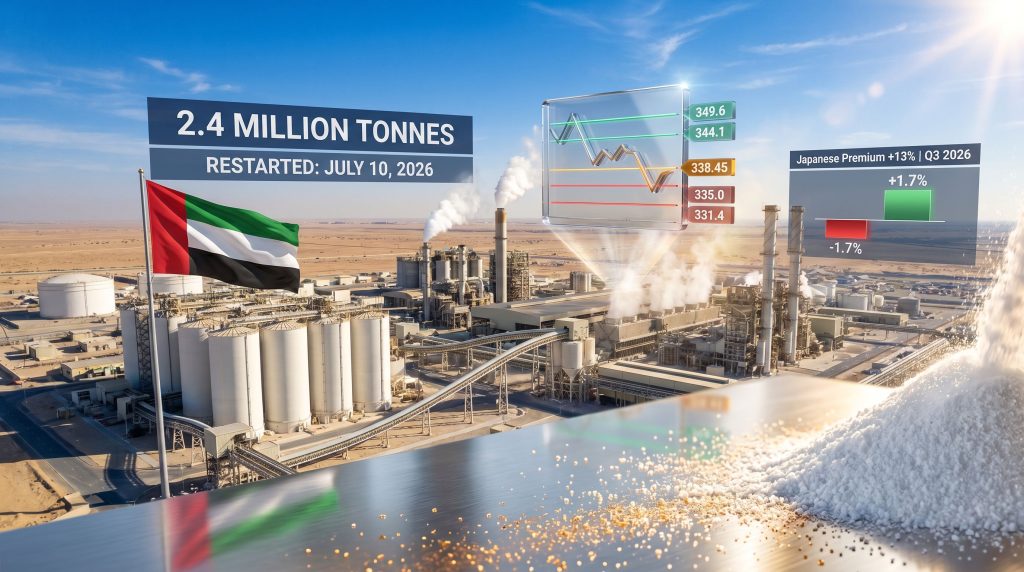
That is exactly what happened when the EGA Al Taweelah alumina refinery restart was confirmed in July 2026, triggering an immediate 1.6% decline in aluminium futures prices to settle at 338.45. To understand why a single facility in Abu Dhabi can move global commodity markets, it is first necessary to understand what alumina actually is, where it sits in the production hierarchy, and why the Al Taweelah refinery occupies such a strategically sensitive position.
When big ASX news breaks, our subscribers know first
Understanding the Alumina-to-Aluminium Production Chain
Alumina, chemically known as aluminium oxide (Al₂O₃), is the obligatory intermediate product between bauxite ore and finished primary aluminium. Every tonne of aluminium metal requires roughly 1.9 to 2.0 tonnes of alumina as feedstock in the smelting process. This means alumina refineries are not optional components in aluminium production; they are structural bottlenecks.
The global alumina refining industry is heavily concentrated. A handful of large-scale facilities account for a disproportionate share of the world's output, meaning any disruption to a major refinery creates supply stress that ripples far beyond its immediate geography. Furthermore, understanding this concentration effect is essential to interpreting the Al Taweelah story correctly. The bauxite production leaders in Guinea, Australia, and Brazil ultimately feed refineries like Al Taweelah, making upstream sourcing continuity a critical variable.
The Bayer Process and Why Refinery Restarts Are Complex
Alumina refineries operate using the Bayer Process, a four-stage chemical refining method that converts bauxite ore into alumina through digestion, clarification, precipitation, and calcination. Each stage is chemically interdependent, which is why restarting a shut-down refinery is not simply a matter of switching the facility back on.
The restart sequence at Al Taweelah reflects this technical complexity. The facility first resumed production of aluminium hydroxide hydrate, the chemical precursor to calcined alumina, on June 24, 2026, before advancing to full alumina output on July 10, 2026. This staged approach is standard Bayer Process restart protocol and reflects the need to stabilise chemical conditions before advancing to the calcination stage that yields saleable alumina.
Al Taweelah's Production Footprint Within EGA's Operations
Emirates Global Aluminium is one of the world's largest aluminium producers outside of China, and the Al Taweelah refinery is central to that position. The facility's operational significance can be understood through several key metrics:
| Metric | Detail |
|---|---|
| Annual Alumina Output (2025) | 2.4 million tonnes |
| Share of EGA's Total Alumina Requirements | ~46% |
| Location | Khalifa Economic Zone Abu Dhabi (KEZAD), UAE |
| Refinery Status (as of July 2026) | Restarted; ramping toward full capacity |
| Full Capacity Target | End of 2026 |
What makes the 46% self-supply figure particularly significant is what it implies about EGA's exposure during the outage. For approximately three and a half months, nearly half of the refinery's normal alumina contribution to EGA's smelting operations had to be sourced alternatively, either through spot market purchases, long-term contract activation, or drawdown of strategic stockpiles. Each of these alternatives carries cost and logistics overhead that would not ordinarily apply.
EGA's vertical integration strategy, which spans bauxite mining through to finished aluminium products, is designed precisely to reduce this kind of exposure. Al Taweelah's role within that structure is to anchor the upstream refining link, keeping alumina supply internal and predictable. When that anchor failed, the ripple effects extended well beyond EGA's own production ledger. Indeed, the top aluminium producers globally were watching the situation closely, given what it implied for broader supply balances.
What Triggered the Shutdown: Geopolitical Shock at Industrial Scale
The refinery was not shut down for maintenance or economic reasons. On March 28, 2025, Iranian missile and drone strikes targeted infrastructure within the Khalifa Economic Zone Abu Dhabi, causing significant damage to the industrial complex and forcing an immediate halt to Al Taweelah operations.
This context matters for several reasons that go beyond headline risk:
- The KEZAD industrial zone concentrates significant global industrial capacity within a geographically compact area, creating a single-point-of-failure risk that is difficult to fully hedge
- The strike demonstrated that Middle Eastern industrial infrastructure is not immune to the region's escalating military dynamics, a reality that metals markets had arguably underpriced
- The roughly 3.5-month outage at 2.4 million tonnes annualised capacity represents an estimated production loss of approximately 700,000 tonnes of alumina, a figure with material implications for EGA's sourcing costs and the wider spot alumina market
"Geopolitical risk premiums in commodity markets are rarely priced continuously. They tend to be ignored until an event forces repricing, then partially reversed once tensions appear to ease. The Al Taweelah shutdown is a textbook example of this pattern playing out in industrial metals."
However, it is worth noting that commodity tariff impacts were also compounding market uncertainty during this period, layering additional complexity onto an already stressed supply environment.
The Strait of Hormuz Factor
Even after the refinery restart, residual risk from the Strait of Hormuz shipping corridor has not fully dissipated. The Strait remains the critical passage for a significant portion of the Middle East's industrial exports, and renewed incidents in or near the waterway continue to embed a background risk premium into alumina and aluminium pricing.
This is not unique to EGA; the broader Gulf aluminium production ecosystem, which includes significant capacity in Bahrain, Qatar, and Saudi Arabia, shares this exposure. For traders and procurement teams relying on Gulf-sourced alumina, the practical implication is that freight insurance costs, force majeure clauses, and supply chain redundancy have all become more prominent line items since March 2025.
The Phased Restart: Milestones and Market Implications
The Al Taweelah recovery has followed a deliberate, staged ramp-up rather than an immediate full restart. The key milestone sequence is as follows:
- June 24, 2026 — Resumption of hydrate production, the chemical precursor stage within the Bayer Process
- July 10, 2026 — Official restart of alumina production confirmed, as reported by Aluminium Today
- Within days of restart — Target of reaching 50% of plant capacity
- End of 2026 — Technical capability to achieve 100% full production capacity
The distinction between technical capability and actual full output is subtle but important. EGA's stated target refers to the refinery's ability to operate at full capacity, not necessarily a guarantee of 100% utilisation. Actual throughput will depend on bauxite feedstock availability, alumina demand signals from EGA's smelting operations, and broader market conditions.
Smelter Restart: A Separate and Slower Recovery Curve
The Al Taweelah aluminium smelter, which is co-located with the refinery but operates on an entirely independent restart timeline, is undergoing its own phased recovery. Of the facility's 1,262 reduction cells, only 89 had been restarted as of early July 2026.
This asymmetry is technically inevitable. Electrolytic reduction cells used in aluminium smelting cannot simply be switched back on after an extended shutdown. The cells must be carefully relined, preheated, and brought back to operating temperature in sequence, a process that takes months across a large cell line. Consequently, the smelter's recovery trajectory will lag well behind the refinery's alumina output recovery.
How Markets Responded: Sentiment, Technicals, and Physical Reality
The immediate price response to the EGA Al Taweelah alumina refinery restart was a 1.6% decline in aluminium futures, settling at 338.45. This represents a textbook sentiment-driven reaction: the removal of a known supply risk prompted algorithmic and discretionary traders to exit risk premium positions simultaneously.
But the underlying physical market tells a more nuanced story:
| Market Indicator | Signal | Period |
|---|---|---|
| LME aluminium inventories | Lowest level since September 2022 | July 2026 |
| Cash-to-three-month spread | Backwardation (cash premium) | July 2026 |
| SHFE aluminium stocks in China | Fell 4.8% week-on-week | July 2026 |
| Japanese Q3 2026 premium | +13% year-on-year increase | July-September 2026 |
Backwardation in the LME aluminium curve, where the spot price exceeds the forward price, is a structural signal of near-term physical tightness. It indicates that buyers are willing to pay a premium for immediate delivery, which is inconsistent with the bearish price action driven purely by the restart news. In addition, commodity volatility hedging strategies have become increasingly important for market participants navigating these divergences between futures sentiment and physical fundamentals.
"The divergence between sentiment-driven futures price declines and physically tight inventory conditions is one of the most exploitable inefficiencies in base metals markets. The restart narrative may have temporarily suppressed prices below levels justified by fundamental demand."
Japanese Premium Surge: Why It Matters
The 13% increase in Japan's quarterly aluminium premium for the July-September 2026 period is a particularly informative data point. Japan is one of the world's largest aluminium-importing economies and essentially all-import dependent for primary metal. Japanese quarterly premiums are negotiated between Japanese buyers and producers and function as a forward-looking demand signal. A 13% jump signals that Japanese end-users are competing aggressively for material, pointing to robust underlying consumption.
The next major ASX story will hit our subscribers first
Global Production Trends: The China Divergence
The macro production backdrop adds another layer of complexity to the Al Taweelah narrative.
| Production Metric | Figure | Period |
|---|---|---|
| Global primary aluminium output change | -1.7% year-on-year | May 2026 |
| China's aluminium output change | +1.7% year-on-year | May 2026 |
| China's unwrought aluminium import growth | +6.9% | May 2026 |
The widening divergence between Chinese and ex-China aluminium production trajectories carries significant structural implications. China's continued output growth, combined with a 6.9% rise in unwrought aluminium imports, suggests that domestic Chinese demand is expanding faster than even China's aggressive capacity additions can accommodate.
For ex-China producers including EGA, this dynamic is a double-edged signal. Strong Chinese import demand supports global aluminium prices and absorbs ex-China supply. However, it also means that any disruption to ex-China production, such as the Al Taweelah outage, has outsized global impact because there is less redundant capacity available outside of China to compensate. This dynamic is further complicated by green steel pricing trends, which are reshaping broader metals demand patterns across adjacent markets.
Technical Price Structure: Key Levels Post-Restart
For market participants monitoring aluminium price dynamics following the refinery news, the technical structure sets out a clear framework of support and resistance:
| Price Level | Significance |
|---|---|
| 338.45 | Post-restart settlement price |
| 335.0 | Near-term support level |
| 331.4 | Secondary support if 335.0 breaks |
| 344.1 | Upside resistance level |
| 349.6 | Extended bullish target above resistance |
Three Scenarios for Aluminium Prices Through Year-End 2026
Scenario A: Accelerated Al Taweelah Ramp-Up
If the refinery returns to full capacity ahead of the year-end target and supply chain conditions are favourable, alumina availability improves faster than expected. This would maintain downward price pressure, likely pushing aluminium toward the 331.4 secondary support zone.
Scenario B: Delayed Full Recovery
Supply chain constraints, bauxite feedstock logistics, or technical challenges slow the ramp-up beyond year-end 2026. Physical tightness, already evidenced by LME backwardation and the Japanese premium surge, would intensify and potentially push prices back toward the 344.1 to 349.6 resistance band.
Scenario C: Renewed Geopolitical Disruption
Further incidents near the Strait of Hormuz or within KEZAD itself would reignite the supply risk premium, producing sharp upside volatility regardless of refinery ramp-up progress. This tail risk remains non-trivial given the broader regional security environment, as Argus Media has noted in its coverage of the ongoing situation.
Disclaimer: All price scenarios and forecasts described above are speculative in nature and should not be construed as financial advice. Commodity prices are subject to rapid change based on geopolitical, macroeconomic, and technical factors.
What the Al Taweelah Story Reveals About Aluminium Market Architecture
The broader lesson from the EGA Al Taweelah alumina refinery restart is not simply about one facility recovering from damage. It exposes several structural realities of the global aluminium market that are not always visible during periods of stable supply:
- Geographic concentration risk in Middle Eastern aluminium production creates correlated exposure across multiple producers when regional security deteriorates
- Bayer Process chemistry makes alumina refinery restarts technically complex and time-consuming, meaning supply disruptions cannot be rapidly reversed even when the political or physical conditions that caused them have resolved
- Physical tightness can persist beneath bearish sentiment, creating conditions where futures price declines may understate the true state of supply-demand balance
- Upstream bauxite sourcing remains the least visible but most critical link in the chain; a refinery restart is only as credible as its bauxite supply continuity
The interplay between geopolitical risk, Bayer Process technical constraints, and LME market microstructure makes alumina one of the most analytically rich commodities in the base metals complex. The EGA Al Taweelah alumina refinery restart is a reminder that in this market, the most important price signals are often found not in futures screens, but in physical inventory data, freight premiums, and the quiet restart sequences of chemical plants in the UAE.
FAQs: EGA Al Taweelah Alumina Refinery Restart
When did EGA restart the Al Taweelah alumina refinery?
EGA officially restarted alumina production at Al Taweelah on July 10, 2026, following a suspension that began on March 28, 2025.
What caused the Al Taweelah refinery to shut down?
The refinery was forced offline after missile and drone strikes targeted the Khalifa Economic Zone Abu Dhabi, damaging the industrial complex in which the refinery operates.
How long will it take for Al Taweelah to reach full production capacity?
EGA expects to have the technical capability to operate at full capacity by the end of 2026, though actual throughput will depend on supply chain conditions and broader alumina demand.
How much alumina does the Al Taweelah refinery produce?
The refinery produced approximately 2.4 million tonnes of alumina in 2025, supplying around 46% of EGA's total alumina requirements.
Why did aluminium prices fall after the restart announcement?
The confirmed restart reduced market anxiety over alumina raw material availability, prompting traders to unwind the supply risk premium that had accumulated in aluminium futures pricing during the outage period.
Is the Al Taweelah smelter also restarting?
Yes, though on a separate and slower timeline. As of early July 2026, 89 of 1,262 reduction cells had been restarted, with the smelter's recovery running independently of the refinery ramp-up.
Want to Stay Ahead of Commodity Supply Shocks Before They Move Markets?
Discovery Alert's proprietary Discovery IQ model delivers real-time alerts on significant ASX mineral discoveries the moment they hit the exchange, transforming complex commodity dynamics into actionable investment insights for traders and investors at every level. Explore how major discoveries have historically generated substantial returns on Discovery Alert's dedicated discoveries page, and begin your 14-day free trial today to position yourself ahead of the next market-moving event.