July 14, 2026
The Strait That Holds the World's Energy Hostage
Few geographic features carry the economic weight of a 33-kilometre-wide body of water. The Strait of Hormuz, separating the Iranian coastline from the Omani peninsula of Musandam, functions as the singular pressure point through which roughly one-fifth of the world's daily oil and liquefied natural gas supply must pass. Monitoring crude oil price trends becomes essential when that passage becomes contested, as the consequences radiate outward across freight markets, currency valuations, inflation forecasts, and geopolitical alignments simultaneously.
That is exactly what occurred in mid-July 2026, when renewed military exchanges between US and Iranian forces compressed tanker traffic to historic lows and reignited a debate that has circulated in energy security circles for decades: what happens when the world's most critical maritime chokepoint becomes a tool of coercion rather than free commerce?
The answers emerging from Washington are unconventional, legally contested, and in some cases factually misrepresented in media coverage. Before investors, logistics operators, and energy procurement teams can assess their exposure, the policy landscape itself requires careful disaggregation.
When big ASX news breaks, our subscribers know first
What the "Trump 20% Hormuz Cargo Fee" Actually Means
The phrase Trump 20% Hormuz cargo fee has circulated widely, but its meaning depends entirely on which 20% figure is being referenced. There are two distinct interpretations, and confusing them carries significant analytical consequences.
The first and most established use of the 20% figure describes the share of global daily oil and LNG supplies that transited the Strait of Hormuz before the current conflict escalated in late February 2026. This is a long-standing geopolitical statistic, not a proposed tariff instrument. It reflects the structural dependency the global energy system has developed on a single waterway controlled by no single sovereign power under international law.
The second interpretation, which gained traction in some media outlets, describes a proposed US cargo fee equivalent to 20% of transported goods as a form of security reimbursement. This is where verification becomes critical.
Fact-Check Alert: No major international news organisation has independently confirmed that the Trump administration formally proposed a structured 20% cargo fee applying to all vessels transiting the Strait of Hormuz. The specific figure appears in Trump's own Truth Social post dated July 13, 2026, where he stated the US would seek reimbursement "at the rate of 20% on all cargo shipped" for the costs of providing security in the waterway. However, no accompanying mechanism for calculating, billing, or enforcing such a charge has been announced.
Four Distinct Policy Positions Trump Has Floated
Rather than a single coherent policy, Trump's statements on Hormuz have spanned a spectrum of positions, some of which contradict each other:
| Policy Position | Core Claim | Verification Status |
|---|---|---|
| Opposition to Iranian tolls | Trump warned Iran must cease charging fees to transiting tankers | Corroborated across multiple major outlets |
| US-imposed toll proposal | Washington might levy its own passage fees, with Trump suggesting the US "won" and should benefit accordingly | Partially corroborated via Truth Social post |
| Joint revenue-sharing with Iran | A proposed arrangement where both nations share toll collection revenue | Reported; rejected by the EU as inconsistent with international law |
| 20% cargo fee on all ships | The specific rate cited by Trump on Truth Social; no enforcement mechanism announced | Announced but operationally unverified |
The absence of any formal enforcement structure is significant. Existing models for maritime transit fees, such as those applied at the Suez Canal or the Panama Canal, involve treaty frameworks, administrative bodies, standardised billing systems, and internationally recognised tariff schedules built over decades. None of these preconditions exist for a US-administered Hormuz fee. This strongly suggests the proposal functions more as a negotiating posture than a near-term implementable policy. For broader context on oil price disruption risks, the parallels with other supply-side pressures are worth examining carefully.
Iran's Competing Toll Structure and the Sovereignty Dispute
While debate centres on what the US might charge, Iran has reportedly already moved to monetise its claimed sovereignty over the waterway. Tehran has imposed a fee of approximately $1 per barrel on vessels transiting the strait. For a Very Large Crude Carrier (VLCC) carrying a standard cargo of roughly 2 million barrels, this translates to an effective per-transit cost of approximately $2 million per vessel.
Reported payment mechanisms include yuan-denominated transfers and cryptocurrency, reflecting Iran's broader effort to conduct international commerce outside dollar-denominated clearing systems subject to US sanctions. These developments are consistent with the widening geopolitical trade tensions reshaping energy and logistics markets across the globe.
Iran's position on the strait's status is unambiguous. Following what Iranian authorities described as an unauthorised transit on July 11, 2026, Tehran announced the closure of the waterway entirely. The following day, Iranian officials confirmed passage remained suspended, conditioning resumption on a complete cessation of US military operations in the area.
Iran's Revolutionary Guards reinforced this position, warning that continued US intervention could trigger further disruptions with cascading effects on global energy markets. This created a direct confrontation with Trump's July 13 Truth Social post declaring the reinstatement of a naval blockade on Iran, asserting that the US would serve as the waterway's guardian and would be compensated for that role.
The statement lacked operational specificity on virtually every material detail: how charges would be assessed, which vessels would be subject to collection, and through what legal or administrative mechanism enforcement would occur. An interim US-Iran agreement signed in June, designed to reopen the strait and pause hostilities for 60 days of negotiations, has come under severe strain as a result of the renewed military exchanges.
Oil Markets React: Price Movements and Tanker Traffic Collapse
Energy markets did not wait for policy clarity before pricing in the disruption risk. On July 13, 2026, both major crude benchmarks registered sharp gains:
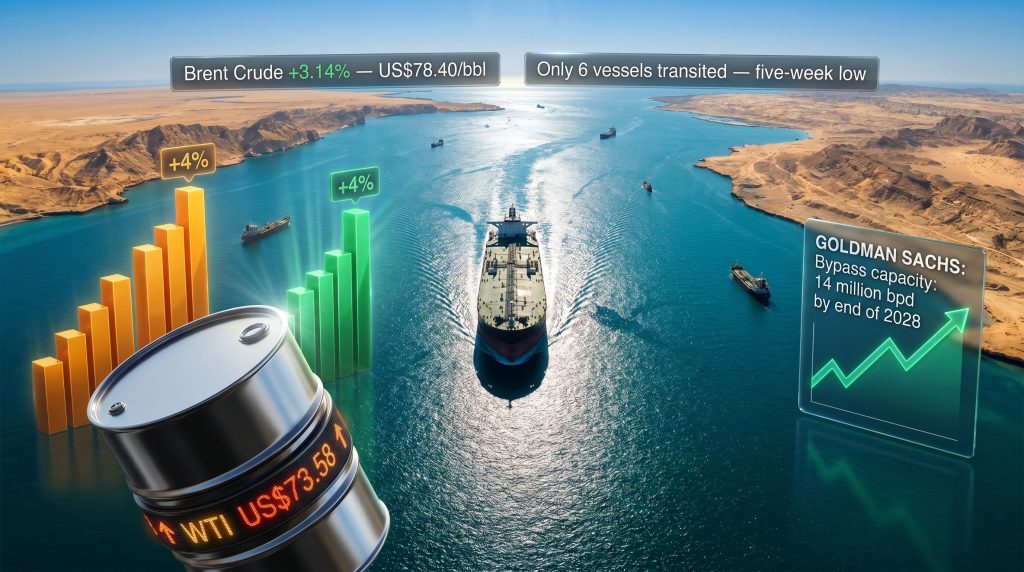
- Brent crude futures rose US$2.39 (3.14%) to US$78.40 per barrel
- West Texas Intermediate (WTI) climbed US$2.17 (3.04%) to US$73.58 per barrel
- Both benchmarks had surged more than 4% earlier in the same session before partially retreating as traders digested conflicting signals
Analysts attributed the price movement to two reinforcing drivers. The first was a straightforward geopolitical risk premium applied to any asset correlated with Middle Eastern supply security. The second, and arguably more structurally significant, was concern that reduced tanker access to the Persian Gulf could eventually constrain regional production output, tightening physical crude availability independent of any policy decision.
Ship-tracking data from Kpler revealed the full extent of the traffic collapse. On July 12, only six vessels transited the Strait of Hormuz, representing the lowest single-day traffic count recorded in five weeks. The vessels that did transit were carrying Iranian crude oil and Kuwaiti petroleum products, suggesting that traffic had effectively been reduced to movements by parties with direct state-level clearance from Iran.
Shipping Industry Exposure: Shipowners, charterers, and cargo insurers are now simultaneously managing military incident risk, vessel damage liability, crew safety obligations, and rapidly shifting navigation restrictions. This combination is accelerating freight rate increases and war-risk insurance premium escalation across global supply chains at a pace that historical precedent from prior Gulf crises suggests could persist well beyond the immediate conflict period.
For a detailed breakdown of how the Trump 20% Hormuz cargo fee proposals interact with broader trade policy, The Hill's reporting on Trump's Hormuz toll threats provides useful additional context on the administration's stated rationale.
The Legal Dimension: Can Anyone Actually Charge a Hormuz Toll?
Both the US and Iranian positions face substantial challenges under existing international maritime law. The United Nations Convention on the Law of the Sea (UNCLOS) establishes the principle of transit passage through international straits, which grants vessels of all nations the right of continuous and expeditious transit. This framework was specifically designed to prevent any single coastal state from exercising exclusive control over strategically important waterways.
Under this framework, Iran's imposition of per-barrel transit fees on foreign-flagged vessels is legally contestable. The EU has already formally rejected Trump's proposed joint revenue-sharing arrangement with Tehran as inconsistent with international legal norms. A unilateral US cargo levy faces similar objections, with the additional complication that the US is not itself a coastal state bordering the strait.
The contrast with legitimate canal toll structures is instructive:
- The Suez Canal operates under Egyptian sovereign authority over a manmade waterway, with internationally recognised tariff schedules
- The Panama Canal functions under a treaty framework with established fee structures and a neutral administrative body
- The Strait of Hormuz is a natural international strait subject to UNCLOS transit passage provisions, with no legal precedent for sovereign toll collection by any party
This legal gap means any enforcement mechanism would require either a new international agreement, a unilateral military posture, or bilateral arrangements with individual flag states, each carrying significant diplomatic and operational complexity.
Supply Chain and Inflation Consequences Beyond the Headline Price
The economic consequences of sustained Hormuz disruption extend well beyond the crude oil price itself. Energy costs function as an input to virtually every segment of the global goods economy, and the transmission mechanisms are faster than many non-specialist observers appreciate. Furthermore, the global trade impact of prolonged disruption compounds inflationary pressures across multiple industries simultaneously.
Industries facing the most direct exposure include:
- Petrochemicals and plastics manufacturing, where feedstock costs are directly linked to crude and condensate pricing
- Fertiliser production, which depends heavily on natural gas derivatives transiting the Gulf
- Aviation, where jet fuel costs represent the largest single variable operating expense for carriers
- Long-haul trucking, where diesel cost increases pass through rapidly to consumer goods pricing
- Consumer electronics supply chains that route finished goods through sea lanes passing near the Gulf region
The countries carrying the greatest structural vulnerability are concentrated in East Asia. Japan, South Korea, China, and India collectively source a substantial majority of their crude oil imports from Gulf producers. Any sustained disruption to Hormuz transit forces these economies to either pay elevated spot market premiums, draw down strategic reserves, or accept reduced supply, each of which carries distinct macroeconomic consequences.
European nations with limited pipeline alternatives to Middle Eastern LNG face a parallel vulnerability. The LNG supply outlook for the region has consequently become a focal point for energy security planning across European capitals. Emerging market economies where energy import costs represent a disproportionate share of current account expenditure face the sharpest inflationary exposure per dollar of crude price increase.
The next major ASX story will hit our subscribers first
Pipeline Bypass Infrastructure: The Medium-Term Structural Response
The most credible long-term hedge against Hormuz vulnerability is expanded pipeline infrastructure that allows Gulf producers to export crude without using the strait. This conversation accelerated significantly following the 2019 attacks on Saudi Aramco facilities, but the current conflict has compressed investment timelines and increased the urgency of bypass capacity expansion.
Goldman Sachs has estimated that expanded Middle Eastern pipeline infrastructure could protect more than 60% of pre-war Gulf oil exports from potential strait disruption by the end of 2028, based on projected capacity additions:
- +3.8 million barrels per day by end of 2027
- +7.3 million barrels per day cumulative by end of 2028
- Total effective bypass capacity exceeding 14 million barrels per day
The existing bypass route landscape provides the foundation for these expansions:
| Route | Operator/Country | Current Capacity | Strategic Significance |
|---|---|---|---|
| Petroline (East-West Pipeline) | Saudi Arabia | ~5 million bpd | Primary Saudi bypass route to the Red Sea |
| Abu Dhabi Crude Oil Pipeline | UAE | ~1.5 million bpd | Terminates at Fujairah on the Gulf of Oman |
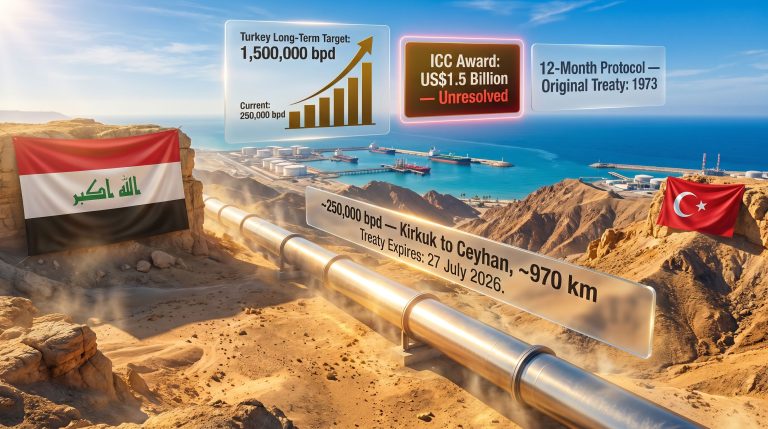
| Iraq-Turkey Pipeline | Iraq/Turkey | ~0.4 to 0.6 million bpd | Partially operational; subject to periodic disruption |
| Proposed Gulf expansions | Multiple Gulf states | Under active development | Targeted at post-2027 capacity uplift |
A critical nuance that frequently goes under-reported: pipeline bypass capacity is a structural medium-term solution, not a crisis response tool. Bringing new pipeline capacity online requires three to five years of engineering, construction, and commissioning activity. The bypass capacity Goldman Sachs projects for 2027 to 2028 reflects investment decisions made years earlier, not emergency responses to the current conflict. The practical implication is that the world remains substantially exposed to Hormuz disruption risk for the next 12 to 24 months regardless of pipeline expansion timelines.
Frequently Asked Questions: Trump, Hormuz, and the 20% Fee
Has Trump officially announced a 20% fee on cargo ships in the Strait of Hormuz?
Trump posted on Truth Social on July 13, 2026 that the US would seek reimbursement at the rate of 20% on all cargo shipped through the strait. However, no formal mechanism for calculating, collecting, or enforcing this charge has been announced, and major international news organisations have not confirmed it as an operationalised policy. i24 News has reported further detail on both Iran's competing toll plans and Trump's denials of certain aspects of the fee scheme.
What is Iran charging ships to transit the Strait of Hormuz?
Iran has reportedly imposed a fee of approximately $1 per barrel on transiting vessels, translating to roughly $2 million per VLCC tanker, payable in yuan or cryptocurrency.
How much oil passes through the Strait of Hormuz?
Before the current conflict escalated, the strait handled approximately one-fifth of global daily oil and LNG supplies. This 20% figure is a geopolitical statistic describing supply flow concentration, not a tariff rate.
What happened to oil prices during the July 2026 disruption?
Brent crude rose 3.14% to US$78.40 per barrel and WTI climbed 3.04% to US$73.58 per barrel on July 13, 2026, with both benchmarks having surged more than 4% earlier in the same session.
Are there alternative routes if the Strait of Hormuz closes?
Yes, though none are immediately scalable to replace full Hormuz capacity. Goldman Sachs projects bypass infrastructure could protect more than 60% of pre-war Gulf oil exports from strait disruption by end of 2028, with total effective bypass capacity potentially exceeding 14 million barrels per day.
Key Takeaways for Investors and Logistics Operators
Several conclusions emerge from a structured analysis of the current situation that are not immediately obvious from headline coverage:
- The Trump 20% Hormuz cargo fee as a concept conflates two different 20% figures — a statistical descriptor of oil flow concentration and a proposed security reimbursement rate. These require separate analytical frameworks.
- What Trump has actually proposed spans at least four distinct positions, none of which have been operationalised with formal collection or enforcement mechanisms, suggesting these statements currently function more as negotiating signals than implementable trade policy.
- The measurable market impact is real and significant: oil prices surged more than 3%, tanker traffic collapsed to six vessels in a single day, and freight and war-risk insurance costs are rising across global supply chains.
- The legal obstacles to any Hormuz toll structure, whether US or Iranian in origin, are substantial under UNCLOS transit passage principles, and the EU's rejection of the joint venture proposal illustrates the diplomatic resistance such arrangements would face.
- Pipeline bypass investment represents the most credible structural hedge, but its benefits remain 12 to 24 months away at minimum, leaving near-term exposure substantially unreduced.
- Energy procurement teams and logistics operators should distinguish rigorously between verified policy developments and unconfirmed or operationally vague announcements when making exposure assessments in this environment.
This article contains forward-looking projections, including Goldman Sachs pipeline capacity estimates, which are subject to change based on geopolitical developments, investment decisions, and engineering timelines. Nothing in this article constitutes financial or investment advice. Readers should conduct independent due diligence before making any decisions based on the information presented here.
Want to Track the ASX Stocks Most Exposed to Energy Market Disruptions?
When geopolitical shocks like the Hormuz crisis send commodity prices surging, Discovery Alert's proprietary Discovery IQ model scans ASX announcements in real time, instantly identifying significant mineral and energy-related discoveries so subscribers can act on actionable opportunities before the broader market catches up — explore historic discovery returns on Discovery Alert's discoveries page and begin your 14-day free trial today.