
July 14, 2026
The Hidden Architecture of a Market in Crisis
Global commodity markets have always carried embedded vulnerabilities that remain invisible until a single event exposes them all at once. Sulphur is one of the least glamorous commodities in industrial chemistry, yet it underpins a supply chain that feeds billions of people. It flows from refineries as an unavoidable byproduct of crude oil and natural gas processing, gets converted into sulphuric acid, and then combines with phosphate rock to create the fertilisers that sustain modern agriculture. When that flow is interrupted, the consequences ripple outward in ways that are rarely understood until prices reach levels that were previously unimaginable.
That is precisely where the market finds itself in mid-2026. The Tampa liquid sulphur price record of $705 per long tonne delivered for Q3 2026 is not simply a large number. It is the measurable outcome of compounding structural failures that have been building across geopolitics, infrastructure, and demand economics simultaneously.
When big ASX news breaks, our subscribers know first
Understanding the Tampa Benchmark and Why It Anchors Global Sulphur Trade
The Tampa liquid sulphur contract is not a futures instrument traded on an exchange. It is a quarterly bilateral negotiation between major US Gulf refiners and the phosphate fertiliser producers concentrated around Tampa Bay, Florida. The settlement price that emerges from these negotiations then functions as a global reference point for molten sulphur pricing across North America and influences how buyers and sellers position themselves in related markets.
Tampa holds this role for a specific physical reason. The region hosts one of the densest concentrations of phosphate fertiliser manufacturing infrastructure anywhere in the world. Sulphuric acid, produced by burning elemental sulphur in specialised contact process plants, is consumed in massive quantities to dissolve phosphate rock into the soluble forms used in crop nutrition. This creates a structural, recurring demand centre that justifies the quarterly negotiation framework and gives the resulting price its benchmark status.
Because sulphur is a mandatory byproduct of hydrocarbon processing rather than a deliberately produced commodity, its supply cannot easily respond to price signals. Refineries produce sulphur whether they want to or not. This supply inelasticity is one of the defining characteristics of the market and helps explain why price dislocations, once they occur, can be severe and prolonged. Furthermore, phosphate market dynamics play a critical role in shaping overall demand patterns for sulphur across the supply chain.
A Decade of Price History Compressed Into Three Record-Breaking Quarters
To appreciate the magnitude of what has happened in 2026, the longer price history provides essential context.
| Settlement Period | Price ($/long tonne delivered) | Market Significance |
|---|---|---|
| Q3 2008 | $617/lt | Pre-2026 all-time high |
| Q3 2022 | $481/lt | Post-pandemic commodity peak |
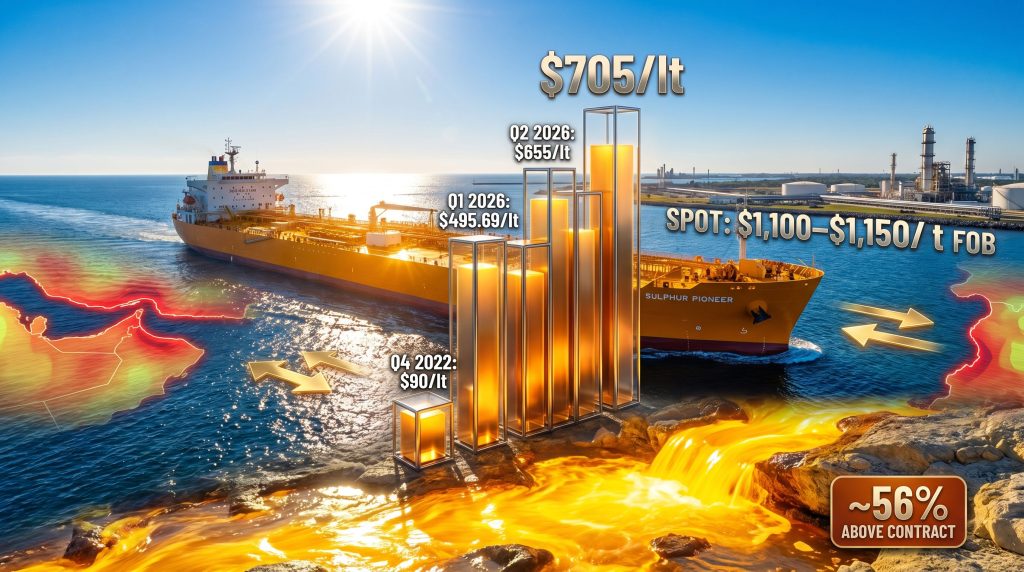
| Q4 2022 | $90/lt | Severe single-quarter correction |
| Q1 2026 | $495.69/lt | 13-year high at time of settlement |
| Q2 2026 | $655/lt | Broke the 18-year-old 2008 record |
| Q3 2026 | $705/lt | Current all-time record, up 8% quarter-on-quarter |
The Q4 2022 collapse from $481/lt to $90/lt within a single quarter is arguably the most important data point for understanding current market risk. It demonstrates that sulphur markets are capable of price reversals that dwarf almost any other industrial commodity. That precedent sits in the background of every negotiation happening right now.
What distinguishes the 2026 pricing environment from previous peaks is the sequential nature of the record-breaking. Three consecutive quarters of escalating prices, each setting a new high, indicate a structural disruption rather than a short-term demand spike. When a market breaks its own record twice in succession, the underlying cause is typically more durable than seasonal fluctuation or inventory cycle dynamics. According to the sulfur price index, such sustained multi-quarter escalations are historically rare and typically signal deeply embedded supply-side constraints.
How the Strait of Hormuz Closure Reorganised Global Sulphur Supply
The catalyst for the 2026 price surge traces directly to the outbreak of US-Iran military conflict beginning in February 2026, which ultimately led to the closure of the Strait of Hormuz to commercial shipping. According to Argus Media reporting from July 2026, ship transits through the strait fell sharply following fresh clashes between US and Iranian forces, with Iran's Islamic Revolutionary Guard Corps announcing the strait would be closed until further notice. AIS tracking data showed negligible traffic movement through the waterway during the most intense phases of the conflict.
The strategic importance of this cannot be overstated for sulphur specifically. The Gulf region, encompassing Saudi Arabia, Kuwait, the UAE, and Qatar, is one of the world's largest sources of seaborne sulphur. This sulphur originates as a byproduct of hydrocarbon processing at some of the highest-throughput refinery and gas plant complexes on earth. With Hormuz transit volumes collapsing, buyers who had traditionally sourced from Gulf suppliers found themselves without their primary supply source and were forced to pivot rapidly toward alternative origins. The resulting oil market disruption compounded supply pressures across multiple interconnected commodity markets simultaneously.
The US Gulf became the swing supplier of last resort. Refineries along the Gulf Coast found themselves able to export liquid sulphur into markets they had never previously served at scale:
- North Africa, including fertiliser production operations in Algeria and Morocco, where phosphate processing infrastructure requires substantial sulphur acid inputs
- East Africa, serving copper belt industrial consumers in countries such as Zambia and the Democratic Republic of Congo, where sulphuric acid converted from elemental sulphur is a critical input for copper leaching operations
This geographic redistribution of US Gulf exports is significant beyond the price data. It reveals just how thoroughly the Middle Eastern supply disruption reorganised the physical architecture of global sulphur trade flows within the space of two quarters. In addition, geopolitical oil price pressures have historically preceded and amplified sulphur market tightness, and the current cycle is no exception.
The Contract-Spot Price Divergence: What a 56% Gap Actually Means
One of the most analytically revealing features of the current market is the gap between contract and spot pricing.
The Q3 2026 Tampa contract settled at $705/lt delivered, while spot export assessments from US Gulf refineries reached $1,100 to $1,150 per tonne FOB as of 9 July 2026, according to Argus Media price data. That represents a premium of approximately 56% above the contract benchmark for physical spot cargo.
During the Q2 2026 settlement window, spot prices were reportedly ranging between $850 and $900 per tonne, with certain delivery points approaching $1,000 per tonne. The fact that the contract settled at $655/lt for Q2 while spot prices were simultaneously trading near $1,000/t tells a specific story about how bilateral contract negotiations absorb market stress differently from open spot trading.
Contract negotiations between large counterparties involve relationship economics, long-term supply security considerations, and downstream affordability constraints that spot trades do not. The moderate contract settlement relative to spot levels reflects a deliberate decision by producers and buyers to preserve downstream fertiliser economics rather than extract maximum short-term revenue. This is a signal that the market is approaching, or has reached, a demand destruction threshold.
Infrastructure Rigidity: The Constraint Nobody Discusses
Among the less-publicised dynamics shaping the US Gulf sulphur market is a structural infrastructure limitation that constrains how producers can respond to elevated pricing. A portion of US Gulf sulphur producers lack the handling and processing equipment needed to export sulphur in solid form. This means they are entirely dependent on selling liquid sulphur to domestic consumers, primarily the phosphate fertiliser complex in Florida.
This creates a two-directional vulnerability:
-
Upward price pressure: When international demand surges due to Middle Eastern supply disruption, these producers cannot easily redirect volumes to export markets in solid form to capture premium international pricing.
-
Downward demand risk: If domestic fertiliser producers curtail production due to high input costs or weakening finished product demand, liquid sulphur producers face the prospect of their storage tanks reaching capacity with nowhere else to send product. This is not a theoretical risk. The Q4 2022 correction demonstrated how rapidly domestic demand destruction can translate into price collapse when storage limitations are reached.
This infrastructure rigidity effectively concentrates pricing risk within the domestic liquid sulphur contract market and reduces the flexibility that producers would otherwise have to optimise their sales channels across both domestic and export options. Consequently, phosphate project development initiatives in new regions are increasingly factoring sulphur supply security into their feasibility assessments.
The next major ASX story will hit our subscribers first
The Fertiliser Demand Paradox: When High Prices Destroy Their Own Foundation
The relationship between sulphur prices and phosphate fertiliser demand is not simply linear. As Tampa liquid sulphur prices reached record territory, the downstream phosphate fertiliser market simultaneously showed signs of demand softening. According to Argus Media analysis, the moderated contract settlement relative to spot levels was understood to partly reflect affordability concerns within the fertiliser complex, as high input costs cascaded into finished product pricing and reduced demand from agricultural buyers.
This creates a self-limiting dynamic: record sulphur prices increase phosphate fertiliser production costs, which raises finished product prices, which suppresses agricultural demand, which reduces sulphur consumption, which ultimately constrains further sulphur price escalation.
Globally, this affordability tension has already manifested in concrete ways. Domestic sulphur consumers in multiple regions have negotiated discounts relative to international benchmark prices specifically to keep fertiliser production economically viable. In Europe, the French government announced a subsidy scheme in July 2026 providing farmers with at least €50 per tonne on nitrogen fertiliser purchases, rising to €70/t where fertilisers account for more than 10% of farm operating costs, according to Argus Media reporting.
While this scheme targeted nitrogen rather than phosphate products, it illustrates the extent to which fertiliser affordability has become a policy-level concern across multiple markets. French granular urea prices, according to the same source, had risen by 50% between late February and mid-April 2026 before retracing below pre-war levels by early July, then moving upward again following the subsidy announcement.
Supply-Demand Framework: A Multi-Factor Analytical View
Understanding the full price environment requires tracking several simultaneous forces. However, no single factor operates in isolation — the current market represents a convergence of supply-side shocks, infrastructure constraints, and demand fragility that has produced the Tampa liquid sulphur price record seen across three consecutive quarters.
Supply-Side Pressure Points
- Geopolitical supply disruption: Hormuz closure eliminating Middle Eastern sulphur export volumes that had historically served as a globally mobile supply buffer
- Infrastructure rigidity: A subset of US Gulf producers locked into domestic liquid markets with no export optionality in solid sulphur form
- Refinery byproduct dependency: Sulphur supply is price-inelastic in the short term, produced whether market conditions are favourable or not, meaning supply cannot quickly expand in response to elevated pricing
- Secondary supply chain disruption: A fire at South Korean zinc smelter Young Poong's Seokpo facility in July 2026, which has an estimated 728,000 tonne per year zinc smelting capacity, introduced additional uncertainty into sulphuric acid supply chains in Asia, adding a secondary layer of tightness to the broader acid market. The broader global supply chain disruption context has further amplified these pressures across interconnected industrial inputs.
Demand-Side Complexity
- Phosphate fertiliser sector demand softening as high sulphur input costs reduce production economics
- Industrial demand from non-fertiliser consumers, including copper belt operations in East Africa competing for available volumes at elevated spot prices
- European nitrogen subsidy interventions indirectly influencing the broader fertiliser demand picture
| Input / Product | Price Reference | Q3 2026 Context |
|---|---|---|
| Tampa liquid sulphur | $705/lt DEL (contract) | All-time record |
| US Gulf spot sulphur | $1,100-$1,150/t FOB | Approx. 56% above contract |
| Phosphate fertiliser | Elevated | Affordability threshold approaching |
| French granular urea | ~$495/t FCA | Rising post-subsidy announcement |
Three Scenarios for the Remainder of 2026
Scenario 1: Persistent Geopolitical Disruption
If Hormuz transit volumes remain suppressed through Q4 2026, the structural supply deficit persists. US Gulf spot prices could hold in the $1,000+ per tonne range, placing continued upward pressure on Q4 contract negotiations. However, accelerating production curtailments from phosphate fertiliser producers would create a self-limiting ceiling, potentially capping further escalation even in this scenario.
Scenario 2: Partial Supply Restoration
A partial reopening of Middle Eastern sulphur export routes, even without full Hormuz normalisation, could introduce enough incremental supply to compress spot premiums. Q4 contract settlements might stabilise at or modestly below the $705/lt level. US Gulf producers would likely retain elevated pricing power given the infrastructure constraints identified above, but the extreme spot-contract divergence would likely narrow.
Scenario 3: Demand Destruction Acceleration
This is the scenario that most closely mirrors Q4 2022. If phosphate fertiliser production cutbacks intensify globally, sulphur demand could fall faster than supply constraints ease. Storage capacity limitations at US Gulf production sites would amplify downward price pressure, potentially triggering a correction of severity comparable to the collapse from $481/lt to $90/lt observed in the final quarter of 2022. Investors and market participants should treat this historical precedent as a material downside risk rather than a remote tail event.
Frequently Asked Questions: Tampa Liquid Sulphur Pricing
What is the Tampa liquid sulphur price?
The Tampa liquid sulphur price refers to the quarterly contract settlement for molten sulphur delivered to Tampa, Florida. It functions as the primary North American benchmark for liquid sulphur and directly influences fertiliser production costs across the phosphate complex. The Q3 2026 settlement established a new all-time record at $705 per long tonne delivered, according to Argus Media.
Why does Tampa serve as the global pricing benchmark?
Tampa hosts a major concentration of phosphate fertiliser manufacturing infrastructure in the United States. Because sulphuric acid derived from elemental sulphur is a critical input for phosphate fertiliser production, Tampa represents the largest single liquid sulphur demand centre in North America, giving its quarterly settlement its benchmark status across the broader market.
What caused the 2026 record pricing environment?
The primary driver was the disruption to Middle Eastern sulphur exports following the closure of the Strait of Hormuz amid US-Iran military conflict beginning in February 2026. This removed a substantial volume of seaborne sulphur supply from global markets, redirecting demand toward US Gulf producers and driving both spot and contract prices to historic levels across three consecutive quarters.
How does the Q3 2026 contract price compare to the spot market?
The contract settlement of $705/lt delivered sits well below the physical spot export market, where US Gulf FOB prices were assessed at $1,100 to $1,150 per tonne as of 9 July 2026, according to Argus Media data. This divergence of approximately 56% reflects acute physical tightness in spot cargo markets versus the moderated pricing agreed in bilateral quarterly negotiations.
Could Tampa sulphur prices collapse from current levels?
The Q4 2022 correction, when the Tampa price fell from $481/lt to $90/lt within a single quarter, establishes that severe and rapid price reversals are a genuine feature of this market rather than an extreme outlier. A combination of Middle Eastern supply restoration and accelerating downstream demand destruction could produce a similar outcome, though the current geopolitical environment makes near-term supply normalisation difficult to predict with confidence.
Key Takeaways for Market Participants
- The Tampa liquid sulphur price record of $705/lt surpasses the Q2 2026 record of $655/lt and the previous 2008 all-time high of $617/lt
- Sequential record-breaking across three consecutive quarters points to structural rather than transient market disruption
- The 56% gap between contract pricing and US Gulf spot export assessments signals acute physical tightness that quarterly negotiations are deliberately moderating to protect downstream fertiliser economics
- Infrastructure constraints among US Gulf producers, specifically the inability to export solid sulphur, concentrate risk within the domestic liquid market on both the upside and the downside
- Demand destruction in the phosphate fertiliser complex represents the primary ceiling on further price escalation and the primary trigger risk for a sharp reversal
- The Q4 2022 price collapse from $481/lt to $90/lt remains the most instructive historical analogue for understanding downside scenarios in the current cycle
This article is intended for informational purposes only and does not constitute financial or investment advice. Commodity market forecasts and scenario projections involve inherent uncertainty. Past price behaviour does not guarantee future outcomes. Readers should conduct their own due diligence before making any trading or investment decisions.
For ongoing price assessments and market commentary relevant to sulphur and fertiliser sectors, Argus Media publishes continuous coverage of Tampa molten sulphur price movements and quarterly settlement analysis. For forward-looking price projections and probabilistic scenario modelling, Metaculus forecasting provides community-driven estimates on where Tampa sulphur prices may trend through the remainder of 2026.
Want to Stay Ahead of Commodity Market Shifts Driven by Major Mineral Discoveries?
When supply disruptions reshape global commodity chains — as the sulphur market's record-breaking 2026 pricing cycle demonstrates — early identification of emerging opportunities becomes critical. Discovery Alert's proprietary Discovery IQ model delivers real-time ASX mineral discovery alerts, instantly translating complex commodity data into actionable insights for investors at every level; explore historic discovery returns on Discovery Alert's discoveries page to see why positioning early matters, and start your 14-day free trial today.