July 14, 2026
The Pipeline That Cannot Afford to Fail: Understanding the Iraq-Turkey Ceyhan Deal
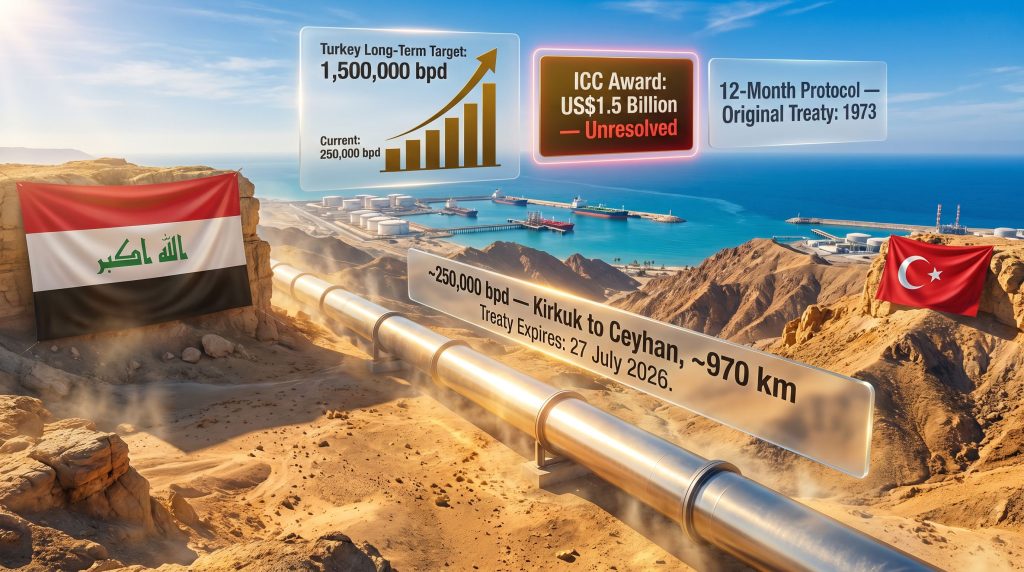
Energy infrastructure rarely operates in isolation from political reality. Pipelines are not merely engineering assets — they are physical embodiments of treaties, power asymmetries, and economic dependencies. Few examples illustrate this more clearly than the Kirkuk-to-Ceyhan corridor, a 970-kilometre overland artery connecting the oil fields of northern Iraq to the Mediterranean coast of Turkey. The Iraq Turkey Ceyhan pipeline deal struck in mid-2026 preserved the flow of crude through this corridor for another twelve months, but the agreement raises more questions than it answers about the long-term viability of one of the Middle East's most strategically consequential export routes.
When big ASX news breaks, our subscribers know first
Why the Kirkuk-Ceyhan Corridor Is Structurally Indispensable
The Kirkuk-Ceyhan Oil Pipeline — formally designated the Iraq-Turkey Pipeline (ITP) — is Iraq's primary overland crude export mechanism. Its significance is not merely logistical; it represents a geopolitical lifeline for a country whose entire economic architecture is built on hydrocarbon revenues.
| Metric | Data Point |
|---|---|
| Pipeline length | ~970 km (Kirkuk to Ceyhan) |
| Current daily throughput | ~250,000 bpd |
| Turkey's long-term volume target | Up to 1,500,000 bpd |
| Original treaty year | 1973 |
| Treaty expiration date | 27 July 2026 |
| Previous full shutdown period | March 2023 – September 2025 |
| ICC arbitration award against Turkey | US$1.5 billion |
| New interim agreement duration | 12 months |
For most of its modern history, Iraq directed approximately 95% of its crude exports through the Strait of Hormuz toward Asian buyers, with China absorbing the dominant share. When the Strait became effectively non-operational in February 2026, this singular dependency transformed from a manageable concentration risk into an acute national emergency.
The consequences cascaded rapidly. With no alternative maritime route capable of absorbing equivalent volumes, Iraq's onshore storage infrastructure reached saturation within weeks. The resulting production well shutdowns introduced risks that extend well beyond lost revenue — reservoir depressurisation, water infiltration, and accelerated corrosion are physical damage mechanisms that can permanently impair production capacity. These are not reversible problems that resolve themselves once export routes reopen. They represent long-term structural degradation of Iraq's core productive asset.
Against this backdrop, the northern overland corridor into Turkey ceased to be a supplementary route and became Iraq's only viable large-scale export pathway. The stakes attached to the Iraq Turkey Ceyhan pipeline deal therefore extended far beyond diplomatic symbolism. Furthermore, the broader geopolitical landscape of the region meant that any disruption to this corridor would reverberate across multiple commodity markets simultaneously.
The 2023 ICC Ruling: How Arbitration Reshaped the Regulatory Landscape
Understanding the 2026 agreement requires tracing the legal fracture that preceded it. On 13 February 2023, the International Chamber of Commerce issued an arbitration ruling ordering Turkey to pay US$1.5 billion in damages to Baghdad. The ICC determined that Turkey had facilitated independent crude oil exports by the Kurdistan Regional Government (KRG) in breach of the foundational 1973 Crude Oil Pipeline Agreement.
Turkey's response was immediate and consequential. It halted all crude flows through the northern Iraq corridor, removing approximately 450,000 barrels per day from global supply — volumes that had been flowing regularly from the Kirkuk region to the Ceyhan terminal. The pipeline remained idle for two and a half years, from March 2023 through September 2025, when a US-mediated interim arrangement restored partial operations.
The Federal-Regional Oil Governance Dispute at the Core of the Crisis
The legal conflict between Baghdad and Erbil over oil export rights is not a recent development. Its roots trace back to competing legislative frameworks that emerged more than a decade before the ICC ruling.
The 2014 agreement between Iraq's Federal Government (FGI) and the Kurdistan Regional Government established a structured quid pro quo:
- The KRG would channel all crude produced within its territory through federal authorities, marketed via the state-owned State Organization for Marketing of Oil (SOMO)
- In exchange, the KRG would receive a fixed monthly allocation of Iraq's national budget, set at approximately 17%
- The KRG's oil production at the time was estimated at roughly 550,000 barrels per day, making this a substantial revenue-sharing mechanism
Baghdad's core concern was that independent KRG oil sales would create an unmonitored revenue stream capable of financing fiscal self-sufficiency — and, ultimately, political independence. This was not an abstract concern.
In April 2013, the KRG parliament passed legislation authorising independent crude exports if Baghdad failed to meet its budget-sharing obligations. A companion measure approved the creation of a separate KRG oil exploration and production entity and a sovereign wealth fund to capture all energy revenues. At the time, the Kurdistan region was producing approximately 350,000 bpd and had publicly stated ambitions to reach 1 million bpd by the end of 2015. The legislative architecture of 2013 was explicitly designed to establish complete Kurdish financial independence as a precursor to formal political separation.
The independence referendum held in 2017 produced a striking result: over 90% of the KRI's population voted in favour of independence. However, the initiative failed to attract meaningful external support and instead triggered coordinated pressure from Baghdad, Tehran, and Ankara — all of which had strategic interests in preventing Kurdish territorial consolidation.
| Party | Legal Position | Strategic Objective |
|---|---|---|
| Baghdad (FGI) | Sole export authority under 1973 treaty | Preserve national unity; prevent KRG fiscal independence |
| Kurdistan Regional Government | Right to independent export under 2013 legislation | Secure financial autonomy as precursor to political independence |
| Turkey | Transit facilitator; ICC-ordered debtor | Maximise transit revenue; balance Baghdad and Erbil relationships |
| ICC (Arbitration Body) | Treaty violation confirmed against Turkey | Enforce 1973 agreement provisions |
What the 2026 Transitional Protocol Actually Delivers
The 12-month arrangement formalised ahead of the 27 July 2026 treaty expiration preserves pipeline operations by treating the two-pipeline ITP corridor as a single unified mechanism, consistent with the original 1973 framework. Turkish Energy Minister Alparslan Bayraktar publicly confirmed that crude flows from Iraq to Ceyhan would continue under the arrangement.
Current throughput under the transitional protocol stands at approximately 250,000 barrels per day — materially below the corridor's historical capacity and far short of Turkey's stated ambition of eventually reaching 1.5 million bpd under a permanent long-term framework.
However, the protocol's most significant characteristic is what it deliberately leaves unresolved. The 12-month window is a bridge to negotiations, not a resolution of the underlying disputes.
| Issue | Status Under 12-Month Protocol |
|---|---|
| Immediate pipeline operational continuity | Resolved — flows maintained at ~250,000 bpd |
| ICC arbitration debt of US$1.5 billion | Unresolved — offset mechanism under negotiation |
| KRG independent export rights | Unresolved — federal vs. regional authority dispute ongoing |
| Pipeline transit tariff rates (US$1.00–$1.25/barrel) | Unresolved — Turkey seeking significant upward revision |
| Minimum guaranteed daily volume commitments | Unresolved — Turkey demanding binding volume floors |
| Long-term treaty replacement (5–10 year framework) | Unresolved — permanent negotiations ongoing |
Turkey's Negotiating Demands: Far More Than a Tariff Discussion
Turkey has been explicit that the transitional protocol represents a starting point, not an endpoint. Its demands for a permanent long-term treaty span commercial, financial, and strategic dimensions that go considerably beyond conventional pipeline transit negotiations.
According to a senior energy source with direct knowledge of Iraq's Oil Ministry negotiations, Ankara is pursuing a comprehensive restructuring of the bilateral energy relationship, with Iraqi capital investment at its core. The demands reportedly include:
- Tariff restructuring — A substantial increase from the current fixed rates of US$1.00 and US$1.25 per barrel to commercially viable transit fees that reflect Turkey's infrastructure leverage
- Volume guarantees — Binding commitments from Baghdad to maintain high continuous daily throughput, with one-for-one financial penalties applied for any volume shortfall
- Arbitration debt offset — A structured mechanism to neutralise or eliminate the US$1.5 billion ICC-ordered damages Turkey technically still owes to Baghdad
- Multi-sector energy joint ventures — Partnerships spanning oil, natural gas, petrochemicals, and electricity generation, with the emphasis placed specifically on Iraqi capital participation
- Long-term treaty horizon — A replacement agreement spanning 5 to 10 years to provide investment-grade certainty for infrastructure planning
The same source indicated that if Turkey does not secure satisfactory terms, it may decline to extend the protocol at the 12-month mark — or potentially seek to terminate the arrangement before it expires.
Analyst note: Turkey's insistence on a debt offset mechanism is particularly notable. The US$1.5 billion ICC award technically runs in Baghdad's favour, yet Ankara's leverage over Iraq's northern export route gives it significant practical bargaining power to negotiate away an obligation it has never voluntarily moved to settle.
Geopolitical Realignment and Its Limits
The diplomatic environment that enabled the 2026 transitional protocol reflects broader shifts in regional power dynamics. The US-China trade war impacts on energy markets added an additional layer of complexity to Baghdad's strategic calculations, as China's reduced purchasing capacity compelled Iraq to diversify its export relationships. Baghdad's posture toward Western partners has moved meaningfully since the commencement of U.S. President Donald Trump's second term, driven by Washington's more assertive approach to extracting policy commitments from governments it regards as having engaged in strategic double-dealing.
Multiple major oil and gas sector agreements have since been redirected toward Western energy firms, reversing a trajectory that had seen Russia and China steadily deepen their foothold in Iraqi energy infrastructure. This realignment also reflects an emerging multipolar world economy in which Middle Eastern energy producers are increasingly seeking to balance relationships across competing power blocs rather than maintaining singular dependencies.
Ankara's concurrent tilt toward closer NATO alignment and a more cooperative relationship with Washington created a convergence of interests that made the one-year deal politically achievable. However, Turkey's strategic autonomy instincts remain structurally intact. Its commercially aggressive negotiating posture reflects independent national interest calculations, not unconditional alignment with any external partner.
The KRG occupies a particularly complex position within this realignment. Its continued distance from Baghdad's historical China-Russia orientation and its underlying preference for Western partnerships are partly premised on the long-term possibility of securing independence — an ambition that the 2017 referendum demonstrated retains overwhelming popular support within the Kurdistan region, even if external political conditions have not yet made it viable.
The next major ASX story will hit our subscribers first
Scenario Analysis: Three Paths at the 12-Month Mark
| Scenario | Probability Driver | Economic Impact on Iraq |
|---|---|---|
| Permanent treaty concluded | Turkey's demands substantially met; geopolitical alignment holds | High positive — restores investment certainty, enables capacity expansion toward 1.5M bpd |
| Second short-term extension | Negotiations progress but key issues remain unresolved | Moderate — operational continuity maintained but infrastructure investment delayed |
| Pipeline suspension | Turkey's demands unmet; political breakdown or regional escalation | Severe — Iraq loses northern export capacity, budget crisis risk re-emerges |
The fiscal exposure Iraq faces without this corridor is not theoretical. Its federal budget derives well over 90% of its revenues from crude oil exports, and the Hormuz crisis demonstrated with brutal clarity how rapidly production infrastructure deteriorates when storage capacity fills and well shutdowns become unavoidable. Restoring the northern corridor to its full potential — contributing meaningfully toward Iraq's broader export capacity target of 3.6 million bpd — is a structural economic necessity, not a discretionary policy preference.
The Unresolved KRG Question as a Persistent Risk Factor
No analysis of the Iraq Turkey Ceyhan pipeline deal is complete without acknowledging that the federal-regional governance dispute remains the most structurally destabilising variable in the entire equation. The KRG's production capacity, its legislative claim to independent export rights, and Baghdad's existential opposition to any arrangement that accelerates Kurdish fiscal self-sufficiency represent fault lines that a 12-month transitional protocol does nothing to address.
What makes this particularly complex from an energy market perspective is that Kurdish production volumes are not trivial. At the time the 2013 independence legislation was passed, the KRI was producing approximately 350,000 bpd. Its stated ambition of reaching 1 million bpd — if ever realised through a stable governance framework — would represent a meaningful addition to the corridor's throughput. However, achieving that volume under conditions that satisfy both Baghdad's sovereignty concerns and the KRG's financial autonomy requirements requires a political settlement that has so far proved elusive across multiple government cycles and treaty frameworks.
Any resurgence of Kurdish independence momentum, or a renewed breakdown in the Baghdad-Erbil budget-sharing arrangement, risks reigniting the precise legal and political conflicts that triggered the 2023 ICC arbitration and the subsequent two-and-a-half-year pipeline closure.
What Energy Market Participants Should Watch
For observers tracking the Iraq Turkey Ceyhan pipeline deal and its implications for global crude markets, the oil price movements associated with each negotiation milestone will carry particular significance. In addition, several indicators carry specific forward-looking weight:
- Progress on the US$1.5 billion offset mechanism — whether Baghdad agrees to formally extinguish or restructure Turkey's arbitration liability will signal how much political capital Iraq is genuinely willing to spend on securing long-term access
- Tariff negotiation outcomes — any upward movement from the current US$1.00-$1.25 per barrel rate will establish a new baseline for transit economics across the region
- Volume commitment structures — binding daily throughput floors with financial penalties would lock Iraq into maintaining high output levels through the corridor regardless of global price conditions
- Baghdad-Erbil budget-sharing compliance — any deterioration in the monthly budget allocation to the KRG increases the legal and political probability of Erbil invoking its 2013 independent export legislation
The commodity price impact of a renewed pipeline suspension would extend well beyond Iraq's borders, affecting downstream markets and investment sentiment across the broader energy sector. The Hormuz disruption transformed the Ceyhan corridor from a supplementary route into Iraq's primary export lifeline. That shift in strategic weight has permanently altered the negotiating dynamics between Baghdad and Ankara. Turkey now holds leverage it did not possess before February 2026 — and its negotiating demands reflect a clear-eyed understanding of that changed reality.
This article contains forward-looking analysis based on publicly available information and expert commentary. It should not be construed as financial or investment advice. Readers are encouraged to conduct independent research and consult qualified advisors before making decisions based on geopolitical or energy market assessments.
Want to Stay Ahead of the Commodity Markets Shaped by Geopolitical Events Like This?
Discovery Alert's proprietary Discovery IQ model delivers real-time alerts on significant ASX mineral discoveries, instantly translating complex market shifts — including those driven by energy supply disruptions and geopolitical realignments — into actionable investment opportunities for both traders and long-term investors. Explore historic discoveries and their remarkable returns, then begin your 14-day free trial at Discovery Alert to position yourself ahead of the market.