August 12, 2026
The Hidden Complexity Behind Large-Scale Aluminium Smelter Restarts
Most industrial facilities, when shut down unexpectedly, can be brought back online within days or weeks. Aluminium smelters operate by an entirely different set of rules. The electrochemical process at the heart of primary aluminium production relies on reduction cells that must maintain precise thermal and chemical conditions continuously. When those conditions are disrupted, the path back to full output is measured not in days, but in quarters. Understanding this technical reality is essential context for evaluating what the EGA Al Taweelah aluminium smelter running at 18% of capacity actually means for global markets, recovery timelines, and the broader geopolitical dynamics reshaping Gulf industrial infrastructure.
When big ASX news breaks, our subscribers know first
Why Al Taweelah's Scale Makes Its Disruption a Global Event
At full output, the Al Taweelah facility in the UAE is the largest aluminium smelter in the Middle East, with a nameplate capacity of 1.5 million metric tonnes per year. Before the March 2026 incident, the plant was actually outperforming its design specification, having produced approximately 1.6 million tonnes of cast metal in the prior year. That level of operational performance reflects decades of process optimisation and positions the facility among the highest-throughput primary aluminium producers anywhere in the world.
To put that scale in context, consider how Al Taweelah compares to other major global smelters. Furthermore, looking at the top aluminium companies reveals just how exceptional this facility's output is relative to the broader industry landscape:
| Smelter | Location | Annual Capacity (Mt) | Current Status |
|---|---|---|---|
| Al Taweelah (EGA) | UAE | 1.5 | Disrupted, 18% utilisation |
| Hillside (South32) | South Africa | 0.72 | Operational |
| Boyne Smelter | Australia | 0.56 | Operational |
| Mozal (South32) | Mozambique | 0.27 | Operational |
A single facility of this magnitude operating at 18% of rated capacity is not merely a corporate earnings problem. It represents the sudden effective withdrawal of over 1.2 million tonnes of annual production capacity from global supply chains. Aluminium markets are highly sensitive to large concentrated disruptions of this type, and the ripple effects extend from spot pricing through to physical delivery premiums across multiple downstream sectors.
Reconstructing the March 2026 Incident and Its Immediate Consequences
An Iranian strike on the Al Taweelah facility on March 28, 2026 triggered an emergency full shutdown of the plant. The market response was immediate: aluminium prices moved toward four-year highs in the days following the incident, reflecting the sudden removal of a massive supply source from the global balance sheet.
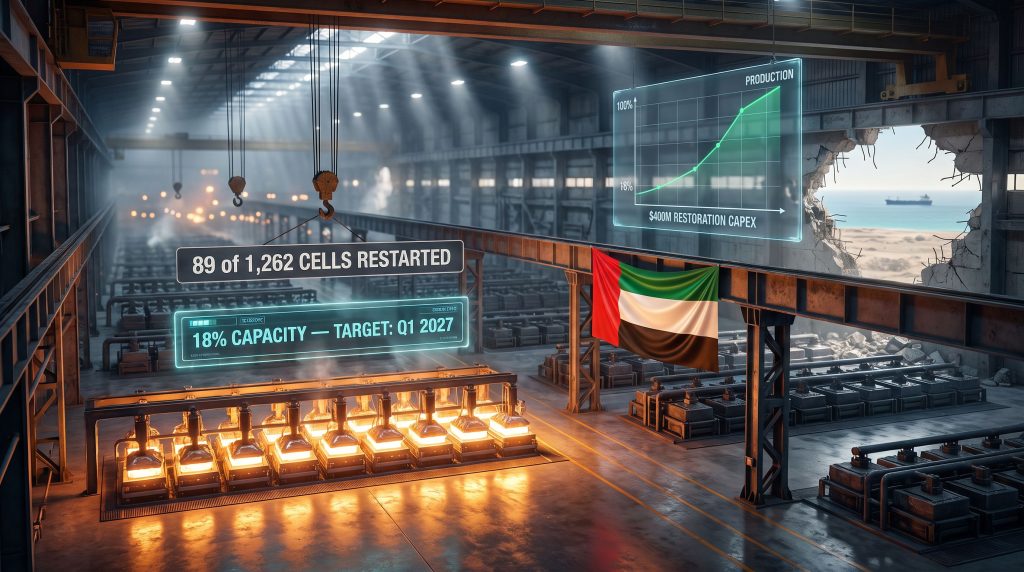
The scale of the operational damage becomes clearer when you examine the smelter's cell infrastructure. Al Taweelah operates 1,262 electrolytic reduction cells in total. By early July 2026, only 89 cells had been successfully restarted, representing approximately 7% of total cell capacity. The fact that 89 active cells can generate 18% of overall facility output reflects the partial productivity gains achievable from operational cells running at higher-than-baseline efficiency, but the gap between current output and design capacity remains enormous.
The Technical Challenge That Investors Often Underestimate
What makes aluminium smelter restarts uniquely difficult is the nature of the reduction cell itself. Each cell functions as an electrolytic bath, with molten cryolite acting as a solvent for alumina feedstock. When a cell is forced into an emergency cold shutdown, the bath solidifies. Relining and reheating each cell is a careful, sequential process that cannot be rushed without risking permanent damage to the cell lining or compromising the quality of the metal produced.
Technical Insight: Reduction cells that have undergone cold shutdown require a process called prebaking or ramping, where temperature is incrementally increased over weeks to restore the bath chemistry to operational parameters. Attempting to accelerate this process risks thermal shock to the carbon lining, which can cause premature failure and require the entire cell to be relined again, adding months to the timeline.
The first cell was successfully restarted on May 26, 2026, approximately 59 days after the emergency shutdown. That milestone marked the proof-of-concept moment in EGA's recovery trajectory, demonstrating that damaged cells could be brought back online systematically. The challenge now is scaling that process from 89 cells to the full complement of 1,262.
Financial Damage Assessment: What 18% Utilisation Costs at This Scale
The financial impact of the EGA Al Taweelah aluminium smelter running at 18% of capacity is significant across multiple dimensions. The strike caused an 84 million UAE dirham (approximately $23 million USD) reduction in EGA's first-half 2026 earnings. The total capital expenditure authorised to fund the complete restoration of the facility is approximately $400 million USD, making this one of the largest smelter recovery investments in recent industrial history.
EGA's chief executive described the first half of 2026 as the most difficult period in the company's long operating history, a characterisation that underscores the severity of the disruption relative to everything the business had previously encountered. This context is particularly important when considering broader aluminum and alumina markets, which were already navigating considerable headwinds before the incident occurred.
The Self-Funding Recovery Dynamic
One of the more counterintuitive aspects of this crisis is the degree to which the disruption itself is helping fund the recovery. When a facility of Al Taweelah's scale is effectively taken offline, the regional supply shortfall generates elevated physical delivery premiums on aluminium. EGA's CFO confirmed that the cost of rerouting exports through alternative channels is being more than covered by these elevated premiums.
Financial Scenario: At 1.5 million tonnes per year design capacity, each percentage point of restored utilisation represents approximately 15,000 tonnes of incremental annual output. Restoring from 18% to 100% across four to six quarters creates a compounding revenue recovery curve. If premiums remain elevated throughout the ramp, the premium windfall partially offsets the $400M restoration capex, effectively creating a natural hedge between the cost of recovery and the market conditions driving that cost.
This dynamic is not unique to aluminium. In fact, it appears across commodity market volatility events whenever a large concentrated source of supply is disrupted. The key risk variable is duration: premiums tend to compress as alternative supply sources respond to elevated prices, so the self-funding mechanism is time-sensitive.
Logistics Under Pressure: Operating Without the Strait of Hormuz
The Strait of Hormuz closure created a secondary operational challenge that sits entirely outside EGA's control. For a facility of Al Taweelah's size, the logistics requirements are substantial in both directions: inbound raw materials including alumina, caustic soda, and other process inputs, and outbound finished metal exports.
| Logistics Direction | Current Status | Risk Level |
|---|---|---|
| Inbound raw materials | 100% rerouted prior to incident | Low |
| Outbound metal exports | Partially rerouted, needs strengthening | Medium-High |
The critical pre-incident advantage that EGA holds is that inbound supply chains were already fully rerouted through non-Hormuz channels before the smelter was struck. This means the facility's ability to source raw materials in all operating scenarios is effectively secured, as EGA's CFO confirmed publicly.
The outbound picture is more nuanced. EGA's CFO characterised the rerouting of exports as a massive logistical undertaking, while also acknowledging that further strengthening of outbound export options is necessary if the strait remains closed for an extended period. The asymmetry between inbound resilience and outbound exposure is a genuine operational risk that bears monitoring.
Three Strait Closure Scenarios and Their Recovery Implications
-
Hormuz reopens within three months: Outbound logistics normalise rapidly. Recovery timeline toward Q1 2027 accelerates with reduced freight cost drag.
-
Strait remains closed through end of 2026: Alternative outbound routing must scale significantly. Elevated premiums continue to offset additional freight costs. Q1 2027 target remains achievable but under logistical pressure.
-
Extended closure beyond twelve months: Structural investment in outbound route infrastructure becomes necessary. Recovery timeline risk shifts toward mid-2027. Broader Gulf aluminium supply chain disruption intensifies across all regional producers.
The Q1 2027 Recovery Roadmap: What the Cell Restart Progression Reveals
EGA's official guidance places a return to pre-incident production levels in Q1 2027, with internal teams actively working to push that date earlier. The ramp-up model is a progressive, cell-by-cell recommissioning process rather than a single large-scale restart event.
Step-by-Step Recovery Framework
-
Emergency shutdown stabilisation and damage assessment (March to May 2026)
-
Capital expenditure commitment of approximately $400 million USD authorised
-
First proof-of-concept cell restart completed on May 26, 2026
-
Progressive cell restart batches scaling through June to December 2026
-
Ramp from 89 active cells toward the full 1,262-cell operational complement
-
Target: pre-incident production output restored by Q1 2027
A structurally important detail in EGA's recovery framework is that the production ramp-up at the smelter is not contingent on a full restart of the co-located alumina refinery. This decoupling removes a potentially significant bottleneck from the timeline. During the refinery's own recovery phase, EGA is sourcing alumina feedstock through alternative procurement channels, which is logistically manageable given the global alumina supply available from producers in Australia, Brazil, and West Africa.
The next major ASX story will hit our subscribers first
Geographic Diversification: The US Smelter Project in Strategic Context
The Al Taweelah disruption has sharpened the strategic case for EGA's geographic diversification agenda. The company is co-developing a new primary aluminium smelter in the United States alongside Century Aluminum, a project designed to establish production capacity outside the Gulf region entirely. However, the broader trade environment also matters here: US aluminium tariffs have introduced additional complexity into the economics of any new North American smelting capacity.
The single most critical unresolved element in the US project is a long-term power supply agreement. Aluminium smelting is among the most electricity-intensive industrial processes on earth, with power typically accounting for 30 to 40 percent of total production cost. Without a bankable long-term power contract, the project cannot attract project financing or achieve economically viable production cost structures.
EGA's chief executive has publicly indicated that negotiations are progressing well and that a conclusion is expected in due course, though the timeline remains open. The lesson from Al Taweelah is unmistakable: single-geography concentration in a geopolitically volatile region is a risk that materialises faster and more severely than most scenario planning anticipates.
Downstream Exposure: Which Industries Bear the Consequences
The sectors most acutely exposed to an extended Al Taweelah disruption include:
- Automotive and electric vehicle manufacturing, where aluminium-intensive lightweighting strategies have increased per-vehicle metal content significantly over the past decade
- Aerospace and defence supply chains, which require consistent access to high-purity primary aluminium rather than secondary scrap
- Packaging manufacturers, particularly beverage can producers across Europe and Asia who source Gulf aluminium competitively priced against Australian and Brazilian alternatives
- Construction and infrastructure, where structural aluminium demand is growing in high-heat environments where the material's weight-to-strength advantages are most pronounced
The distinction between commodity and premium-grade aluminium also matters here. Facilities like Al Taweelah that produce high-purity primary metal serve different end markets than secondary aluminium recyclers. Consequently, the supply disruption affects specific downstream segments more acutely than aggregate aluminium production statistics might suggest. These pressures compound the existing challenges facing industrial metals demand across global manufacturing supply chains.
Furthermore, for downstream manufacturers seeking to understand current aluminium price benchmarks, the London Metal Exchange provides real-time data that reflects the ongoing supply disruption across forward curves.
Frequently Asked Questions: EGA Al Taweelah Smelter Recovery
What caused the Al Taweelah smelter to shut down in 2026?
An Iranian strike on the Al Taweelah facility on March 28, 2026 triggered an emergency shutdown of the 1.5 million tonne per year plant, the largest aluminium smelter in the Middle East.
How much of Al Taweelah's capacity is currently running?
As of August 2026, the EGA Al Taweelah aluminium smelter running at 18% of capacity means the facility is operating well below its rated annual output.
When is full production expected to resume?
EGA's official target is to restore pre-incident output by Q1 2027, with active efforts underway to potentially accelerate that timeline.
How many reduction cells have been restarted?
By early July 2026, 89 of the smelter's 1,262 reduction cells had been recommissioned, with the first cell restarted on May 26, 2026.
What is the total cost of restoring the facility?
EGA has authorised approximately $400 million USD in capital expenditure to fund the complete restoration of Al Taweelah to pre-incident production levels.
Is EGA still able to export metal with the Strait of Hormuz closed?
Yes, though outbound logistics require further strengthening. Alternative routing costs are being more than offset by elevated metal premiums. Inbound raw material supply was already fully rerouted before the incident occurred.
Does the alumina refinery need to restart before smelter output can recover?
No. EGA has confirmed that the smelter's production ramp is independent of a full alumina refinery restart, removing a potential bottleneck from the Q1 2027 recovery roadmap.
Key Strategic Lessons From the Al Taweelah Disruption
- Single-facility concentration risk is not theoretical: A single strike removed over 80% of the Middle East's largest smelter's output in a matter of hours, with recovery measured in quarters not weeks
- Inbound and outbound logistics resilience require separate solutions: EGA's pre-incident success in rerouting inbound supply was a critical operational advantage, but outbound exposure remains partially unresolved
- The $400 million restoration cost is large but partially self-financed: Elevated premiums generated by the supply disruption itself provide a natural offset mechanism during the recovery period
- Cell-by-cell restart dynamics make timeline acceleration difficult to guarantee: The technical constraints of reduction cell recommissioning impose a practical ceiling on how fast recovery can proceed regardless of capital availability
- Geographic diversification is now an operational imperative, not just a growth strategy: The US smelter project with Century Aluminum represents a deliberate structural response to Gulf-region concentration risk
Disclaimer: This article contains forward-looking statements, scenario projections, and financial modelling based on publicly available information as of August 2026. Actual recovery timelines, financial outcomes, and market conditions may differ materially from those discussed. This content does not constitute investment advice. Readers should conduct independent research before making any investment decisions.
Want to Stay Ahead of Major Commodity Disruptions Like the Al Taweelah Crisis?
Discovery Alert's proprietary Discovery IQ model delivers real-time alerts on significant ASX mineral discoveries, transforming complex commodity market shifts into actionable investment insights — explore historic examples of exceptional discovery returns to understand the scale of opportunity, then begin your 14-day free trial at Discovery Alert to position yourself ahead of the market.