
August 12, 2026
The Quiet Restructuring Beneath US Bauxite Import Numbers
Global commodity trade rarely collapses overnight. When an import category contracts by nearly 18% year on year, the underlying causes are almost always layered, interconnected, and months or years in the making. The US bauxite imports fall is a textbook illustration of this principle. What appears on the surface as a straightforward volume decline is, on closer examination, a story about industrial transformation: ageing refinery infrastructure, the rising economic logic of aluminium recycling, and a trade policy environment that has made long-term procurement planning increasingly difficult.
Understanding these forces matters not just for commodity traders and raw material buyers, but for anyone tracking the long-term evolution of the North American aluminium industry.
When big ASX news breaks, our subscribers know first
How Significant Is the US Bauxite Import Decline?
Key Import Volume Metrics at a Glance
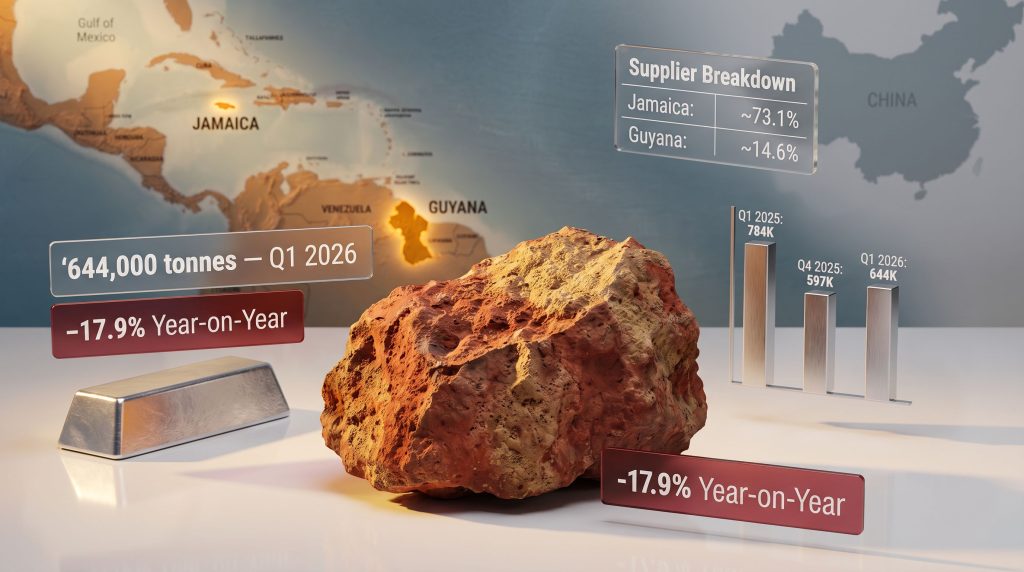
The numbers tell a consistent and directional story. US bauxite imports totalled 644,000 tonnes in Q1 2026, marking a 15.8% contraction from the 765,000 tonnes recorded in Q3 2024. On a year-on-year basis, the decline was even steeper, falling 17.9% from 784,000 tonnes in Q1 2025.
| Period | Import Volume (000 tonnes) | Year-on-Year Change |
|---|---|---|
| Q1 2025 | 784 | Baseline |
| Q3 2024 | 765 | Baseline |
| H1 2025 | 849 | -17.6% vs H1 2024 |
| Q4 2025 | 597 | Sequential low |
| Q1 2026 | 644 | -17.9% vs Q1 2025 |
The sequential quarterly recovery from 597,000 tonnes in Q4 2025 to 644,000 tonnes in Q1 2026 represents a 7.9% improvement, but this modest bounce does not change the directional reality of a market in structural contraction. Furthermore, according to recent industry reporting, the H1 2025 contraction was already well-established before Q1 2026 figures emerged.
Import Value Compression: A Deeper Signal
Volume figures alone do not fully capture the severity of the shift. The dollar value of US bauxite imports tells an equally important story:
- Total import value reached USD 38 million in Q1 2026
- This compares to USD 50 million in Q3 2024, representing a 24% value decline
- Year-on-year, value fell 17.4% from USD 46 million in Q1 2025
The fact that value is declining faster than volume is a critical signal. When unit prices compress alongside falling shipment tonnages, it points to weakening negotiating power among buyers, surplus supply relative to demand, or both. In the bauxite context, this pricing softness compounds already weak demand, creating a feedback dynamic that makes near-term recovery harder to sustain even if volumes tick upward.
"The divergence between value and volume declines is often an early indicator that structural, not temporary, demand forces are at work. When buyers reduce volumes and pay less per tonne, the market is not just adjusting, it is repricing to a new equilibrium."
What Is Driving the Structural Decline in US Bauxite Demand?
The Alumina Refinery Contraction Problem
To understand why US bauxite imports are falling, it is essential to understand how bauxite actually enters the US industrial economy. The processing chain moves from raw bauxite through alumina refining (the Bayer process) to primary aluminium smelting. Each step in this chain requires functioning capacity at the next stage downstream.
The US has historically depended almost entirely on imported bauxite to feed its domestic alumina refineries, with Jamaica serving as the primary supplier for decades. However, US alumina refining capacity has contracted materially over recent years through a combination of permanent facility closures and reduced operating rates at surviving plants. Fewer active refineries require proportionally less raw bauxite, which means the import decline is partly a demand-side structural adjustment rather than a supply disruption.
This distinction matters enormously for interpreting the data. A supply disruption would eventually self-correct as logistics and geopolitics normalise. A demand-side structural contraction, driven by refinery rationalisation, may prove far more durable. Moreover, the bauxite-producing countries that have historically relied on US demand are now being forced to reassess their export strategies as this structural shift deepens.
Industry data from H1 2025 confirmed the trend was already accelerating well before Q1 2026, with imports falling to 849,000 tonnes across the first half of that year, down 17.6% from the same period in 2024.
The Recycled Aluminium Substitution Effect
Secondary aluminium production, sourced from recycled scrap metal, bypasses the bauxite-to-alumina-to-primary-metal chain entirely. When a manufacturer uses recycled aluminium instead of primary metal, the upstream demand signal for bauxite disappears completely. This substitution effect is not a short-term phenomenon. In fact, the broader aluminium recycling shift is accelerating as industry participants commit to joint ventures and infrastructure investments that entrench secondary production at scale.
Several structural forces are accelerating the shift toward secondary aluminium in the US and globally:
- Recycled aluminium requires approximately 5% of the energy needed to produce primary aluminium from bauxite, giving it a significant cost advantage as energy prices rise
- Scrap collection and sorting infrastructure has improved substantially, increasing the availability and quality of secondary aluminium feedstock
- Automotive, packaging, and construction sectors are actively increasing recycled aluminium content to meet sustainability commitments and reduce embodied carbon
- The economics of recycling become more compelling as primary aluminium smelting faces ongoing cost and competitiveness pressures in developed markets
"The decline in US bauxite imports is not primarily a trade story. It is a manufacturing transformation story, where secondary aluminium is progressively displacing the need for primary raw material inputs across the supply chain."
Lower Primary Aluminium Output as a Demand Suppressor
Even where US alumina refinery capacity technically remains intact, reduced primary aluminium smelting activity limits the volume of alumina that can actually be consumed. Less smelting means less alumina demand, which in turn means less bauxite required at the refinery gate.
US primary aluminium smelters have faced sustained structural pressures including high electricity costs, global competition from lower-cost producers, and ageing infrastructure. The result is an industry operating below historical capacity rates, amplifying the demand suppression effect already created by refinery closures and recycled aluminium substitution. The top aluminium miners are consequently recalibrating their long-term investment and supply strategies in response to these shifting demand dynamics.
How Are Trade Policy and Tariffs Reshaping Bauxite Procurement?
The 2025 Tariff Environment and Its Upstream Ripple Effects
Trade policy changes during 2025 added a layer of uncertainty on top of existing structural pressures. US aluminium tariffs on covered aluminium articles were increased from 25% to 50% in June 2025, significantly raising costs across the downstream aluminium supply chain.
It is important to apply appropriate precision here. Bauxite, classified as an aluminium ore and concentrate, sits in a different tariff category from finished aluminium articles and derivative products. However, the broader trade uncertainty created by escalating tariff measures has materially affected procurement planning throughout the aluminium value chain, including at the raw material sourcing level.
Buyers who are uncertain about whether their downstream aluminium costs will rise further, or whether trade policy will shift again, tend to reduce forward purchasing commitments and hold smaller inventory buffers. This procurement conservatism translates directly into lower import volumes, even if bauxite itself is not the primary tariff target.
Distinguishing Structural Pressure from Trade-Induced Volatility
Not all the forces driving the US bauxite imports fall carry equal weight or durability. The table below frames each driver by type and likely impact:
| Driver | Type | Impact on Imports |
|---|---|---|
| Alumina refinery closures | Structural | High — reduces raw material demand permanently |
| Recycled aluminium substitution | Structural | High — long-term displacement of primary inputs |
| Lower primary aluminium output | Cyclical/Structural | Medium — reduces upstream demand signal |
| Tariff uncertainty (2025) | Policy/Cyclical | Medium — affects procurement timing and confidence |
| Bauxite price softening | Market | Low-Medium — value decline faster than volume |
The distinction between structural and cyclical drivers has significant implications. Cyclical pressures, including tariff uncertainty and short-term smelter output reductions, may partially reverse as conditions change. Structural pressures, particularly refinery closures and the substitution of primary aluminium with recycled content, are far less likely to unwind.
Who Is Supplying US Bauxite, and Is Concentration a Risk?
Q1 2026 Supplier Breakdown
| Supplier Country | Volume (000 tonnes) | Share of Total Imports |
|---|---|---|
| Jamaica | 471 | ~73.1% |
| Guyana | 94 | ~14.6% |
| Australia | 50 | ~7.8% |
| Brazil | 23 | ~3.6% |
| China | 5.9 | ~0.9% |
| United Kingdom | 0.008 | Negligible |
Jamaica's Dominant but Declining Position
Jamaica has been the cornerstone of US bauxite supply for generations. The island's bauxite deposits, primarily located in the central parishes including Manchester and St Elizabeth, produce gibbsite-dominant ore well-suited to the Bayer process used in alumina refining. In Q1 2026, Jamaica shipped 471,000 tonnes to the US, representing 73.1% of total imports.
The quarterly rebound is notable: Jamaican shipments increased 54.4% from just 305,000 tonnes in Q4 2025. However, contextualising this against a longer time horizon reveals that even with the recovery, Jamaican shipments remain 10.5% below the 526,000 tonnes recorded in Q1 2025.
The concentration of US bauxite supply in Caribbean sources, Jamaica and Guyana together accounting for approximately 87.7% of all imports, creates a structural vulnerability that is underappreciated in most mainstream commentary on the US aluminium sector. Notably, among the major bauxite producers globally, neither Jamaica nor Guyana ranks among the world's largest, making the depth of US dependence on these two nations particularly striking.
"With nearly 88% of US bauxite imports sourced from just two Caribbean nations, any geopolitical disruption, extreme weather event, or infrastructure failure in Jamaica or Guyana carries outsized supply chain risk for remaining US alumina operations. This concentration is not new, but declining import volumes mean any disruption would have proportionally larger consequences for a smaller, less resilient domestic processing base."
China's Dramatic Exit from the US Bauxite Market
One of the most striking supplier-level developments in the dataset is the near-complete withdrawal of Chinese bauxite from the US market. Chinese shipments collapsed from 32,000 tonnes in Q3 2024 to just 5,900 tonnes in Q1 2026, an 81.6% decline representing the sharpest contraction of any significant supplier.
This is not simply a trade policy artefact. China's domestic bauxite resources, while substantial, are increasingly prioritised for its own rapidly expanding alumina refining base. China has simultaneously been developing offshore bauxite supply relationships in Guinea and other West African nations to supplement its own reserves, reducing the strategic rationale for exporting ore to third-party markets like the US. The near-exit from the US bauxite trade reflects both geopolitical friction and a deliberate resource allocation strategy by Chinese industry participants.
Is the Q1 2026 Recovery a Turning Point or a Temporary Bounce?
Reading the Sequential Improvement Carefully
The 7.9% sequential increase from Q4 2025 to Q1 2026 has prompted some optimism about whether the worst of the import contraction is behind the market. A more cautious reading of the data supports a different interpretation.
Several factors suggest the Q1 2026 uptick is more likely a seasonal normalisation than a fundamental turning point:
- Q4 2025's 597,000 tonnes represented an unusually weak quarter even within the prevailing downtrend
- Jamaica's shipment surge of 54.4% in Q1 2026 appears to reflect restocking and logistics normalisation after a disrupted Q4 rather than renewed underlying demand
- The year-on-year comparison remains deeply negative at -17.9%, confirming that any recovery from Q4 lows has not translated into genuine demand improvement
- The value per tonne implied by Q1 2026 figures continues to compress, inconsistent with a demand-led recovery scenario
What a Genuine Recovery Would Require
For US bauxite import volumes to sustainably recover, several concurrent developments would need to materialise:
- Stabilisation or reversal of alumina refinery closures, potentially through new investment or capacity recommissioning
- New primary aluminium smelting capacity or the restart of idled smelters, creating fresh upstream demand for alumina and bauxite
- A more predictable and stable trade policy environment that allows procurement managers to plan forward purchasing with confidence
- A moderation in the pace of recycled aluminium substitution, which would require either scrap supply constraints or primary metal cost advantages over secondary production
None of these conditions appear imminent based on currently available evidence, suggesting the structural contraction in US bauxite demand will persist through the medium term.
The next major ASX story will hit our subscribers first
What Does the Multi-Year Trend Reveal About US Aluminium Strategy?
The Structural Contraction Timeline
Mapping the import data across multiple periods confirms that the current decline is not a recent aberration but the continuation of a well-established trend:
- Full year 2024: Total US bauxite imports approximately 2.08 million tonnes, already below 2023 levels
- H1 2025: Imports fell to 849,000 tonnes, down 17.6% year on year
- Q2 2025: Imports of 369,000 tonnes, down approximately 30% compared to Q2 2024
- Q4 2025: Sequential trough at 597,000 tonnes
- Q1 2026: Partial recovery to 644,000 tonnes, but still down 17.9% year on year
"The multi-year trajectory makes clear that this is a market undergoing fundamental restructuring, not cycling through a temporary demand trough. The combination of refinery rationalisation, secondary aluminium growth, and policy-driven procurement uncertainty points toward a structurally lower import baseline that will likely persist regardless of near-term cyclical fluctuations."
Implications for Global Bauxite Trade Flows
The contraction in US bauxite import demand has consequences that extend well beyond North American shores. Jamaica, in particular, remains heavily exposed to the US market, and sustained volume declines create real economic pressure on a country where bauxite and alumina exports represent a meaningful share of foreign exchange earnings. As noted by detailed trade data analysis, these supplier-nation consequences are only beginning to surface in official economic reporting.
For Australian and Brazilian producers, the strategic response may involve redirecting volumes toward Asian markets, where alumina refining capacity continues to expand, particularly across India, the Middle East, and Southeast Asia. The global bauxite trade flow map is gradually being redrawn, with the US playing a proportionally smaller role as a destination market than it did even five years ago.
This rebalancing will be reflected in any credible long-term market forecast for bauxite and alumina through 2036. Historical US demand averages are increasingly poor predictors of future import requirements, given the structural changes now embedded in the domestic aluminium industry.
Frequently Asked Questions: US Bauxite Imports
Why are US bauxite imports falling?
The decline reflects a combination of structural and policy-driven forces. Alumina refinery closures and reduced operating rates have directly lowered the volume of raw bauxite required domestically. Growing reliance on recycled aluminium bypasses the primary production chain entirely. Lower primary aluminium smelting output has reduced upstream demand signals. Trade policy uncertainty during 2025 has also made forward procurement planning more conservative across the supply chain.
Which country supplies the most bauxite to the US?
Jamaica is the dominant supplier by a significant margin, accounting for approximately 73.1% of total US bauxite imports in Q1 2026 with 471,000 tonnes shipped. Guyana ranks second at approximately 14.6% market share.
How much did US bauxite imports fall between Q3 2024 and Q1 2026?
Volume declined 15.8%, from 765,000 tonnes in Q3 2024 to 644,000 tonnes in Q1 2026. In dollar value terms, the contraction was more severe at 24%, from USD 50 million to USD 38 million over the same period.
Does the decline in bauxite imports signal a supply shortage?
No. The US bauxite imports fall primarily reflects reduced demand from a contracting US alumina refining base, not any shortage of available bauxite supply globally. The remaining US refining capacity simply requires less imported raw material than it did in prior years.
How has China's role as a bauxite supplier to the US changed?
China's bauxite shipments to the US declined by 81.6%, from 32,000 tonnes in Q3 2024 to just 5,900 tonnes in Q1 2026, making it the most dramatic supplier-level contraction in the dataset.
Key Takeaways: US Bauxite Import Outlook
- Volume contraction is structural, not cyclical, driven by refinery rationalisation and the secular growth of secondary aluminium production
- Value decline is outpacing volume decline, reflecting pricing softness that compounds underlying demand weakness
- Supply concentration risk is elevated, with Jamaica and Guyana controlling approximately 87.7% of US import volumes
- China's near-exit from the US bauxite market reflects both geopolitical realignment and domestic resource prioritisation strategy
- Q1 2026's sequential recovery is most likely a seasonal and logistical normalisation rather than a signal of sustained demand improvement
- Trade policy uncertainty has added procurement volatility on top of deeper structural demand pressures, and resolution of that uncertainty alone would be insufficient to reverse the import trajectory
Disclaimer: This article contains forward-looking analysis and market interpretations based on available trade data and industry reporting. It does not constitute financial or investment advice. Readers should conduct independent research and consult qualified professionals before making any investment or commercial decisions based on commodity market trends.
Want to Stay Ahead of Significant ASX Mineral Discoveries Before the Broader Market Does?
While the structural contraction in US bauxite imports reshapes global aluminium trade flows, Discovery Alert's proprietary Discovery IQ model delivers real-time alerts on significant ASX mineral discoveries across bauxite, aluminium, and more than 30 other commodities, turning complex data into actionable insights for both traders and long-term investors. Explore how major mineral discoveries have historically generated substantial returns and begin your 14-day free trial today to position yourself ahead of the market.