August 12, 2026
The Grade Gap: How Iron Ore Quality Will Determine India's Steel Decarbonisation Trajectory
The global steel industry is entering a period of profound technological transition, one where the chemical composition of raw materials matters as much as their availability. Across the world's largest steelmaking nations, a quiet but consequential shift is underway: the question of which ore to use is becoming more strategically significant than how much ore to secure. Nowhere is this dynamic more consequential than in India, where one of history's most ambitious industrial expansions is colliding with a structural raw material quality challenge that could shape the country's emissions trajectory for decades. Understanding India iron ore quality for steel decarbonisation is therefore no longer a niche technical question — it is a central strategic concern.
When big ASX news breaks, our subscribers know first
Rethinking the Iron Ore Problem: Volume Was Never the Whole Story
For most of its modern industrial history, India's iron ore conversation centred on tonnage. Could domestic mines keep pace with steelmaking growth? Would export policies restrict supply? These remain relevant questions, but a more consequential variable has emerged at the intersection of industrial policy and energy transition strategy.
The iron ore types and deposits decisions being made today will effectively determine which technologies India can deploy between 2030 and 2050. This is not a marginal consideration — it is a technology-locking mechanism operating at civilisational scale.
The ore grades that Indian steel producers import and process over the next five years will influence whether the country can migrate toward hydrogen-based ironmaking, or whether its capital stock becomes anchored to blast furnace infrastructure that requires coking coal for generations. Understanding why requires examining the metallurgical distinctions that separate conventional steelmaking feedstocks from those compatible with lower-emissions processes.
The Fe Threshold: What Makes Ore Decarbonisation-Compatible
Blast Furnace Grade vs. DR Grade: A Critical Metallurgical Divide
Iron ore is not a uniform commodity. Its suitability for different steelmaking technologies is determined primarily by iron content (expressed as Fe%) and the concentration of gangue minerals, particularly alumina (Al₂O₃) and silica (SiO₂).
- Blast furnace (BF) grade ore typically contains 58 to 63% Fe and tolerates a relatively wide range of impurities, compensated by the chemical reducing environment of the blast furnace process
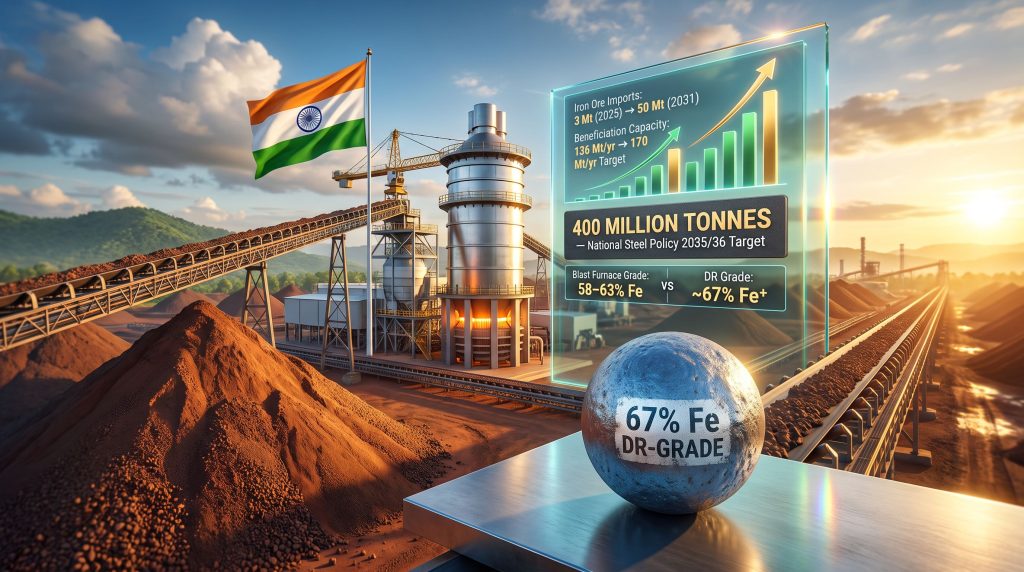
- Direct Reduction (DR) grade ore requires a minimum of approximately 67% Fe, with tightly controlled alumina, silica, and phosphorus levels to enable efficient solid-state reduction
- Green hydrogen DRI feedstock demands the highest purity thresholds of all, where every percentage point of gangue increases energy consumption and undermines process economics
Q: What iron ore grade is needed for hydrogen-based DRI steelmaking?
Hydrogen iron ore reduction requires iron ore with a minimum iron content of approximately 67% Fe, combined with low levels of gangue minerals including alumina and silica. Standard blast furnace-grade ore in the 58 to 63% Fe range is generally incompatible with this process without prior beneficiation or pelletisation into a higher-grade feedstock.
The Hidden Cost of Alumina: A Compounding Efficiency Penalty
A dimension of India's ore quality challenge that receives insufficient attention is the alumina content profile of many domestic deposits. According to analysis by the IEEFA, every 1% increase in alumina content produces measurable and compounding inefficiencies in conventional steelmaking:
- Coke consumption rises by approximately 2.2% per 1% alumina increase
- Blast furnace productivity falls by approximately 4% per 1% alumina increase
At the scale India is targeting, these are not rounding errors. They translate directly into higher carbon intensity per tonne of steel produced and higher operating costs that systematically erode competitiveness. Furthermore, the alumina penalty also undermines the economics of any transition pathway, since high-alumina ore requires more aggressive beneficiation before it can serve DR-grade applications.
India's Steel Expansion: The Raw Material Arithmetic
National Steel Policy 2025 and the Scale of Ambition
India's proposed National Steel Policy 2025 sets a target of more than doubling crude steel production capacity to 400 million tonnes by 2035/36, while simultaneously reducing emissions intensity and cutting dependence on imported coking coal, which currently accounts for approximately 85% of India's coking coal requirements.
The scale of capacity under development makes this more than aspirational. Global Energy Monitor estimates that more than 357 million tonnes of steelmaking capacity is currently under development in India, of which approximately 57% remains blast furnace-based.
The Supply Gap: Structural Arithmetic That Points to Imports
| Steel Output Target (2030) | Iron Ore Required | Estimated Domestic Supply | Projected Import Gap |
|---|---|---|---|
| ~220 million tonnes | ~500 million tonnes | ~460 million tonnes | ~40 million tonnes |
The head of raw materials at Jindal Steel has indicated that producing around 220 million tonnes of steel by 2030 would require roughly 500 million tonnes of iron ore annually, leaving a potential shortfall of approximately 40 million tonnes even after planned domestic mine expansions are accounted for.
India produced approximately 289 million tonnes of iron ore in the 2024/25 financial year, ranking it as the world's fourth-largest producer. That gap between production and requirement is not a contingency scenario; it is a structural forecast that makes iron ore imports an inevitability. The critical insight is that the type of ore filling that 40-million-tonne gap will have far greater long-term consequences than the gap itself.
Domestic Ore Quality: A Mixed Picture
The Hematite Advantage and Its Limitations
India's iron ore reserves are predominantly hematite-based, which offers a meaningful starting advantage for decarbonisation pathways compared to magnetite-dominant resource bases that require more intensive processing. A significant share of current production exceeds 62% Fe, providing a reasonable foundation.
However, approximately 66.5% of India's remaining iron ore resources are classified as medium or low grade, requiring beneficiation before they can serve premium steelmaking applications. Additionally, grade depletion in several established mining regions is increasing the energy and cost burden of extracting usable material, eroding the advantage of proximity to domestic supply.
Beneficiation Capacity: The $5.7 Billion Investment Gap
India currently operates 27 beneficiation plants with combined processing capacity of approximately 136 million tonnes per year. Scaling this infrastructure to meet the demands of a lower-emissions steel sector requires a substantial step-change:
| Metric | Current Status | 2030 Target | Investment Required |
|---|---|---|---|
| Beneficiation plant capacity | 136 Mt/year | 170 Mt/year | ~$5.7 billion |
| Number of operating plants | 27 | Expansion required | Policy-dependent |
| Low/medium-grade ore share | ~66.5% of reserves | Requires upgrading | Ongoing |
Reaching the 170 million tonnes per year target by 2030 would require approximately $5.7 billion in capital investment, alongside supportive policy measures including reduced royalties for beneficiated low-grade ore. Without royalty reform and targeted infrastructure investment, beneficiation bottlenecks could force steel producers to default to blast furnace-grade imports, locking in higher-emission technology pathways for decades.
Policy Gap Warning: The beneficiation investment requirement is not merely a financial challenge. Without concurrent regulatory reform, including royalty structures that reward ore upgrading rather than penalising it, private capital is unlikely to flow into beneficiation infrastructure at the required pace.
The Technology Lock-In Risk: Why Today's Choices Are Structurally Irreversible
Two Technology Trajectories, Two Ore Requirement Profiles
The technology lock-in risk embedded in India's current sourcing decisions is perhaps the most underappreciated dimension of the entire India iron ore quality for steel decarbonisation challenge. Steelmaking infrastructure operates with asset lives measured in decades. A blast furnace commissioned today will likely still be operating in 2050, and the ore grade decisions that accompany its commissioning effectively pre-determine its emissions profile across that entire lifespan.
If blast furnace-grade ore dominates future imports:
- Investment continues flowing into BF-BOF (blast furnace-basic oxygen furnace) infrastructure
- Dependence on imported coking coal, currently at approximately 85% of demand, persists or deepens
- Emissions intensity reduction targets become structurally more difficult to achieve
- Carbon pricing risks accumulate as global mechanisms mature
If DR-grade premium ore gains import share:
- Natural gas-based DRI expansion becomes commercially viable at scale
- A pathway opens toward coal-derived syngas DRI as a transitional step relevant to India's coal-abundant context
- Green iron production becomes technically and economically feasible over time as renewable energy costs continue to decline
The DRI Pathway: A Staged Decarbonisation Ladder
Direct Reduced Iron technology is not a single destination but a staged decarbonisation pathway, with each stage accessible only if the prior ore quality foundations are in place:
- Near-term: Natural gas-based DRI, a proven and commercially available technology already operating at scale in multiple markets
- Medium-term: Coal-derived syngas DRI, particularly relevant for India given its domestic coal resource base and existing energy infrastructure
- Long-term: Green hydrogen DRI, dependent on renewable energy scale-up and requiring the highest ore purity thresholds of all three stages
Each successive stage requires progressively higher Fe content and lower impurity levels. Consequently, the sourcing and beneficiation decisions made between 2025 and 2030 will determine whether stages two and three remain accessible, or become foreclosed by the installed infrastructure base.
The next major ASX story will hit our subscribers first
Global Supply Dynamics: Who Can Serve India's Premium Ore Demand
The Structural Reorientation of Iron Ore Trade
Global iron ore trade is undergoing a meaningful structural shift. Demand growth is migrating away from a maturing China steel and iron ore market toward emerging steel producers across South and Southeast Asia. India is positioned at the centre of this reorientation, and major global suppliers are adjusting their commercial strategies accordingly.
The Australian government forecasts India's iron ore imports rising from approximately 3 million tonnes in 2025 to 50 million tonnes by 2031, representing a near-17-fold increase in six years. Brazilian iron ore giant Vale has explicitly identified India as a strategic growth market, signalling that commercial positioning is already shifting ahead of demand materialisation.
Supplier Positioning: A Comparative Overview
| Supplier | Key Advantage | DR-Grade Capability | Green Iron Positioning |
|---|---|---|---|
| Australia | Proximity, established trade relationships, scale | Expanding DR-grade product lines | Developing green iron export ambitions |
| Brazil | Abundant high-grade hematite reserves | Strong DR-grade feedstock production | Growing; Oman partnership model relevant |
| Canada | Lower-alumina ore profiles, trial shipments underway | Moderate | Early stage |
| Oman | Emerging green iron processing hub | Processing imported ore | Positioning as value-added exporter |
Brazil's structural advantage lies in its natural abundance of high-grade hematite and its expanding production of DR-grade pellets and concentrates. IEEFA analysis specifically identifies Brazil as well-positioned to benefit from India's shift toward lower-emissions steelmaking, given these reserve characteristics and growing DR-grade feedstock output.
Oman's Novel Model: Processing Hub Over Raw Exporter
Oman's emergence as a green iron processing hub deserves particular attention as an indicator of how iron ore trade is evolving. Rather than exporting raw ore, Oman imports ore, processes it using renewable-powered DRI facilities, and exports value-added metallics. This model represents a fundamentally different commercial logic than traditional bulk commodity trade, one where value capture occurs through processing capability rather than resource ownership.
Jindal Steel's engagement with this model is instructive. The company already owns one DRI plant in Oman and is developing a second, and has indicated it is evaluating DRI imports as a response to the shortage of suitable metallics within India. This strategy reflects a rational economic response to domestic ore quality constraints: when upgrading low-grade domestic ore is uneconomic at scale, importing the upgraded metallic product may deliver superior value-in-use outcomes.
Corporate Strategy Signals: How India's Majors Are Responding
Tata Steel's Post-2030 Raw Material Approach
Tata Steel's strategic posture provides one of the clearest signals that India's leading producers are already integrating ore quality — not just ore cost — into long-term raw material planning. The company's articulated post-2030 strategy centres on three pillars:
- Securing additional domestic mining leases to reduce import exposure and maintain supply security
- Expanding production in regions where ore availability and quality characteristics align with premium steelmaking requirements
- Evaluating imported ore as a complement to domestic supply, with explicit attention to alumina content and value-in-use metrics rather than cost per tonne alone
Tata Steel has already conducted trial imports of Canadian iron ore, with the company's leadership noting that lower-alumina ore profiles can deliver measurably better value in use, particularly for coastal plants where import logistics are commercially viable. This is a significant strategic signal: a major Indian producer is already paying a quality premium and finding that it generates net economic value.
Jindal Steel's DRI Diversification Strategy
Jindal Steel's approach illustrates a complementary dimension of the quality challenge. The company's dual DRI investments in Oman — one operational and one under development — combined with its stated evaluation of DRI imports to address domestic metallic shortages, reflects a broader strategic logic. Furthermore, access to DR-grade feedstocks, whether through imports of ore or processed metallics, is becoming a competitive differentiator in Indian steelmaking.
A Multi-Dimensional Framework for Future Ore Sourcing Decisions
Beyond Cost Per Tonne: Four Lenses for Evaluating Iron Ore Imports
The conventional procurement approach of prioritising cost per tonne is structurally inadequate for the decarbonisation era. According to research on sustainable steelmaking, a more robust evaluation framework should incorporate four dimensions:
- Technology compatibility: Does the ore grade support the steelmaking route being targeted, both now and across the asset's operational life?
- Energy security implications: Does the sourcing decision reduce or entrench dependence on imported coking coal, which currently represents approximately 85% of India's coking coal demand?
- Emissions trajectory: Does the ore quality enable lower emissions intensity across the full value chain, including beneficiation energy inputs?
- Industrial competitiveness: Does access to premium ore improve cost competitiveness as carbon pricing mechanisms mature in India's major export markets?
Strategic Principle: Iron ore sourcing decisions made between 2025 and 2030 will effectively determine which steelmaking technologies India can deploy between 2030 and 2050. The cost of the ore is a secondary consideration relative to the technology pathway it enables or forecloses.
Domestic Upgrading and Premium Imports: A Coordinated Dual Strategy
The most effective response to India's ore quality challenge is not a binary choice between upgrading domestic material and importing premium feedstocks. In addition, it is a coordinated dual strategy that treats both as complementary pillars:
- Domestic beneficiation investment should form the foundation, supported by royalty reform and the approximately $5.7 billion in capital investment required to reach 170 million tonnes per year of processing capacity by 2030
- Selective premium ore imports should fill the quality gap where domestic upgrading is uneconomic or technically insufficient, with DR-grade ore prioritisation embedded in procurement policy rather than left to individual corporate discretion
- Import evaluation frameworks should incorporate alumina content, silica levels, and technology compatibility metrics alongside price benchmarks
FAQ: India Iron Ore Quality and Steel Decarbonisation
Q: Why does iron ore quality matter specifically for steel decarbonisation?
Higher-grade iron ore, particularly at approximately 67% Fe or above, is required for direct reduction ironmaking processes that use natural gas or green hydrogen instead of coking coal. Lower-grade ore is compatible only with blast furnace technology, which is substantially more carbon-intensive and structurally dependent on imported coking coal.
Q: What share of India's iron ore reserves are low or medium grade?
Approximately 66.5% of India's remaining iron ore resources are classified as medium or low grade, requiring beneficiation or pelletisation before they can serve premium steelmaking applications at DR-grade specifications.
Q: How much investment is required to expand India's beneficiation capacity by 2030?
Expanding beneficiation plant capacity from approximately 136 million tonnes per year to 170 million tonnes per year by 2030 is estimated to require around $5.7 billion in capital investment, alongside supportive policy reform.
Q: What is the alumina penalty in blast furnace steelmaking?
Every 1% increase in alumina content in iron ore raises coke consumption by approximately 2.2% and reduces blast furnace productivity by approximately 4%, creating compounding cost and emissions penalties at scale.
Q: How much will India's iron ore imports grow by 2031?
Australian government forecasts project India's iron ore imports rising from approximately 3 million tonnes in 2025 to around 50 million tonnes by 2031, a near-17-fold increase driven by domestic supply constraints and growing demand for premium-grade feedstocks.
Q: Which suppliers are best positioned to serve India's DR-grade ore demand?
Brazil and Australia are the primary candidates, given their large reserves of high-grade ore and expanding DR-grade product lines. However, Canada has also emerged as a potential low-alumina supplier, with trial shipments already conducted by Indian producers including Tata Steel. The China steel outlook also continues to influence how global suppliers prioritise competing markets.
Key Takeaways
- India's India iron ore quality for steel decarbonisation challenge has fundamentally shifted from a volume problem to a quality problem, with the grade of ore imported over the next five years effectively determining the country's steelmaking technology trajectory through 2050
- The 66.5% share of low to medium-grade domestic reserves creates a structural beneficiation imperative requiring approximately $5.7 billion in investment and concurrent royalty reform by 2030
- Alumina contamination in domestic ore imposes measurable compounding penalties: +2.2% coke consumption and -4% blast furnace productivity per 1% alumina increase, making quality upgrading an economic as well as environmental priority
- With 57% of India's announced steelmaking capacity under development remaining blast furnace-based, the window for redirecting capital toward DRI-compatible infrastructure is narrowing rapidly
- Australia, Brazil, Canada, and Oman are actively repositioning to capture India's growing demand for premium and green iron feedstocks, with iron ore trade evolving from a bulk commodity flow into a quality- and technology-differentiated market
- Corporate leaders at Tata Steel and Jindal Steel are already integrating ore quality metrics, alumina content, and value-in-use calculations into long-term raw material strategy, signalling a broader industry shift that policy frameworks have yet to fully reflect
This article contains forward-looking projections and analysis drawn from industry research, including IEEFA reporting and Australian government forecasts. Projections regarding import volumes, investment requirements, and technology adoption timelines involve inherent uncertainty and should not be interpreted as investment advice. Readers should conduct independent research before making financial or commercial decisions.
Want to Track the Next Major Mineral Discovery Before the Broader Market Does?
Discovery Alert's proprietary Discovery IQ model scans ASX announcements in real time, instantly translating complex mineral data across more than 30 commodities into clear, actionable insights — giving subscribers a decisive edge in identifying high-potential opportunities the moment they emerge. Explore historic discoveries and the returns they generated, then begin your 14-day free trial at Discovery Alert to position yourself ahead of the market.