August 12, 2026
The Infrastructure Race to Rewire Global Energy Around Iran
Every major realignment in global energy geography begins not with a policy announcement, but with a slow-building recognition that existing infrastructure can no longer be trusted. The current moment carries the hallmarks of one of those generational shifts. Two of the world's most consequential maritime energy corridors now sit under the effective influence of a single state and its allied proxies, and the nations most exposed to that vulnerability are quietly constructing an alternative architecture designed to make those corridors irrelevant.
The U.S.–Israel–Saudi plan to cut Iran out of global oil flows is not a single initiative. It is a layered, multi-decade infrastructure strategy composed of three distinct tracks, each at a different stage of development, each serving both commercial and geopolitical objectives simultaneously. Understanding what is real, what is aspirational, and what lies in between requires disaggregating the strategy into its component parts. The broader geopolitical landscape of 2025 and beyond makes this disaggregation more important than ever.
When big ASX news breaks, our subscribers know first
Iran's Chokepoint Dominance: A Structural Condition, Not a Temporary Crisis
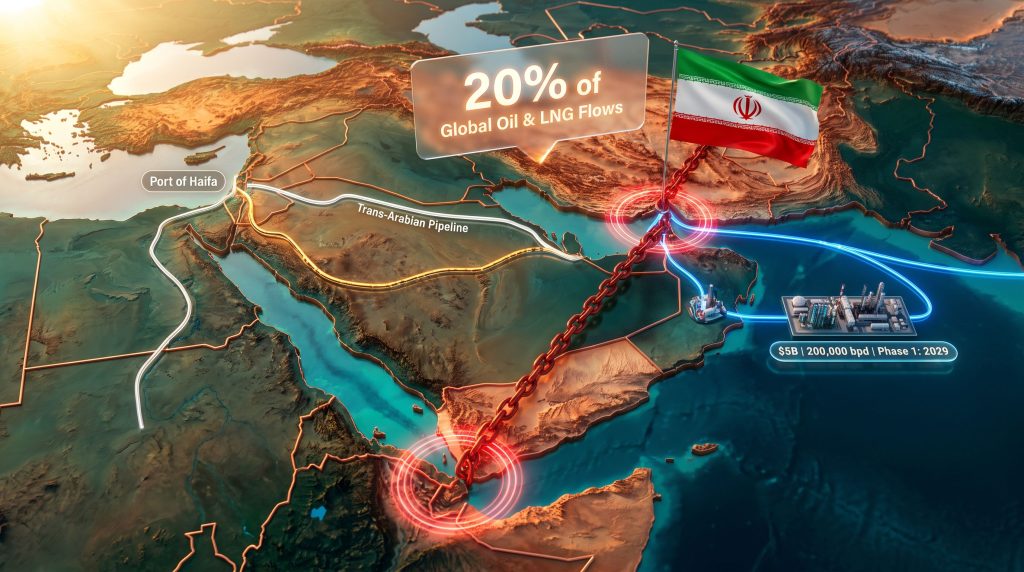
The Strait of Hormuz is approximately 33 kilometres wide at its narrowest navigable point, yet it carries roughly 20% of all global oil and LNG flows daily. Iran's military forces command the strait's entire eastern flank, giving Tehran the practical capacity to obstruct or threaten traffic at will. No comparable chokepoint exists anywhere in the world's energy infrastructure.
Prior to the U.S.-Israel military operation launched on 28 February, Iranian closure of the strait functioned primarily as a deterrence instrument, a threat held in reserve. Following that operation and Tehran's subsequent formalization of chokepoint control, what was once a conditional threat has hardened into an established posture. The distinction matters enormously: deterrence is negotiable, whereas institutionalized doctrine is structurally embedded.
Compounding the problem is the Bab el-Mandeb Strait at the southern end of the Red Sea. Iran-backed Houthi forces in Yemen have demonstrated sustained capacity to disrupt tanker traffic attempting to transit this corridor toward the Suez Canal and onward to European markets. The simultaneous effective influence over both primary Middle Eastern energy exit routes represents a strategic condition with no clear modern precedent. For further context on alternative bypass routes, analysts continue to examine the practical limits of circumventing Hormuz.
Major global powers — Washington, Beijing, Brussels, London, and Moscow — have each independently assessed Iran's position in these waterways as structurally consolidated rather than temporarily opportunistic.
Bank of America analysts have estimated that stabilizing Hormuz under sustained closure conditions would require ten times more vessels than currently operate in the region, an impossible near-term deployment that underscores just how dependent global energy markets remain on a corridor now under contested control. Furthermore, the oil price geopolitics surrounding Hormuz have become inseparable from broader market volatility.
The MERA Oil Consortium: A $5 Billion Route-Resilient Refinery Hub
Against this backdrop, a private consortium has formally announced the first major piece of bypass infrastructure designed to create a commercially viable alternative to Hormuz-dependent export routes.
The MERA Oil consortium — a joint venture between U.S.-based MWG Enterprises, the Patel Family Office, and PWS (an affiliate of the Saudi-headquartered AHQ Group) — has entered the final stage of selecting a host location for a $5 billion integrated refinery and export corridor explicitly positioned outside the Strait of Hormuz.
| Feature | Detail |
|---|---|
| Total Project Cost | USD $5 billion |
| Planned Refinery Capacity | 200,000 barrels per day |
| Key Infrastructure | Deepwater port, crude and product storage, marine export terminals |
| Strategic Location Criteria | Outside Strait of Hormuz; unrestricted Indian Ocean access |
| Phase One Target Completion | End of 2029 |
| Consortium Partners | MWG Enterprises (U.S.), Patel Family Office, PWS (AHQ Group affiliate) |
Given the operational parameters and the project's stated alignment with all six Gulf Cooperation Council member states — Bahrain, Kuwait, Oman, Qatar, Saudi Arabia, and the UAE — the two most viable candidate locations are sites offering direct access to the Gulf of Oman or the Arabian Sea. Fujairah in the UAE and Duqm or Salalah in Oman both satisfy this geographic requirement, offering completely unobstructed access to Indian Ocean shipping lanes without any Hormuz transit dependency.
The MERA facility is not conceived as a standalone refinery. Its designers envision it as a physical anchor for a wider regional industrial base, incorporating manufacturing capacity, logistics infrastructure, and technical capability alongside its core refining and export functions. Once the site is formally announced, the project moves into final engineering diligence, with commissioning and commercial operations following Phase One mechanical completion.
Why Positioning Outside Hormuz Changes the Commercial Calculus
A route-resilient export platform fundamentally alters the risk premium embedded in Gulf energy flows. Buyers currently accepting a Hormuz risk discount — or avoiding Gulf supply altogether during periods of heightened tension — gain access to a Hormuz-independent source of refined product. This commercial logic is independent of the geopolitical narrative and gives the MERA project a durable demand base that pure geopolitical bypass facilities historically lack.
IMEC: From G20 Trade Vision to Wartime Bypass Architecture
The India-Middle East-Europe Economic Corridor was originally conceived at the 2023 G20 Summit as a multilateral trade facilitation initiative. Regional conflict stalled its implementation almost immediately. By 2026, however, U.S. planners had fundamentally redesigned the corridor's architecture, reframing it as a strategic bypass system aimed at routing energy and cargo flows around Iran-controlled maritime corridors entirely.
The 2026 redesign operates on two integrated corridors:
Eastern Maritime Leg:
- Connects India's western ports to Arabian Gulf terminals
- The 2026 redesign anchors this leg in Oman rather than the UAE, enabling Indian cargo vessels to discharge entirely outside the Strait of Hormuz
- Cargo transfers directly onto the Arabian Peninsula rail network without any Hormuz transit requirement
Northern Overland Rail Network:
- Runs through Saudi Arabia and Jordan to Israel's Port of Haifa
- Short-sea shipping from Haifa provides direct connectivity to European markets
- New legal frameworks, including the India-EU Free Trade Agreement and the U.S. Senate's Eastern Mediterranean Gateway Act, have formally designated Greece as Europe's primary entry hub for this corridor
Additional IMEC Plus nodes through Egypt and Syria are under active discussion, designed to create a modular, distributed bypass lattice capable of functioning even if individual nodes face disruption. The expanded network would handle diversified cargo and energy flows well beyond the core India-to-Europe trade lane.
U.S. planners estimate IMEC could eventually divert approximately 60% of container traffic currently transiting the Strait of Hormuz. Analysts caution, however, that this projection describes a long-horizon ambition rather than near-term operational capacity. Existing alternative infrastructure currently handles only a small fraction of Hormuz-transiting volumes, and the rail, port, and storage buildout required to approach the 60% diversion target represents a construction effort spanning well into the early 2030s.
IMEC as a U.S.-China Geopolitical Contest
The IMEC corridor carries a dimension that extends far beyond energy logistics. Under existing conditions, China holds structural influence over Hormuz and Bab el-Mandeb flows through its 25-Year Comprehensive Cooperation Agreement with Iran, an arrangement that gives Beijing indirect leverage over roughly one-fifth of global oil and LNG supply. A functional IMEC corridor would transfer a meaningful degree of route-governance authority from China's sphere of influence into a corridor anchored by U.S. allies and partners.
Consequently, the ongoing U.S.-China trade war adds another layer of urgency to IMEC's development. This positions the corridor not merely as an energy infrastructure project but as one of the most consequential instruments of U.S.-China great power competition currently under development anywhere in the world.
The Trans-Arabian Pipeline Concept: The Most Ambitious and Least Certain Track
The third element of the bypass strategy is simultaneously the most strategically powerful and the furthest from implementation. The concept involves constructing a new overland pipeline across the Saudi Arabian desert to the Israeli border, where it would connect to the existing Trans-Israel Pipeline, also known as the Eilat-Ashkelon Pipeline.
Built between 1968 and 1969, the 42-inch diameter pipeline runs from the Red Sea port of Eilat northward to the Mediterranean port of Ashkelon. From Mediterranean terminals, oil accesses European and global markets through conventional tanker shipping, entirely bypassing both the Strait of Hormuz and the Bab el-Mandeb.
The Historical Irony at the Heart of the Eilat-Ashkelon Pipeline
The Trans-Israel Pipeline carries remarkable historical weight. It was originally constructed as a covert joint venture between Israel and Iran under the Shah's government, designed to move Iranian crude from the Red Sea to the Mediterranean while avoiding the Suez Canal. Decades later, the same piece of infrastructure is now being seriously considered as a mechanism to structurally isolate the Islamic Republic of Iran from global energy markets. Few historical reversals in energy infrastructure carry this degree of geopolitical irony. The 2026 Strait of Hormuz crisis has, in many respects, accelerated these discussions considerably.
Senior-Level Political Endorsements
Israeli Energy Minister Eli Cohen has stated publicly that Gulf states have expressed a clear preference for land-based export routes that remove dependence on both Iranian-controlled straits and Houthi-disrupted waters, and that Israel's geographic position makes it the optimal transit corridor for Gulf oil moving toward Mediterranean markets.
Israeli Prime Minister Benjamin Netanyahu has publicly endorsed the overland pipeline concept, describing westward-running oil and gas pipelines across the Arabian Peninsula to Israeli Mediterranean ports as a permanent structural solution to the chokepoint vulnerability problem — one that he characterises as definitively achievable.
A senior Washington-based source closely associated with U.S. Treasury deliberations has indicated that the infrastructure's cross-border positioning across Saudi and Israeli territory would create a natural platform for security force deployment, generating significant strategic leverage for Washington across the region and providing a mechanism to advance the Abraham Accords normalisation agenda. The evolving U.S. policy on PDVSA further illustrates Washington's broader willingness to deploy energy policy as a geopolitical instrument.
The Saudi Commitment Gap
Critical caveat: While Israeli and U.S. officials have offered public and private endorsements of the pipeline concept, Saudi Arabia has not made any formal commitment to the project. The overland Trans-Arabian pipeline remains a strategic proposal under senior-level discussion, not an agreed infrastructure initiative.
This distinction is not minor. The pipeline's entire commercial and geopolitical logic depends on Saudi participation. Without a formal Riyadh commitment, the most transformative element of the U.S.–Israel–Saudi plan to cut Iran out of global oil markets exists primarily as a signalling instrument and a coalition-building tool. OPEC's market influence over Saudi decision-making adds yet another layer of complexity to any formal commitment timeline.
Comparing the Three Tracks: Status, Constraints, and Timelines
| Initiative | Current Status | Primary Constraint | Realistic Timeline |
|---|---|---|---|
| MERA $5B Refinery Hub | Site selection finalising | Site not yet formally announced | Phase One: end of 2029 |
| IMEC Corridor (2026 redesign) | Legal frameworks advancing; Oman anchor confirmed | Massive rail and port buildout required | Early 2030s for meaningful capacity |
| Trans-Arabian Pipeline to Israel | Conceptual; senior political endorsements on record | No formal Saudi commitment | Aspirational; no construction timeline |
The next major ASX story will hit our subscribers first
Escalation Architecture: The Security Logic Embedded in Bypass Infrastructure
A dimension of the bypass strategy that receives insufficient attention in mainstream analysis is its embedded security architecture. Overland pipeline infrastructure crossing Saudi and Israeli territory would require permanent large-scale security deployments from multiple state actors. U.S. strategic planners have indicated that any Iranian or proxy attack on the corridor would provide a pre-established legal and military justification for a coordinated response involving the United States, Israel, and Gulf allies.
This creates what security analysts describe as a deliberate escalation ladder. The infrastructure itself functions as a formalised tripwire that embeds a U.S. military commitment to the region within the commercial logic of an energy bypass system. The Abraham Accords dimension reinforces this architecture: shared economic infrastructure between Saudi Arabia and Israel would represent the most powerful normalisation incentive yet constructed, and U.S. strategic planners view the pipeline as simultaneously an energy security instrument and a foreign policy tool for expanding American influence at the direct expense of Chinese and Russian regional positioning.
Three Scenarios for the Bypass Strategy's Trajectory
Scenario 1: Successful Bypass Architecture
- MERA refinery operational by 2029; IMEC network functional by early 2030s; Saudi-Israel pipeline under construction
- Iran's leverage over global oil markets structurally diminished
- Hormuz risk premium in oil pricing gradually compresses
Scenario 2: Partial Implementation (Base Case)
- MERA refinery delivers as planned; IMEC partially functional; Trans-Arabian pipeline stalled
- Iran retains significant chokepoint leverage but faces growing bypass competition
- Ongoing Hormuz risk premium persists at reduced levels
Scenario 3: Infrastructure Failure or Escalation
- Iranian or proxy attacks on bypass infrastructure trigger broader regional conflict
- Construction timelines collapse; energy markets face sustained supply disruption
- Oil prices spike as both Hormuz and alternative routes face simultaneous threat
The Long-Game Nature of an Infrastructure-Based Geopolitical Strategy
None of the three tracks in the U.S.–Israel–Saudi plan to cut Iran out of global oil flows will deliver full operational capacity before the early 2030s at the earliest. In the interim, Iran retains effective control over the world's most critical energy transit corridors, and global energy markets remain exposed to Hormuz-related price volatility.
The strategic value of the bypass plan during this interim period is therefore as much about signalling intent and building coalition architecture as it is about immediate infrastructure delivery. Each announced initiative — the MERA consortium, IMEC's legal frameworks, Netanyahu's pipeline endorsements — shifts the calculus for regional actors calculating where to anchor their long-term energy relationships.
What makes this strategy genuinely consequential is not any single piece of infrastructure. It is the intersection of commercial logic, geopolitical competition, normalisation diplomacy, and embedded security architecture within a single coordinated framework. The Abraham Accords dimension, the U.S.-China route-governance contest, and the deliberate escalation mechanisms embedded in the infrastructure design collectively make this a multi-decade geopolitical project operating under the cover of energy infrastructure development.
Disclaimer: This article is for informational purposes only and does not constitute financial or investment advice. Forecasts, scenario projections, and strategic assessments referenced herein involve significant uncertainty and should not be relied upon as predictions of future market conditions or geopolitical outcomes.
Want to Stay Ahead of the Commodity Shifts Reshaping Global Markets?
As geopolitical realignments redirect energy flows and reshape commodity landscapes, Discovery Alert's proprietary Discovery IQ model delivers real-time alerts on significant ASX mineral discoveries, transforming complex market signals into actionable investment opportunities — explore historic discovery returns that demonstrate why being early matters, and begin your 14-day free trial at Discovery Alert to position yourself ahead of the market.