August 12, 2026
The Hidden Fracture Lines in Global Alumina Supply
Commodity markets rarely collapse in a single moment. More often, they erode through the accumulation of overlapping pressures, structural decisions, and operational shocks that compound over quarters rather than days. The Oceania alumina production decline now unfolding across Western Australia is a textbook example of this process, and understanding its mechanics matters far beyond the region's borders.
When big ASX news breaks, our subscribers know first
Why Oceania's Alumina Output Is Contracting: The Full Picture
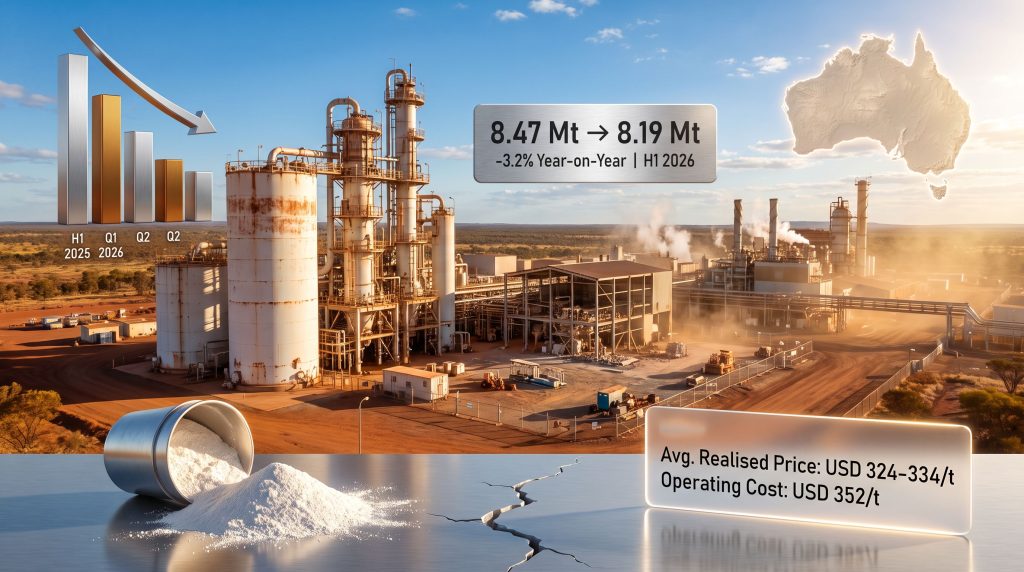
The numbers are unambiguous. Oceania produced 8.194 million tonnes of alumina across the first half of 2026, compared with 8.467 million tonnes during the same period in 2025. That 3.23% year-on-year contraction translates to roughly 273,000 tonnes of lost output in just twelve months, with average daily production slipping from 46.78 thousand tonnes to 45.27 thousand tonnes.
Production Performance: Quarter-by-Quarter Data
| Metric | H1 2025 | H1 2026 | Change |
|---|---|---|---|
| Total Alumina Output (Mt) | 8.467 | 8.194 | -3.23% |
| Average Daily Production (kt/day) | 46.78 | 45.27 | -3.23% |
| Q1 Production (Mt) | 4.312 | 4.142 | -3.94% |
| Q2 Production (Mt) | 4.155 | 4.052 | -2.48% |
| Q1 Daily Average (kt/day) | 47.9 | 46.0 | -3.97% |
| Q2 Daily Average (kt/day) | 45.7 | 44.5 | -2.63% |
Critically, neither quarter showed signs of improvement. Q1 2026 recorded the steeper year-on-year decline at -3.94%, while Q2 2026 followed with a further -2.48% reduction. A sequential fall of 90,000 tonnes between Q1 and Q2 2026 confirmed the downward trajectory was not a temporary seasonal anomaly. Both quarters contracted independently, ruling out isolated weather events as the sole explanation. Furthermore, global alumina output across other regions remained comparatively resilient, making Oceania's contraction all the more notable.
The Kwinana Closure: Permanent Capacity Loss and What It Really Means
At the centre of this Oceania alumina production decline sits the permanent decommissioning of Alcoa's Kwinana alumina refinery in Western Australia. With 2.2 million tonnes of annual nameplate capacity, Kwinana was one of the region's most significant refining assets. Production curtailment began in 2024, and its formal permanent closure ahead of 2026 removed this capacity from the global refining system for good.
Alcoa cited a confluence of factors behind the decision:
- The refinery's advancing age and associated infrastructure costs
- Insufficient scale relative to more modern, larger facilities
- Elevated and rising operating cost structures
- Unfavourable market pricing that eroded the economics of continued operation
- Declining bauxite feed quality affecting refining efficiency
What makes permanent closures structurally different from curtailments: When a refinery is curtailed, the option to restart production remains intact if market conditions improve. When a refinery is permanently decommissioned, that optionality disappears. Workforces are dispersed, equipment is repurposed or removed, and the supply chain reconfigures permanently around a smaller production base. Kwinana's closure is therefore not a temporary reduction in Oceanian output — it is a structural reset of the region's refining ceiling.
Alcoa's broader strategic direction in Australia is worth examining in this context. The Alcoa IGNIS EQT joint venture reflects a wider repositioning of the company's asset base, and Kwinana's decommissioning fits within that evolving strategic framework.
Understanding Bauxite Grade as a Driver of Refinery Economics
The mention of declining bauxite grades in Alcoa's closure rationale deserves closer attention, as this is a dimension of alumina refining economics that receives less mainstream coverage than it warrants. Alumina refineries are calibrated around specific bauxite feed characteristics, particularly the ratio of available alumina to reactive silica. As ore grades decline over a mine's life, the refinery must either process more ore to yield the same alumina output or accept lower throughput efficiency.
For older refineries like Kwinana, operating near the end of their economic life, declining feed quality acts as a cost amplifier. Caustic soda consumption increases, energy intensity per tonne of alumina rises, and the cost per tonne shipped climbs. This dynamic is not unique to Kwinana and may eventually affect other ageing Australian refinery assets as their associated mine plans extend into lower-quality ore zones. Indeed, bauxite's importance to global aluminium supply chains makes feed quality a critical variable that market participants increasingly cannot afford to overlook.
Cyclone Narelle, Gas Supply Disruptions, and the Compounding Risk Effect
The structural capacity loss from Kwinana was further amplified by a sequence of operational disruptions across the first half of 2026 that concentrated significant pressure on remaining Western Australian refining infrastructure.
| Period | Event | Facility Affected | Nature of Impact |
|---|---|---|---|
| January-February 2026 | Heavy rainfall events | Rio Tinto Weipa bauxite operations | Mining and logistics disruption |
| Late March 2026 | Tropical Cyclone Narelle | Alcoa Pinjarra refinery | Operational instability triggered |
| March-Q2 2026 | Cyclone-linked gas supply disruption | Pinjarra refinery | Energy supply interruption compounding instability |
| Q1 2026 (seasonal) | Scheduled maintenance programmes | Multiple Australian refineries | Planned production reduction |
The Pinjarra disruption was particularly instructive from a risk management perspective. What began as weather-related operational instability in late March then cascaded into an energy supply problem when gas infrastructure serving the refinery was disrupted by the same cyclone system. This compounding dynamic illustrates a vulnerability specific to Western Australian alumina refining: the region's refinery assets are deeply dependent on continuous pipeline gas supply, and that gas infrastructure shares geographic exposure with the weather systems that can also disrupt bauxite mining and logistics.
Alcoa responded by formally revising its 2026 full-year alumina production guidance downward, specifically attributing the revision to reduced output expectations at Pinjarra. Rio Tinto's Weipa bauxite operations in Queensland also experienced disruption from heavy rainfall earlier in the year, adding upstream feed supply uncertainty to an already pressured system. For further context on how upstream bauxite supply interacts with refinery output, Metro Mining's Bauxite Hills operations provide a useful point of comparison in terms of Queensland-based production resilience.
Alumina refining is an energy-intensive process, with thermal energy requirements for the Bayer process digestion stage typically representing one of the largest single cost inputs. Natural gas is the preferred fuel source for most Australian refineries, making uninterrupted gas supply a critical operational dependency rather than an optional input.
Margin Compression: When the Economics of Refining Turn Against Output
The Oceania alumina production decline cannot be fully explained through a purely operational lens. The financial environment facing Oceanian refiners in H1 2026 was among the most challenging in recent years, creating a set of economic incentives that actively discouraged higher throughput at marginal capacity.
The Price-Cost Squeeze in Numbers
| Financial Metric | H1 2025 | H1 2026 | Change |
|---|---|---|---|
| Average Realised Alumina Price (USD/t) | ~USD 475 | USD 324-334 | -29% to -32% |
| Adjusted Operating Cost per Tonne Shipped | USD 318 | USD 352 | +10.7% |
| Platts Alumina Index Range (Q2 2026) | – | USD 303-330/t | Benchmark context |
The arithmetic here is stark. Alcoa's average realised third-party alumina price fell to USD 324-334 per tonne in H1 2026, against approximately USD 475 per tonne a year earlier. That represents a roughly 30% revenue reduction per tonne sold. Simultaneously, adjusted operating costs per tonne shipped climbed from USD 318 to USD 352, a 10.7% cost increase moving in the opposite direction to revenue.
When operating costs per tonne approach or exceed realised prices at marginal production levels, the rational economic response for a refiner is to reduce throughput at its highest-cost facilities. This is not a failure of operational management; it is market discipline functioning correctly. However, the consequence for regional output is accelerated contraction. US aluminium tariffs have added a further layer of complexity to this already challenging pricing environment, influencing trade flows and putting additional pressure on refiner margins.
The ex-China seaborne alumina market remained in an oversupplied condition throughout Q2 2026, with the Platts alumina index trading in the USD 303-330 per tonne range. Australia's alumina production is overwhelmingly export-oriented, meaning Western Australian refiners are directly exposed to seaborne benchmark pricing with limited ability to access premium markets that might offset cost inflation. The international alumina production data from the International Aluminium Institute confirms this pricing pressure has been a broadly consistent feature of the global market throughout the period.
Where Australia's Alumina Decline Fits Within a Multi-Year Trend
The H1 2026 data does not represent the beginning of a new problem. Australian alumina production has been tracking on a multi-year declining trajectory for approximately three consecutive years, according to industry analysis from S&P Global. The Kwinana closure accelerates a trend that predates the 2026 disruptions, pointing toward structural rather than purely cyclical forces reshaping regional output capacity.
This longer-horizon perspective is important for market participants assessing whether the current Oceania alumina production decline is temporary or represents a durable shift in regional supply contribution. Several factors suggest the structural dimension is dominant:
- Permanent capacity withdrawal means Kwinana's 2.2 million tonnes per year cannot return to the market regardless of price recovery
- Ageing refinery infrastructure at remaining Western Australian facilities creates ongoing cost disadvantages relative to newer Asian refining capacity
- Bauxite grade trajectories at associated mine plans will influence future refinery efficiency for surviving assets
- Energy cost structures in Western Australia remain a competitive constraint relative to refining locations with access to cheaper energy inputs
The next major ASX story will hit our subscribers first
Three Scenarios for Oceania's Output Trajectory
Looking beyond 2026, the regional output pathway will be determined by the interplay of market pricing, operational stability at surviving refineries, and the pace of any new project development capable of replacing lost capacity.
Scenario 1: Gradual Stabilisation (Base Case)
Remaining refineries including Pinjarra, Wagerup, and Yarwun return to stable operating rates through H2 2026, alumina prices recover modestly as seaborne oversupply moderates, and output stabilises in the 8.0-8.2 million tonne per half-year range without new capacity additions.
Scenario 2: Accelerated Contraction (Downside)
Further weather events or energy infrastructure disruptions affect remaining Western Australian refinery operations, alumina prices remain suppressed, and Oceania output falls below 8.0 million tonnes per half-year for the first time in the modern era.
Scenario 3: New Project-Led Recovery (Upside)
New alumina project development in Australia reaches operational maturity over a multi-year horizon, partially replacing Kwinana's lost capacity, while alumina price recovery improves refiner economics and supports higher throughput at existing facilities.
Investor note: Each scenario carries materially different implications for alumina buyers, smelter operators, and investors with exposure to the aluminium value chain. The base case assumes no further structural capacity withdrawals, which may prove optimistic given the cost pressures facing ageing refinery assets in a sub-USD 350 per tonne pricing environment.
Strategic Implications for Market Participants
The Oceania alumina production decline creates a set of distinct considerations depending on where a market participant sits within the aluminium value chain. In addition, broader commodity market dynamics — for instance, the challenges facing China's steel sector — offer a useful parallel for understanding how structural overcapacity and margin pressure interact across industrial commodity markets.
- Alumina buyers sourcing from Australian refineries should conduct supply security assessments and evaluate origin diversification options, particularly if their contracted volumes include production from facilities facing ongoing cost pressure
- Smelter operators dependent on Australian alumina supply should treat Pinjarra's operational trajectory as a leading indicator of near-term availability, given its recent disruption history and its role as one of the remaining high-volume assets in the region
- Aluminium producers evaluating long-term raw material strategy should factor in the structural ceiling now imposed on Oceanian output by the permanent loss of Kwinana's capacity
- Investors assessing exposure to alumina refining assets globally should weigh the cost-price dynamics now visibly evident across Oceania's refining base, particularly the margin inversion risk at facilities where operating costs per tonne approach or exceed prevailing realised prices
Key Takeaways
- Oceania produced 8.194 million tonnes of alumina in H1 2026, a 3.23% year-on-year decline from 8.467 million tonnes in H1 2025
- The permanent closure of Alcoa's Kwinana refinery removed 2.2 million tonnes of annual capacity from the regional and global refining system
- Cyclone Narelle and associated gas supply disruptions compounded structural capacity loss through operational instability at the Pinjarra refinery
- Average realised alumina prices fell approximately 30% year-on-year while operating costs per tonne rose nearly 11%, creating a severe margin compression dynamic
- Declining bauxite feed quality was identified as a contributing factor to the Kwinana closure decision, a dynamic that may increasingly affect other ageing Australian refinery assets
- Australian alumina production has been declining for approximately three consecutive years, indicating structural rather than purely cyclical forces are at work
- Recovery depends heavily on new project development timelines, energy cost trajectories, and the direction of seaborne alumina pricing through H2 2026 and beyond
This article is intended for informational purposes only and does not constitute financial advice. Forward-looking statements, scenario projections, and market forecasts involve inherent uncertainty and should not be relied upon as predictions of future outcomes. Readers should conduct their own independent research before making investment or procurement decisions.
Want To Stay Ahead of Structural Shifts in ASX Commodity Markets?
Discovery Alert's proprietary Discovery IQ model scans ASX announcements in real time, instantly identifying high-potential mineral discoveries across alumina, bauxite, and over 30 other commodities — turning complex data into actionable investment insights before the broader market reacts. Explore historic examples of major discoveries and their returns, then begin your 14-day free trial at Discovery Alert to position yourself ahead of the next significant market opportunity.