August 12, 2026
The Paradox at the Heart of African Energy: Producing the Resource, Importing the Price
Few structural contradictions in global commodity markets are as striking as the one that has defined West Africa's relationship with petroleum for decades. The region sits atop substantial crude oil reserves, pumping millions of barrels into international markets each year, yet for most of its modern energy history, the West Africa fuel pricing benchmark has been set thousands of kilometres away in European trading centres. The mechanics of this arrangement are worth understanding before examining why they may finally be changing.
When West African buyers import refined petroleum products, the contract price has traditionally been anchored to benchmarks set in the Mediterranean or Northwest European markets, specifically the Amsterdam-Rotterdam-Antwerp (ARA) hub. Freight costs, currency conversion, and the margin layers embedded in international trading chains are then added on top. The result is a pricing structure where local supply and demand conditions carry remarkably little weight in determining what consumers and distributors actually pay at the point of delivery.
This is the foundational problem that the emerging West Africa fuel pricing benchmark initiative is designed to solve, and the ambition is far more complex than simply creating a new price index.
When big ASX news breaks, our subscribers know first
Why External Benchmarks Persisted Despite Regional Hydrocarbon Wealth
The Refining Gap That Made Import Dependence Structural
The persistence of benchmark dependency across West Africa was not accidental. It reflected a specific and deliberate gap in the region's industrial development: the almost complete absence of competitive refining capacity. Extracting crude oil and transforming it into usable petroleum products are fundamentally different industrial activities, and for most of the post-independence era, West African governments and private investors failed to close that gap at scale.
Without sufficient domestic refining, the region had no choice but to import refined products. And since those products arrived from European or Asian refineries, the price logic of those distant markets travelled with the cargo. The terms most commonly used in international petroleum trade, namely FOB (free on board), CIF (cost and freight plus insurance), and CFR (cost and freight), each embed external market conditions into the final landed price paid by West African buyers.
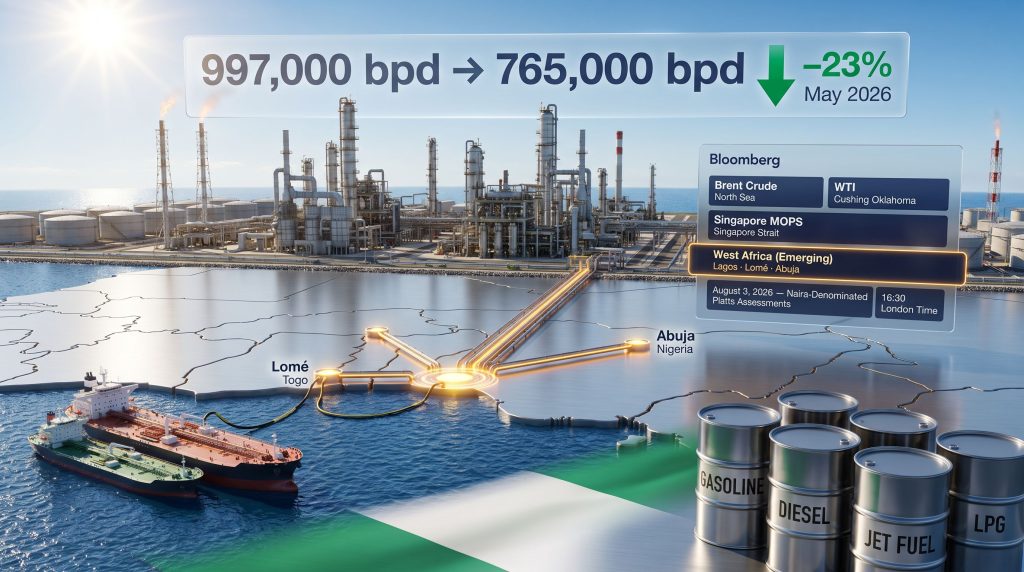
The scale of this dependency was significant. West Africa's clean petroleum product imports reached approximately 997,000 barrels per day as recently as April 2026, according to S&P Global Commodities at Sea data, a figure that underscores just how deeply embedded import reliance had become across the region's downstream markets.
The arithmetic of this arrangement worked against West African economies at every level: governments absorbed foreign exchange costs, distributors managed freight price risk, and consumers paid the compounded result of all of it.
How a Genuine Regional Benchmark Is Built: Mechanics and Precedents
The Three Non-Negotiable Pillars of Benchmark Credibility
Understanding what a real petroleum benchmark requires, as opposed to a regulatory price reference or a government-mandated index, is essential context for evaluating West Africa's current trajectory. The global commodity trading industry has developed clear criteria through decades of benchmark evolution:
-
Physical transaction volume – A benchmark must be underpinned by actual, verifiable trades in sufficient quantity to prevent any single participant from distorting the price.
-
Commercial liquidity – There must be a critical mass of independent buyers, sellers, traders, and financial intermediaries participating in the market and willing to reference the same price in their contracts.
-
Transparent, independently verified data – Price reporting agencies (PRAs) like S&P Global Platts publish assessments based on submitted transaction data and market observations, and the integrity of those assessments depends entirely on the quality and completeness of the data feeding into them.
The absence of any single pillar is sufficient to prevent a functioning benchmark from emerging, regardless of how much political will or regulatory architecture exists around it.
Lessons from the Benchmark Playbook: Brent, WTI, and Singapore
The history of successful commodity benchmarks offers both encouragement and sobering context for West Africa's ambitions. Furthermore, understanding the path taken by established markers reveals just how demanding the journey ahead is likely to be.
| Benchmark | Geographic Anchor | Physical Base | Approximate Time to Credibility |
|---|---|---|---|
| Brent Crude | North Sea / London | North Sea production | ~15 years |
| WTI | Cushing, Oklahoma | US pipeline and storage hub | ~10 years |
| Singapore MOPS | Singapore Strait | Regional import and export flows | ~20 years |
| West Africa (Emerging) | Lagos / Lomé / Abuja | Dangote output and regional trade | In development |
The Singapore model is arguably the most instructive precedent for West Africa, because Singapore itself produces almost no petroleum. Its dominance as Asia's fuel pricing reference was built entirely through strategic investment in storage infrastructure, deep-water port capacity, a stable regulatory environment, and deliberate cultivation of international trading firm participation.
Brent and WTI futures, meanwhile, each took well over a decade to evolve from physical crude markers into the financially layered global instruments they became. West Africa is at the very beginning of an equivalent journey, and the timeline should be measured in decades rather than years.
The Dangote Refinery: Necessary Condition, Not Sufficient Cause
A Supply Transformation of Measurable Scale
The Dangote Petroleum Refinery in Lagos represents the single most significant structural change to West Africa's downstream petroleum market in the region's history. With a nameplate capacity of 650,000 barrels per day, it ranks among the largest single-train refineries anywhere in the world. Operationally, the facility has demonstrated the ability to process more than 700,000 barrels per day during peak throughput tests, exceeding its design specification, according to reporting by Business Insider Africa.
The supply consequences of this capacity coming online have been rapid and measurable. West Africa's clean petroleum product imports fell from approximately 997,000 bpd in April 2026 to roughly 765,000 bpd in May 2026, a contraction of approximately 23% within a single month. S&P Global Commodities at Sea attributed a meaningful portion of this shift to increased Dangote output.
A 23% decline in regional petroleum product imports within a single calendar month represents a supply disruption of a magnitude typically associated with major geopolitical events or severe demand collapses, yet this one was driven by domestic industrial capacity coming online.
The refinery's output is simultaneously serving multiple market channels:
- Domestic Nigerian fuel supply, reducing the country's own import dependence
- Intra-regional distribution to neighbouring West African markets across the Economic Community of West African States (ECOWAS)
- Exports to European and other international destinations, creating the two-directional trade flows that begin to resemble a genuine trading hub
The Critical Distinction: Supply Is Not a Benchmark
Nigeria's downstream regulator, the Nigerian Midstream and Downstream Petroleum Regulatory Authority (NMDPRA), articulated a point that deserves to be understood clearly by anyone following this market development. Increased refining output creates the precondition for a benchmark, but the two things are fundamentally different in nature.
At the West Africa Refined Fuel Market Conference held in Abuja in August 2026, the NMDPRA made clear that a reference price alone does not constitute a trading hub, and that convening industry stakeholders does not create a functioning market. Physical infrastructure, commercial liquidity, and credible independently sourced market information are the actual prerequisites.
The goal articulated by Nigeria's regulator is a market so organically deep and transparent that a benchmark does not need to be imposed by any authority. When the infrastructure, participants, and transaction volume are in place, the market itself generates the price signal.
S&P Global Platts and the Architecture of West African Price Assessments
Building the Pricing Framework Around Emerging Trade Flows
S&P Global Platts has moved to construct a pricing architecture that can serve as the foundation for a credible West Africa fuel pricing benchmark as regional trade flows evolve. Current assessments span multiple delivery points and product categories. In addition, LPG price benchmarks from established markets offer a useful comparative framework for understanding how localised assessments gain commercial traction over time.
Assessment locations currently in use:
- STS Lomé – Ship-to-ship transfer hub in Togo, serving as an offshore aggregation and distribution point
- FOB West Africa – Free on board, reflecting cargo values at the point of regional export
- DAP Lagos – Delivered at place, Nigeria's primary commercial centre
- CFR South Africa – Cost and freight for southern African delivery, extending the benchmark's geographic reach
Products currently covered:
- Gasoline (premium motor spirit)
- Diesel and gasoil
- Aviation fuel (jet fuel)
- LPG and butane
A significant structural step was taken on August 3, 2026, when Platts introduced Naira-denominated assessments alongside the existing USD-denominated instruments, with prices timestamped to 16:30 London time. This localisation of currency denomination is meaningful because it begins to reduce the implicit dollarisation of West African fuel pricing, though the London timestamp reflects where much of the international trading community still operates.
The Infrastructure Gap: What Still Has to Be Built
A Multi-Layer Physical Deficit
The NMDPRA's roadmap presented at the Abuja conference identified the categories of physical infrastructure that must exist before West Africa can support a deep, integrated petroleum product market. The gap between current conditions and those requirements is substantial:
| Infrastructure Category | Current Status | Role in Benchmark Development |
|---|---|---|
| Cross-border pipelines | Largely absent at regional scale | Enables cost-efficient inter-country product movement |
| Storage terminals | Limited and fragmented | Supports inventory management and price arbitrage |
| Deepwater jetties and port facilities | Insufficient outside major hubs | Facilitates waterborne trade and cargo aggregation |
| Rail and road freight corridors | Underdeveloped regionally | Connects landlocked markets to coastal supply |
| Marine logistics and STS networks | Emerging but thin | Enables offshore trading and cargo flexibility |
Without this physical backbone, petroleum product flows between West African markets remain fragmented and expensive. Fragmented flows mean opaque pricing. Opaque pricing means that benchmark arbitrage, the mechanism that keeps prices honest by allowing traders to exploit price discrepancies between markets, cannot function.
Commercial Liquidity and the Market Participation Problem
Beyond physical infrastructure, building benchmark credibility requires a critical mass of commercially independent market participants. This includes traders, distributors, independent refiners where they exist, financial institutions willing to provide hedging products, and international commodity trading firms with genuine West African market-making mandates.
Several structural barriers currently limit this participation:
- Fragmented and inconsistent regulatory environments across ECOWAS member states, creating compliance complexity for regional operators
- Currency convertibility constraints that complicate cross-border commercial settlement in local currencies
- Limited presence of commodity trading giants operating with market-making depth in West African petroleum products
- An underdeveloped derivatives and hedging infrastructure that leaves commercial participants unable to manage price risk against a regional benchmark
The next major ASX story will hit our subscribers first
Nigeria's Policy Framework and the Sovereignty Dimension
More Than a Commercial Project
Olu Verheijen, Special Adviser on Energy to President Bola Tinubu, framed the benchmark ambition at the Abuja conference in terms that went beyond commercial logic. The underlying argument was that a product refined within West Africa should have its market value determined within West Africa, not by reference to conditions in distant trading centres.
This framing positions the West Africa fuel pricing benchmark as an instrument of economic sovereignty, a dimension that matters for understanding the political durability of the initiative. Benchmark development is a years-long, technically demanding undertaking that requires sustained institutional commitment across multiple election cycles and regulatory administrations. Anchoring it to a sovereignty narrative, rather than purely commercial rationale, may be the most reliable way to maintain that commitment through inevitable periods of slow progress.
The ECOWAS Integration Variable
The ECOWAS framework presents both opportunity and complexity for the benchmark initiative. A harmonised regional approach to product quality standards, cross-border trade facilitation, and customs procedures would significantly accelerate the development of inter-country petroleum product flows that a credible benchmark requires. However, achieving that harmonisation requires coordinating the interests of fifteen member states with different fiscal positions and different relationships with incumbent international fuel suppliers.
Furthermore, ongoing global trade tensions add another layer of complexity, as shifts in international supply chains can alter the commercial incentives of member states mid-negotiation. Countries that currently derive revenue from managing fuel import and distribution chains may have commercial incentives that run counter to the transparency and competition that a functioning benchmark would introduce.
Scenario Analysis: Three Pathways to 2035
Scenario A: Full Regional Hub Emergence (estimated probability: low to moderate over 10 years)
West Africa develops a liquid, transparent regional benchmark anchored at Lagos and Lomé. Platts assessments accumulate sufficient transaction backing to become the contractual reference for intra-regional fuel trade. International traders begin pricing West African cargoes against the regional marker rather than ARA or Mediterranean references. This scenario requires sustained infrastructure investment, ECOWAS regulatory harmonisation, and meaningful participation from international trading firms. Timeline: 8 to 12 years under favourable conditions.
Scenario B: Partial Localisation (most probable near-term outcome)
The Naira-denominated Platts assessment gains traction within Nigeria but fails to achieve broad regional adoption. The West Africa benchmark functions as a secondary reference used alongside, rather than instead of, international markers. Infrastructure gaps persist, limiting cross-border petroleum product trade depth.
Scenario C: Stalled Development
Infrastructure investment falls short of requirements, commercial liquidity remains too thin to support price discovery, and international traders continue anchoring West African cargoes to European benchmarks. The benchmark initiative becomes a recurring policy aspiration at industry conferences rather than a functioning market mechanism.
Disclaimer: The scenario projections above are analytical frameworks based on publicly available information and historical benchmark development timelines. They do not constitute investment advice or predictions of specific market outcomes.
What the Benchmark Means for Different Stakeholders
Downstream Consumers and Governments
A credible locally anchored benchmark could reduce the freight cost premium embedded in import-priced fuel, directly benefiting consumers in landlocked and coastal markets alike. For governments operating subsidy programmes or import duty regimes referenced to international prices, a regional benchmark would simplify fiscal management and reduce opportunities for transfer pricing manipulation in state-controlled procurement.
Commercial Operators and International Traders
A credible West Africa fuel pricing benchmark would open new arbitrage opportunities between the regional marker and international references like ARA and Mediterranean assessments. Over time, it would also create demand for derivative instruments, and robust commodity hedging strategies referenced to the regional price would become commercially essential. International commodity trading firms are likely watching the benchmark's development closely, since early positioning in a new market can generate significant structural advantages before liquidity deepens and spreads compress.
Frequently Asked Questions: West Africa Fuel Pricing Benchmark
What is the West Africa fuel pricing benchmark?
A regional petroleum price reference mechanism designed to reflect the actual supply, demand, and logistics conditions of West African refined product markets, rather than anchoring fuel import prices to benchmarks set in European or other external trading centres.
Who is developing it?
Nigeria's government and the NMDPRA are driving the policy framework, with S&P Global Platts providing the price assessment architecture. The broader commercial ecosystem required to make it credible is still being built.
When did Naira-denominated assessments launch?
S&P Global Platts introduced Naira-denominated West African refined product assessments on August 3, 2026, alongside existing USD-denominated instruments, timestamped to 16:30 London time.
What products does coverage include?
Gasoline, diesel, gasoil, aviation fuel, and LPG/butane, assessed at STS Lomé, FOB West Africa, DAP Lagos, and CFR South Africa delivery points.
What are the biggest obstacles?
Physical infrastructure deficits, insufficient commercial liquidity, limited data transparency, currency convertibility constraints, and the need for coordinated regulatory frameworks across ECOWAS member states.
The Longer Arc: Commodity Pricing as Economic Sovereignty
West Africa's pursuit of a fuel pricing benchmark sits within a broader continental pattern. Parallel ambitions in cocoa, gold, and critical mineral sectors reflect the same underlying recognition: that the ability to set the price of your own commodities is a marker of genuine economic maturity, not simply a commercial convenience.
The Singapore precedent is instructive precisely because it demonstrates that geographic production of a commodity is not necessary for benchmark authority. What is necessary is the combination of infrastructure, institutional credibility, regulatory consistency, and accumulated commercial participation. West Africa has begun the first steps of that journey. The Dangote refinery has provided the physical supply base. S&P Global Platts has begun constructing the pricing architecture. Nigerian policymakers have articulated the sovereign rationale.
What remains is the harder and longer work: building the roads, terminals, pipelines, and regulatory frameworks that transform a policy ambition into a market reality, and doing so with enough consistency that international traders and regional governments alike begin to trust and reference the price that emerges. That transition, from aspiration to functioning benchmark, is likely to take longer than optimists project and matter more than sceptics currently appreciate.
Want to Know Which ASX Resource Companies Could Benefit From Shifting Global Commodity Dynamics?
Discovery Alert's proprietary Discovery IQ model delivers real-time alerts on significant ASX mineral discoveries the moment they hit the exchange, transforming complex market data into actionable investment insights for both short-term traders and long-term investors. Explore historic discoveries and their remarkable returns, then start your 14-day free trial to position yourself ahead of the market.