July 11, 2026
The Hidden Fragility Inside Vertically Integrated Aluminium Giants
The aluminium industry has long celebrated vertical integration as its ultimate competitive shield. When a single producer controls the full chain from bauxite mine to finished metal, the logic runs, it insulates itself from market volatility, reduces input costs, and gains pricing leverage that standalone smelters simply cannot match. Yet the events of early 2026 at one of the world's most sophisticated aluminium complexes exposed a less-discussed vulnerability: geographic concentration of integrated assets amplifies, rather than reduces, operational risk when force majeure strikes.
The news that EGA restarts alumina production at Al Taweelah refinery is, consequently, a pivotal moment not just for one company, but for how the global aluminium industry thinks about geopolitical risk, supply chain architecture, and the true cost of co-location efficiency models.
When big ASX news breaks, our subscribers know first
Why Al Taweelah Is Not Just Another Refinery
To understand why EGA restarts alumina production at Al Taweelah refinery carries significance well beyond a single operational update, it helps to first appreciate the facility's structural role within global bauxite supply chains and downstream processing.
EGA ranks among the top aluminium producers operating outside of China, a distinction that places it in a select tier capable of meaningfully influencing non-Chinese aluminium supply. The Al Taweelah complex is not a peripheral asset; it functions as the industrial centrepiece of Abu Dhabi's long-running strategy to diversify its economy beyond hydrocarbon revenues.
The refinery itself commenced operations in 2019, purpose-built adjacent to the Al Taweelah aluminium smelter. What makes this configuration genuinely distinctive is the direct physical integration between the two facilities: alumina is transferred from refinery to smelter via a dedicated conveyor belt system, bypassing seaborne shipping entirely. This design eliminates port logistics costs, reduces handling losses, and creates one of the most cost-efficient alumina delivery models in the industry.
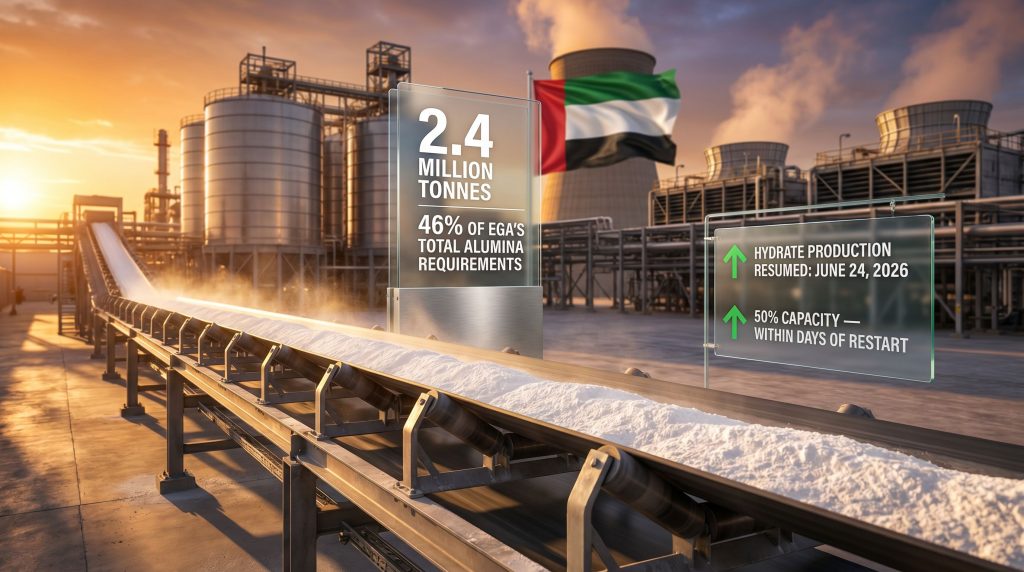
In 2025, the refinery produced 2.4 million tonnes of alumina, covering approximately 46% of EGA's total alumina requirements for smelting operations. The remaining 54% is sourced externally, a deliberate diversification that provides a buffer, though as events in 2026 demonstrated, that buffer has limits.
What the March 2026 Shutdown Actually Revealed
The Attack on Khalifa Economic Zone and Its Industrial Cascade
On 28 March 2026, Iranian missile and drone strikes targeted the Khalifa Economic Zone in Abu Dhabi. The strikes forced an emergency shutdown of EGA's Al Taweelah operations, affecting the smelter, casthouse, and alumina refinery simultaneously. For the aluminium industry, the incident served as a live stress test of how geopolitical force majeure interacts with integrated production models. Furthermore, this event underscored broader industrial commodity market pressures that have been reshaping supply chain thinking globally.
Alumina refineries present unique restart challenges that smelters do not. The refining process involves high-temperature caustic digestion of bauxite, followed by precipitation, calcination, and cooling sequences that cannot simply be paused and resumed at will. The chemistry of Bayer Process refining, the dominant global method, requires carefully managed thermal and chemical equilibria that take weeks to restabilise after an unplanned shutdown.
"Technical Context: The Bayer Process, used at Al Taweelah and virtually every commercial alumina refinery worldwide, dissolves bauxite in hot sodium hydroxide solution under pressure to extract aluminium hydroxide (hydrate), which is then calcined at temperatures exceeding 1,000 degrees Celsius to produce smelter-grade alumina. Restarting this process after an emergency shutdown requires sequential re-establishment of each stage before alumina output can resume."
This explains why hydrate production, the precursor stage, resumed on 24 June 2026, nearly three months after the initial shutdown, and why alumina output followed subsequently in early July rather than immediately. The phasing was not a failure of urgency but a reflection of the technical discipline required to restart Bayer Process operations safely.
How Geopolitical Risk Is Recalibrating Industrial Asset Valuations
The Al Taweelah incident has forced a reconsideration of how geopolitical exposure should factor into industrial asset risk models, particularly for energy-intensive processing facilities in politically complex regions. Gulf-based aluminium assets benefit from proximity to cheap energy and strategic trade routes, but they carry a geographic concentration risk that producers in more politically stable regions do not.
The co-location efficiency model, so prized for its cost advantages, simultaneously concentrates multiple production stages within a single blast radius, so to speak. When the refinery and smelter share a site and a geographic risk profile, a single geopolitical event can take offline both the feedstock producer and the feedstock consumer simultaneously.
The Restart Timeline: A Phased and Technically Disciplined Recovery
Milestone Sequencing From Shutdown to Full Restoration
EGA's recovery approach has followed a sequenced model that reflects both technical necessity and operational pragmatism.
| Milestone | Date / Status |
|---|---|
| Emergency shutdown triggered | 28 March 2026 |
| Hydrate production resumed | 24 June 2026 |
| Alumina production restarted | Early July 2026 (Q3) |
| 50% refinery capacity target | Within days of alumina restart |
| Full technical capacity target | End of 2026 |
| Smelter reduction cells restarted | 89 of 1,262 cells as of early July 2026 |
The decision to decouple smelter ramp-up from refinery output dependency is strategically significant. By explicitly stating that aluminium production at the adjacent smelter does not require the refinery to reach full capacity first, EGA signals that it has built sufficient sourcing flexibility — presumably through external alumina procurement arrangements — to allow both recovery tracks to proceed independently.
Reading the Smelter Cell Restart Numbers
With only 89 of 1,262 reduction cells restarted as of early July 2026, the smelter remains in very early stages of recovery. For industry observers, the ratio of restarted cells to total capacity is one of the most useful leading indicators of when meaningful aluminium output will resume at scale.
Aluminium reduction cells, also known as electrolytic pots, cannot be restarted instantaneously. Each cell must be gradually brought up to operating temperature, its cryolite bath reconstituted, and its alumina feeding systems recommissioned before commercial production can occur. Restarting large numbers of cells simultaneously risks thermal stress and premature failure, so producers sequence restarts in controlled batches.
At 89 cells operational from a total of 1,262, EGA has restarted approximately 7% of the smelter's reduction capacity. This figure, while modest, confirms that the restart process has genuinely commenced rather than remaining at a planning stage.
Supply Chain Dependencies and the Bauxite Variable
Why Bauxite Logistics Will Set the Ceiling on Recovery Speed
EGA has been clear that the pace of ramp-up beyond the initial 50% refinery capacity target will depend on supply chain conditions and the optimisation of its alumina sourcing strategy. The critical upstream variable here is bauxite.
Guinea has emerged as one of the most dominant global bauxite suppliers in recent years, accounting for a substantial and growing share of internationally traded bauxite volumes. For Middle Eastern refineries that rely on seaborne bauxite imports, Guinea's export reliability carries outsized importance. Any disruption to Guinean bauxite logistics — whether from weather, port congestion, or political instability — can constrain a technically ready refinery's ability to ramp up output.
This dependency also highlights a broader structural vulnerability in the global aluminium value chain: the concentration of bauxite supply among a small number of producing nations creates a single-point-of-failure risk that travels upstream through refining and smelting.
The Alumina Market Context During the Outage Period
| Market Factor | Relevance to EGA Restart |
|---|---|
| Global alumina spot price volatility | Elevated spot costs during outage period increase procurement burden |
| Bauxite supply concentration risk | Guinea's dominant market share amplifies logistics exposure |
| Smelter-grade alumina availability | Tight market conditions heighten urgency of internal supply restoration |
| Freight and logistics costs | Conveyor belt model insulates EGA from seaborne alumina cost pressures once operational |
| External contract unwinding | Scaling back spot/term purchases as internal production recovers requires careful timing |
During the outage period, EGA would have needed to source externally the approximately 2.4 million tonnes per annum worth of alumina that the refinery would otherwise have supplied internally. Securing this volume at short notice in global spot markets — particularly during a period of already tightened aluminum and alumina markets — would have carried a significant cost premium compared to internal production economics.
"Industry Note: Alumina typically represents the single largest variable cost in aluminium smelting, accounting for roughly 30 to 40 percent of smelting cash costs depending on prevailing spot prices. A prolonged period of forced external sourcing at elevated spot rates therefore has a material impact on smelting economics, even for a producer of EGA's scale."
Understanding the Aluminium Value Chain: Why Refinery Disruptions Compound
The Bauxite-to-Metal Conversion Ratios That Define Supply Sensitivity
For readers less familiar with the aluminium production chain, the numerical relationships between raw materials and finished metal help explain why a refinery disruption carries magnified downstream consequences.
- Approximately 4 to 5 tonnes of bauxite are required to produce 2 tonnes of alumina
- Those 2 tonnes of alumina are then consumed to produce approximately 1 tonne of aluminium metal
- This means a disruption at the refinery stage removes roughly twice the volume of potential metal output relative to the alumina lost
These ratios make the refinery stage one of the highest-leverage points in the aluminium supply chain. A refinery producing 2.4 million tonnes of alumina annually supports the potential production of approximately 1.2 million tonnes of aluminium metal, a volume significant enough to influence regional supply balances.
What Downstream Buyers Should Monitor During the Ramp-Up
Buyers with exposure to Middle Eastern aluminium supply should track several indicators as the Al Taweelah recovery progresses:
- Reduction cell restart velocity at the smelter, measured as cells restarted per week, provides the clearest signal of when significant metal output will resume
- Refinery capacity utilisation relative to the 50% initial target, with progress toward full capacity indicating improving bauxite supply chain conditions
- EGA's external alumina procurement activity, as a reduction in spot buying would signal increasing confidence in internal production recovery
- Any further geopolitical developments affecting the Khalifa Economic Zone and surrounding industrial infrastructure
The next major ASX story will hit our subscribers first
What the Recovery Signals to the Broader Industry
Operational Resilience as a Competitive Differentiator
EGA's ability to restore hydrate production within approximately three months of a major geopolitical incident — and to follow this with an alumina production restart — reflects meaningful engineering and project management capability. Restarting Bayer Process operations safely after an unplanned emergency shutdown is not a trivial exercise, and the sequenced, safety-first approach taken at Al Taweelah is consistent with best practice in the industry.
EGA's chief executive characterised the alumina production restart as another milestone in the recovery of Al Taweelah's standing as one of the world's major aluminium production complexes, emphasising that the refinery team completed the restart safely and efficiently. In addition, the incident has prompted renewed industry-wide discussions around decarbonisation in mining and resilient industrial planning in high-risk regions.
For the aluminium industry more broadly, the Al Taweelah incident and recovery arc offers several durable lessons:
- Integrated production models offer structural cost advantages but concentrate geopolitical and operational risk within a single geographic footprint
- Modular restart capability — the ability to bring production stages back online independently and in sequence — is a critical but under-discussed dimension of industrial resilience
- Geopolitical risk premiums deserve more explicit incorporation into industrial asset valuations and supply contract structures in politically exposed regions
- Bauxite supply chain diversification is as strategically important as alumina and aluminium market positioning, yet receives comparatively less attention in industry risk frameworks
The Broader Market Signal
The confirmation that EGA restarts alumina production at Al Taweelah refinery, with a credible pathway to full capacity restoration by the end of 2026, removes a degree of uncertainty from global aluminium supply projections. Markets had been pricing in the possibility of a prolonged or partial recovery; a defined timeline with stated milestones allows buyers, traders, and analysts to model supply scenarios with greater precision.
The recovery also reinforces Abu Dhabi's position as a serious industrial jurisdiction capable of maintaining and restoring world-class manufacturing operations even following significant external shocks. That signal, furthermore, carries weight for investors assessing long-term exposure to Gulf-based industrial assets.
"Forward-Looking Disclaimer: Projections regarding production timelines, capacity targets, and market conditions are based on information available as of the date of publication and are subject to change. Actual outcomes may differ materially from stated targets depending on geopolitical, logistical, and market factors. This article does not constitute financial or investment advice."
Want to Stay Ahead of Major Commodity Supply Disruptions Like This One?
Discovery Alert's proprietary Discovery IQ model delivers real-time alerts on significant ASX mineral discoveries, instantly converting complex commodity data into actionable investment insights — ensuring subscribers are positioned ahead of the broader market. Explore historic discoveries and their exceptional returns to understand how major supply chain shifts create transformative opportunities, and begin a 14-day free trial today to gain your market-leading edge.