June 17, 2026
The Hidden Contest Beneath Egypt's $6 Billion Energy Debt Clearance
When sovereign debt accumulates inside an energy sector, it does not simply represent a financing problem. It functions as a signal flare, alerting international capital markets that the underlying fiscal architecture is unstable. Upstream investors respond by throttling back commitments, delaying final investment decisions, and demanding higher risk premiums before re-engaging. The result is a self-reinforcing contraction: less investment produces less output, less output generates less foreign currency, and less foreign currency deepens the arrears cycle. Understanding how a country breaks this pattern is as important as understanding the reserves that make breaking it worthwhile.
Egypt clears $6 billion in energy debt and opens door to a new gas boom — and for analysts watching the Eastern Mediterranean energy landscape, this is not merely a debt settlement. Egypt has now cleared approximately $6.1 billion in outstanding obligations owed to foreign energy companies, according to a statement from Egypt's petroleum and mineral resources minister. It is, furthermore, a carefully orchestrated sovereign repositioning designed to restart a new cycle of upstream capital commitment from Western majors, while simultaneously triggering a geopolitical contest between competing global powers.
When big ASX news breaks, our subscribers know first
Why Egypt's Energy Sector Is at a Strategic Inflection Point
The Weight of $6.1 Billion: How Accumulated Arrears Froze Upstream Potential
The mechanics of how Egypt accumulated such a substantial liability are instructive. When Russia invaded Ukraine on 24 February 2022, the macroeconomic shockwaves hit Egypt with unusual severity. As one of the world's largest wheat importers, Egypt faced a dramatic spike in food import costs at precisely the moment that foreign capital was exiting emerging markets globally. The combination of surging import bills and capital flight placed enormous pressure on Egypt's foreign currency reserves.
The timing was particularly damaging because Egypt's gas sector had been in an active development phase, attracting international oil company (IOC) investment that required regular foreign currency payments. When the Central Bank struggled to source sufficient hard currency to honour those commitments, arrears began accumulating. Foreign firms technically continued operating but with growing reluctance, and new investment decisions were effectively frozen.
From Debt Paralysis to Investment Catalyst: Understanding the Structural Reset
Egypt's resolution of this crisis involved more than simply writing a large cheque. The country constructed what analysts describe as a multi-layered economic defence mechanism, designed to prevent the same dynamics from recurring:
- Measure 1: A significant reduction in state ownership levels in energy projects, capping sovereign liability exposure and shifting more risk onto international partners
- Measure 2: The Central Bank of Egypt abandoned its artificial peg for the Egyptian pound, allowing the currency to find a more realistic market-clearing level and reducing the distortion that had previously accelerated foreign currency depletion
- Measure 3: A commitment to monthly payment discipline on current energy bills, preventing new arrears from accumulating even as historic obligations were being settled
- Measure 4: Oversight frameworks introduced through the IMF, World Bank, and European Union, providing external accountability mechanisms
In March 2024, the IMF approved an expansion of Egypt's financial support package to $8 billion, with complementary assistance from the World Bank and the EU. The package included structural conditions targeting sovereign energy liability reduction and exchange rate liberalisation. While these frameworks represent institutional oversight rather than project-specific support, they provide the broader fiscal guardrails within which Egypt's energy sector can now operate more predictably.
Key Insight: The abandonment of the Egyptian pound peg is arguably the single most important structural change for international oil companies. An artificially maintained exchange rate creates invisible risk that crystallises suddenly. A freely floating currency, however volatile in the short term, removes the binary cliff-edge risk that had previously made long-term capital commitments so difficult to underwrite.
How Large Is Egypt's Gas Opportunity? Mapping the Reserve Potential
Official vs. Estimated Reserves: Why the Numbers Tell Two Very Different Stories
Egypt's officially stated proven natural gas reserves sit at approximately 93 trillion cubic feet (Tcf). However, unofficial industry estimates suggest the true potential could be three to four times larger. The divergence between these figures is not simply a matter of accounting methodology. It reflects the genuinely vast geological potential of Egypt's undeveloped basins, particularly in deepwater Mediterranean acreage that has barely been explored.
| Reserve Category | Volume (Tcf) | Source/Basis |
|---|---|---|
| Officially Stated Proven Reserves | ~93 Tcf | Egyptian Government |
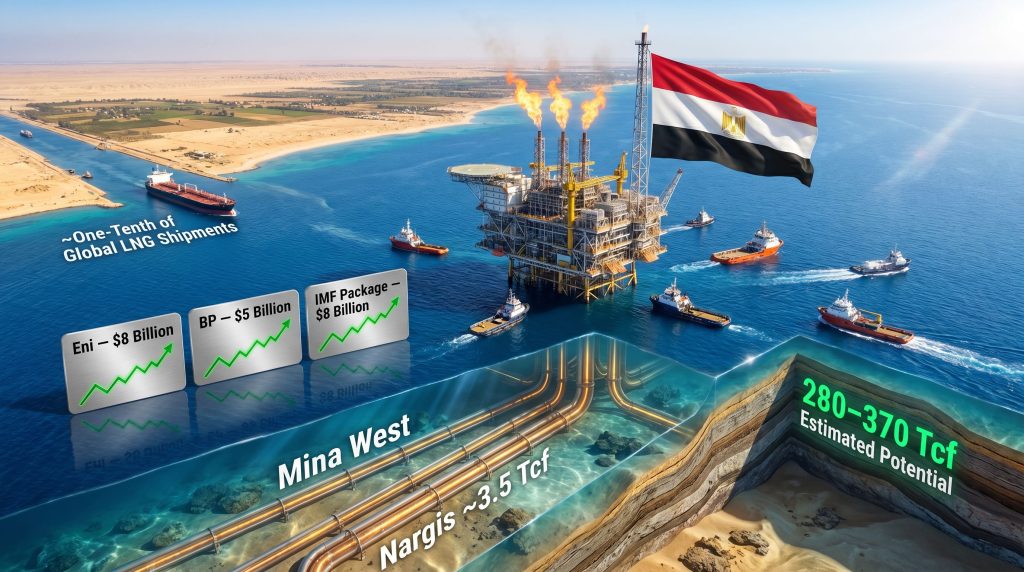
| Unofficial Estimated Potential | 280-370 Tcf | Industry Analyst Estimates |
| Nile Delta Basin Undiscovered Recoverable Gas | Up to 286 Tcf | U.S. Geological Survey |
The U.S. Geological Survey has estimated that the Nile Delta Basin Province alone holds up to 286 Tcf of undiscovered, technically recoverable natural gas. This figure refers specifically to gas that geologists believe exists and could be physically extracted using current technology, but which has not yet been formally confirmed through drilling. The gap between Egypt's stated reserves and this undiscovered potential estimate represents one of the most significant exploration upside cases in the Eastern Mediterranean.
The Nile Delta Basin Province: A Geological Frontier With Supergiant Potential
The Nile Delta Basin Province encompasses both onshore and offshore acreage, with the most prospective deepwater areas extending into the Eastern Mediterranean. The geological characteristics of this province are closely analogous to other prolific gas-bearing basins in the region, including those that host Cyprus's Aphrodite field and Israel's Leviathan and Tamar developments. Thick Miocene and Pliocene sedimentary sequences have created the trap structures and source rock conditions necessary for large-scale gas accumulation.
Critically, Egypt benefits from an infrastructure advantage that its Eastern Mediterranean neighbours currently lack: operational LNG export terminals. The Idku and Damietta liquefaction facilities, though operating below capacity in recent years, give Egypt the ability to convert domestic gas production into internationally tradeable LNG cargoes. No other country in the Eastern Mediterranean gas province currently possesses this capability, making Egypt the natural export hub for the entire region's undeveloped resource base. This dynamic closely mirrors shifts in the global LNG supply landscape that have reshaped energy trade routes across the globe.
Which Western Energy Majors Are Positioned to Move First?
Shell's Deepwater Mediterranean Play: Mina West and the Herodotus Basin
British supermajor Shell is targeting Q4 2026 for first gas at the Mina West field in the deepwater Northeast El Amriya concession in the Mediterranean Sea. Initial flow test results have been commercially significant:
- Flow rate: 45 million standard cubic feet per day (mmcf/d) of gas
- Condensate production: 1,000 barrels per day (bpd) of high-value condensates
- Phase 1 capacity target: 160 mmcf/d gas plus 3,000 bpd condensates into Egypt's domestic grid
- Exploratory upside: The Sirius well and the potentially high-reward Velox well in the North Cleopatra block within the Herodotus Basin
The condensate component of Mina West deserves particular attention. Condensates are ultra-light hydrocarbon liquids that co-produce with natural gas and command premium pricing relative to heavier crude grades. Their presence at Mina West meaningfully improves the project's economics beyond what the gas volumes alone would suggest.
Chevron's Nargis Field Commitment and the North Cleopatra Consortium
U.S. supermajor Chevron has initiated new drilling at the Nargis field, which carries a conservatively estimated 3.5 Tcf of natural gas reserves. Chevron has also secured a 27% participating interest in the ultra-deepwater North Cleopatra offshore block, positioning it alongside:
- Shell (36%, operator)
- QatarEnergy (27%)
- Tharwa Petroleum (10%)
- Chevron (27%)
This consortium structure is significant beyond its drilling commitments. QatarEnergy's involvement brings LNG commercialisation expertise and offtake relationships that could accelerate the pathway from gas discovery to export revenue. The presence of both Shell and Chevron in the same deepwater block creates a mutually reinforcing development incentive.
Eni, BP, and the Broader Western Investment Framework
Italian major Eni has committed to an $8 billion investment plan that includes fast-track development at the newly identified Denise exploration well, which holds an estimated ~2 Tcf of gas in the East Mediterranean. BP, meanwhile, has pledged a $5 billion exploration framework for new wells across the Mediterranean and Nile Delta, building on its historic $12 billion commitment to the West Nile Delta project.
| Company | Country | Committed Capital | Key Asset | Timeline |
|---|---|---|---|---|
| Shell | UK | Undisclosed | Mina West / North Cleopatra | Q4 2026 first gas |
| Chevron | USA | Undisclosed | Nargis field / North Cleopatra | Active drilling |
| Eni | Italy | $8 billion | Denise well, East Mediterranean | Fast-track development |
| BP | UK | $5 billion (new) | Mediterranean / Nile Delta | Exploration framework |
| CNOOC | China | Undisclosed | Mediterranean / Red Sea deepwater | Entry phase |
| Zarubezhneft | Russia | $14 million | North Khatatba, Nile Delta | Drilling agreement |
Western vs. Eastern Powers: Who Is Competing for Egypt's Energy Future?
China's Strategic Pivot From Logistics to Upstream
China's engagement with Egypt has historically centred on infrastructure and manufacturing within the Suez Canal Economic Zone (SCZONE). That posture changed materially in October 2025, when state-owned China National Offshore Oil Corporation (CNOOC) announced its first direct investment in Egypt's upstream oil and gas sector, targeting deepwater blocks in both the Mediterranean and the Red Sea.
Separately, Chinese firm United Energy Group had signed a memorandum of understanding exploring joint investment opportunities across oil and gas production, renewable energy, and regional energy trading. Complementing these upstream moves, Chinese firms also launched a $2.4 billion logistics and container terminal investment at Ain Sokhna Port, designed to integrate commodity flows through the SCZONE. The combination of upstream entry and port infrastructure investment reflects a vertically integrated supply chain strategy rather than a simple resource acquisition play.
Russia's Dual-Track Approach: Drilling Agreements and Long-Term Nuclear Ambitions
Russia's strategic interest in Egypt operates across two distinct timescales. In the near term, state-controlled Zarubezhneft has committed to a $14 million drilling agreement targeting the onshore North Khatatba block in the Nile Delta. Rosneft already maintains a 30% stake in the offshore Zohr gas field, one of the largest gas discoveries in the Eastern Mediterranean in recent decades. This arrangement is broadly consistent with how Russia has pursued its Russia nuclear partnership model in other emerging market energy states.
| Russian Activity | Detail |
|---|---|
| Zarubezhneft drilling agreement | North Khatatba block, Nile Delta (onshore) – $14 million commitment |
| Rosneft existing stake | 30% in the offshore Zohr gas field |
| Al-Dabaa Nuclear Power Plant | $25 billion financing package (2017); construction ~33% complete |
| First reactor grid connection target | 2028 (subject to significant uncertainty) |
| All four units operational target | 2030 (widely regarded as optimistic) |
Over the longer term, Russian President Vladimir Putin has proposed transforming Egypt into a centralised Russian grain and energy hub, blending fuel and agricultural distribution channels in a way designed to sidestep European shipping sanctions. The $25 billion Al-Dabaa nuclear power plant project, financed under a 2017 agreement, underpins this longer-term ambition. Construction has stalled at approximately 33% completion, and given the trajectory of Western pressure on Russian nuclear exports — including the ban on Russian uranium imports in other jurisdictions — the 2028 grid connection target carries considerable execution risk.
Scenario Analysis: Three Possible Outcomes for Egypt's Energy Alignment
Scenario A: Western Consolidation. Western majors accelerate upstream development, Egypt deepens IMF-aligned fiscal reforms, and the country establishes itself as the primary Eastern Mediterranean LNG export hub supplying European markets diversifying away from Russian pipeline gas.
Scenario B: Multipolar Equilibrium. Egypt plays multiple partners simultaneously, accepting Western upstream capital while preserving Chinese logistics partnerships and Russian nuclear financing. This maximises sovereign leverage but introduces coordination complexity for each partner.
Scenario C: Eastern Drift. Delayed Western project timelines, renewed currency instability, or geopolitical realignment push Egypt closer to China-Russia frameworks, replicating dynamics observed in other Belt and Road-adjacent energy states.
The balance of evidence currently favours Scenario B as the near-term outcome, with Scenario A becoming more probable as Western upstream projects begin delivering measurable production volumes. Furthermore, this competitive dynamic closely reflects the broader geopolitical mining landscape that has come to define resource competition in the post-Ukraine era.
Why Egypt's Strategic Geography Amplifies Every Energy Decision
The Suez Canal, SUMED Pipeline, and the Chokepoint Premium
Egypt's value to global energy markets extends well beyond what lies beneath its territorial waters. The Suez Canal has historically carried approximately one-tenth of global oil and LNG shipments, functioning as one of the world's most consequential energy transit corridors. Its strategic importance is further amplified by the Suez-Mediterranean (SUMED) Pipeline, which runs from the Ain Sokhna terminal on the Gulf of Suez to the Sidi Kerir export hub on the Mediterranean coast. This pipeline allows Gulf crude to bypass the canal entirely, providing critical redundancy for global energy flows during periods of canal congestion or closure.
A less widely appreciated dimension of the Suez system's strategic value is its position within the broader chokepoint landscape. Beijing has established significant operational influence over the Strait of Hormuz through the Iran-China 25-Year Comprehensive Cooperation Agreement, a framework that gives China substantial leverage over roughly 20% of global oil flows. The same framework extends China's indirect influence to the Bab al-Mandab Strait via Iranian-aligned Houthi forces in Yemen and through debt-linked infrastructure control in Djibouti. Against this backdrop, the Suez Canal represents one of the few remaining major energy transit points that sits outside China's direct operational sphere, elevating Egypt's strategic value to Western powers considerably beyond its hydrocarbon reserves alone.
The next major ASX story will hit our subscribers first
Egypt's Political Capital in the Arab World: An Undervalued Strategic Asset
Cairo's Historical Role and Its Continued Relevance
Egypt's geopolitical weight cannot be reduced to barrels and cubic feet. Cairo was the intellectual and political centre of the Pan-Arabism movement that reshaped the Middle East after the Second World War, with President Gamal Abdel Nasser serving as its most prominent architect during his leadership from 1954 to 1970. The movement produced structurally significant events: the short-lived Egypt-Syria union as the United Arab Republic from 1958 to 1961, the formation of OPEC in 1960, and the 1973-74 oil embargo that fundamentally altered the relationship between producing nations and Western consumers.
This historical legacy continues to confer diplomatic leverage that purely hydrocarbon-focused analysis tends to undervalue. For both Western and Eastern powers, Egypt represents the intersection of three distinct sources of strategic influence: major gas reserves, control of critical maritime chokepoints, and a legacy of Arab world political leadership that no other state in the region can fully replicate. In addition, these dynamics bear a striking resemblance to the resource diplomacy observed in the Ukrainian-US minerals deal, where strategic resource access has become inseparable from broader geopolitical alignment.
Frequently Asked Questions: Egypt's Gas Boom and the $6 Billion Debt Clearance
How Much Did Egypt Owe Foreign Energy Companies?
Egypt cleared approximately $6.1 billion in accumulated arrears owed to international oil companies, as confirmed by Egypt's petroleum and mineral resources minister. Reuters reported that the clearance marked a significant turning point for Egypt's energy investment climate.
Why Did Egypt Accumulate Such Large Energy Arrears?
The debt crisis was triggered primarily by the economic shockwaves that followed Russia's 2022 invasion of Ukraine, which simultaneously drove up Egypt's wheat import costs and triggered capital flight from emerging markets, depleting the foreign currency reserves needed to pay IOCs.
Which International Companies Are Investing in Egypt's Gas Sector?
Shell, Chevron, Eni, and BP represent the primary Western majors with active or recently committed upstream positions. CNOOC entered the upstream sector in October 2025, while Russia's Zarubezhneft and Rosneft maintain separate positions in the Nile Delta and Zohr field respectively.
Is Egypt Becoming an Eastern Mediterranean LNG Export Hub?
Egypt is currently the only country in the Eastern Mediterranean gas province with operational LNG export capacity. Its Idku and Damietta terminals position it as the natural aggregator and exporter for regional gas discoveries made in Egyptian, Cypriot, and potentially Lebanese and Israeli waters.
What Is the Risk That a New Debt Cycle Could Re-Emerge?
The structural reforms embedded in Egypt's IMF framework — including pound liberalisation, reduced state ownership in energy projects, and monthly payment discipline — are specifically designed to prevent a recurrence. However, commodity price volatility, political instability, or a renewed emerging market capital flight episode could test these mechanisms.
What Investors and Analysts Should Watch Over the Next 12-24 Months
Three Structural Reasons Why This Moment Differs From Previous Recovery Cycles
-
The reform architecture is deeper. Previous recovery cycles in Egypt's energy sector involved isolated financial measures. The current framework combines currency reform, ownership restructuring, and multilateral oversight simultaneously.
-
The geopolitical urgency is higher. Europe's structural need to replace Russian pipeline gas creates persistent demand-pull for Eastern Mediterranean LNG that was absent in earlier cycles, raising the cost of Western disengagement from Egypt.
-
The competitive pressure from China and Russia is more direct. CNOOC's upstream entry and Russia's integrated grain-and-energy hub proposal represent more sophisticated strategies than previous Eastern power engagements with Egypt, creating a genuine competitive dynamic that incentivises Western majors to accelerate rather than defer.
The key milestones to track include Shell's Mina West first gas delivery targeted for Q4 2026, Chevron's drilling results at the Nargis field, and whether Egypt's monthly payment discipline on current IOC bills holds through the next global commodity cycle. Each data point will either reinforce or undermine the thesis that Egypt clears $6 billion in energy debt as part of a genuine structural reset rather than simply a deferred reckoning.
This article is intended for informational and educational purposes only. It does not constitute financial, investment, or legal advice. All forecasts, timelines, and investment figures referenced herein are subject to change and carry inherent uncertainty. Readers should conduct independent research and consult qualified advisers before making any investment decisions.
Want to Track the Next Major Energy or Mineral Discovery Before the Market Moves?
Discovery Alert's proprietary Discovery IQ model delivers real-time alerts on significant ASX mineral discoveries — instantly translating complex geological and commodity data into actionable insights for investors at every experience level. Explore how historic discoveries have generated extraordinary returns on Discovery Alert's dedicated discoveries page, and begin your 14-day free trial today to position yourself ahead of the broader market.