June 17, 2026
The Geography of Risk: Why Chokepoints Define Energy Vulnerability
Every major energy crisis in modern history has ultimately been a story about geography. The physical pathways through which fossil fuels travel from extraction to consumption are not evenly distributed across the globe, and the narrower those pathways, the greater the systemic fragility they introduce. The Strait of Hormuz, a waterway stretching no more than 33 kilometres at its narrowest point between Iran and Oman, has long been understood as the single most consequential pressure point in global energy supply. What the conflict that began in February 2026 has done is transform that theoretical vulnerability into a lived economic reality for billions of people.
Understanding whether the Iran war energy shock represents a temporary market disruption or a structural turning point requires examining not just the volumes of oil and gas involved, but the behavioural, political, and technological responses that are already taking shape in markets from Sydney to Shanghai.
When big ASX news breaks, our subscribers know first
Why the Strait of Hormuz Has No Viable Alternative
The Architecture of an Irreplaceable Passage
The Hormuz strait is not simply a convenient shipping lane. It is the only maritime exit for landlocked crude production from Iraq, Kuwait, and the UAE, and the primary outlet for Iranian exports. Alternative pipeline routes exist but carry nowhere near sufficient capacity to compensate for a full closure. The East-West Pipeline across Saudi Arabia, for instance, can handle approximately 5 million barrels per day, well short of the volumes that normally transit Hormuz.
What makes the current Iran war energy shock categorically different from previous Middle East conflicts is the simultaneous disruption of two distinct fossil fuel markets through a single geographic bottleneck. Furthermore, the scale of disruption to global LNG supply has added a dimension that prior crises simply did not feature:
- Approximately 1 billion barrels of crude oil and refined products have been removed from Middle East supply chains since hostilities escalated on February 28, 2026
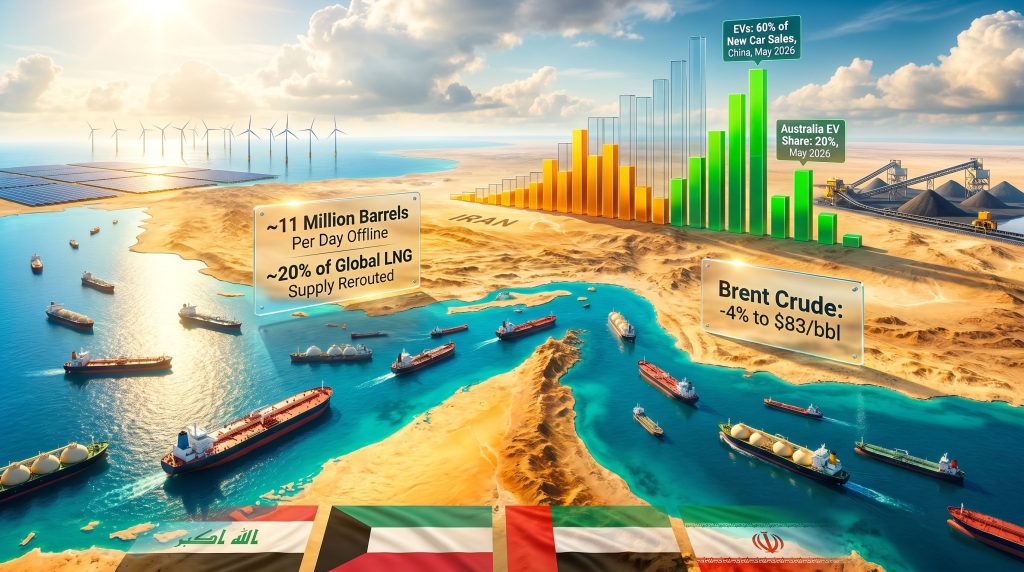
- Roughly 11 million barrels per day of crude production has been effectively offline during peak disruption periods
- Close to 20% of global LNG supply has been trapped or forced onto significantly longer alternative routes
- Key producers affected include Iraq, Kuwait, the UAE, and Iran itself
Prior Middle East crises typically disrupted crude oil markets in isolation. The Hormuz closure in 2026 has simultaneously locked up a substantial share of global LNG trade, creating a compound supply shock with no direct historical precedent for scale or complexity.
The LNG dimension is particularly significant. Unlike crude oil, which can be rerouted via tanker with relatively modest logistical adjustments, LNG supply chains are far more rigid. Liquefaction terminals, regasification infrastructure, and specialised tanker fleets cannot simply be redeployed overnight. The disruption to LNG flows carries implications for power generation and industrial gas supply across Asia that extend well beyond what crude oil price charts alone can capture. The Atlantic Council has noted that this dual-market disruption marks a qualitative departure from all prior Hormuz-related risk scenarios.
Classifying the Iran War Energy Shock: Temporary Blip or Structural Break?
A Historical Framework for Energy Crises
Not all energy shocks are equal. Some are absorbed rapidly by markets and forgotten within a price cycle. Others quietly rewrite the structural rules of energy consumption for decades. Placing the current Iran war energy shock within a historical classification framework is essential for any investor or policymaker attempting to assess long-term risk.
| Crisis | Trigger | Price Impact Duration | Structural Market Change? |
|---|---|---|---|
| 1973 Arab Oil Embargo | Geopolitical | Multi-year | Yes — strategic reserves mandated |
| 1979 Iranian Revolution | Political | 2 to 3 years | Partial — efficiency standards adopted |
| Russia-Ukraine War (2022) | Military | 12 to 18 months | Partial — European LNG diversification |
| Dieselgate Scandal (2015) | Regulatory | Gradual, decade-long | Yes — diesel passenger car collapse |
| Iran War (2026) | Military/Geopolitical | Ongoing | Under evaluation |
The Forgive and Forget Scenario
Russia's 2022 invasion of Ukraine provides the most recent comparable template. Energy prices surged dramatically, European nations scrambled for alternative LNG sources, and political rhetoric about accelerating the energy transition reached a fever pitch. Yet within 18 months, supply rerouting, inventory management, and demand adjustments had largely contained the structural damage. Brent crude's sharp decline of approximately 4% to around $83 per barrel on the announcement of a US-Iran peace framework suggests traders may already be positioning for a similar normalisation this time around.
The Dieselgate Parallel: Slow Catalyst, Lasting Consequence
The more instructive comparison may be less obvious. The 2015 Volkswagen emissions scandal appeared, at first glance, to be a corporate governance failure of limited systemic consequence. What it actually triggered was a decade-long structural collapse in diesel's dominance of European passenger vehicle markets. Diesel's share of new car sales in Europe fell from approximately 52% in 2015 to below 10% by 2025, a decline driven not by a single dramatic event but by the gradual accumulation of policy responses, consumer sentiment shifts, and manufacturer investment reallocation.
The Iran war energy shock may function analogously. The mechanism is not immediate collapse of fossil fuel demand, but a catalytic acceleration of pre-existing trends that, once embedded in policy frameworks and consumer behaviour, becomes self-reinforcing. In addition, current commodities investment trends suggest capital is already beginning to flow accordingly, with energy security considerations reshaping portfolio allocations across institutional investors globally.
What Happens to Oil and LNG Markets After Hormuz Reopens?
Three Phases of Market Recovery
The reopening of the Strait of Hormuz does not simply restore the pre-war status quo. Market recovery will unfold across distinct phases, each with its own price implications.
Phase 1: The Relief Rally
The immediate market response to peace deal news has already been visible. Brent crude fell approximately 4% to $83 per barrel on deal announcement. Traders began positioning for the exit of tankers trapped in the Persian Gulf and the eventual delivery of backlogged cargoes. This relief-driven price correction is mechanical and expected.
Phase 2: Supply Chain Restoration
Restoring flows to pre-war levels is not a switch that can simply be flipped. Middle East producers must physically ramp output, export infrastructure must be recommissioned, and depleted strategic and commercial inventories must be rebuilt. OPEC+ has agreed to higher production volumes, but the group's execution track record introduces meaningful uncertainty about the pace of recovery.
Phase 3: The Sticky Price Risk
Lost barrels cannot be instantly replaced. Refinery disruptions, tanker scheduling backlogs, and LNG liquefaction facility complications compound the lag between political resolution and physical market normalisation. If Asian demand, particularly from China, rebounds sharply while supply restoration lags, Brent could revisit territory well above $90 per barrel even after the strait formally reopens.
Investors should not conflate a peace deal announcement with a return to pre-war energy market conditions. The gap between political resolution and physical supply normalisation is the key risk variable in energy markets through the remainder of 2026.
Asia as the Decisive Battleground for Energy Transition
China's Dual Role in the Crisis
China has played a paradoxical role throughout the Iran war energy shock. As the world's largest crude importer, its deliberate reduction in import volumes during the crisis period helped prevent Brent from breaching the psychologically significant $100 per barrel level. At the same time, China's domestic energy transition has continued at a pace that is reshaping global demand projections.
Electric vehicles and hybrid models exceeded 50% of new car sales in China in 2025, and that figure climbed to 60% in May 2026. China's manufacturing dominance across solar panels, wind turbines, and battery storage systems gives regional trading partners a cost-competitive pathway to the energy security transition that simply did not exist during prior oil price crises.
Australia as an Early Behavioural Indicator
Perhaps the most striking data point to emerge from this crisis period comes from Australia, a market not typically associated with rapid energy transition. Australia is the world's largest diesel importer, sourcing more than 80% of its fuel requirements from overseas refineries, making it uniquely exposed to the kind of supply shock the Hormuz closure has delivered.
The market response has been significant. Australian EV sales reached a record high in May 2026, capturing 20% market share. When hybrid vehicles are included, combined electrified vehicle sales reached 46% of all new vehicles sold in that month. For a market historically resistant to electrification, this represents a meaningful behavioural shift driven directly by fuel price anxiety.
Southeast Asia's Accelerating Policy Pivot
Vietnam has introduced frameworks to accelerate EV and electric scooter adoption, and comparable policy momentum is building across the broader Southeast Asian region. Crucially, the motivation in many cases is energy security rather than environmental conviction. Governments that have just witnessed what a single geographic chokepoint can do to their fuel supply chains are making rational sovereign risk calculations when they invest in domestically deployable clean energy transition infrastructure backed by Chinese manufacturing supply chains.
Winners and Losers From the Iran War's Energy Legacy
The Structural Losers: Crude Oil and LNG
Both crude oil and LNG face long-term structural headwinds if the behavioural and policy responses triggered by the Iran war energy shock prove durable:
- Crude oil demand faces sustained pressure if EV adoption locks in at elevated post-crisis levels across Asia-Pacific markets
- LNG now carries a documented geopolitical risk premium that makes it less attractive as a foundation for long-term energy security planning in import-dependent nations
- The chokepoint vulnerability of LNG shipping routes is no longer a theoretical concern but a demonstrated strategic liability, as disruptions to global LNG supply have made abundantly clear throughout this conflict period
Coal's Unexpected Competitive Advantage
One of the less comfortable conclusions emerging from this crisis is that coal may be among the most durable near-term beneficiaries. Furthermore, the logic underpinning this advantage is rooted in geography as much as economics:
- Nations with large domestic reserves, including China, India, and Indonesia, face compelling economic and security arguments for maintaining or expanding coal consumption
- Major coal export routes through Indonesia, Australia, and South Africa carry no meaningful chokepoint exposure equivalent to Hormuz
- Even energy-importing nations may rationally view reliable coal supply chains as lower geopolitical risk than LNG in the post-crisis environment
The coal advantage creates a direct and unresolved tension with global decarbonisation commitments. Energy security logic and climate policy are pulling in opposite directions in ways that carbon pricing frameworks have not yet fully priced in.
Conditional Winners: Renewables, Nuclear, and Storage
Renewables, battery storage, and potentially nuclear power benefit from energy security logic now reinforcing the pre-existing economic case for clean energy investment. Battery metals investment is consequently attracting renewed institutional interest as governments and corporates alike seek to reduce dependence on geopolitically exposed fossil fuel supply chains. The critical caveat, however, is speed. If fossil fuel prices fall quickly and remain low, the political urgency that currently drives accelerated clean energy policy may dissipate, as has occurred repeatedly after prior oil price spikes.
The next major ASX story will hit our subscribers first
Strategic Scenarios for Investors and Policymakers
A Three-Scenario Framework
Scenario A: Shock Absorbed, Status Quo Restored
Peace holds, Hormuz reopens fully, prices normalise below $85 per barrel within six months, and EV adoption spike proves temporary as cheap fuel returns. Probability driver: rapid OPEC+ production ramp-up combined with sustained low retail fuel prices.
Scenario B: Catalytic Disruption, the Dieselgate Parallel
Peace holds but structural behaviour changes persist. EV adoption locks in at elevated levels, Asian governments convert energy security rhetoric into durable infrastructure investment. Probability driver: sustained policy commitment combined with continued cost competitiveness of Chinese-manufactured clean energy systems.
Scenario C: Prolonged Tightness, the Sticky Price Scenario
Strait reopens but supply restoration lags significantly. Prices remain elevated at $90 to $100 per barrel for 12 or more months. Coal consumption expands across Asia while LNG investment contracts face delays. Probability driver: OPEC+ execution failure combined with faster-than-expected Asian demand recovery.
Key Metrics to Monitor
| Indicator | What It Signals |
|---|---|
| Brent crude price trajectory post-reopening | Speed of physical supply normalisation |
| OPEC+ production compliance rates | Execution capacity of key producers |
| Asian EV sales data across China, Australia, Vietnam | Durability of consumer behaviour change |
| LNG versus coal spot price spread in Asia | Relative competitiveness of transition fuels |
| Strategic petroleum reserve replenishment rates | Government confidence in long-term supply security |
| Renewable energy investment commitment announcements | Policy response durability |
The Verdict: Shock, Catalyst, or Both?
The binary framing of the Iran war energy shock as either a temporary disruption or a permanent turning point is itself a misleading analytical construct. Energy transitions do not move in binary steps, and neither do market shocks.
The more accurate assessment is that the current crisis is both simultaneously, with the depth and durability of structural change varying dramatically by region, fuel type, and policy environment. Reuters commentary examining precisely this question suggests the answer will ultimately be determined by three conditions:
- Whether fossil fuel prices remain elevated long enough to sustain the political and consumer urgency currently visible in markets like Australia and Vietnam
- Whether Asian governments convert energy security rhetoric into durable, bankable infrastructure investment in renewables and storage
- Whether OPEC+ and major producers successfully defend fossil fuel competitiveness through rapid, sustained price normalisation that removes the economic incentive for structural change
Markets that absorb the shock cheaply and quickly will likely revert toward prior consumption patterns. Markets that have experienced sustained price pain and have viable, cost-competitive clean energy alternatives within reach may lock in a new trajectory that outlasts the memory of the crisis itself. However, the structural legacy of this episode will ultimately be written not in the headlines of 2026 but in the investment decisions, policy frameworks, and consumer habits that solidify over the years that follow.
This article is intended for informational purposes only and does not constitute financial or investment advice. Forecasts, price projections, and scenario analyses represent analytical perspectives and involve inherent uncertainty. Readers should conduct independent research before making investment or policy decisions.
Want to Stay Ahead of the Resource Opportunities Reshaping Energy Markets?
As the Iran war energy shock accelerates the structural shift toward critical minerals, battery metals, and clean energy infrastructure, Discovery Alert's proprietary Discovery IQ model instantly identifies significant ASX mineral discoveries — transforming complex market signals into clear, actionable investment opportunities. Explore historic examples of major discovery returns that have delivered exceptional outcomes, and begin your 14-day free trial at Discovery Alert to position yourself ahead of the next transformative market move.