August 7, 2026
Egypt Fuel Prices Unchanged in 2026: The Policy Logic Behind the Freeze
Energy pricing policy in import-dependent economies is rarely a simple calculation. For governments caught between volatile global commodity markets, domestic inflation pressures, and long-term structural energy deficits, the temptation to react to short-term price movements can produce outcomes far costlier than staying the course. Egypt's decision to keep Egypt fuel prices unchanged through 2026 is a case study in exactly this kind of disciplined policy restraint, and understanding why it was made reveals far more than a headline price freeze.
When big ASX news breaks, our subscribers know first
Why Egypt Fuel Prices Unchanged Is More Than a Headline
The phrase Egypt fuel prices unchanged might initially suggest policy paralysis or a government slow to respond to market signals. The reality is the opposite. The decision to hold prices steady emerged from a formal institutional process, not inaction.
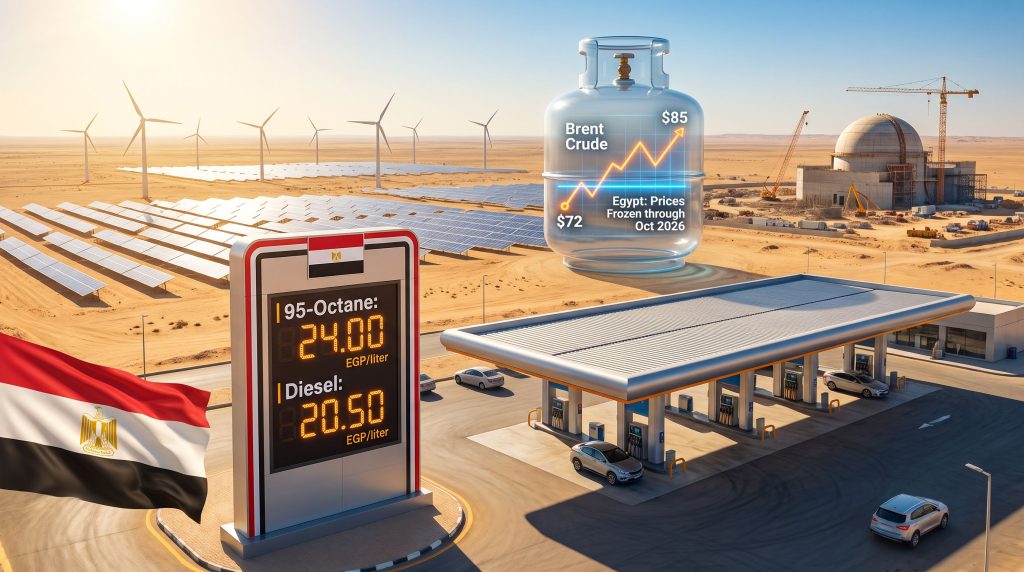
Egypt's Automatic Pricing Committee formalised a one-year price stabilisation window in October 2025, with the mandate running through to October 2026. The committee's reasoning was structural: allowing petroleum refineries to plan and operate at full throughput without the disruption of frequent recalibrations. A subsequent government declaration reinforced this framework, confirming that no further adjustments would be introduced in 2026.
The last price movement before the freeze took effect occurred on March 10, 2026, when diesel was set at 20.50 EGP per liter and 95-octane petrol reached 24.00 EGP per liter, representing approximately a 17% increase on some grades. Since that date, the government has held all domestic prices without modification.
Current Domestic Fuel Price Schedule (Fixed as of March 2026)
| Fuel Grade | Price (EGP/liter) |
|---|---|
| 80-Octane Petrol | 20.75 |
| 92-Octane Petrol | 22.25 |
| 95-Octane Petrol | 24.00 |
| Diesel | 20.50 |
The Brent Crude Swing That Validated the Freeze
In the weeks preceding Prime Minister Mostafa Madbouly's July 2026 press conference, Brent crude experienced a sharp decline toward $72 per barrel, prompting public calls within Egypt for a corresponding reduction in domestic fuel prices. The government declined to act, and within a short window, Brent rebounded to approximately $85 per barrel, according to Trading Economics.
That $13 per barrel swing in a compressed timeframe was precisely the scenario Egyptian policymakers had anticipated. Madbouly acknowledged the public pressure but argued that pricing decisions must be grounded in thorough forward-looking assessments rather than transient market conditions. His position was that policymakers should avoid frequent adjustments in highly volatile environments, a stance that the subsequent Brent rebound appeared to vindicate.
Key Insight: A fuel price reduction triggered by Brent's dip to $72 would have required a costly and politically awkward reversal within weeks, as the benchmark climbed back to $85. The freeze avoided exactly this trap.
The oil price volatility driving that instability centred on renewed hostilities between the United States and Iran, which introduced significant supply-side uncertainty across global energy markets. For a country like Egypt, whose geographic position and growing import dependency amplify exposure to Middle East energy disruptions, the prudence of avoiding reactive pricing is amplified further.
To manage summer-season supply continuity during peak demand, the government also strengthened inter-ministerial coordination, directly linking the Central Bank of Egypt, the Ministry of Finance, and the Ministry of Petroleum in a unified supply management framework.
Egypt's Structural Energy Problem: From Zohr's Peak to Net Importer Status
Beyond the short-term debate about crude oil price trends, Egypt faces a structural energy challenge that makes the current pricing freeze only one dimension of a much larger policy response.
For several years following the discovery of the Zohr offshore gas field, Egypt achieved a rare milestone for an African energy economy: natural gas self-sufficiency. Zohr, located in the Eastern Mediterranean and discovered in 2015, was one of the largest gas finds in the region's history. At its peak in 2021, the field underpinned Egypt's ability to export LNG and position itself as a regional energy hub.
That era has ended. Zohr's output has declined significantly since its 2021 peak, according to Enerdata, and the country has transitioned from a net gas exporter to a net natural gas importer. This reversal carries consequences far beyond energy trade statistics. It directly inflates the government's import bill, pressures foreign currency reserves, and amplifies Egypt's sensitivity to global LNG price fluctuations.
The scale of the shift is striking. Furthermore, Egypt's LNG imports surged by 188% during the first eleven months of 2025, according to Egypt Oil & Gas data. This is not a marginal adjustment. It represents a fundamental reorientation of the country's energy supply architecture.
Egypt's Structural Energy Position at a Glance
| Factor | Detail |
|---|---|
| Zohr Peak Production Year | 2021 |
| LNG Import Growth (Jan-Nov 2025) | +188% year-on-year |
| Current Trade Status | Net natural gas importer |
| Primary Fiscal Pressure | Rising fuel import expenditure |
What the Zohr Decline Means Beyond the Numbers
The Zohr field's production trajectory illustrates a broader pattern in large offshore gas developments: early plateau production often gives way to faster-than-anticipated decline rates as reservoir pressure drops and water breakthrough accelerates. In Egypt's case, the field came online rapidly and production was maximised aggressively, which may have contributed to steeper decline curves than initial projections anticipated.
This dynamic is not unique to Egypt. Several large gas fields across the Mediterranean and North Africa have exhibited similar production profiles, yet governments and markets routinely underestimate how quickly the shift from net exporter to net importer can occur. The lesson for energy policymakers across the region is that energy self-sufficiency built on a single large-field production base is inherently fragile. Consequently, natural gas price trends remain a critical variable for import-dependent economies navigating this transition.
Egypt's Long-Term Energy Independence Strategy
Understanding why Egypt fuel prices unchanged represents a calculated position rather than a stopgap requires examining what the government is doing in parallel to address its structural energy vulnerability.
Renewable Energy Acceleration
Madbouly confirmed that he chairs weekly meetings with the electricity minister specifically focused on accelerating the deployment of solar and wind capacity within Egypt's national grid. These sessions are designed to resolve logistical and procedural bottlenecks that slow project timelines, with solar energy prioritised given Egypt's exceptional solar irradiance across its desert regions.
The strategic logic is clear: every additional gigawatt of renewable electricity generation capacity reduces the volume of gas or LNG required to meet domestic power demand, directly cutting the import bill.
El Dabaa Nuclear Power Plant: A Baseload Game-Changer
The most strategically significant long-term investment in Egypt's energy independence is the El Dabaa nuclear power plant on the Mediterranean coast. Engineers recently completed installation of the pressure vessel for the second reactor, marking a meaningful construction milestone. In addition, nuclear fuel supply investment at the European level signals a broader global commitment to expanding nuclear baseload capacity.
The first reactor is projected to begin commercial electricity generation by the end of 2028, with the remaining units following in phased commissioning stages thereafter.
El Dabaa Nuclear Plant: Development Milestones
| Milestone | Status / Timeline |
|---|---|
| Reactor 2 Pressure Vessel Installation | Completed |
| Reactor 1 Commercial Generation | End of 2028 (projected) |
| Remaining Reactors | Phased commissioning post-2028 |
| Strategic Goal | Reduce gas-fired generation and LNG import dependency |
Nuclear baseload capacity has a uniquely powerful role in Egypt's energy equation. Unlike solar or wind, nuclear generates continuous power regardless of weather conditions, making it the most effective technology for displacing gas-fired generation at scale. If El Dabaa reaches full operational capacity across all planned reactors, the reduction in Egypt's gas consumption for power generation could materially shrink the LNG import bill that currently strains the country's fiscal position.
Egypt's IMF Reform Trajectory and the Freeze as Strategic Pause
Egypt's engagement with the International Monetary Fund has involved multi-year commitments to progressively reduce fuel subsidies. Multiple rounds of domestic price increases over recent years have been consistent with this structural adjustment agenda. The March 2026 revision, which raised select fuel grades by up to 17%, sat squarely within that framework.
The current freeze should not be interpreted as a retreat from subsidy reform. Rather, it reflects a calibrated pause in an economy where pass-through inflation risks are significant. In import-dependent economies with large informal sectors, fuel price increases can rapidly translate into food price rises and broader cost-of-living pressures that erode real household incomes and threaten social stability.
By anchoring prices for a defined period rather than adjusting them reactively, the government is managing inflation expectations while retaining the structural direction of reform. However, analysts monitoring Egypt's fiscal position will note that this approach limits the government's ability to pass elevated global LNG costs onto domestic consumers in the short term, potentially widening the petroleum subsidy gap if import prices remain elevated.
The next major ASX story will hit our subscribers first
A Policy Model for Commodity-Exposed Emerging Economies
Egypt's multi-layered approach to energy pricing and transition offers a framework that other commodity-exposed economies may find instructive. The architecture combines several distinct elements:
- A formal pricing stabilisation mandate with a defined time horizon, reducing ad hoc political interference
- Inter-ministerial coordination to manage supply continuity during demand peaks
- Parallel investment in structural supply diversification through renewables and nuclear
- Explicit geopolitical risk integration into long-term energy planning
Countries across North Africa and Sub-Saharan Africa that are navigating the transition from fossil fuel dependency to more diversified energy systems face structurally similar challenges to Egypt's. The combination of reactive short-term pricing frameworks and inadequate long-term supply investment has historically produced both fiscal instability and energy insecurity simultaneously. The broader geopolitical risk landscape further complicates planning for resource-dependent economies across the continent.
The Egyptian case illustrates how geopolitical events, particularly tensions across the broader Middle East, have evolved from episodic shocks into persistent structural variables in domestic energy pricing models. Governments that fail to incorporate this reality into long-term planning are systematically exposed to avoidable policy errors.
The acknowledgment from Egypt's Prime Minister that the entire global economy absorbs the cost of geopolitical conflicts reflects a level of policy candour that positions Egypt's energy management within a broader macroeconomic and geopolitical reality, rather than treating fuel prices as a purely domestic variable.
Frequently Asked Questions: Egypt Fuel Prices 2026
Are Egypt's fuel prices going up in 2026?
No. The Egyptian government confirmed that Egypt fuel prices unchanged will remain the policy through at least October 2026, following the Automatic Pricing Committee's one-year stabilisation decision made in October 2025. The last price change occurred on March 10, 2026.
What is the current petrol price in Egypt?
As of March 2026, 92-octane petrol is priced at 22.25 EGP per liter, 95-octane at 24.00 EGP per liter, and 80-octane at 20.75 EGP per liter. Diesel is set at 20.50 EGP per liter.
Why did Egypt not reduce fuel prices when global oil prices fell?
The government cited the need to avoid reactive policy changes in volatile markets. Brent crude fell to approximately $72 per barrel before rebounding to around $85, demonstrating that a price reduction based on the temporary decline would have required a rapid and disruptive policy reversal.
Is Egypt still self-sufficient in natural gas?
No. Egypt's domestic gas output has declined significantly since the Zohr field peaked in 2021, according to Enerdata. The country has transitioned from a net gas exporter to a net importer, with LNG imports rising 188% in the first eleven months of 2025, according to Egypt Oil & Gas.
When will Egypt's El Dabaa nuclear plant generate electricity?
The first reactor at El Dabaa is projected to begin generating electricity by the end of 2028, with subsequent reactors coming online in phased stages thereafter.
Readers seeking ongoing coverage of Egypt's energy sector and African economic policy can explore reporting from Ecofin Agency at ecofinagency.com, which provides detailed coverage of energy, finance, and public policy across the African continent.
This article contains forward-looking projections, including timelines for nuclear plant commissioning and references to energy import trends. These are based on available data at the time of publication and are subject to change. Nothing in this article constitutes financial or investment advice.
Want to Stay Ahead of the Next Major Commodity Discovery?
While Egypt's energy policy illustrates how volatile global commodity markets can reshape entire economies overnight, Discovery Alert's proprietary Discovery IQ model cuts through that complexity by delivering real-time ASX mineral discovery alerts the moment they hit the market — explore historic discovery returns to see what's possible, or begin your 14-day free trial today to position yourself ahead of the broader market.