June 8, 2026
The Global Race for Green Ammonia Export Dominance Is Already Underway
Somewhere between the ambition of climate summits and the hard arithmetic of project finance, a genuinely transformative industrial shift is taking shape across North Africa. Green ammonia, once a theoretical concept confined to academic energy modelling, is rapidly becoming a practical commercial asset class, with nations positioned along key shipping corridors racing to secure first-mover advantages in what could become one of the most consequential commodity markets of the 2030s.
Egypt finds itself at a particularly compelling intersection of geography, natural resources, and industrial policy. Its southeastern coastline along the Red Sea sits within striking distance of European import terminals, its desert interior offers some of the highest solar irradiance measurements in the world, and its government has articulated an unusually specific long-term ambition: producing 10 million tonnes of green hydrogen and capturing 8% of the global green hydrogen market. Against this backdrop, the Egypt green ammonia project landscape is accelerating quickly, with multiple proposals now competing for capital, political support, and export contracts simultaneously.
When big ASX news breaks, our subscribers know first
Understanding What Green Ammonia Actually Is and Why It Matters
The Chemistry Behind the Commodity
Green ammonia is not a fundamentally new molecule. Ammonia has been industrially synthesized since the early twentieth century using the Haber-Bosch process, which combines hydrogen and nitrogen under high pressure and temperature. The distinction between conventional and green ammonia lies entirely in how that hydrogen is produced.
In conventional ammonia production, hydrogen is derived from natural gas via steam methane reforming, a process that generates substantial carbon dioxide emissions as a byproduct. Green ammonia replaces this with hydrogen produced through electrolysis, splitting water molecules using electricity generated entirely from renewable sources, most commonly solar photovoltaic or wind turbines.
The result is a product with the same chemical structure and physical properties as conventional ammonia, but with near-zero carbon emissions across its production chain. Furthermore, this distinction has significant commercial consequences:
-
Fertilizer applications: Ammonia is the foundational feedstock for nitrogen-based fertilizers, which underpin global food production. Green ammonia can replace its carbon-intensive equivalent in this role without requiring changes to existing agricultural chemistry.
-
Hydrogen carrier: Hydrogen itself is extremely difficult and expensive to transport and store in gaseous form. Ammonia has a much higher volumetric hydrogen density and can be liquefied at relatively modest temperatures (-33°C at atmospheric pressure), making it a practical medium for shipping hydrogen across oceanic distances.
-
Direct fuel potential: Research into ammonia as a direct combustion fuel, particularly for marine shipping, is advancing, with several major shipping companies actively trialling ammonia-capable vessel designs.
Why European Demand Is the Defining Commercial Driver
The European Union's Carbon Border Adjustment Mechanism (CBAM) creates a direct financial incentive for European buyers to prioritise low-carbon ammonia imports. Under CBAM, carbon-intensive imports face levies calibrated to the EU carbon price, which effectively makes green ammonia more price-competitive relative to grey ammonia in European markets even before direct carbon pricing reaches parity.
Simultaneously, the REPowerEU plan targets the import of 10 million tonnes of green hydrogen equivalent annually by 2030, with ammonia identified as one of the primary carrier molecules for long-distance supply chains. European supply chains are increasingly shaped by these regulatory pressures, and Egypt's geographic position — offering access to both Mediterranean and Red Sea shipping routes — makes it a natural candidate for servicing this demand.
The commercial logic for Egypt's green ammonia ambitions is not primarily environmental. It is an industrial export strategy designed to monetise renewable resource endowments by supplying a premium-priced commodity to energy-importing economies facing increasing regulatory pressure to decarbonise their supply chains.
The Egypt Amun Project: What the $10 Billion Ras Banas Proposal Actually Involves
Core Project Specifications
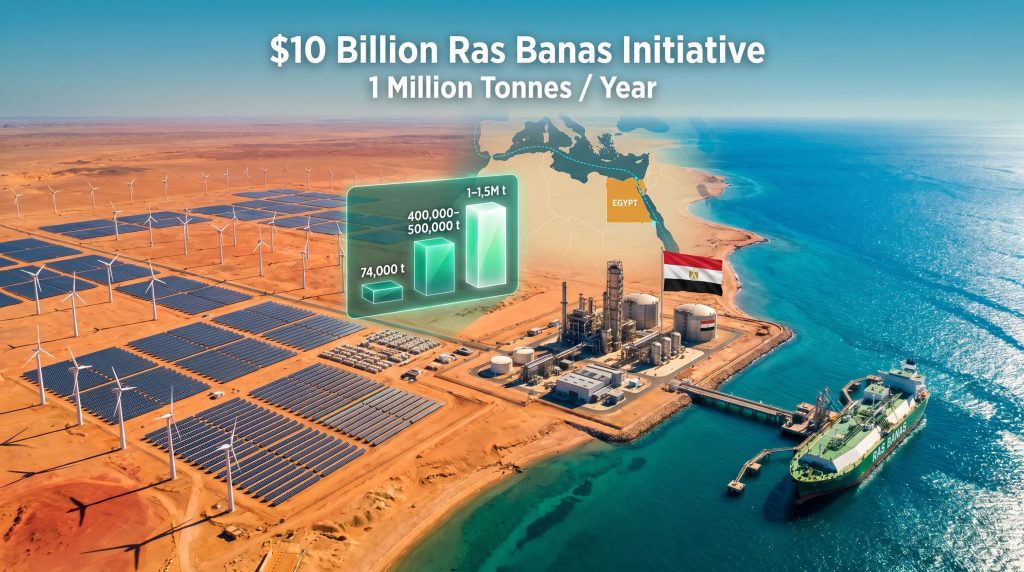
The most ambitious single-site Egypt green ammonia project currently under development is the Egypt Amun Green Ammonia initiative, led by Polish energy developer Hynfra in partnership with Egypt's Coxswains. The project was formally presented to Egypt's Minister of Industry on April 24, 2026, as reported by Ecofin Agency.
The key specifications as currently disclosed are as follows:
| Parameter | Phase 1 | Full Capacity |
|---|---|---|
| Total Capital Investment | ~$5 billion | Up to $10 billion |
| Annual Production Capacity | 400,000 tonnes | 1 million tonnes |
| Total Renewable Generation | 2,000 MW | 2,000 MW |
| Solar Component | 1,000 MW | 1,000 MW |
| Wind Component | 1,000 MW | 1,000 MW |
| Electrolyser Capacity | 692 MW | Expansion planned |
| Site Area | 100 km² | 100 km² |
| Production Start Target | 2031 | Post-2031 |
| Projected Annual Export Revenue | ~$490 million | Higher at scale |
It bears emphasising that as of April 2026, Ecofin Agency confirmed that no details had been disclosed regarding funding sources, binding offtake agreements, or a precise implementation timeline beyond the 2031 initial production target. The project remains in a political endorsement phase rather than a bankable financing phase.
Why Ras Banas Was Selected
The site at Ras Banas on Egypt's southeastern Red Sea coastline offers a combination of resource and logistical advantages that are difficult to replicate elsewhere in the country. Hynfra cited strong solar exposure across the Eastern Desert and consistent Red Sea wind regimes as the primary factors in site selection.
The off-grid architecture of the production facility is not incidental. By designing the entire operation as an isolated power system, fed exclusively by dedicated renewable generation assets, the project is positioned to meet the strictest international definitions of green ammonia under evolving EU and multilateral certification frameworks. This distinction matters commercially: European buyers and financing institutions are increasingly requiring verifiable proof of additionality — that is, confirmation that the renewable electricity used in hydrogen production would not have been generated anyway.
The Production Process Step by Step
The Ras Banas production chain follows a five-stage integrated process:
-
Seawater desalination: Red Sea water is processed on-site to produce ultra-pure water suitable for electrolysis, eliminating dependence on freshwater sources in a water-scarce environment.
-
Green hydrogen production: A 692 MW electrolyser array uses renewable electricity to split purified water into hydrogen and oxygen through electrolysis.
-
Nitrogen separation: An air separation unit (ASU) extracts high-purity nitrogen from the atmosphere for use in synthesis.
-
Haber-Bosch synthesis: Green hydrogen and nitrogen are combined under high pressure using the Haber-Bosch process to produce ammonia, the same fundamental chemistry used in conventional facilities but powered entirely by renewables.
-
Export logistics: Liquid ammonia is transferred to a dedicated Red Sea export terminal for vessel loading and international shipment.
Egypt's Broader Green Ammonia Pipeline: Where Does Ras Banas Sit?
The Competitive Landscape Within Egypt
The Egypt Amun project is the largest by proposed capacity, but it is far from alone. Multiple initiatives are at various stages of development across the country, each with distinct profiles, timelines, and levels of commercial advancement.
| Project | Location | Lead Developer(s) | Capacity Target | Current Status |
|---|---|---|---|---|
| Egypt Amun (Hynfra/Coxswains) | Ras Banas, Red Sea | Hynfra + Coxswains | 1 million tonnes/year | Ministerial presentation, April 2026; no financing confirmed |
| Egypt Green (Scatec-led) | Ain Sokhna, SCZONE | Scatec, Orascom, TSFE, Fertiglobe | ~74,000 tonnes/year (export phase) | €35M EU grant secured; approaching FID |
| SCZONE/Ocior Energy | Suez Canal Economic Zone | Ocior Energy | Phase I: 100,000 t/y; Phase II: 1M t/y | Phase I targeted 2027-2028 |
| Abu Qir/Alexfert/Orascom/UEG Hub | Alexandria | Abu Qir Fertilizers, Alexfert, Orascom, UEG | MoU signed April 2026; feasibility stage |
An important factual clarification: the Abu Qir consortium MoU was signed in early April 2026, not April 2025 as sometimes referenced. Ecofin Agency's April 30, 2026 reporting confirms this is a very recent development, with the project including feasibility studies for a 500 MW facility targeting approximately 480 tonnes of green ammonia per day, though no investment commitments or precise timelines have been attached to that initiative.
The Egypt Green Project: The Most Commercially Advanced Benchmark
While the Ras Banas project commands attention through sheer scale, the Scatec-led Egypt Green project in Ain Sokhna represents the most financially de-risked initiative in the country's pipeline. This consortium, involving Scatec of Norway, Orascom Construction, Egypt's sovereign wealth fund TSFE, and Fertiglobe, has secured a €35 million EU grant and is approaching a Final Investment Decision.
With a 100 MW electrolyser producing approximately 74,000 tonnes per year and 40,000 tonnes committed for export to Rotterdam between 2027 and 2033, Egypt Green provides an important proof-of-concept benchmark for the broader pipeline. Its smaller scale makes it considerably more straightforward to finance and construct than the Ras Banas behemoth, and its EU grant funding establishes a template for how future projects might access European development finance.
The Financing Gap: The Central Challenge Across Egypt's Green Ammonia Sector
From MoU to Bankable Project: A Systemic Challenge
Any serious assessment of Egypt's green ammonia ambitions must confront the structural gap between political endorsement and financeable project structure. This challenge is closely intertwined with the broader geopolitical mining landscape and is not unique to Egypt, but it is particularly pronounced given the country's COP27 experience.
When Egypt hosted COP27 in Sharm El-Sheikh in 2022, more than $83 billion in green hydrogen and ammonia memorandums of understanding were announced. Three years later, the vast majority of these remain at pre-feasibility or early development stages. The conversion rate from announced MoU to operational project has been extremely low, consistent with broader global patterns in green hydrogen development.
The Egypt Amun project, despite its scale and political traction, currently sits firmly in the early-stage category. As Ecofin Agency confirmed in its April 2026 reporting, no funding sources, buyer agreements, or detailed implementation timelines have been disclosed.
Key Risk Factors Investors and Stakeholders Should Understand
The principal risks facing Egypt's green ammonia pipeline extend well beyond simple project execution:
-
Offtake pricing risk: Long-term ammonia purchase agreements that support project economics are extremely difficult to secure in a market where green ammonia production costs remain above conventional ammonia in most scenarios absent carbon pricing mechanisms.
-
Macroeconomic and currency risk: Egypt's foreign exchange dynamics and sovereign credit profile add meaningful complexity to project financing structures, particularly when international lenders assess country risk.
-
Technology cost trajectory uncertainty: Electrolyser costs have been declining rapidly, but assumptions about future cost curves embedded in project feasibility models carry significant uncertainty at the 2031 production horizon.
-
Regulatory and permitting timelines: Large-scale industrial energy projects in Egypt have historically encountered extended permitting and land allocation processes that can compress developer timelines substantially.
-
Infrastructure gaps beyond the fence line: Even a perfectly engineered off-grid facility requires port infrastructure, internal roads, water pipelines, and transmission connections to remote generation assets, all of which carry cost and timeline risk.
What Would Actually Make These Projects Financeable?
The pathway from aspirational MoU to bankable project structure requires a specific combination of conditions:
-
Binding long-term offtake contracts with creditworthy European buyers at floor prices that support positive project economics.
-
Concessional financing from multilateral development banks, including the IFC, EBRD, and EIB, to reduce the cost of capital to levels consistent with project viability.
-
EU grant support of the type secured by the Egypt Green consortium, which materially reduces the equity requirement and signals political commitment to European counterparties.
-
Clear and durable carbon pricing signals in target export markets that improve green ammonia's price competitiveness relative to conventional production.
-
Streamlined regulatory pathways within Egypt for large-scale renewable energy solutions and industrial project permitting.
Egypt's Position in the Global Green Ammonia Export Race
How Egypt Compares to Competing Producer Nations
Egypt is not the only country positioning itself as a future green ammonia exporter. Understanding where it sits competitively relative to other emerging producers is essential for assessing the long-term commercial viability of projects like Ras Banas. Furthermore, the broader context of critical minerals energy transition dynamics adds another layer of strategic significance to this competition.
| Country | Primary Advantage | Key Challenge |
|---|---|---|
| Egypt | European proximity, dual solar/wind resources, Red Sea export access | Macroeconomic risk, financing gaps |
| Morocco | Atlantic wind resources, strong EU proximity, established investment frameworks | Smaller land footprint, water scarcity constraints |
| Saudi Arabia | Capital availability, sovereign project scale, existing ammonia infrastructure | Higher political risk perception in certain European markets |
| Australia | World-class solar and wind resources, stable political environment | Significant distance from European markets increases shipping costs |
| Chile | Exceptional Patagonian wind resources, established mining infrastructure | Distance from Europe, domestic infrastructure gaps |
Egypt's combination of high solar irradiance, complementary Red Sea wind generation profiles, and relative proximity to Southern European ports creates a genuinely competitive cost structure compared to most alternatives. The shipping route via the Suez Canal to Mediterranean ports is shorter and cheaper than competing routes from the Arabian Gulf or Pacific Basin.
A Lesser-Known Dynamic: The Additionality Certification Challenge
One technical dimension of the green ammonia market that receives insufficient attention in mainstream coverage is the evolving certification landscape for what qualifies as genuinely green production. The EU's Delegated Acts under the Renewable Energy Directive (RED III) impose specific requirements on hydrogen producers seeking to claim renewable status, including temporal correlation between renewable generation and electrolyser operation.
This requirement creates a structural advantage for off-grid projects like Ras Banas relative to grid-connected facilities. Off-grid facilities powered by dedicated assets inherently satisfy this requirement more cleanly, potentially commanding a certification premium in sophisticated European markets where buyers differentiate between certified and uncertified green ammonia. Consequently, this design choice may prove to be one of the most commercially astute decisions in the project's development.
The next major ASX story will hit our subscribers first
Scenario Analysis: What Egypt's Green Ammonia Output Could Look Like by 2035
Three Plausible Futures
Given the current development status of Egypt's pipeline, it is instructive to map out three scenarios for actual output by the mid-2030s. These scenarios reflect the range of outcomes from financing success to continued delays, and should be understood as illustrative frameworks rather than forecasts.
| Scenario | Projects Reaching Production | Estimated Annual Output | Key Condition |
|---|---|---|---|
| Conservative | Egypt Green only | ~74,000 tonnes | FID delays and financing gaps persist for large-scale projects |
| Base Case | Egypt Green + partial Ras Banas Phase I | 400,000-500,000 tonnes | Ras Banas achieves financial close by 2027-2028 |
| Optimistic | Egypt Green + Ras Banas full Phase I + SCZONE/Ocior Phase I | 1-1.5 million tonnes | Strong EU financing, binding offtake, streamlined permitting |
Disclaimer: These scenarios are analytical frameworks based on publicly available project information and are not investment advice. Actual outcomes will depend on financing conditions, regulatory developments, technology cost trajectories, and global commodity markets, all of which carry material uncertainty. Past performance of energy project development timelines should not be used as a reliable guide to future execution.
Frequently Asked Questions: Egypt Green Ammonia Projects
What exactly is the Egypt Amun Green Ammonia project?
The Egypt Amun project is a large-scale green ammonia production facility proposed for the Ras Banas site on Egypt's southeastern Red Sea coastline. Developed by Polish company Hynfra in partnership with Egypt's Coxswains, the project was presented to Egypt's Minister of Industry in April 2026. It targets initial production of 400,000 tonnes per year from 2031, with full expansion to 1 million tonnes per year at a total investment of up to $10 billion.
Why is the off-grid design of Ras Banas commercially significant?
Off-grid architecture means the facility draws power exclusively from its own dedicated 2,000 MW renewable generation system rather than from Egypt's national electricity grid. This design satisfies the additionality requirements embedded in EU renewable hydrogen certification frameworks, allowing the ammonia produced to qualify as genuinely green under European regulatory standards. This certification status is increasingly essential for accessing premium pricing from European buyers.
Which Egypt green ammonia project is closest to production?
The Scatec-led Egypt Green project at Ain Sokhna is the most advanced, having secured a €35 million EU grant and approached a Final Investment Decision. It targets export of approximately 40,000 tonnes per year to Rotterdam between 2027 and 2033, making it the near-term benchmark for the entire Egyptian green ammonia sector.
What is Egypt's national green hydrogen production target?
Egypt has set a long-term national target to produce 10 million tonnes of green hydrogen and capture 8% of the global green hydrogen market, according to government statements reported by Ecofin Agency. In addition, these targets form part of a wider strategy to position Egypt as a key supplier of green transition materials to energy-importing nations.
Has the Ras Banas project secured any financing?
As of April 2026, no financing sources, binding offtake agreements, or detailed implementation milestones beyond the 2031 production start target have been publicly disclosed for the Egypt Amun project. The initiative remains in a political endorsement and pre-feasibility stage.
How does Egypt's COP27 legacy affect its green ammonia credibility?
At COP27 in Sharm El-Sheikh in 2022, more than $83 billion in green hydrogen and ammonia MoUs were announced involving Egypt. The very low conversion rate of these announcements into operational projects has made international financiers and buyers more cautious about Egyptian green energy commitments, raising the evidentiary bar that newer projects like Ras Banas must clear to access institutional capital.
Key Takeaways for Investors, Developers, and Energy Buyers
Egypt's emerging position in the global Egypt green ammonia project landscape reflects both genuine strategic advantages and substantial execution risks that exist in tension with one another. Several conclusions stand out:
-
The Egypt Amun project at Ras Banas represents the most ambitious single-site proposal in the country, but its current status is political rather than financial, with no confirmed funding structure in place.
-
The Egypt Green initiative led by Scatec offers the most commercially credible near-term pathway to production, with EU grant funding and export commitments providing a financial foundation that larger projects have not yet achieved.
-
The off-grid certification advantage embedded in Ras Banas's design may prove to be a meaningful commercial differentiator as EU green hydrogen certification requirements tighten, though this premium can only be realised if the project reaches financial close.
-
The COP27 MoU conversion problem is the central challenge for Egyptian credibility in this sector: the gap between announced ambitions and executed projects remains wide, and international capital allocators are acutely aware of this pattern.
-
Equipment suppliers and logistics operators face near-term opportunities as the most advanced projects approach FID, regardless of whether larger-scale projects ultimately proceed on announced timelines.
-
Investors with a 5 to 8 year patient capital horizon and appetite for frontier energy market exposure may find the Egyptian green ammonia pipeline compelling, but should conduct thorough due diligence on project-specific financing structures, offtake economics, and country risk factors before drawing conclusions from headline capacity figures.
This article is intended for informational purposes only and does not constitute financial or investment advice. Forecasts, scenarios, and projections referenced throughout are analytical frameworks based on publicly available information and carry material uncertainty. Readers should seek independent professional advice before making any investment decisions related to the sectors or projects discussed.
Want to Track the Next Major Resource Discovery Before the Broader Market Does?
Discovery Alert's proprietary Discovery IQ model delivers real-time alerts on significant ASX mineral discoveries — instantly converting complex resource data into actionable insights for both short-term traders and long-term investors. Explore how historic discoveries have generated substantial returns and begin your 14-day free trial today to position yourself ahead of the market.