June 8, 2026
The Economics of Scarcity: Why Frontier LNG Provinces Command a Decade-Defining Premium
Across the global energy landscape, a quiet but consequential reality is reshaping how institutional capital thinks about resource investment: world-class gas discoveries of the scale capable of redefining national economies are not merely rare, they are becoming structurally scarce. The geological conditions, water depths, reservoir quality, and proximity to viable export infrastructure required to produce a truly transformational LNG province align perhaps once or twice per generation. When they do, the economic consequences extend far beyond royalty payments and export receipts into the foundations of sovereign development itself.
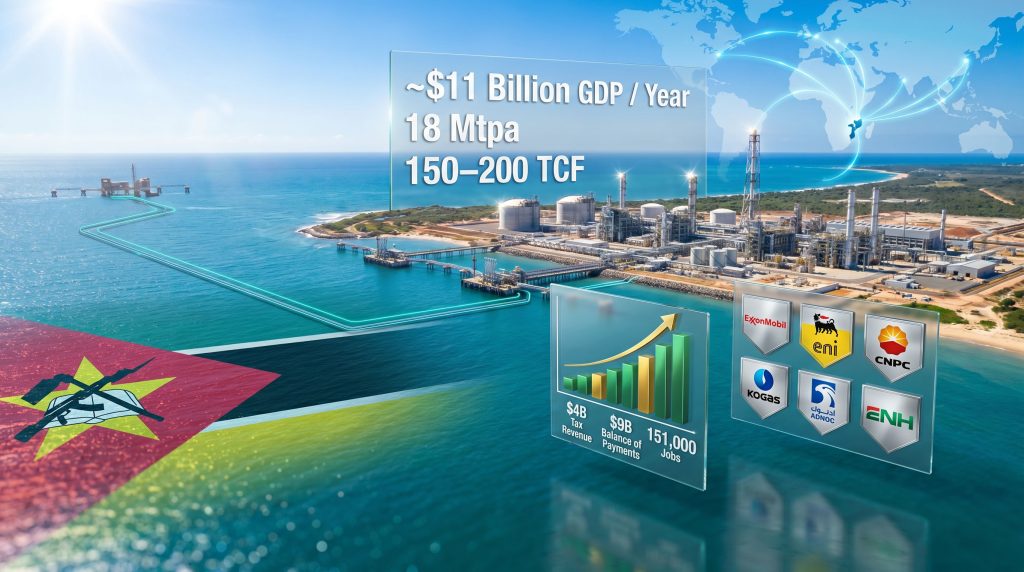
The Mozambique Rovuma LNG project sits within this category of genuinely exceptional discoveries. With an estimated resource base of between 150 and 200 trillion cubic feet (TCF) of natural gas identified across the offshore Rovuma Basin, this is not a marginal deposit requiring aggressive price assumptions to justify development. It is a resource endowment that places northern Mozambique in the same geological league as established LNG provinces that have anchored national economies for decades.
Understanding the full significance of the Mozambique Rovuma LNG project requires moving beyond production statistics and export volumes. The real story is structural: what happens to a low-income frontier economy when it suddenly controls access to one of the world's largest undeveloped gas reserves, and whether the institutions, partnerships, and policy frameworks in place are sufficient to convert geological fortune into lasting industrial transformation.
When big ASX news breaks, our subscribers know first
From Frontier Geology to Global LNG Province
The geological narrative behind the Rovuma Basin's emergence as a world-class gas province is a story of patient exploration in a region that most major operators had historically overlooked. The Rovuma Basin stretches across the offshore margins of northern Mozambique and southern Tanzania, formed through the ancient rifting of the African continent from the Indian subcontinent. This tectonic history created a series of deep-water sedimentary sequences that proved, upon systematic exploration, to be extraordinarily gas-bearing.
The transformation of geological potential into confirmed resource began in earnest during the early 2010s, when exploration campaigns by Eni and Anadarko Petroleum delivered a succession of world-class discoveries. Eni's identification of the Mamba complex in Area 4 and Anadarko's discoveries in the adjacent Area 1 concession collectively revealed a gas province of extraordinary scale. The aggregate resource estimates of between 150 and 200 TCF established Mozambique as the holder of one of the largest gas discoveries anywhere in the world during the past two decades.
To contextualise this scale, Qatar's legendary North Field, the world's largest single natural gas reservoir, contains approximately 900 TCF of reserves and has underpinned Qatar's transformation into one of the world's wealthiest nations per capita. The Rovuma Basin represents a fraction of that scale, but its resource endowment remains exceptional by virtually any other global comparison, and its development potential remains largely untapped.
The basin's emergence has directly enabled three major development tracks:
| LNG Project | Operator | Current Status |
|---|---|---|
| Coral South FLNG | Eni | In production |
| Mozambique LNG | TotalEnergies | Restarting after security disruptions |
| Rovuma LNG (Area 4) | ExxonMobil / Eni | Pre-FID; force majeure lifted November 2025 |
Together, these three projects represent Mozambique's pathway toward joining the ranks of significant global LNG exporters alongside Qatar, Australia, and the United States. The distinction between the Coral South floating LNG facility, which processes and liquefies gas offshore aboard a dedicated vessel, and the onshore liquefaction infrastructure planned for the Rovuma LNG project at the Afungi Peninsula carries profound economic implications. Onshore processing creates physical infrastructure, employment ecosystems, and industrial linkages that permanently transform local economies in ways that floating offshore facilities, by their nature, cannot replicate.
Technical Architecture: What Makes the Rovuma LNG Project Distinctive
The Modular Electric LNG Design and What It Means in Practice
The technical evolution of the Mozambique Rovuma LNG project's design concept reflects broader innovation trends within the global LNG industry. The original two-train concept targeted a combined liquefaction capacity of approximately 15.2 million tonnes per annum (Mtpa), with each train sized at roughly 7.6 Mtpa. ExxonMobil subsequently led a design evolution toward an 18 Mtpa modular electric LNG configuration that carries meaningful operational and financial advantages over conventional designs.
Modular electric LNG represents a fundamentally different approach to liquefaction facility construction and operation. Rather than relying on large gas turbine-driven compression trains, the design uses electrically powered refrigeration systems, which offers several structural advantages:
- Emissions reduction: Electric drives can be powered by lower-carbon sources, improving the project's environmental footprint and positioning it more favourably in carbon-conscious offtake markets
- Scalability: Modular construction allows incremental capacity additions with lower incremental capital requirements compared to traditional mega-train designs
- Efficiency: Electric compression technology has demonstrated superior reliability and operational efficiency metrics in comparable applications
- Cost structure: Modular approaches can reduce construction risk by enabling parallel fabrication and phased commissioning
- Maintenance: Electrically driven systems typically carry lower long-term maintenance costs than gas turbine equivalents
The upstream gas feeding the Afungi Peninsula facility is sourced from the Mamba complex in offshore Area 4, requiring subsea pipeline infrastructure, offshore production facilities, and onshore processing systems. The export chain extends further through jetties and LNG carrier loading systems capable of accommodating the very large LNG carriers that service long-haul routes to European and Asian buyers. Furthermore, the Rovuma LNG terminal infrastructure is designed to handle the full scale of planned export volumes from Area 4.
The Area 4 Partnership: A Consortium Built for Scale
The partnership structure underpinning the Mozambique Rovuma LNG project reflects the complexity and capital intensity of frontier mega-project development. No single entity, regardless of financial strength, typically absorbs the full risk of a multi-billion dollar development in a frontier jurisdiction. The Area 4 consortium has been assembled to combine technical expertise, financial capacity, and market access across multiple dimensions.
| Partner | Reported Equity Stake | Primary Role |
|---|---|---|
| ExxonMobil | 25% | LNG facilities lead operator |
| Eni | 25% | Upstream facilities lead operator |
| CNPC | 20% | Equity and offtake partner |
| KOGAS | 10% | Long-term supply security |
| ADNOC | 10% | International portfolio expansion |
| ENH | 10% | Mozambican sovereign participation |
The dual-operator model, with ExxonMobil leading the LNG liquefaction infrastructure while Eni manages upstream production operations, reflects a deliberate division of technical responsibility. Each partner's core competencies are deployed where they deliver greatest value across the full project value chain. Eni's operational experience with the adjacent Coral South FLNG facility provides continuity of local knowledge and established relationships with Mozambican regulatory authorities, while ExxonMobil's global LNG project delivery expertise anchors the downstream processing infrastructure.
The strategic motivations behind the non-operating partners deserve consideration. CNPC's 20% equity position aligns with China's long-standing strategy of securing upstream equity positions in major global energy resources rather than relying solely on spot or term purchasing arrangements. KOGAS, South Korea's state gas utility, participates to secure supply certainty for a domestic market that is structurally dependent on LNG imports. ADNOC's involvement, however, reflects Abu Dhabi's deliberate expansion of its international LNG portfolio beyond its own territorial resources.
ENH's 10% stake serves a function that extends beyond revenue participation. Sovereign equity participation in major resource projects is increasingly regarded as an essential mechanism for ensuring that the host nation retains genuine economic agency over its resource development rather than simply collecting royalties from an externally controlled enterprise.
It is worth noting that the source transcript referenced Galp Energia as a consortium participant rather than ADNOC. Industry reporting on the Area 4 consortium composition has varied over time due to equity transfers and partner changes. Readers should consult the most current operator disclosures for verified equity positions.
Security Disruptions, Force Majeure, and the Path Back to Development
The Cabo Delgado Insurgency and Its Development Consequences
The insurgency that emerged in Cabo Delgado Province from 2017 onwards represents the most significant single disruption to Mozambique's LNG development trajectory. What began as a localised conflict with complex roots in economic marginalisation, religious extremism, and governance deficits progressively intensified into a security crisis that forced all major project operators to fundamentally reassess their development timelines and safety frameworks. Consequently, the broader geopolitical risk landscape for frontier resource investment came under renewed institutional scrutiny.
The formal declaration of force majeure in April 2021 represented the legal crystallisation of what had already become operationally untenable. The force majeure mechanism, a standard contractual provision allowing parties to suspend performance obligations due to extraordinary circumstances beyond their control, suspended project development activities and paused the contractual obligations between the consortium and its contractors, financiers, and offtake counterparties. The practical consequences included:
- Suspension of engineering, procurement, and construction activities across the Afungi site
- Evacuation of construction personnel and technical staff
- Suspension of contractor mobilisation and equipment delivery programmes
- Deferral of project financing discussions with banks and export credit agencies
- Uncertainty regarding offtake contract validity and long-term buyer commitment
The regional military response, led by forces from the Southern African Development Community Mission in Mozambique (SAMIM) alongside Rwandan Defence Forces deployed from mid-2021, progressively improved security conditions around the key northern Mozambique project areas. This sustained stabilisation effort, combined with ongoing counter-insurgency operations by Mozambican security forces, gradually shifted the operational risk assessment from prohibitive to manageable.
November 2025: Force Majeure Lifted and Project Momentum Restored
The lifting of force majeure in November 2025 marked a pivotal transition point for the Mozambique Rovuma LNG project. This was not simply an administrative milestone. It signalled that ExxonMobil and the Area 4 consortium partners had assessed security conditions as sufficiently stable to resume active project development work and re-engage the contractual and financing frameworks necessary to advance toward a Final Investment Decision (FID).
Industry analysis increasingly characterises the security environment across key project areas as manageable rather than prohibitive, representing a meaningful evolution from the risk framing that dominated assessments between 2021 and 2023. This shift in risk perception matters enormously for the financing community, where political risk insurance providers and export credit agencies must form independent assessments of country risk before committing to participate in project finance structures.
The coincidence of improved security conditions with renewed global demand for diversified LNG supply sources has created a potentially favourable market window. European buyers seeking to reduce dependence on any single supply corridor, and Asian economies requiring growing volumes of gas to support industrialisation and urbanisation, represent natural offtake counterparties for a large, long-tenure Mozambican LNG project. In addition, the global LNG supply outlook reinforces the structural case for bringing new long-term sources of supply online.
The Economic Transformation Case: Quantifying What Is at Stake
A $11 Billion Annual Contribution: Dissecting the Projections
Standard Bank Mozambique's economic assessment provides the most comprehensive public quantification of the project's potential national economic impact. The bank's analysis projects an average annual contribution of approximately $11 billion to Mozambique's GDP across a thirty-year project life. To place this figure in context, Mozambique's total GDP stood at approximately $16 billion in recent years, meaning the project's projected contribution alone would represent a potential near-doubling of current national output over the long run.
The full suite of economic impact projections from Standard Bank's analysis presents a compelling transformation narrative:
| Economic Metric | Projected Annual Contribution |
|---|---|
| GDP contribution | ~$11 billion per year (averaged over 30 years) |
| Tax revenue generation | ~$4 billion per year |
| Balance of payments | ~$9 billion per year |
| Employment supported | ~151,000 jobs (direct, indirect and induced) |
The balance of payments contribution of approximately $9 billion annually may prove to be the most structurally significant metric for Mozambique's long-term economic development. Countries with structural current account deficits face chronic constraints on domestic investment capacity, vulnerability to currency depreciation, and dependence on external borrowing to fund development. A sustained, large-scale improvement in the balance of payments would strengthen Mozambique's external financial position, support currency stability, and enhance the sovereign's ability to borrow for infrastructure and social investment.
Tax revenue projections of approximately $4 billion annually reflect a typical large-scale LNG project fiscal profile, where government revenues are weighted toward the latter portion of the project's operational life due to the front-loading of capital cost recovery. Mozambican policymakers and development planners should factor this temporal structure into sovereign debt management and development finance planning, ensuring that borrowing undertaken in anticipation of LNG revenues is structured to match the actual revenue timing profile.
These projections carry inherent uncertainty. Long-run economic modelling over thirty-year horizons involves assumptions about LNG prices, operating costs, fiscal terms, and macroeconomic conditions that cannot be predicted with precision. The figures represent indicative scenarios rather than guaranteed outcomes, and should be interpreted accordingly.
The Industrial Multiplier: Where the Real Long-Term Value Lies
Perhaps the most important insight in Standard Bank's analysis is the conclusion that the greatest long-term economic value may emerge outside the gas sector entirely. This counterintuitive finding reflects the experience of LNG-producing nations that have successfully converted hydrocarbon revenues and domestic gas availability into broad industrial transformation. Furthermore, the energy transition demand dynamics underpinning global gas markets add a further layer of strategic value to Mozambique's resource position.
The pathway from LNG production to industrial diversification runs through reliable, affordable domestic gas supply. When manufacturers, agri-processors, and industrial operators can access competitively priced natural gas, it fundamentally transforms their cost structures and global competitiveness. For Mozambique, this creates the potential to develop industrial sectors that would simply not be viable in the absence of the gas resource:
- Fertiliser and agrochemical manufacturing, leveraging gas feedstock to supply regional agricultural markets across southern and eastern Africa
- Petrochemical processing, establishing downstream chemical production capacity that captures additional value from the hydrocarbon resource base
- Gas-to-power generation, addressing Mozambique's chronic electricity access constraints and creating the energy infrastructure that industrial development requires
- Industrial park development, attracting energy-intensive manufacturers seeking competitive power and gas costs
- Export-oriented manufacturing clusters, positioned to serve regional and global markets from a low-cost industrial base
- Transport and logistics infrastructure hubs, building on the port, road, and communications infrastructure developed for LNG operations
Malaysia and Qatar are frequently cited as illustrative comparators. Both nations leveraged their LNG development phases to systematically build downstream industrial capacity, diversifying their economic bases before commodity price cycles created pressure to do so. The critical variable in both cases was deliberate government policy that channelled resource revenues into productive industrial investment rather than consumption or commodity-linked fiscal expenditure.
Rovuma LNG and the Global Energy Transition
The Strategic Market Window and Why Timing Matters
The project enters the development pipeline at a moment of genuine strategic opportunity, though that window carries time constraints that make FID timing consequential beyond conventional project economics. The global energy transition is not a single event but a multi-decade process, and natural gas occupies a complex and evolving position within it. Indeed, commodity price impacts on broader resource investment sentiment make the timing of major FID commitments increasingly sensitive to market conditions.
The fundamental transition-fuel argument for natural gas rests on its emissions profile relative to coal. In power generation applications, natural gas produces roughly half the carbon dioxide emissions of coal per unit of electricity generated, making it an attractive interim option for economies seeking to reduce emissions while maintaining industrial energy security during renewable scale-up. For coal-dependent economies across South and Southeast Asia, this substitution represents a pragmatic decarbonisation pathway.
European demand dynamics have added a further dimension to the LNG market opportunity. The broader global trade tensions reshaping energy supply corridors have accelerated European buyers' interest in diversifying their LNG sourcing away from any single region or supplier, creating demand for new long-term supply relationships from politically stable or stabilising jurisdictions.
Projects entering production before long-term energy transition pressures materially constrain new hydrocarbon investment are likely to capture a disproportionate share of available offtake contracts and financing. The FID timing for Rovuma LNG is therefore not merely a project milestone but a market positioning decision with multi-decade revenue implications.
LNG projects of the Rovuma scale typically require fifteen to twenty years of contracted offtake to support project financing. Offtake counterparties in Europe and Asia are making those commitment decisions now, and projects that cannot demonstrate credible FID timelines risk being excluded from the current wave of long-term contract placements.
Competitive Positioning Against Established LNG Suppliers
The project competes for offtake volumes and financing attention against a global pool of LNG supply options. Qatar has announced substantial LNG expansion capacity through its North Field projects. The United States Gulf Coast continues to add liquefaction capacity. Australian LNG producers, while facing cost pressures, maintain established market relationships across Asia.
Rovuma LNG's competitive advantages centre on resource quality, scale, and the potential for competitive long-run operating costs once capital investment is fully deployed. The project's disadvantages relate primarily to sovereign risk premium, infrastructure development requirements, and the timeline uncertainty associated with frontier jurisdiction development. Closing the gap on those disadvantages requires the precise combination of security stability, regulatory certainty, and consortium alignment that the post-November 2025 environment is beginning to provide.
The next major ASX story will hit our subscribers first
Infrastructure as a Development Catalyst
The Corridor Economics Argument
Large-scale resource development projects in frontier economies create infrastructure that, when properly integrated into national planning frameworks, functions as a development catalyst extending far beyond the extractive sector itself. The ports capable of handling LNG carriers can also handle bulk commodity imports. The roads built to transport construction materials become arteries for agricultural produce. The power networks installed for industrial use can connect rural communities.
The Lobito Corridor project, spanning Angola, Zambia, and the Democratic Republic of Congo, provides an instructive parallel. Infrastructure originally constructed to service mineral export logistics is increasingly being repositioned as a platform for regional industrial development, agricultural trade, and manufacturing investment. The corridor's value extends across multiple economic sectors precisely because infrastructure capable of supporting heavy industrial logistics is also capable of supporting diverse economic activity.
For northern Mozambique, the infrastructure programme associated with the project at Afungi represents a potential transformation of Cabo Delgado Province's economic geography. Ports, roads, power networks, airports, and telecommunications systems developed for LNG operations become foundational public assets with economic utility extending across agriculture, manufacturing, services, and trade.
The critical policy challenge is preventing enclave formation, the pattern seen in some historical resource developments where project infrastructure remains operationally isolated from the surrounding domestic economy. Avoiding this outcome requires explicit national planning alignment, local content mandates embedded in project agreements, and community investment frameworks that create tangible linkages between project operations and local economic participation.
What Needs to Happen Before Final Investment Decision
FID Prerequisites and Scenario Analysis
Advancing the project from its current pre-FID status to construction mobilisation requires the successful resolution of multiple interdependent conditions. None of these conditions is individually insurmountable, but their cumulative resolution within a coherent timeline represents a significant coordination challenge across multiple sovereign, commercial, and technical domains.
The key prerequisites include:
- Sustained security stability across Cabo Delgado Province with credible long-term risk assessment
- Finalisation of Mozambique's fiscal and regulatory framework governing LNG development
- Execution of offtake agreements with sufficient contracted volumes to underpin project financing
- Assembly of the project finance package, including equity commitments, debt facilities, and export credit agency participation
- EPC contractor mobilisation readiness and construction workforce availability
- Environmental and social impact assessment compliance and community engagement completion
- Final capital expenditure commitment alignment among all Area 4 consortium partners
The scenario space for FID timing carries significantly different implications for Mozambique's development trajectory:
| Scenario | FID Timing | First Revenue Estimate | Key Risk Factor |
|---|---|---|---|
| Base Case | 2026-2027 | Mid-2030s | Project financing delays |
| Accelerated | 2025-2026 | Early 2030s | Security deterioration risk |
| Delayed | Post-2028 | Late 2030s | LNG market window narrowing |
| Abandoned | N/A | Significant opportunity cost | Sovereign debt and development gap |
The delayed or abandoned scenarios carry consequences that extend well beyond foregone LNG revenues. Infrastructure investment programmes, sovereign credit positioning, and the broader signalling effect of Mozambique's capacity to host and advance large-scale resource development would all be affected by an extended deferral or project cancellation.
The Broader Significance: A Template for African Resource Development
Measuring Success Beyond Export Volumes
The ultimate measure of success will not be found in LNG carrier loading statistics or export revenue accounts. It will be found in whether the project catalyses the kind of broad-based industrial transformation that converts resource wealth into sustained improvements in living standards, institutional capacity, and economic diversification.
The resource curse literature documents extensively how hydrocarbon wealth, when poorly managed, can undermine institutional quality, distort exchange rates, crowd out non-resource tradeable sectors, and generate fiscal dependence on commodity price cycles. Mozambique's policymakers are operating with the benefit of that extensive comparative evidence base, and the frameworks being developed to govern LNG revenue management reflect awareness of those risks.
The experience of resource-rich economies that successfully avoided the curse shares common elements: deliberate industrial policy linking resource revenues to productive investment, institutional frameworks that insulate public spending from commodity price volatility, local content requirements that embed domestic participation in resource supply chains, and infrastructure investment strategies that create lasting productive capacity rather than consumable transfers.
What Rovuma LNG Signals to Global Capital Markets
Beyond its direct economic impact on Mozambique, the Mozambique Rovuma LNG project functions as a signal to international capital markets about the risk-reward proposition of frontier African energy investment. A successfully executed, large-scale LNG development in a post-conflict stabilisation environment would demonstrate that African frontier energy projects can navigate the full development cycle, from discovery through construction to production, while delivering returns that justify the risk premium required by institutional investors.
That signal, if delivered, would meaningfully expand the pool of capital willing to consider comparable African energy and infrastructure investments, with compounding effects across the continent's development financing landscape. The stakes extend well beyond northern Mozambique.
Standard Bank Mozambique's assessment underscores a conclusion that resonates across the African development finance community: the central question facing Mozambique is no longer whether the Rovuma Basin contains the resources to drive transformational economic change. The geological case has been conclusively made. The question now is whether the institutional frameworks, security environment, and partnership structures in place are sufficient to convert that geological reality into an enduring industrial legacy.
This article is intended for informational purposes only and does not constitute financial or investment advice. Economic projections and development timelines referenced herein are drawn from third-party analyses and industry assessments. All forward-looking statements involve inherent uncertainty, and actual outcomes may differ materially from those projected. Readers should conduct independent due diligence before making any investment or policy decisions based on the information presented.
Want to Catch the Next Major Resource Discovery Before the Market Does?
Discovery Alert's proprietary Discovery IQ model scans ASX announcements in real time, instantly identifying significant mineral discoveries across over 30 commodities — from energy plays to critical minerals — and delivering actionable alerts directly to subscribers before the broader market reacts. Explore how historic discoveries have generated extraordinary returns on Discovery Alert's dedicated discoveries page, and begin your 14-day free trial today to position yourself ahead of the next major find.