
August 14, 2026
Corporate Criminal Investigations in the Base Metals Sector: A Framework for Understanding What Comes Next
When industrial conglomerates operating across multiple continents become entangled in criminal proceedings, the ripple effects extend far beyond courtroom proceedings. The base metals refining industry, characterised by long-cycle capital investment, multi-decade smelting infrastructure, and deeply integrated supply chains, is particularly vulnerable to reputational and financial disruption during legal proceedings. Understanding how criminal investigations unfold within European inquisitorial legal systems, and what they mean for global commodity markets, requires a fundamentally different analytical lens than the one typically applied to corporate news events.
The Nyrstar forgery investigation in Antwerp represents precisely this kind of complex, multi-layered legal situation, one where procedural designations carry significant weight, operational continuity remains a live question, and investors must navigate uncertainty without access to the full factual record.
When big ASX news breaks, our subscribers know first
What the Nyrstar Forgery Investigation in Antwerp Actually Involves
The Three Core Allegations and What They Signal
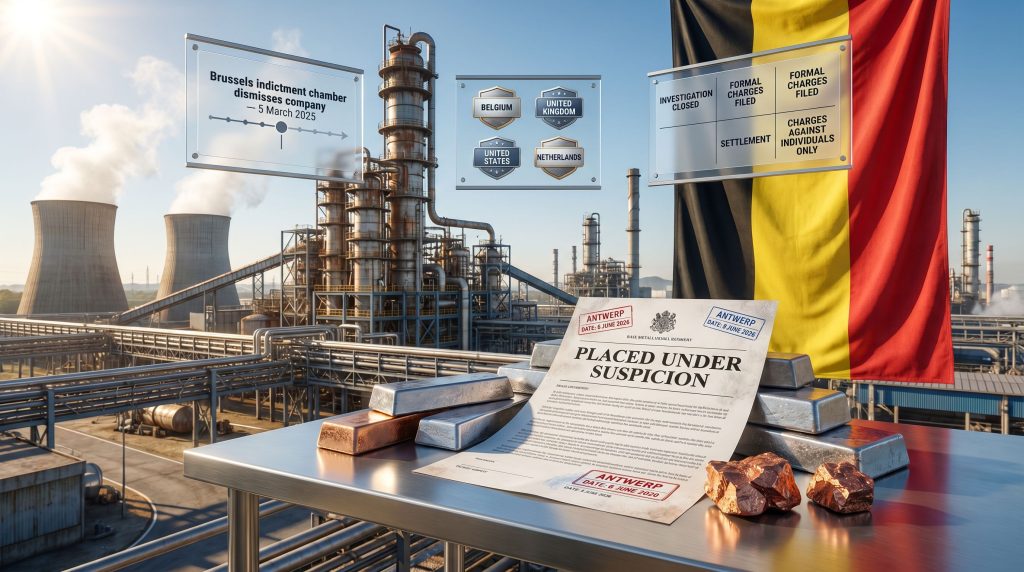
Euronext Brussels-listed Nyrstar has been formally placed under suspicion by the examining magistrate's office in Antwerp in connection with three distinct categories of alleged criminal conduct: suspected forgery, the use of falsified annual accounts, and misuse of corporate assets. This disclosure was made public on 8 June 2026, two days after the company was formally placed under suspicion on 6 June 2026.
These three allegations are not minor regulatory infractions. Under Belgian criminal law, each represents a serious category of corporate misconduct with distinct legal definitions, evidentiary requirements, and potential consequences.
-
Suspected forgery involves the alleged intentional falsification of documents with the intent to deceive third parties regarding their authenticity. In corporate contexts, this typically encompasses financial statements, contracts, regulatory filings, or internal records.
-
Use of falsified annual accounts sits at the intersection of criminal and commercial law, engaging both the Belgian Penal Code and the Belgian Companies and Associations Code. For a Euronext Brussels-listed company, this allegation also triggers potential overlap with securities regulation administered by the FSMA (Financial Services and Markets Authority of Belgium).
-
Misuse of corporate assets (known in Belgian legal tradition as abus de biens sociaux) refers to the alleged use of company assets for purposes other than the corporate interest, in a manner intended to cause harm to the company or its shareholders. This charge often encompasses undisclosed related-party transactions, diversion of funds, or asset transfers that disadvantage shareholders.
The combination of all three allegations in a single investigation is particularly notable. Each charge category individually represents serious criminal exposure, but together they suggest investigators have identified a potentially interconnected pattern of conduct spanning documentation, financial reporting, and asset management.
Key Procedural Milestones in the Investigation
The timeline of the Nyrstar forgery investigation in Antwerp reflects a legal process that has been evolving across multiple Belgian jurisdictions over a period of years.
| Milestone | Date | Significance |
|---|---|---|
| Mechelen criminal investigation transferred to Antwerp | Late 2024 | Consolidated jurisdiction for related proceedings under a single examining magistrate |
| Brussels indictment chamber dismisses Nyrstar from separate prosecution | 5 March 2025 | Partial legal relief in distinct parallel proceedings; does not resolve Antwerp case |
| Nyrstar formally placed under suspicion in Antwerp | 6 June 2026 | Examining magistrate confirms sufficient grounds for formal investigation of the company |
| Nyrstar public disclosure of investigation | 8 June 2026 | Company fulfils investor notification obligations under EU Market Abuse Regulation |
The consolidation of the Mechelen investigation into Antwerp in late 2024 is a procedurally significant development. Under Belgian judicial code, such transfers occur when related proceedings become sufficiently interconnected that a single examining magistrate's oversight is more appropriate. This consolidation often signals that the scope of an investigation has expanded beyond its initial parameters.
How Belgian Criminal Procedure Works in Corporate Investigations
The Examining Magistrate's Role and Powers
Belgium operates under an inquisitorial legal system, which is fundamentally different from the adversarial systems found in the United Kingdom or the United States. In the Belgian model, the examining magistrate (juge d'instruction) functions as an independent judicial investigator who leads the investigation phase, known as the instruction, with broad compulsory powers.
These powers include the authority to order judicial searches of premises, compel testimony from witnesses, and require the production of documents from both private entities and public bodies. All of this operates under judicial oversight rather than prosecutorial discretion, which is the defining characteristic of inquisitorial systems.
The investigative phase under Belgian procedure is distinct from formal prosecution. A formal prosecution, known as renvoi en jugement, occurs only if the examining magistrate concludes the investigative phase with sufficient evidence to warrant referring the case to a trial court. The two stages are procedurally and functionally separate.
What Being Placed Under Suspicion Actually Means
For investors, counterparties, and supply chain participants seeking to interpret the significance of Nyrstar's situation, understanding precisely what the formal status of being placed under suspicion entails is critical.
- This designation is not equivalent to being charged with a criminal offence.
- It is not a finding of guilt or a conviction.
- It does mean the examining magistrate has reviewed preliminary evidence and determined it sufficiently compelling to warrant a formal investigation of the corporate entity itself.
- It does confer certain procedural rights, including legal representation during questioning, alongside limitations, including restricted access to the criminal file in the early investigative stage.
Nyrstar's public statement that it has not yet been granted access to the criminal file is procedurally normal at this stage. Access to the file typically becomes available later in the investigative phase, once the examining magistrate has gathered sufficient evidence to proceed. This limitation does not indicate any unusual treatment or procedural preference by the authorities.
Comparing Corporate Criminal Exposure Across Jurisdictions
For multinational operators and international investors more familiar with common law systems, the following comparison provides useful context for understanding where Belgium's approach sits within the broader landscape of corporate criminal procedure.
| Jurisdiction | Equivalent Mechanism | Key Structural Difference |
|---|---|---|
| Belgium | Placed under suspicion / examining magistrate | Inquisitorial system; independent magistrate leads the investigation |
| United Kingdom | Serious Fraud Office investigation | Adversarial system; prosecution-led process |
| United States | Grand jury indictment / DOJ investigation | Prosecutorial-led; plea bargaining extensively used |
| Netherlands | FIOD criminal investigation | Comparable civil law tradition; similar inquisitorial structure |
| France | Mise en examen / juge d'instruction | Nearly identical to Belgian model; same inquisitorial tradition |
The judicial search that has been confirmed as part of the Antwerp proceedings is particularly significant within this framework. Under Belgian judicial code, such searches require specific authorisation, indicating that investigators believe physical or documentary evidence relevant to the allegations exists at the specified locations. This represents a meaningful escalation beyond preliminary inquiry, and Belgium has expanded the investigation into Nyrstar over time to reflect that broadening scope.
Why Nyrstar's Global Position Makes This Investigation Matter Beyond Belgium
The Operational Scale of a Multi-Continent Metals Processor
Nyrstar is not a typical mid-tier mining company. Its operational footprint spans three continents and encompasses processing facilities that handle multiple base and precious metals simultaneously, a level of operational complexity that is rare even within the global smelting industry.
-
Port Pirie, South Australia: One of the world's largest multi-metal smelting complexes, processing lead, silver, zinc fume, and copper matte in a single integrated facility. This smelter's scale and multi-metal processing capability make it globally significant within the base metals refining sector.
-
The Netherlands: A zinc smelting operation located near Nyrstar's corporate headquarters, contributing to the European zinc supply chain that feeds galvanisation, construction, and advanced manufacturing industries.
-
France: A historic zinc refining plant that represents a long-established processing asset within the European base metals network.
Nyrstar's Port Pirie smelter processes multiple base and precious metals simultaneously at a scale that places it among the most significant smelting operations globally. Any reputational or operational disruption at the corporate level carries implications for commodity supply chains that extend well beyond Belgium's borders.
The Strategic Importance of Zinc, Lead, and Silver Processing
Each of the metals processed at Nyrstar's facilities occupies an increasingly critical position in global supply chains. Furthermore, understanding these metals' roles helps contextualise the broader market significance of the investigation.
-
Zinc is indispensable for galvanising steel used in construction and infrastructure, and is growing in relevance to battery technology, particularly in zinc-air battery systems attracting attention as alternatives to lithium-based storage. Global zinc production trends suggest tightening supply conditions that make Nyrstar's smelting capacity all the more strategically important.
-
Lead remains critical for lead-acid battery production, which despite competition from lithium-ion technology continues to dominate certain applications including automotive starting batteries, telecommunications backup power, and grid storage in developing markets.
-
Silver produced as a by-product at Port Pirie feeds into photovoltaic panel manufacturing, electronics, and medical applications, markets experiencing strong structural demand growth. Indeed, silver's industrial role continues to expand rapidly across clean energy and technology sectors.
-
Copper matte output from Port Pirie connects into global copper refining capacity. Copper market trends point consistently upward owing to electrification and grid expansion, reinforcing Nyrstar's strategic relevance.
This metals mix means that any sustained operational disruption or reputational damage affecting Nyrstar's processing throughput would have downstream effects across multiple commodity markets simultaneously.
The Full Legal History Behind the Antwerp Investigation
A Multi-Jurisdictional Proceeding with Complex Parallel Threads
The Nyrstar forgery investigation in Antwerp did not emerge in isolation. It represents the current focal point of a legal history involving multiple concurrent and sequential proceedings across at least three Belgian jurisdictions.
The Mechelen criminal investigation, which was transferred to Antwerp in late 2024, suggests judicial recognition that the factual and legal threads running through that case were sufficiently interrelated with the Antwerp proceedings to warrant consolidation under a single examining magistrate. This kind of jurisdictional consolidation is a deliberate procedural choice, not an administrative convenience, and typically reflects the complexity and interconnected nature of the allegations.
The Brussels indictment chamber's dismissal of Nyrstar from a separate prosecution on 5 March 2025 delivered partial legal relief. However, it is essential for observers not to overinterpret this outcome. A dismissal from one set of proceedings by one chamber in Brussels carries no formal precedential weight for the distinct Antwerp investigation, which concerns different allegations under a different examining magistrate's jurisdiction.
The FSMA's involvement represents an additional regulatory dimension that runs parallel to but is entirely separate from the criminal proceedings. The FSMA's communication on the Nyrstar dossier covers financial market regulation and securities law compliance, meaning its scrutiny relates to potential violations of market disclosure rules and financial reporting obligations rather than the criminal conduct alleged in Antwerp.
How the Antwerp Case Differs from Prior Proceedings
Several characteristics of the Antwerp investigation distinguish it from the prior proceedings Nyrstar has navigated:
-
The occurrence of a formal judicial search as part of the Antwerp proceedings indicates that investigators have progressed beyond documentary review to active evidence gathering from physical locations.
-
The consolidation of the Mechelen investigation into Antwerp suggests the examining magistrate's mandate has been expanded to encompass related conduct, potentially broadening the factual scope of the investigation.
-
The three-category nature of the allegations, spanning document integrity, financial reporting, and asset governance, suggests investigators have identified what they consider to be a pattern of conduct rather than an isolated incident.
How Nyrstar Is Responding and What Disclosure Obligations Require
Navigating the Tension Between Cooperation and Communication
Nyrstar has publicly stated that it is cooperating fully with the criminal investigation in Antwerp. This posture reflects both a legal obligation to cooperate with judicial authorities and a reputational strategy of transparency in circumstances where the company's ability to comment substantively is constrained by its lack of access to the criminal file.
The company's acknowledgement that it cannot comment further on the allegations or the underlying facts at this time is legally appropriate. Active criminal investigations impose real constraints on corporate commentary. Making statements that could be construed as admissions, or that could potentially prejudice the investigation, carries significant legal risk for both the company and its legal representatives.
For publicly listed companies under active criminal investigation, EU Market Abuse Regulation requires timely disclosure of material developments that could reasonably be expected to affect the company's share price. Nyrstar's public statement on 8 June 2026, two days after being formally placed under suspicion, is consistent with this framework, balancing disclosure obligations against the constraints of active proceedings.
The disclosure also represents a careful calibration: providing investors with the information they are legally entitled to receive while avoiding commentary that could complicate the company's legal position in the investigation itself.
The next major ASX story will hit our subscribers first
Potential Outcomes and Their Implications for Investors
Four Scenario Trajectories Worth Monitoring
Given the procedural stage of the investigation and the publicly available information, investors and counterparties should consider four plausible trajectories. These scenarios involve forward-looking analysis and are inherently speculative; actual outcomes will depend on evidence not currently in the public domain.
| Scenario | Description | Probability Indicators | Potential Market Impact |
|---|---|---|---|
| Investigation closed without charges | Examining magistrate finds insufficient evidence to proceed | Nyrstar's cooperation; prior Brussels dismissal provides partial precedent | Neutral to positive for stock and counterparty relationships |
| Formal charges filed against the company | Magistrate refers case to trial court following investigative phase | Scope and outcome of judicial search; documentary evidence strength | Significant reputational and financial exposure; potential covenant triggers |
| Negotiated resolution | Deferred prosecution or settlement agreement with Belgian authorities | Complexity and duration of case; corporate willingness to acknowledge issues | Moderate impact; operational continuity likely preserved |
| Charges against individuals only | Company exonerated at corporate level; personal liability for executives | Precedent from Brussels dismissal; structure of corporate criminal liability law | Limited operational disruption; governance restructuring likely required |
Operational and Financial Risk Considerations
Regardless of which scenario ultimately prevails, several risk factors warrant ongoing monitoring. In addition, commodity price impacts across zinc, lead, and silver markets will interact with any operational or reputational disruption to amplify financial consequences for the company.
-
Banking covenants and credit facilities: Many corporate lending agreements contain material adverse change clauses or representations regarding the absence of material criminal proceedings. The Antwerp investigation may trigger review or renegotiation of existing facilities.
-
Counterparty risk appetite: Offtake agreement partners, concentrate suppliers, and long-term procurement counterparties in the metals industry typically include representations regarding the legal standing of their commercial partners. Active criminal proceedings may prompt counterparties to seek clarification or protection.
-
Euronext Brussels share price dynamics: Criminal investigations at the corporate level typically introduce a sustained risk premium into the share price, compressing multiples until the investigative outcome becomes clearer.
-
Operational continuity: As of the date of public disclosure, Nyrstar has not indicated any operational disruption at Port Pirie, the Netherlands facility, or the French zinc refining plant. Maintaining operational continuity during legal proceedings is both a commercial priority and a signal to markets that the investigation remains procedurally contained.
Historical Parallels: How Corporate Fraud Investigations Affect Mining Companies
Lessons from the Base Metals Sector
Corporate criminal investigations in the base metals and broader mining sector have historically demonstrated that the investigative phase, while disruptive, does not necessarily translate into operational impairment if managed carefully. The key differentiating factor in cases where companies have maintained stakeholder confidence during investigations has consistently been the quality and credibility of independent governance responses.
Companies that commission independent board-level investigations, engage credible third-party forensic auditors, and maintain transparent communication with investors tend to preserve relationships with lenders and counterparties more effectively than those that adopt defensive postures. Scrutinising management red flags early is consequently one of the most reliable indicators of how well a company is likely to weather criminal proceedings of this nature.
This pattern is observable across European industrial companies that have navigated accounting-related criminal proceedings over the past two decades. The multi-jurisdictional nature of Nyrstar's operations, spanning Belgian corporate law, Dutch commercial regulation, French environmental and labour obligations, and Australian mining and environmental requirements at Port Pirie, creates compounded compliance complexity that is inherent to multi-metal, multi-continent smelting operations.
This structural complexity does not excuse potential misconduct, but it does help explain why governance failures in such organisations, when they occur, often manifest across multiple regulatory dimensions simultaneously.
Governance Frameworks for Multi-Jurisdiction Metals Operations
The intersection of local corporate law, EU financial regulation, and host-country mining obligations creates a compliance environment of exceptional complexity for operators like Nyrstar. Best practice frameworks for corporate governance in these settings typically emphasise:
-
Centralised financial controls with jurisdiction-specific compliance overlays, ensuring that group-level reporting integrity is not compromised by local accounting variations.
-
Independent audit committee oversight with direct access to external auditors operating across all jurisdictions, not filtered through management in any single operating location.
-
Regular third-party compliance reviews that assess whether locally appropriate accounting treatments are consistent with group-level financial reporting obligations.
-
Whistleblower frameworks that provide safe channels for employees across all jurisdictions to report concerns about document integrity, financial reporting, or asset management without fear of retaliation.
The degree to which Nyrstar's historical governance structure reflected these principles is not publicly known at this stage, but it is precisely this question that the examining magistrate's investigation in Antwerp will seek to address.
FAQ: Nyrstar Forgery Investigation in Antwerp
What Is Nyrstar Being Investigated for in Antwerp?
Nyrstar has been formally placed under suspicion by the examining magistrate's office in Antwerp in connection with three categories of alleged conduct: forgery, the use of falsified annual accounts, and misuse of corporate assets. These are criminal allegations under Belgian law, and the investigation is ongoing with no findings of guilt having been made.
Has Nyrstar Been Charged or Convicted?
No. Being placed under suspicion is a formal investigative designation under Belgian criminal procedure that is procedurally distinct from being charged or convicted. The examining magistrate is still conducting the investigative phase of the proceedings, and no referral to a trial court has been made.
What Is Nyrstar's Response to the Investigation?
Nyrstar has publicly stated that it is cooperating fully with the investigation. The company has also confirmed that it has not yet been granted access to the criminal file and is therefore not in a position to comment on the specific allegations or the underlying facts at this stage of the proceedings.
Does This Investigation Affect Nyrstar's Operations?
As of the date of public disclosure on 8 June 2026, Nyrstar has not indicated any operational disruption at its facilities in South Australia, the Netherlands, or France. However, the investigation introduces reputational and financial risks that investors, lenders, and counterparties are likely to monitor closely as proceedings develop.
What Other Legal Proceedings Has Nyrstar Faced in Belgium?
Nyrstar has been involved in multiple legal proceedings across Belgian jurisdictions. A criminal investigation originating in Mechelen was transferred to Antwerp in late 2024. In a separate and distinct case, the Brussels indictment chamber dismissed Nyrstar from prosecution on 5 March 2025. The FSMA has also been involved in separate regulatory proceedings that are distinct from the criminal investigation.
What Is the FSMA's Role in This Matter?
The FSMA is Belgium's financial markets regulator and operates independently of the criminal justice system. Its involvement relates to potential securities and financial market regulatory matters, which may run in parallel to but are legally distinct from the criminal investigation being conducted by the examining magistrate in Antwerp.
What Is the Significance of the Judicial Search That Occurred in This Case?
A judicial search in Belgium requires specific authorisation from the examining magistrate and indicates that investigators believe physical or documentary evidence relevant to the allegations exists at the searched locations. The occurrence of a search represents a meaningful escalation in investigative intensity beyond preliminary documentary inquiry.
What the Nyrstar Antwerp Investigation Signals for the Base Metals Industry
The Nyrstar forgery investigation in Antwerp is a developing legal situation with significant implications that extend well beyond the company's immediate legal exposure. For the broader base metals sector, it serves as a reminder that multi-jurisdictional smelting operations of global scale carry commensurate governance complexity, and that the consequences of alleged failures in document integrity and financial reporting can manifest across criminal, regulatory, and market dimensions simultaneously.
Several critical points define the current state of affairs:
-
The Antwerp investigation represents the most serious current legal exposure for Nyrstar, covering three distinct and serious categories of alleged criminal conduct.
-
Belgian criminal procedure places the company in a formal investigative status that carries real legal and reputational weight, even before any charges are contemplated.
-
The consolidation of prior proceedings into Antwerp and the confirmed occurrence of a judicial search indicate an investigation of meaningful scope being conducted by judicial authorities with broad compulsory powers.
-
Nyrstar's global operational footprint means the investigation's market implications span the zinc, lead, silver, and copper sectors across supply chains in Europe, Australia, and beyond.
-
Investors and counterparties should monitor the progression of proceedings from the current investigative phase to any potential referral for prosecution, while recognising that multiple outcome scenarios remain viable at this stage.
This article is intended for informational purposes only and does not constitute legal or financial advice. The Nyrstar forgery investigation in Antwerp involves active criminal proceedings and the factual record is not fully accessible to the public. All scenario analysis and forward-looking commentary involves inherent uncertainty and should not be relied upon as a prediction of outcomes. Readers with specific legal or investment concerns relating to these proceedings should seek independent professional advice.
Want to Stay Ahead of Major ASX Mineral Discoveries Before the Broader Market Does?
Discovery Alert's proprietary Discovery IQ model delivers real-time alerts on significant ASX mineral discoveries across zinc, lead, silver, copper, and more than 30 other commodities — turning complex market data into clear, actionable investment insights the moment announcements hit the exchange. Explore how historic mineral discoveries have generated substantial returns for early movers, and begin your 14-day free trial today to secure a genuine market-leading advantage.