August 7, 2026
The Eastern Mediterranean has emerged as a critical hydrocarbon province, with geological formations beneath these waters containing vast natural gas reserves that could reshape regional energy security. Current market dynamics reveal significant imbalances between production capacity and domestic demand across Mediterranean nations, creating both challenges and opportunities for strategic resource development. Furthermore, the Egypt Mediterranean gas drilling programme represents a pivotal initiative addressing these regional supply-demand dynamics through targeted offshore exploration and development activities.
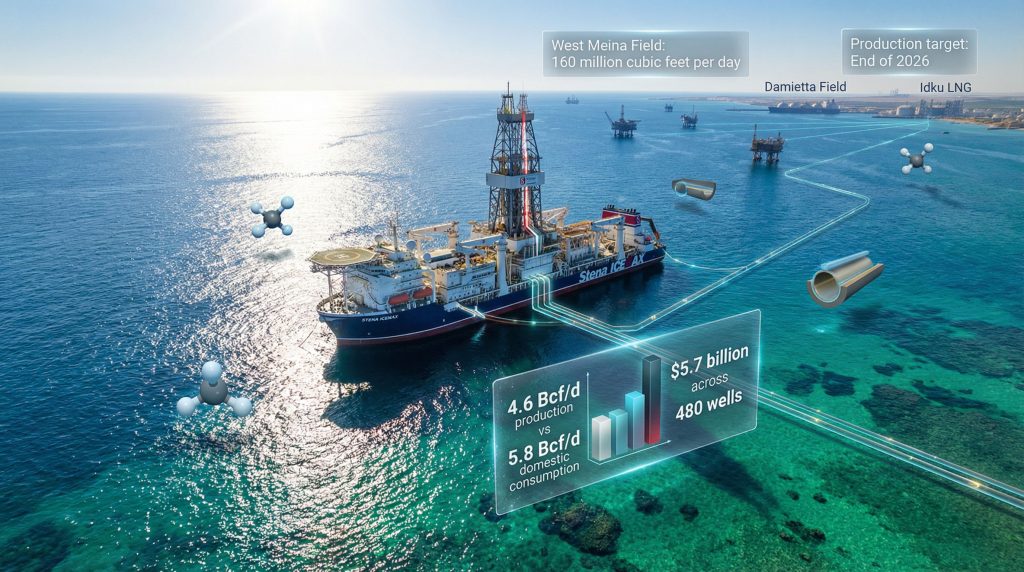
Egypt's position within this energy landscape reflects broader trends affecting regional supply chains. The nation currently produces 4.6 billion cubic feet per day (Bcf/d) while domestic consumption reaches 5.8 Bcf/d, creating a substantial deficit requiring import dependency and strategic production enhancement. These conditions highlight the importance of natural gas price trends and their impact on domestic energy security.
Mediterranean Reserve Distribution and Strategic Positioning
Regional hydrocarbon assessments indicate Egypt controls approximately 65 trillion cubic feet (Tcf) of proven natural gas reserves, representing nearly two-thirds of documented Eastern Mediterranean resources. This concentration positions Egypt as a potential energy hub for surrounding nations facing supply constraints or seeking diversified sourcing arrangements.
Cyprus, Israel, and Lebanon maintain varying degrees of exploration and production activity, yet their combined output remains insufficient to address regional demand growth. Israel's Leviathan and Tamar fields contribute meaningful production, while Cyprus continues evaluating discovered resources and Lebanon faces ongoing regulatory and technical challenges in offshore development.
The strategic implications extend beyond pure resource availability. Egypt's existing infrastructure, including the Damietta and Idku LNG facilities, provides processing and export capabilities that neighbouring countries lack. This infrastructure advantage creates potential for regional gas processing agreements and transit arrangements that could benefit multiple stakeholders.
When big ASX news breaks, our subscribers know first
Investment Climate and Policy Framework Evolution
According to Karim Badawi, Egyptian Minister of Petroleum and Mineral Resources, recent policy adjustments emphasise credibility and mutual benefit in attracting international investment. The ministry's approach focuses on three core objectives: increasing production capacity, reducing import dependency, and securing domestic supply reliability.
These policy modifications have attracted sustained commitment from major international oil companies (IOCs), with Shell, Eni, bp, and Chevron maintaining active operations across Egyptian offshore blocks. The competitive environment among IOCs suggests confidence in Egypt's regulatory framework and geological potential, contrasting with challenges faced in other regions such as those associated with Alaska drilling policy changes.
Current Investment Allocation (2025-2030)
| Investment Category | Amount | Timeframe | Well Count |
|---|---|---|---|
| Total Exploration Programme | $5.7 billion | 5 years | 480 wells |
| 2026 Phase Allocation | ~$1.2 billion | 1 year | 101 wells |
| Mediterranean Component (2026) | ~$167 million | 1 year | 14 wells |
The proportional allocation suggests Mediterranean exploration represents approximately 13.9% of annual drilling activity, with average per-well investment costs of roughly $11.9 million when distributed across the five-year programme.
Technical Infrastructure and Operational Capabilities Assessment
Drilling Technology and Vessel Specifications
The STENA ICEMAX drillship serves as the primary drilling platform for West Meina field development. This dynamically positioned vessel operates effectively in water depths ranging from 200 to 3,000+ meters, providing operational flexibility across varying offshore environments.
Technical specifications enable the vessel to handle both exploration and development drilling requirements. The drillship's capabilities include advanced positioning systems, specialised drilling equipment for deep-water operations, and safety systems designed for Mediterranean operating conditions.
Integration with existing infrastructure presents both opportunities and constraints. The West Delta Deep Marine (WDDM) facility provides processing and transportation infrastructure, though specific capacity limitations and expansion requirements remain undisclosed in public documentation.
Hub-and-Spoke Development Model
The Egypt Mediterranean gas drilling programme employs a centralised processing approach where new production wells connect to established facilities through subsea pipeline networks. This model offers several operational advantages:
- Reduced capital expenditure for individual well developments
- Shared processing and compression facilities maximising efficiency
- Centralised control and monitoring systems
- Economies of scale in maintenance and operations
However, the hub-and-spoke model also creates potential vulnerabilities through single-point-of-failure risks and capacity constraints at central processing facilities.
Pipeline and Processing Infrastructure Requirements
Connecting new Mediterranean discoveries to existing processing infrastructure requires significant subsea pipeline development. Water depths in the North East Amriya region typically range from 100 to 800 metres, while deep-water exploration areas like the Herodotus Basin exceed 2,000 metres in certain locations.
Pipeline installation in these environments requires specialised marine construction vessels and advanced laying techniques. Environmental considerations include protection of Mediterranean marine ecosystems and compliance with international maritime regulations, reflecting broader energy export challenges faced across global markets.
Joint Venture Structures and International Partnerships
Shell-KUFPEC Partnership Analysis
The West Meina field operates under a 60/40 partnership structure, with Shell Egypt holding operational control and Kuwait Foreign Petroleum Exploration Company (KUFPEC) maintaining a significant participating interest. This arrangement reflects common Middle Eastern joint venture practices where operational expertise combines with regional investment participation.
Partnership Structure Benefits:
- Shell provides: Technical expertise, operational management, international experience
- KUFPEC contributes: Capital funding, regional relationships, strategic alignment
- Joint advantages: Risk distribution, shared technology transfer, enhanced credibility
The 60/40 split ensures Shell maintains decision-making authority while providing KUFPEC substantial influence over major capital expenditures and strategic direction. Joint venture agreements typically include dispute resolution mechanisms and cost recovery frameworks protecting both parties' interests.
Regional IOC Commitments and Competition
Multiple international operators maintain active Egyptian offshore positions, creating competitive pressure for resource access and development opportunities:
Eni Operations:
The Italian company operates the Zohr field, discovered in 2015 and representing one of the Mediterranean's largest gas discoveries. Zohr began production in December 2017 and has achieved plateau production exceeding 2.7 Bcf/d, demonstrating the region's production potential.
bp West Nile Delta:
British Petroleum operates several producing assets in the West Nile Delta region, including the Sycamore field which commenced production in 2017. These operations provide bp with established infrastructure and operational experience applicable to new development opportunities. According to recent BP plans to bolster investment in the Egyptian oil and gas scene, the company remains committed to expanding its Egyptian operations.
Chevron Exploration Activities:
Chevron maintains exploration rights in various Egyptian offshore blocks, though specific current allocations require verification through Egyptian Ministry of Petroleum concession records.
This multi-operator environment creates both collaboration opportunities and competitive pressures that can accelerate development timelines while maintaining technical standards.
Production Targets and Development Timeline Analysis
West Meina Field Development Projections
Initial production targets for the West Meina field establish clear benchmarks for project success and economic viability:
Production Specifications:
- Gas production: 160 million cubic feet per day (MMcf/d)
- Condensate output: 1,900 barrels per day (bpd)
- Production start: End of 2026
- Infrastructure: Connection to existing WDDM facilities
The 160 MMcf/d gas production target represents approximately 3.5% of Egypt's current production baseline and 2.7% of total domestic demand. While individually modest, successful development could support larger-scale regional expansion.
Condensate production of 1,900 bpd provides additional revenue streams. At current pricing levels ($70-80/barrel), annual condensate revenue could reach $49-62 million, contributing to project economics beyond gas sales.
What Are the Key Components of the Four-Well Programme?
The comprehensive drilling programme addresses both immediate production requirements and longer-term exploration objectives through strategic well placement:
1. West Meina 1 (Primary Production Well)
- Location: North East Amriya region
- Purpose: Initial production establishment
- Timeline: Production by end of 2026
- Integration: Direct connection to WDDM facilities
2. West Meina 2 (Secondary Production Well)
- Location: North East Amriya region
- Purpose: Production capacity expansion
- Combined contribution: Full 160 MMcf/d target with West Meina 1
- Risk profile: Lower geological risk due to proven reservoir
3. Sirius (Shallow Water Exploration)
- Location: North East Amriya region
- Objective: Gas reservoir evaluation in shallower waters
- Strategic value: Resource base expansion and geological understanding
- Success probability: Higher than deep-water exploration (typically 40-60% for near-field exploration)
4. Philox (Deep Water Exploration)
- Location: North Cleopatra area, Herodotus Basin
- Objective: New horizon discovery in frontier basin
- Risk profile: High-risk, high-reward exploration
- Success probability: Typical frontier exploration rates (20-35%)
- Strategic importance: Could open entirely new development areas
Timeline Risk Assessment and Critical Path Analysis
The end-of-2026 production target requires successful completion of multiple interdependent activities within approximately 10-11 months from project announcement. Critical path elements include:
- Drilling operations: Weather-dependent offshore activities
- Completion and testing: Well productivity confirmation
- Pipeline installation: Subsea infrastructure connections
- Facility integration: WDDM capacity and processing adjustments
- Regulatory approvals: Environmental and safety certifications
Weather conditions in the Mediterranean can significantly impact offshore drilling schedules, with optimal drilling windows typically occurring during specific seasonal periods. Winter storms and high sea states may constrain operations, requiring careful timing and contingency planning.
Economic Impact and Import Reduction Strategy
How Will Egypt Reduce Its Energy Import Dependency?
Egypt's current 1.2 Bcf/d supply deficit necessitates costly import arrangements, including LNG purchases and pipeline imports from regional suppliers. The West Meina field's 160 MMcf/d contribution addresses approximately 13% of this deficit, providing meaningful but not transformative improvement.
Import Cost Analysis:
- Current deficit: 1.2 Bcf/d
- Annual import requirement: ~438 billion cubic feet
- Estimated import cost: $2.6-3.5 billion annually (varying with global gas prices)
- West Meina contribution: ~$95-130 million annual import cost reduction
The economic benefits extend beyond direct import substitution. Domestic production generates employment, provides tax revenues, and supports local service industries. Additionally, condensate production offers valuable liquid hydrocarbons for domestic refining or export markets, potentially creating LNG market implications for regional trade flows.
Foreign Investment Attraction and Multiplier Effects
According to Dalia El Gabry, Chair of Shell Egypt, increased foreign investment reflects growing confidence in Egypt's modernised investment climate. The demonstrated commitment from international operators encourages additional exploration investment and technology transfer.
Investment Multiplier Effects:
- Direct investment: $5.7 billion over five years
- Service sector demand: Drilling services, marine logistics, equipment suppliers
- Employment creation: Technical positions, marine operations, support services
- Technology transfer: Advanced drilling techniques, digital monitoring systems
- Infrastructure development: Pipeline networks, processing facilities, port services
The cumulative economic impact often exceeds direct investment by factors of 2-3x when accounting for supply chain spending, employment effects, and induced economic activity.
The next major ASX story will hit our subscribers first
Geological Complexity and Technical Risk Assessment
Mediterranean Basin Petroleum Systems
The Eastern Mediterranean contains complex petroleum systems developed over geological time scales. The Herodotus Basin represents a frontier exploration area with limited well penetrations and uncertain hydrocarbon potential.
Geological Risk Factors:
- Structural complexity: Salt tectonics and fault systems affecting trap integrity
- Reservoir quality: Porosity and permeability variations in carbonate and clastic sequences
- Hydrocarbon migration: Complex migration pathways affecting accumulation timing
- Pressure regimes: High-pressure/high-temperature conditions in deep-water environments
North East Amriya Region Characteristics:
- Water depths: 100-800 metres (intermediate depth drilling)
- Geological setting: Proven hydrocarbon systems with established production
- Infrastructure proximity: Existing pipeline and processing connections
- Technical risk: Lower than frontier exploration areas
Deep Water Drilling Challenges in Mediterranean Environment
The Philox well in the Herodotus Basin faces significant technical challenges common to deep-water frontier exploration:
Operational Challenges:
- Water depths: Exceeding 2,000 metres in drilling locations
- Weather sensitivity: Mediterranean storm systems affecting operations
- Subsea infrastructure: Complex wellhead and completion systems
- Environmental protection: Marine ecosystem preservation requirements
Geological Uncertainties:
- Reservoir presence: Unproven hydrocarbon systems in frontier basin
- Rock properties: Unknown porosity, permeability, and pressure characteristics
- Trap integrity: Structural and stratigraphic seal effectiveness
- Hydrocarbon quality: Gas composition and condensate ratios
Success rates for frontier deep-water exploration typically range from 20-35%, requiring careful risk assessment and portfolio management approaches.
Regional Infrastructure Development and Cross-Border Opportunities
Cyprus Gas Field Integration Potential
Cyprus has discovered significant natural gas resources through exploration activities, though development has faced technical and commercial challenges. Egypt's processing infrastructure could provide development solutions for Cypriot gas fields through subsea pipeline connections.
Potential Integration Benefits:
- Shared infrastructure costs reducing per-unit development expenses
- Processing scale economies improving project economics
- Accelerated development timelines for Cyprus resources
- Regional energy security enhancement through diversified supply
Cross-border pipeline development faces regulatory complexities, requiring coordination between multiple national authorities and international maritime regulations. However, successful implementation could establish Egypt as a regional processing hub, similar to initiatives seen with Saudi exploration licenses expanding regional cooperation frameworks.
Israeli Gas Transit Arrangements
Israel's Leviathan and Tamar fields represent substantial production capacity that could benefit from Egyptian processing and export infrastructure. Existing political and commercial relationships suggest potential for expanded cooperation agreements.
Transit Arrangement Advantages:
- Enhanced export capacity for Israeli production
- Processing fee revenues for Egyptian facilities
- Regional supply diversification reducing single-source dependencies
- Infrastructure utilisation optimisation maximising existing investments
Such arrangements require careful structuring to address pricing mechanisms, capacity allocation, and long-term supply security for all parties.
LNG Export Hub Development Strategy
Egypt's Damietta and Idku LNG facilities provide established liquefaction capacity that could process regional gas supplies for international export markets. Facility expansion or optimisation could accommodate additional throughput from new discoveries.
Hub Development Components:
- Processing capacity expansion to handle increased gas volumes
- Storage infrastructure providing operational flexibility
- Loading facilities accommodating larger LNG carriers
- Pipeline network expansion connecting to new production areas
Competition exists with other Mediterranean LNG hubs, requiring competitive pricing and reliable supply arrangements to attract international buyers.
Investment Opportunities and Service Sector Growth
Marine Services and Equipment Demand
Expanding offshore drilling activity creates substantial demand for specialised marine services and equipment:
Service Categories in High Demand:
- Offshore drilling contractors providing rigs and drilling services
- Marine logistics companies supplying vessels and transportation
- Subsea engineering firms designing and installing infrastructure
- Environmental monitoring services ensuring regulatory compliance
- Catering and accommodation supporting offshore personnel
The 480-well programme over five years represents sustained activity levels supporting long-term service contracts and equipment investments.
Technology Innovation and Digital Integration
Modern offshore operations increasingly rely on advanced technologies for safety, efficiency, and environmental protection:
Technology Applications:
- Real-time drilling monitoring optimising performance and safety
- Predictive maintenance systems reducing equipment downtime
- Environmental monitoring networks ensuring ecosystem protection
- Digital twin modelling improving operational planning and risk assessment
Technology adoption creates opportunities for local technology firms and international partnerships in digital services and equipment supply.
Global Gas Market Integration and Strategic Implications
European Energy Security Considerations
Mediterranean gas development occurs within the context of European efforts to diversify energy sources and reduce import dependencies. Egyptian production growth could contribute to these broader strategic objectives through increased LNG exports to European markets.
European Market Relevance:
- Diversification value reducing reliance on single suppliers
- Geographic advantage shorter transport distances than alternative sources
- Supply reliability from politically stable development environment
- Pricing competitiveness with established infrastructure reducing costs
However, Egyptian gas must compete with global LNG suppliers and pipeline imports, requiring competitive pricing and reliable delivery performance.
LNG Market Dynamics and Pricing Considerations
Global LNG markets face ongoing volatility due to geopolitical developments, seasonal demand variations, and supply chain disruptions. The Egypt Mediterranean gas drilling programme must account for these market dynamics in long-term planning.
Market Factors Affecting Egyptian Gas:
- Asian demand growth providing alternative export markets
- European price volatility creating both opportunities and risks
- Shipping cost variations affecting netback pricing
- Competition intensity from established and emerging suppliers
Successful market integration requires flexible commercial arrangements and diverse buyer relationships reducing exposure to single-market risks.
Long-Term Regional Energy Transformation Scenarios
Supply Chain Reconfiguration Pathways
Mediterranean gas development could fundamentally alter regional energy supply chains over the next decade. Several transformation scenarios merit consideration:
Scenario 1: Egypt as Regional Hub
- Centralised processing and export through Egyptian facilities
- Cross-border pipeline networks connecting multiple national production areas
- Shared infrastructure development reducing per-country investment requirements
- Coordinated exploration reducing geological risk through data sharing
Scenario 2: Distributed Development Model
- Individual national development programs with limited coordination
- Competing infrastructure investments potentially reducing overall efficiency
- Bilateral cooperation agreements rather than multilateral frameworks
- Technology and service provider competition across multiple markets
Scenario 3: Integrated Mediterranean Energy System
- Coordinated development planning across national boundaries
- Shared exploration risk and reward mechanisms
- Standardised regulatory frameworks facilitating cross-border investment
- Regional energy trading arrangements optimising supply and demand matching
Technological Advancement and Exploration Expansion
Advancing drilling and exploration technologies enable access to previously uneconomic resources. Recent developments in Egypt's offshore programme demonstrate how technological capabilities unlock additional Mediterranean resources currently considered too challenging or expensive to develop. Furthermore, Egypt's largest Mediterranean gas drilling programme represents a significant expansion of these technological applications.
Technology Enablers:
- Extended-reach drilling accessing reserves from existing platforms
- Enhanced seismic imaging improving exploration success rates
- Subsea processing systems reducing surface infrastructure requirements
- Digital optimisation tools enhancing operational efficiency and safety
These technological capabilities could unlock additional Mediterranean resources currently considered too challenging or expensive to develop.
Regional Cooperation Frameworks and Shared Resources
Transboundary resource development requires sophisticated cooperation mechanisms addressing shared reservoirs, overlapping territorial claims, and coordinated development planning:
Cooperation Framework Elements:
- Resource sharing agreements for cross-border accumulations
- Joint development entities managing shared infrastructure
- Technology transfer protocols ensuring capability development
- Environmental protection standards maintaining ecosystem integrity
- Dispute resolution mechanisms addressing commercial and technical conflicts
Successful frameworks could establish precedents for global offshore development cooperation and resource optimisation.
Disclaimer: This analysis includes speculative elements regarding future production, market developments, and cooperation arrangements. Actual outcomes may differ significantly from projections due to geological, technical, commercial, and political factors beyond current assessment capabilities. Investment decisions should incorporate comprehensive risk analysis and professional technical and financial advice.
Ready to capitalise on the next major energy discovery?
Discovery Alert's proprietary Discovery IQ model delivers real-time alerts on significant ASX mineral discoveries, instantly empowering subscribers to identify actionable opportunities ahead of the broader market. Understand why historic discoveries can generate substantial returns by exploring Discovery Alert's dedicated discoveries page, showcasing exceptional outcomes, then begin your 14-day free trial today to position yourself ahead of the market.