
May 22, 2026
Africa's Geology-Rich Frontier: Why Egypt's Licensing Overhaul Matters Now
Across Africa's mining landscape, a recurring pattern defines the gap between geological promise and investment reality: regulatory opacity. Jurisdictions that contain world-class mineral endowments routinely underperform their potential not because the ore bodies are absent, but because the frameworks governing access to them are too uncertain, too slow, or too costly to navigate. Egypt fits this profile precisely, and the country's latest round of Egypt mining law amendments signals a deliberate attempt to break from that pattern.
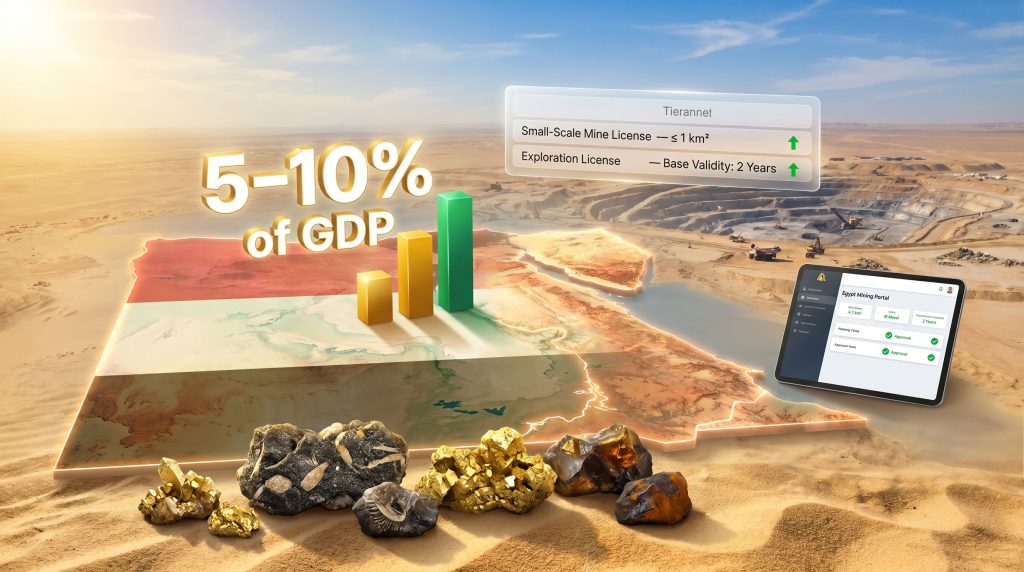
Egypt's Eastern Desert and Sinai Peninsula host one of Africa's most geologically varied subsurface environments, with documented occurrences of gold, phosphate, iron ore, copper, and rare earth elements across Precambrian basement rocks that remain substantially underexplored by modern standards. Despite this endowment, the sector's contribution to national economic output has lagged far behind its theoretical capacity. The government's publicly stated ambition to raise mining's share of GDP to 6% is an ambitious target that requires more than incremental tinkering with existing rules. It demands a structural overhaul of the licensing architecture itself.
The Cabinet's approval of amendments to the executive regulations issued under Prime Ministerial Decree No. 108 of 2020, announced in a session chaired by Prime Minister Mostafa Madbouly, represents the most operationally significant update to Egypt's mining regulatory framework since the passage of Mineral Resources Law No. 198 of 2014 and its subsequent revision under Law No. 145 of 2019.
Understanding what has actually changed, and what it means for investors and operators, requires examining each reform layer on its own terms.
When big ASX news breaks, our subscribers know first
A Legislative Cycle Built in Layers: Egypt's Mining Law Reform Trajectory
The current amendments do not exist in isolation. They represent the third substantive wave of reform in a reform cycle that began with the foundational statute more than a decade ago. Furthermore, similar patterns of layered regulatory evolution can be observed across other resource-rich jurisdictions, where exploration licensing reforms have progressively aligned statutory intent with operational practice.
| Reform Layer | Instrument | Primary Function |
|---|---|---|
| Foundation Law | Mineral Resources Law No. 198/2014 | Established the sector's initial legal framework |
| Structural Amendment | Law No. 145/2019 | Began transitioning MRMIA toward a commercial mandate |
| Operational Framework | Executive Regulations No. 108/2020 | Set licensing procedures and operational rules |
| Current Amendments | 2026 Cabinet-Approved Decree | Expanded eligibility, restricted zones, digital licensing, state equity participation |
Each layer has progressively narrowed the gap between statutory intent and operational reality. Law No. 145 of 2019 was particularly significant because it began converting the Egyptian Mineral Resources and Mining Industries Authority, known as MRMIA or EMRA, from a purely administrative regulator into a commercially enabled entity capable of forming partnerships with private capital. The 2026 amendments translate those higher-order statutory changes into workable licensing procedures that operators can actually engage with.
A reform cycle that spans more than a decade and involves three distinct legislative instruments suggests this is strategic sequencing, not reactive policymaking. Each layer builds operational specificity on top of the prior structural foundations.
New Licensing Eligibility: The Landowner Pathway and What It Changes
One of the more practically significant provisions in the amended framework creates a direct licensing pathway for registered landowners. Previously, access to exploration and exploitation licenses flowed primarily through MRMIA's standard commercial channels. Under the revised rules, landowners who hold formally registered contracts over their land may now apply directly to MRMIA for exploration or exploitation licenses over their own property.
The conditions attached to this pathway are meaningful. Applicants must satisfy both legal ownership documentation requirements and technical competency standards set by the authority. Applications must be accompanied by the prescribed fees, required supporting documents, and a technically validated report approved by MRMIA. Licenses granted through this channel are issued on a personal basis to the landowner and carry an exemption from land rental obligations.
This exemption is not a minor administrative detail. Land rental costs have historically formed a material component of operating expenses for small-scale operators in frontier mining jurisdictions. Removing this cost layer deliberately lowers the participation threshold, creating a financial incentive for landowners to formalise informal or artisanal operations rather than operating outside the licensed system.
Formalisation matters to investors for reasons that go beyond compliance optics. When artisanal and small-scale mining activity moves into the licensed ecosystem, it generates data: production volumes, ore characterisation, geological observations. That data feeds into national geological databases, improving the quality of information available to larger operators conducting prefeasibility work. In this sense, the landowner licensing pathway serves a geological intelligence function as much as a revenue-generation one.
The Tiered Licensing Structure: Scale Thresholds and Approval Pathways
The amendments also formalise a tiered licensing structure that distinguishes between small-scale and large-scale mining operations based on area thresholds, with different approval authorities and procedural requirements at each level.
| License Category | Area Threshold | Issuing Authority | Per-Entity Limit | Base Validity |
|---|---|---|---|---|
| Small-scale mine license | Up to 1 km² | MRMIA Board of Directors | 1 mine per private legal entity | Not specified in source |
| Large-scale mine license | More than 1 km² | Relevant Minister (post-board approval) | Subject to ministerial discretion | Not specified in source |
| Exploration license | Variable | MRMIA or competent authority | Renewable up to 3 times | 2 years |
Exploration licenses carry a base validity of two years, with two standard renewals available for equivalent periods. A third renewal is possible but requires documented technical justification from the applicant. This creates a maximum exploration license duration of up to eight years for operators who can demonstrate sufficient technical grounds for continued work.
The annual per-square-kilometre exploration expenditure commitment attached to licenses is a mechanism familiar to investors with experience in Australian or Canadian mining jurisdictions. In Australia, for instance, a comprehensive critical minerals strategy has similarly employed work commitment obligations to prevent speculative land banking. By requiring licensees to spend against their holdings each year, the framework creates a use-it-or-lose-it dynamic that keeps tenement areas in active exploration rather than sitting dormant on a company's balance sheet.
The Egypt Mining Portal adds a parallel digital submission channel alongside traditional manual applications. This dual-track approach acknowledges that digital infrastructure adoption across the operator base will be uneven, while building the foundation for a fully digitised permitting system over time. The portal also supports data standardisation, which connects directly to the government's broader ambition to update national geological databases through its planned nationwide airborne geochemical survey mapping exercise — the first of its kind since 1984.
Restricted Zones, Hard Deadlines, and the Geometry of Prohibition
A codified restricted zone framework replaces the previously discretionary approach to licensing prohibitions. Under the amended regulations, mining licenses are categorically prohibited in the following categories unless prior approvals are secured from the relevant government authorities:
- Heritage and cultural sites including archaeological zones and formally registered historical areas
- Ecological protection areas such as designated nature reserves
- Urban and community zones covering city boundaries, village lands, markets, and places of worship
- Funerary zones including cemeteries and burial grounds
- Critical infrastructure corridors adjacent to airports, national highways, railways, petroleum pipelines, irrigation canals, dams, and water reservoirs
Where approvals from the relevant authorities are required, those bodies are legally obligated to respond within 30 days of receiving a request.
The 30-day mandatory response window is one of the most investor-relevant provisions in the entire package. In frontier market mining jurisdictions, approval timelines for restricted zone clearances have historically been open-ended, creating capital planning uncertainty that deters early-stage investment. Turning this into a legally bounded procedure materially changes the risk calculus during prefeasibility.
The practical significance of the infrastructure exclusions deserves attention from an operational geology standpoint. Egypt's irrigation canal network, particularly in the Nile Delta and along the Nile Valley, covers an extensive geographic footprint. Operators evaluating project areas will need to map their proposed tenements carefully against these exclusion zones before committing exploration capital.
One important ambiguity in the current framework concerns the legal consequence of non-response within the 30-day window. Whether silence from a relevant authority constitutes deemed approval or triggers an escalation mechanism is not clarified in the source material and will require further regulatory guidance from MRMIA or the implementing decrees.
MRMIA as Market Participant: The State Equity Participation Framework
The most structurally consequential provision for sophisticated investors may be the expansion of MRMIA's institutional mandate to include equity participation in mining and exploration companies. The amendments authorise MRMIA to establish or acquire stakes in specialised entities conducting exploration, exploitation, and mining activities both within Egypt and internationally, with the public sector required to retain a minimum 10% ownership stake in any such entity.
This creates a dual-mandate architecture for MRMIA: simultaneously a licensing regulator and a commercial market participant. The tension inherent in this structure is not unique to Egypt. However, managing the potential conflicts of interest between the regulatory function and the commercial function will require transparent internal governance protocols that the current source material does not detail.
For foreign operators, the 10% public sector floor introduces a structural consideration into partnership economics. On one hand, having MRMIA as a co-investor can simplify regulatory navigation and reduce sovereign risk exposure by aligning the state's financial interests with project success. On the other hand, state participation at any level introduces governance complexity, particularly around decision-making timelines, dividend policy, and exit mechanisms. Consequently, these state-affiliated entities must comply with the same financial, technical, and operational regulations applicable to all sector participants, which prevents regulatory arbitrage by MRMIA-linked companies.
The Advisory Committee: Institutionalising Technical Governance
Alongside the equity participation provisions, the amendments establish a ministerially appointed advisory committee to provide independent technical guidance to the sector. The committee will be chaired by a representative of the Ministry of Petroleum and Mineral Resources and must convene at a minimum of four times per year.
The mandatory meeting cadence is more significant than it appears on the surface. In many frontier mining jurisdictions, advisory or oversight bodies exist on paper but meet infrequently and exercise little practical influence. A legally mandated quarterly meeting schedule creates an institutional accountability rhythm. International mining investors and multilateral financing institutions typically look for precisely this kind of formalised technical governance architecture as a credibility signal before committing capital to frontier market projects.
The next major ASX story will hit our subscribers first
Egypt in Africa's Competitive Mining Investment Landscape
Egypt is competing for exploration and development capital against a field of African jurisdictions with considerably more established regulatory track records, including South Africa, Ghana, Tanzania, and the Democratic Republic of Congo. In addition, the broader regional context is evolving rapidly, with mining exploration licences across the Middle East and North Africa attracting significant international capital flows. Each of these jurisdictions has accumulated decades of investor experience, institutional precedent, and geological data that Egypt's sector currently lacks at scale.
However, Egypt's differentiated competitive advantages are worth examining carefully:
- Geographic positioning: Proximity to European and Middle Eastern commodity markets reduces logistics costs for processed mineral exports compared to landlocked African competitors
- Existing port infrastructure: Red Sea port capacity provides direct export access to Asian and European markets
- Established industrial base: Egypt's manufacturing and processing sectors provide potential downstream linkage opportunities for mineral inputs
- Geological upside: The fact that the last nationwide airborne survey dates to 1984 means the country's mineral inventory is based on legacy data, creating genuine discovery potential rather than exhausted prospectivity
The planned aerial mineral survey will be the first comprehensive national survey in more than four decades. For context, modern airborne geophysical surveys using multi-parameter sensor packages can identify magnetic, radiometric, and electromagnetic anomalies at resolution levels that 1984-era technology could not achieve. The geological intelligence generated by this survey has the potential to materially revalue Egypt's exploration opportunity set.
The Cabinet's simultaneous approval of contracts with Moody's and Fitch Ratings for sovereign credit rating services signals a parallel effort to strengthen Egypt's international financial standing. Sovereign credit ratings directly influence the cost of capital for project financing, meaning a ratings improvement translates into lower borrowing costs not just for the state but for mining companies financing projects within Egyptian jurisdiction.
Recent bilateral discussions between Egypt and Turkey on mining and energy cooperation add a further dimension, potentially creating pathways for technical knowledge transfer and cross-border geological collaboration. Furthermore, the broader regional push for a structured mining claims framework that balances state interests with private investment offers useful comparative precedents for Egypt's ongoing institutional development.
What Investors Need to Watch: Risks, Uncertainties, and Implementation Variables
The coherence of the reform package is notable. These Egypt mining law amendments function as an interconnected system rather than isolated policy changes, with the landowner pathway, the tiered licensing structure, the restricted zone framework, the digital portal, and the MRMIA equity provisions all designed to work in concert. That said, several implementation-dependent risks deserve investor attention:
- Inter-agency coordination quality: The effectiveness of the 30-day restricted zone approval window depends entirely on coordination capacity between MRMIA and the multiple agencies that must respond, which has historically been a friction point in Egyptian administrative processes
- Technical justification subjectivity: The third-cycle exploration license renewal requires documented technical justification, and until MRMIA publishes clear criteria, this introduces evaluator discretion into what should be a procedural determination
- MRMIA dual-mandate conflicts: The combination of regulatory authority and commercial equity participation within a single institution creates structural conflicts that will require transparent governance protocols to manage credibly
- Portal adoption and reliability: The Egypt Mining Portal's operational capacity, uptime reliability, and data security standards will determine whether digital submission becomes a genuine efficiency gain or an additional point of friction
Disclaimer: This article is for informational purposes only and does not constitute financial or investment advice. Prospective investors should conduct independent due diligence and seek professional advice before making any investment decisions related to Egyptian mining assets or the broader sector.
Frequently Asked Questions: Egypt Mining Law Amendments
Who qualifies as a landowner under the amended regulations?
Qualifying landowners are those who hold formally registered contracts over the relevant land, meaning legally documented and officially recognised title. Informal or unregistered ownership claims do not meet the eligibility threshold. Applicants must also satisfy the technical competency requirements established by MRMIA.
What is the maximum exploration license duration under the new framework?
An exploration license is initially valid for two years. Two standard renewals of equivalent duration are available. A third renewal extending to a potential total of eight years is possible, subject to the applicant providing documented technical justification for continued work.
What happens if a restricted zone authority does not respond within 30 days?
The regulations require relevant authorities to respond within 30 days of receiving an approval request. The specific legal consequence of non-response within this window is not clarified in the current source material and will require further implementing guidance from MRMIA.
Can foreign companies apply for mining licenses in Egypt?
The landowner licensing pathway described in the amendments is oriented toward domestic applicants with registered land title. Foreign companies would typically engage through MRMIA's standard commercial licensing processes or through partnership structures with foreign investors, where the public sector retains a minimum 10% stake.
How does the advisory committee differ from MRMIA's existing governance structure?
The advisory committee is a consultative body rather than a decision-making authority. It provides technical opinions to inform ministerial and board-level decisions but holds no independent licensing or approval powers. Its legally mandated minimum meeting schedule of four times annually ensures structured engagement rather than ad hoc consultation. For broader context on Egypt's mineral authority transformation into an economic body, recent coverage provides useful institutional background.
What does the Egypt Mining Portal actually do?
The portal provides a digital channel through which applicants can submit exploration license applications electronically, as an alternative to manual submission. It supports document submission, fee payment, and application tracking for eligible mining licenses and forms part of Egypt's broader administrative digitisation agenda.
Want to Track the Next Major Mineral Discovery Before the Market Does?
Egypt's mining law overhaul is one of many signals that frontier mineral exploration is accelerating globally — and Discovery Alert's proprietary Discovery IQ model ensures subscribers receive real-time ASX mineral discovery alerts the moment they hit the market, turning complex geological data into actionable investment insights. Explore why historic mineral discoveries have generated extraordinary returns for early movers, and begin your 14-day free trial today to position yourself ahead of the broader market.