May 17, 2026
Egypt mining licences approval represents a critical component of the country's strategic approach to balancing resource development with national economic objectives. Furthermore, countries worldwide are refining their licensing mechanisms to align mineral extraction activities with broader economic development objectives, rather than simply maximizing extraction volumes. This shift reflects growing recognition that mineral resources serve as critical inputs for downstream industrial capacity, particularly in emerging economies seeking to strengthen their manufacturing sectors.
Modern mining regulatory systems face pressure to streamline approval processes while maintaining rigorous environmental and social compliance standards. Additionally, jurisdictions across Africa, the Middle East, and other developing regions are implementing specialized committee structures and multi-stage evaluation procedures. These frameworks typically distinguish between exploration activities, which involve resource assessment and geological mapping, and exploitation operations that authorize active mineral extraction, as outlined in mining permitting essentials.
Strategic Mineral Development Through Regulatory Frameworks
Egypt's mining sector demonstrates how specialized regulatory committees can process multiple license categories efficiently while maintaining oversight standards. During the fourth quarter of 2025, the country's Ministry of Petroleum and Mineral Resources approved 53 mining-related decisions through its Board of Directors of the Mineral Resources and Mining Industries Authority. This comprehensive approval cycle encompassed various license types designed to support different stages of mineral development.
Multi-Stage Licensing Architecture for Resource Development
The Egyptian licensing framework distinguishes between three primary authorization categories, each serving specific operational requirements. Exploration licenses grant rights for geological surveys, resource assessment, and initial site evaluation without permitting actual extraction activities. These preliminary authorizations allow companies to determine the commercial viability of potential mining operations before committing to larger-scale development investments.
Exploitation licenses represent the next phase, authorizing active mineral extraction and processing operations. These permits require more comprehensive compliance documentation, including detailed environmental impact assessments and social responsibility protocols. However, the regulatory structure ensures that companies demonstrate both technical capability and financial resources necessary for sustainable mining operations.
License renewal procedures provide ongoing oversight mechanisms for established operations. The renewal process includes performance evaluations, compliance reviews, and assessments of continued alignment with national mineral development priorities. Consequently, this systematic approach enables regulatory authorities to maintain quality control over mining activities while supporting productive long-term operations.
Specialized Committee Evaluation Procedures
Egypt's regulatory system employs specialized ministerial committees to conduct technical evaluations of license applications. These committees integrate multiple assessment criteria, including geological feasibility, environmental compliance, and social impact considerations. The multi-disciplinary approach ensures that licensing decisions reflect comprehensive analysis rather than single-factor evaluations.
The committee structure includes environmental and social impact assessment integration, aligning with international best practices observed in established mining jurisdictions. Furthermore, this comprehensive evaluation methodology helps identify potential operational challenges early in the approval process, reducing the likelihood of subsequent regulatory complications or community relations issues.
When big ASX news breaks, our subscribers know first
Mineral Portfolio Targeting Strategic Industrial Sectors
The Q4 2025 licensing decisions revealed deliberate prioritization of minerals that support established Egyptian manufacturing sectors. Rather than focusing exclusively on high-value export commodities, the regulatory approach emphasizes minerals with strong domestic industrial demand. For instance, comprehensive mineral exploration insights demonstrate how strategic planning can enhance resource development outcomes.
Industrial Mineral Distribution Across License Categories
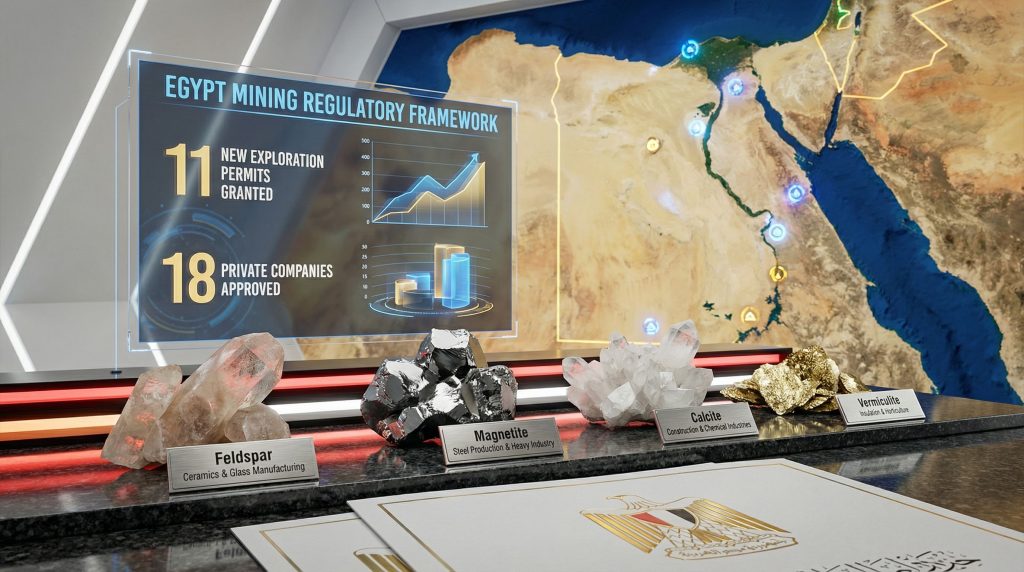
The approved exploration licenses covered 11 distinct mineral types, including vein feldspar, calcite, vermiculite, wadi feldspar, magnetite, iron oxide, and talc. These minerals feed directly into Egypt's ceramics, construction, pharmaceutical, and heavy industry sectors, demonstrating regulatory alignment with domestic manufacturing requirements.
Exploitation licenses were granted for fluorite, iron oxide, and phosphate operations, representing both new operational capacity and expansion of existing production capabilities. The distribution suggests ministerial prioritization of minerals with established market demand and proven industrial applications within Egypt's economy.
| Mineral Category | Primary Industrial Application | Regulatory Priority Level |
|---|---|---|
| Iron Oxide | Cement Production & Construction | High |
| Phosphate | Fertilizer Manufacturing | High |
| Feldspar (Vein & Wadi) | Ceramics & Glass Industries | High |
| Glass Sand | Manufacturing & Foundry | High |
| Magnetite | Steel & Heavy Industry | Medium |
| Talc | Pharmaceuticals & Cosmetics | Medium |
| Vermiculite | Insulation & Agriculture | Medium |
| Calcite | Construction & Chemicals | Medium |
| Fluorite | Industrial Chemicals | Medium |
License Renewal Patterns Indicating Operational Success
The 26 exploitation license renewals covered phosphate, wadi feldspar, iron oxide, glass sand, and vein feldspar operations. This renewal activity indicates successful operational performance and continued compliance with regulatory standards among existing mining enterprises. Moreover, the concentration of renewals in these specific minerals suggests sustained market demand and profitable operational conditions.
Renewal approvals also reflect regulatory confidence in established operators' ability to maintain environmental and social compliance standards. The systematic renewal process enables continuity for productive operations while maintaining oversight mechanisms to ensure ongoing adherence to regulatory requirements.
Private and Public Sector Balance in Mining Development
The licensing approvals benefited 24 companies total, with 18 private-sector firms receiving various authorizations alongside 6 public-sector and public business sector entities. This distribution indicates regulatory openness to private sector participation while maintaining strategic government involvement in key resource development areas.
Private Sector Mining Investment Integration
Private companies received the majority of licensing approvals, suggesting government recognition of private sector technical capabilities and financial resources for effective mining operations. The private sector emphasis reflects broader economic policies encouraging private investment in resource development while maintaining regulatory oversight.
The licensing framework appears to apply consistent compliance standards across all entity types, with both private and public operators subject to identical environmental, social, and technical evaluation criteria. This standardized approach helps ensure operational quality regardless of ownership structure while supporting competitive market conditions.
Strategic Government Participation Through Public Entities
The inclusion of public business sector entities in licensing approvals indicates government retention of direct involvement in strategic mineral development. These entities typically combine state oversight with commercial operational structures, enabling government participation in resource development while maintaining market-oriented efficiency standards.
Public sector involvement may be particularly significant for minerals with national security implications or those requiring substantial infrastructure investments that exceed private sector capabilities. However, the balanced approach allows governments to maintain strategic control while leveraging private sector expertise and capital resources.
Regulatory Alignment with National Industrial Development
Egypt's Ministry of Petroleum and Mineral Resources explicitly connected the licensing strategy to broader industrial development objectives. The ministry emphasised that licensing decisions were designed to support industrial localisation, strengthen integration between mining and industrial sectors, and contribute to sustainable production insights.
Supply Chain Security for Manufacturing Industries
The approved minerals directly support key Egyptian manufacturing sectors, including fertiliser production from phosphate resources, glass manufacturing from glass sand deposits, ceramics production from feldspar varieties, and cement manufacturing from iron oxide supplies. This strategic alignment helps reduce import dependence for critical industrial inputs while supporting downstream manufacturing capacity.
The regulatory framework specifically targets minerals with established domestic industrial utilisation, ensuring that mining development contributes to broader economic objectives beyond raw material extraction and export revenue generation.
Integration Between Extractive and Processing Industries
The licensing approach encourages vertical integration between mining operations and downstream processing facilities. This integration strategy helps capture additional value from mineral extraction while supporting domestic manufacturing capacity development. Companies receiving licenses typically demonstrate capabilities for industrial integration rather than focusing exclusively on raw material production.
The emphasis on sectoral integration reflects recognition that sustainable mining development requires strong linkages between extraction activities and domestic industrial capacity. This approach helps ensure that mineral resources contribute to long-term economic development rather than serving primarily as export commodities.
Regulatory Compliance and Environmental Standards
All Egypt mining licences approval procedures were processed through established regulatory frameworks that include comprehensive compliance requirements. The Ministry emphasised that decisions met applicable laws and regulations while supporting investment promotion and value-added mineral resource development objectives.
Environmental and Social Impact Assessment Integration
The regulatory process incorporates environmental and social impact assessments as standard components of license evaluation procedures. These assessments help identify potential operational challenges and ensure that mining activities align with community development objectives and environmental protection standards. In addition, modern techniques such as in-situ leaching benefits are being evaluated for their environmental advantages.
The integrated assessment approach reflects international best practices for responsible mining development. Companies must demonstrate environmental management capabilities and social responsibility protocols as prerequisites for license approval, ensuring that mining operations contribute positively to local community development.
Ongoing Monitoring and Compliance Verification
License holders remain subject to ongoing monitoring and compliance verification procedures throughout their operational periods. These oversight mechanisms help ensure continued adherence to environmental, social, and technical standards while providing early warning systems for potential operational issues.
The systematic monitoring approach enables regulatory authorities to maintain quality control over mining activities while supporting operators through guidance and technical assistance when needed. This collaborative oversight model helps promote sustainable mining practices while supporting operational success.
Investment Implications and Economic Development Outcomes
The licensing approvals represent significant investment opportunities for both domestic and international mining companies interested in Egyptian mineral resources. The regulatory clarity provided through systematic licensing procedures helps reduce investment uncertainty while supporting long-term operational planning.
Revenue Generation Through Multiple Channels
Mining operations generate government revenue through multiple channels, including licensing fees, royalty payments, corporate taxation, and employment-related economic activity. The diversified revenue structure helps ensure that mineral development contributes broadly to government finances while supporting regional economic development.
The strategic focus on minerals with domestic industrial demand helps create multiplier effects throughout the economy. Mining operations supporting local manufacturing create additional employment and economic activity beyond direct extraction activities, amplifying the overall economic impact of resource development.
Infrastructure Development Synergies
Mining projects often require substantial infrastructure investments, including transportation facilities, power systems, and water management infrastructure. These investments frequently provide benefits beyond immediate mining operations, supporting broader regional development and improving infrastructure access for other economic activities.
The strategic mineral selection process considers infrastructure requirements and development synergies, helping ensure that mining investments contribute to broader regional development objectives. This integrated approach helps maximise the development impact of mineral extraction activities.
The next major ASX story will hit our subscribers first
Regulatory Framework Efficiency and Global Competitiveness
Egypt's licensing framework demonstrates several characteristics that align with international best practices for mining regulation. The specialised committee structure, multi-stage evaluation procedures, and integrated compliance assessments reflect systematic approaches observed in established mining jurisdictions worldwide. Furthermore, understanding mining industry evolution helps contextualise these regulatory developments.
Streamlined Processing Through Specialised Committees
The use of specialised ministerial committees helps streamline license evaluation procedures while maintaining thorough assessment standards. These committees bring together technical expertise from multiple disciplines, enabling comprehensive evaluation without excessive bureaucratic delays.
The committee structure also provides consistency in evaluation criteria and decision-making procedures, helping ensure that similar applications receive comparable treatment. This standardised approach reduces uncertainty for potential investors while maintaining quality control over licensing decisions.
Transparency and Predictability in Regulatory Decisions
The systematic announcement of licensing decisions and explanation of evaluation criteria helps provide transparency and predictability for potential investors. Clear communication of regulatory requirements and decision rationales enables companies to prepare more effective applications while understanding the factors that influence licensing outcomes.
Transparent regulatory procedures help build investor confidence while supporting competitive market conditions. Companies can make informed investment decisions based on clear understanding of regulatory requirements and evaluation criteria, reducing investment uncertainty and supporting long-term operational planning.
Future Development Prospects and Sector Expansion
The Q4 2025 licensing activity suggests continued government commitment to systematic mineral development aligned with national economic objectives. The balanced approach between private and public sector participation, combined with emphasis on domestic industrial integration, provides a foundation for sustainable sector growth.
Capacity Building and Technical Development
Ongoing mining development helps build domestic technical capabilities and operational expertise within Egypt's mineral sector. The experience gained through current operations provides a foundation for more complex future projects while supporting technology transfer and skills development. Additionally, Egypt's mining reforms are creating a more conducive investment environment.
The regulatory framework's emphasis on compliance standards and operational quality helps ensure that mining development contributes to broader capacity building objectives. Companies operating under these standards develop capabilities that support both domestic operations and potential regional expansion opportunities.
Regional Integration and Export Development
While the current licensing strategy emphasises domestic industrial supply, successful operations may eventually support regional export development and broader mineral trade integration. The operational experience and infrastructure development resulting from domestic-focused mining can provide platforms for expanded regional market participation. In fact, Egypt's incentive packages for Australian mining companies demonstrate the country's commitment to attracting international expertise.
Disclaimer: This analysis is based on publicly available information about Egypt's mining licensing activities. Investment decisions should consider comprehensive due diligence including detailed regulatory requirements, market conditions, operational risks, and financial projections. Mining operations involve significant technical, environmental, and market risks that may affect operational success and financial returns. Regulatory frameworks and licensing requirements may change, affecting operational conditions and investment outcomes.
Frequently Asked Questions About Egypt Mining Licences Approval
What criteria determine Egypt mining licences approval decisions?
Egypt mining licences approval follows a systematic evaluation process conducted by specialised ministerial committees. These committees assess applications based on technical feasibility, environmental compliance, social impact considerations, and alignment with national mineral development priorities. The evaluation includes geological assessments, financial capability verification, and integration with domestic industrial requirements.
How does Egypt's mining regulatory process ensure operational compliance?
The regulatory framework includes ongoing monitoring and compliance verification procedures throughout mining operations. License holders must maintain environmental management standards, social responsibility protocols, and technical operational requirements. Regular compliance reviews and renewal procedures provide oversight mechanisms to ensure continued adherence to regulatory standards.
What types of minerals receive priority in Egypt mining licences approval?
Current licensing priorities focus on minerals supporting established Egyptian manufacturing sectors, including iron oxide for cement production, phosphate for fertiliser manufacturing, feldspar for ceramics, and glass sand for manufacturing industries. This strategic approach emphasises minerals with strong domestic demand and industrial integration opportunities.
How long does the Egypt mining licences approval process typically take?
The licensing timeline varies based on application complexity and mineral type, though the specialised committee structure is designed to streamline evaluation procedures while maintaining thorough assessment standards. The multi-stage process includes technical evaluation, environmental assessment, and ministerial board approval, with consistent evaluation criteria applied across all applications.
Seeking Your Next Investment Opportunity in ASX Mining Discoveries?
Discovery Alert's proprietary Discovery IQ model delivers instant notifications on significant ASX mineral discoveries, empowering subscribers to identify actionable trading opportunities ahead of the broader market. Explore how major mineral discoveries have delivered exceptional returns throughout mining history and begin your 30-day free trial today to position yourself at the forefront of mining investment opportunities.