July 12, 2026
Why Fertilizer Supply Chains Are Suddenly Rewriting the Global Price Map
When geopolitical disruption intersects with agricultural commodity cycles, the effects rarely stay contained to a single region or product category. The fertilizer market is experiencing exactly this dynamic in mid-2026, as supply shocks, record input costs, and concentrated procurement activity from major importers converge to reshape pricing across phosphate and nitrogen products simultaneously. Within this environment, the Egypt NCIC fertilizer tender for May has become one of the most closely watched barometers of where global fertilizer prices are heading next.
When big ASX news breaks, our subscribers know first
Understanding NCIC's Role as a Global Fertilizer Price Signal
NCIC operates across a broad product range that few state-linked exporters can match in a single offering. Its product slate spans diammonium phosphate (DAP), triple superphosphate (TSP), single superphosphate (SSP), urea, and water-soluble sulphate of potash (SOP), giving its tenders an unusually wide coverage across the phosphate, nitrogen, and potash fertilizer segments. Operations are anchored at the Fayoum production facility in Egypt's interior, with all bulk products exported through Ain Sokhna on the Red Sea coast.
This provides direct access to both the Suez Canal corridor and the broader Indian Ocean trade network. The frequency and consistency of NCIC's tender cycle, running approximately every two to four weeks with rolling monthly loading windows, means the market receives regular price discovery signals rather than waiting for infrequent benchmark transactions. Furthermore, commodity desks, importers, and trade analysts across Africa, Asia, and Europe monitor NCIC tender outcomes because a single award simultaneously prices five distinct fertilizer categories in one transparent exercise.
Egypt NCIC Fertilizer Tender for May 2026: Full Product Breakdown
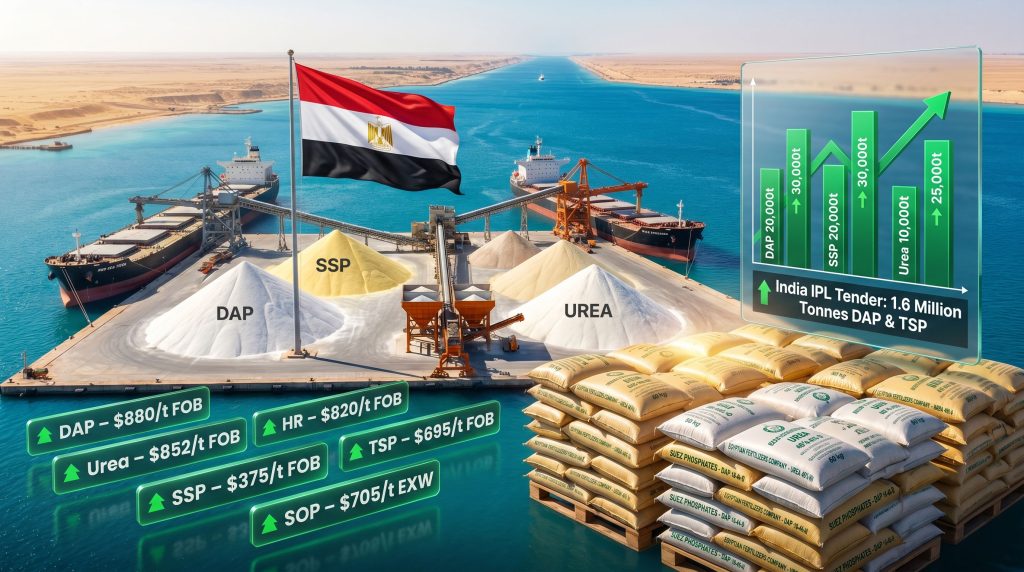
The Egypt NCIC fertilizer tender for May 2026 covers a combined 96,000 tonnes across five product categories, representing a meaningful escalation from recent tender volumes. The full offering is detailed below:
| Product | May 2026 Volume Offered | Previous Award (April) | Previous Achieved Price |
|---|---|---|---|
| DAP | 30,000t | 20,000t (Apr 20) | Up to $880/t FOB |
| TSP | 10,000t | 10,000t (Apr 20) | Up to $695/t FOB |
| SSP | 30,000t | 20,000t (Apr 27) | $340-$375/t FOB Ain Sokhna |
| Urea | 25,000t | 10,000t (Apr 27) | Up to $852/t FOB Ain Sokhna |
| Water-Soluble SOP | 1,000t | 1,000t (Apr 20) | Up to $705/t ex-works |
The tender closes on 4 May 2026, with all cargoes designated as port-ready by 7 May 2026. Buyers must complete loading within 27 days of invoice issuance, a standard commercial structure that compresses the operational window and favours buyers with established freight relationships.
A structural distinction applies to SOP pricing: while every other product in the slate is priced on a free-on-board (FOB) basis from Ain Sokhna port, SOP is priced ex-works from the Fayoum plant in 25kg bags. This places logistics responsibility on the buyer from the production facility outward, reflecting SOP's specialty positioning as a premium horticultural input rather than a bulk commodity.
Volume Escalation: What the April-to-May Jump Reveals
The shift in offered volumes between NCIC's April and May tenders is not uniform across products, and the variation itself carries analytical weight. According to recent reporting by Argus Media, NCIC's SSP and urea sales in late April confirmed firm prices across both categories, reinforcing the case for enlarged May volumes.
- DAP increases from 20,000t awarded in April to 30,000t offered in May, a 50% uplift in offered tonnage
- SSP rises from 20,000t awarded on 27 April to 30,000t offered in May, also a 50% increase, consistent with demonstrated buyer appetite including 15,000t absorbed by Australian importers at the upper price band
- Urea shows the most dramatic shift: from a partial award of only 3,000t from 10,000t offered on April 20, to a full 10,000t award on April 27 at the higher price of $852/t, to a 25,000t offering in May representing a 150% increase over the most recently awarded quantity
- TSP held steady at 10,000t, reflecting a consistent but narrower buyer base
- SOP maintained at 1,000t, with consistent full awards suggesting demand absorption at current price levels
The urea trajectory deserves particular attention. The April 20 partial award at up to $830/t, followed immediately by a full award on April 27 at up to $852/t, suggests that the $22/t incremental increase cleared the demand threshold. NCIC's decision to offer 25,000t in May, against a backdrop of global supply tightening, indicates the producer is actively testing whether buyer tolerance extends meaningfully above the $852/t mark.
The pattern of escalating volume offers paired with full awards in successive tenders is a textbook supply-side price discovery mechanism. NCIC is effectively using tender frequency as a real-time demand elasticity test.
Price Dynamics Across NCIC's Five Product Categories
DAP: Elevated Pricing Supported by Trade Disruption
NCIC's April DAP award at up to $880/t FOB sits in notable contrast to the US Gulf (NOLA) benchmark of approximately $710/short ton FOB in late April 2026. India's cfr DAP price of approximately $865/t cfr narrows the gap when freight is accounted for, suggesting Egyptian DAP remains competitively positioned for buyers in South and Southeast Asia. The divergence between NOLA and Egyptian pricing partly reflects the structural constraints imposed by countervailing duties on Moroccan and Russian phosphate imports into the US, which have suppressed import volumes and kept American prices lower relative to export market equivalents.
Consequently, US fertilizer import reliance continues to shape how global phosphate flows are distributed, with American buyers increasingly isolated from the pricing signals being set in Egyptian tender markets.
Urea: The Most Directionally Significant Product in the May Tender
The sequential price progression in urea across three consecutive NCIC tender cycles makes this the most directionally significant product in the May offering. A partial award at $830/t followed by a full award at $852/t, followed by a substantially enlarged volume offering, encodes a clear message: NCIC believes market depth exists above $852/t and intends to discover how far above.
Geopolitical disruption in the Middle East has tightened seaborne urea availability from Gulf producers, and Egypt's position outside the Hormuz corridor provides a supply chain advantage that is actively being priced into FOB assessments. Furthermore, supply chain disruptions stemming from broader trade tensions have amplified demand for alternative origins, with Egyptian supply increasingly viewed as a reliable non-Hormuz source.
SSP: Australia's Appetite Signals Broad Geographic Demand
The April 27 SSP result deserves closer examination than its modest price range might suggest. The $340-$375/t FOB Ain Sokhna price band, with Australian buyers accepting 15,000t at the upper $375/t level, demonstrates that demand for lower-analysis phosphate fertilizers extends well beyond Egypt's traditional Mediterranean and African buyers.
SSP serves cost-sensitive agricultural markets where lower phosphorus content is appropriate for soil conditions or economic constraints. For instance, the Ammaroo phosphate project in Australia highlights growing domestic interest in securing phosphate supply chains independently, which helps explain Australian buyer activity in Egyptian tenders. The geography of buyers absorbing the May offering will provide additional market intelligence about which regions are most aggressively seeking phosphate supply outside the disrupted Hormuz corridor.
TSP and SOP: Stable Specialty Demand
TSP's consistent 10,000t volume and full award across consecutive tenders reflects a stable buyer base seeking higher-analysis phosphate without DAP's nitrogen component, typically for soil amendment applications where nitrogen is already adequately supplied. SOP's 1,000t volume, full awards, and ex-works specialty pricing at up to $705/t confirm its premium positioning within the horticultural and high-value crop segment, where potassium-sensitive crops command product premiums that justify the price differential over standard MOP-based potassium.
The Sulphur Shock: How a Record-High Input Cost Creates a Structural Price Floor
One of the least-discussed but most consequential forces shaping NCIC's May pricing is the extraordinary disruption to global sulphur markets stemming from the ongoing conflict affecting the Strait of Hormuz. QatarEnergy Marketing set its May Qatar Sulphur Price (QSP) at $740/t FOB Ras Laffan/Mesaieed, a level that represents a record high since Argus Media began tracking the QSP in 2013.
The previous record stood at $490/t FOB, set in August 2022, meaning the May 2026 level carries a $250/t premium over any previously recorded benchmark. The downstream implications for phosphate fertilizer production are substantial. Sulphur is a primary input in sulphuric acid production, which is in turn essential for converting phosphate rock into processed fertilizer products including DAP, TSP, and SSP. Elevated sulphur costs therefore establish a higher cost floor beneath phosphate fertilizer prices globally.
Beyond fertilizer markets, the same sulphur price shock is creating significant disruption in the battery materials sector. Sulphur is now estimated to account for 35-40% of high-pressure acid leaching (HPAL) operating costs at nickel processing facilities in Indonesia, compared with a historical norm closer to 25%. This cross-sector impact illustrates how deeply the sulphur supply shock is reverberating through adjacent commodity chains, reinforcing the broader critical minerals demand pressures already reshaping global supply strategies.
Indonesia sourced approximately 75% of its 5.34 million tonne sulphur import requirements from the Middle East in the prior year, making it acutely exposed to the supply disruption. Indonesia's sulphur cfr prices reached $948/t on 23 April 2026, up by $434/t from $514/t cfr in late February, representing an 84% increase in approximately two months.
One major battery materials producer responded by placing half its MHP capacity into temporary care and maintenance from 1 May, citing unsustainable input costs. For NCIC specifically, Egypt's access to domestically produced ammonia via its own natural gas resources insulates its nitrogen fertilizer economics somewhat from the Hormuz corridor disruption, positioning Egyptian production economics more favourably relative to Middle Eastern peers.
The next major ASX story will hit our subscribers first
India's Procurement Posture Validates the Demand Environment
Concurrent procurement activity from India's fertilizer importers provides the most compelling external validation of NCIC's elevated May pricing ambitions. Two separate Indian procurement exercises are closing within the same week as NCIC's tender:
- India's RCF issued a tender seeking 35,000t of phosphate rock with a minimum P2O5 content of 35%, alongside two 20,000t lots of DAP or MAP across multiple accepted grades (DAP 15.5-44, DAP 18-46, MAP 10-50, MAP 11-52), plus 50,000t of crystalline MOP, all for delivery to Mumbai and closing 9 May 2026
- India's IPL, acting collectively on behalf of the Indian fertilizer import industry, is running a procurement tender for 1.6 million tonnes of DAP and TSP, closing 7 May 2026, representing one of the largest single procurement exercises in the global phosphate market
The scale of IPL's collective industry tender is particularly significant. A 1.6 million tonne procurement exercise, closing in the same window as the Egypt NCIC fertilizer tender for May, creates a concentrated demand signal that supports pricing across the entire phosphate complex. Indian buyers absorbing supply at elevated prices removes inventory from the seaborne market and constrains the supply available to other importers.
Morocco Duties, US Legislation, and the Competitive Supply Landscape
A legislative development in the United States introduces a degree of medium-term uncertainty into North African phosphate trade flows. A US senator has indicated plans to introduce legislation, the proposed Lowering of Input Costs for American Farmers Act, that would remove countervailing duties on Moroccan phosphate imports. Proponents suggest this could reduce US phosphate fertilizer costs by over 20%, or roughly $150/short ton.
However, the five-year sunset review process for existing countervailing duties introduces considerable timing uncertainty. Any legislative pathway would need to navigate both the Commerce Department review process and Congressional approval, making near-term impact on global trade flows speculative rather than certain. Russian fertilizer export availability remains constrained by logistics and sanctions-related complications, supporting demand for alternative origins including Egypt.
Understanding the global energy market importance of the Hormuz corridor also helps contextualise why Egypt's Red Sea export infrastructure has emerged as a structurally advantaged alternative for buyers seeking supply chain resilience. Morocco's OCP, as the dominant global phosphate producer, continues to represent the primary competitive reference point for NCIC, but Egypt's flexible tender frequency and multi-product offering serve a differentiated buyer segment seeking operational responsiveness.
El Nino as the Primary Near-Term Demand Risk
Not all forces in the current environment are constructive for NCIC's May pricing. The Philippines' Department of Agriculture has flagged the likelihood of moderate-to-strong El Nino conditions in the latter part of 2026, with warmer and drier weather expected to reduce rainfall and potentially cause drought conditions in parts of Southeast Asia.
The Philippines' previous strong El Nino event in 2024 suppressed domestic rice output significantly and drove rice imports to their highest level in at least a decade at 4.8 million tonnes, a 32% increase from 2023. Reduced rainfall curtails fertilizer application rates because crop nutrient uptake depends on soil moisture availability, meaning demand from Southeast Asian buyers could soften meaningfully in the second half of 2026. This introduces a plausible downside scenario for NCIC's forward tender pricing, particularly for phosphate products. Whether the current elevated pricing environment persists will partly depend on whether the El Nino conditions materialise at the stronger end of the projected range.
FAQ: Egypt NCIC Fertilizer Tender for May 2026
What products is NCIC offering in its May 2026 fertilizer tender?
NCIC is offering 30,000t of DAP, 10,000t of TSP, 30,000t of SSP, 25,000t of urea, and 1,000t of water-soluble SOP. All products except SOP are priced FOB from Ain Sokhna; SOP is priced ex-works from the Fayoum plant in 25kg bags. Furthermore, detailed pricing comparisons with previous April tenders are available via the fertilizerfield.com tender breakdown for those seeking additional reference data.
When does the May 2026 NCIC tender close?
The tender closes on 4 May 2026, with all cargoes designated as port-ready by 7 May 2026.
What prices did NCIC achieve in its most recent April 2026 tenders?
- DAP: up to $880/t FOB (April 20 tender, 20,000t awarded)
- TSP: up to $695/t FOB (April 20 tender, 10,000t awarded)
- SSP: $340-$375/t FOB Ain Sokhna (April 27 tender, 20,000t awarded)
- Urea: up to $852/t FOB Ain Sokhna (April 27 tender, 10,000t awarded)
- SOP: up to $705/t ex-works (April 20 tender, 1,000t awarded)
Why are NCIC fertilizer prices elevated in May 2026?
Multiple factors are converging: Middle East supply disruptions linked to the Strait of Hormuz conflict have restricted seaborne supply, QatarEnergy's May sulphur price reached a record $740/t FOB representing a $250/t premium over the previous record, and strong demand from India's large-scale collective procurement exercises is absorbing available supply.
What are the loading terms for NCIC's May 2026 tender?
Buyers must complete loading within 27 days of invoice issuance. All products except SOP are loaded FOB from Ain Sokhna port.
Key Takeaways for Market Participants
- Price discovery is active, not passive: The step-up in urea prices across successive April tenders and the expanded May volume offering indicates NCIC is systematically testing the upper boundary of buyer price tolerance rather than simply filling capacity
- Sulphur costs create a durable price floor: At $740/t FOB, QatarEnergy's record May sulphur price structurally supports elevated phosphate fertilizer pricing by increasing the cost base for producers globally
- Egypt's Hormuz-free geography is a genuine commercial advantage: Ain Sokhna's access to the Suez corridor without Hormuz exposure positions NCIC favourably for buyers prioritising supply chain resilience
- India's concurrent procurement validates the demand environment: The combination of RCF's tender and IPL's 1.6 million tonne collective industry exercise creates concentrated demand pressure that supports NCIC's pricing ambitions in the same market window
- El Nino represents the primary near-term downside risk: Potential demand softening across Southeast Asia in the second half of 2026 remains the most credible challenge to sustained elevated pricing across the phosphate and nitrogen complex
This article is intended for informational purposes only and does not constitute financial or investment advice. Fertilizer market prices and tender outcomes are subject to rapid change based on geopolitical developments, weather conditions, and global supply-demand dynamics. Readers should conduct independent research and seek professional guidance before making commercial or investment decisions based on commodity price forecasts or tender activity.
Want to Identify the Next Major ASX Mineral Discovery Before the Market Does?
Discovery Alert's proprietary Discovery IQ model delivers real-time alerts on significant ASX mineral discoveries — including those tied to fertilizer and critical mineral supply chains reshaping global markets — instantly translating complex data into actionable investment insights for both traders and long-term investors. Explore historic discoveries and their remarkable returns, then begin your 14-day free trial to position yourself ahead of the market.