July 12, 2026
Why the Strait of Hormuz Sits at the Centre of Every Global Energy Crisis
Few geographic features carry the economic weight of a 33-kilometre-wide body of water. Yet the Strait of Hormuz has repeatedly demonstrated that its physical narrowness bears no relationship to its systemic importance. Every time geopolitical friction builds in the Persian Gulf, the same question surfaces in trading rooms from London to Tokyo: what happens if the strait closes?
That question is no longer hypothetical. Iran declares Strait of Hormuz closed conditions have materialised in operational form in mid-2026, representing the most serious interdiction of this critical waterway in its modern history. Understanding what this means requires looking beyond the immediate headlines and examining the deeper architecture of energy dependency, asymmetric military strategy, and diplomatic leverage that makes this waterway uniquely irreplaceable.
When big ASX news breaks, our subscribers know first
The Structural Weight of One Shipping Lane
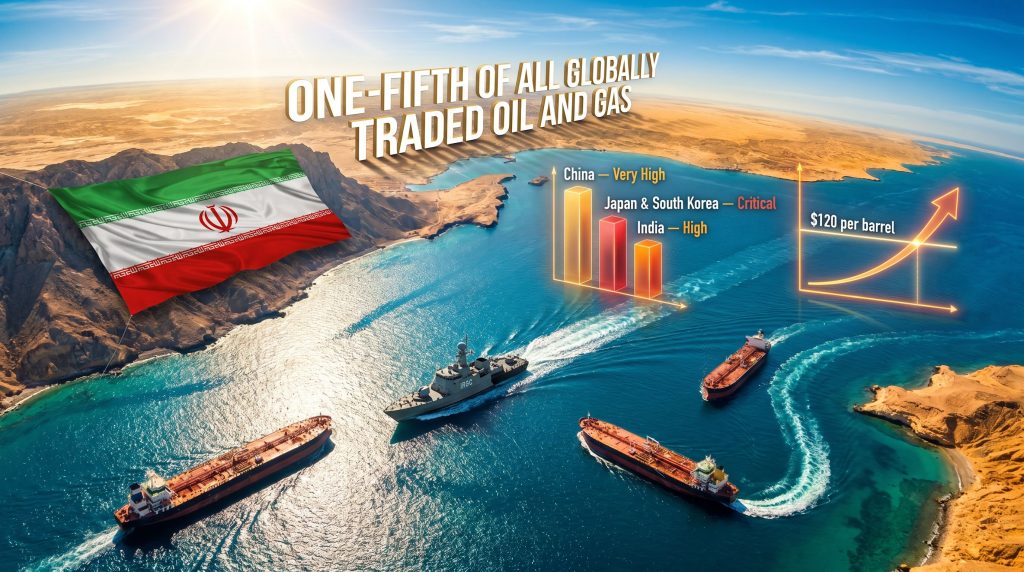
No other single maritime passage concentrates this level of energy exposure. Approximately one-fifth of all globally traded oil and natural gas transits the Strait of Hormuz under normal operating conditions, making it the single most consequential chokepoint in the global hydrocarbon supply chain.
The geography is unforgiving. The strait serves as the only maritime exit for energy exports originating in Saudi Arabia, Iraq, Kuwait, the UAE, and Iran itself. At its narrowest navigable point, vessels operate within a channel that offers no practical alternative for Persian Gulf exporters. The two-lane shipping corridor used by very large crude carriers operates within a space that, geographically speaking, would fit within many major metropolitan boundaries.
During the current conflict cycle, this structural reality translated into crude oil price trends reaching approximately $120 per barrel at peak wartime stress levels, a price point that historically triggers demand destruction across energy-intensive Asian manufacturing economies. Prices have since retreated from those highs, but the baseline risk architecture has fundamentally shifted.
What Iran's Closure Declaration Actually Means in Practice
There is a critical distinction between a declared closure and a functional blockade, and understanding this difference is essential to calibrating both risk and market response.
Iran's closure declarations are not recognised under international maritime law. The United Nations Convention on the Law of the Sea guarantees the right of transit passage through international straits, meaning Iran's assertion of authority over vessel movements has no standing in the framework most maritime nations observe. The legal dispute is not new: Iran has issued closure threats and conducted military exercises simulating a full blockade since at least 2011.
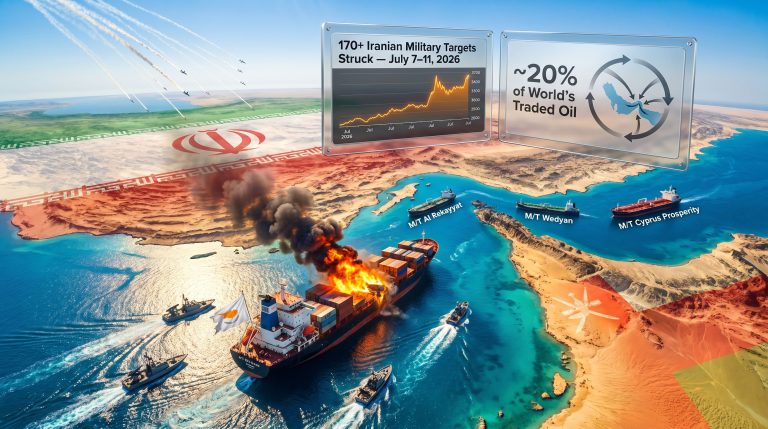
What has changed is the operational credibility of the threat. Iran enforces closure not through a physical barrier but through IRGC naval patrols, warning shots, and vessel interceptions. In the current episode, an IRGC gunboat fired on a tanker travelling through what Iran characterised as an unauthorised route, and a separate container vessel was struck by an unidentified projectile while the waterway remained under declared closure. Iran's declaration of closure has consequently raised significant doubt over the prospects for renewed diplomatic talks.
| Dimension | Iran's Declared Closure | Full Operational Blockade |
|---|---|---|
| Legal basis | Contested sovereign claim | Requires active military enforcement |
| International recognition | Not recognised under UNCLOS | Would constitute an act of war |
| Enforcement mechanism | IRGC naval patrols, warning shots | Physical naval barrier |
| Insurance market impact | Immediate war-risk premium spike | Complete market withdrawal |
| Historical precedent | Multiple declarations since 2011 | Never fully achieved |
Iran's position rests on a contested legal argument that it retains sovereign authority to levy transit charges and regulate vessel movements through the strait. This claim has no parallel in modern international maritime law and is rejected by the majority of seafaring nations.
The Geopolitical Sequence That Produced the Current Crisis
Phase One: The Conflict Architecture and the MOU
The current escalation did not emerge from a vacuum. It sits within a broader Iran-U.S. military confrontation that produced a temporary ceasefire arrangement, structured as a memorandum of understanding signed in June 2026. Iran's position throughout the conflict has been that the strait should remain under its operational jurisdiction, with the claimed right to impose transit fees on commercial vessels transiting the route.
The United States responded to this posture by advising commercial shipping operators to reroute through Oman's territorial waters via a southern corridor, effectively bypassing the contested zone entirely. Furthermore, these geopolitical trade tensions have reverberated well beyond the Persian Gulf, reshaping broader patterns of international commerce.
Phase Two: The Blockade Dispute and the Reopening That Wasn't
The most important trigger for the re-closure was definitional. Iran asserted that the U.S. naval blockade of Iranian ports had not been genuinely lifted, despite U.S. Central Command announcing an end to the blockade on June 11, 2026. Iran characterised the lift as phased and incomplete, with full removal scheduled across a 30-day window. Tehran used this definitional gap as both legal and political justification to maintain its closure posture.
The strait was briefly reopened on June 12, 2026, following a 10-day truce between Israel and Hezbollah, before Iran re-declared it closed on June 13, 2026. This rapid reversal revealed the fragility of any arrangement that depends on unilateral goodwill rather than verified, binding mechanisms.
Iranian Foreign Minister Abbas Araghchi also publicly accused Washington of violating the interim agreement after the U.S. ended waivers that had previously allowed Iran to sell crude oil denominated in U.S. dollars, further compounding the breakdown in trust between the parties.
Phase Three: Military Incidents and the Collapse of Diplomatic Momentum
The operational consequences escalated rapidly:
- IRGC gunboats fired on a tanker using what Iran deemed an unauthorised transit route
- An unidentified projectile struck a container ship while the closure was in force
- Planned nuclear negotiations in Switzerland were cancelled as a direct consequence of the re-closure
- Iran had previously targeted U.S. military installations across Bahrain, Jordan, Kuwait, and Qatar in retaliatory strikes
- Iranian Health Ministry figures indicated that the latest round of strikes killed at least 17 people and injured 115 others
Planned talks between Iranian and U.S. officials on the nuclear file collapsed entirely, removing what had been the principal diplomatic pressure-relief valve in the relationship.
Iran's Strategic Calculus: Why Closure Is the Preferred Instrument
The Asymmetric Deterrence Logic
Iran's threat to close the strait functions as its primary asymmetric deterrent against U.S. conventional military superiority. The arithmetic is straightforward: Iran cannot match the U.S. Fifth Fleet in conventional naval terms, but it can threaten a disruption whose economic consequences extend far beyond the bilateral relationship.
By targeting global energy supply chains, Iran forces third-party economic stakeholders — including China, India, Japan, and South Korea — to apply indirect pressure on Washington. These nations import between 60 and 90 percent of their crude oil from Gulf producers transiting the strait, meaning their economic exposure is immediate and severe.
Iran's demand to levy transit charges on commercial vessels represents something more than a revenue claim. It is an attempt to institutionalise economic sovereignty over the waterway as a permanent post-conflict condition — a demand that, if conceded, would fundamentally alter the architecture of global maritime trade. Consequently, OPEC's market influence has become increasingly entangled with the security dynamics playing out across the Persian Gulf, as explored in analysis of OPEC's market influence on global oil supply decisions.
The Succession Factor and Domestic Political Constraints
The death of Ayatollah Ali Khamenei introduced a new variable into the equation. His successor, Mojtaba Khamenei, made his first public statement pledging that Iran would avenge his father's death, describing this as the will of the nation and a necessity that must be carried out. This public commitment functions as a credibility constraint that limits the regime's ability to make rapid diplomatic concessions without appearing to capitulate to external pressure.
The closure declaration simultaneously serves a domestic political function: demonstrating to Iranian constituencies that the government retains coercive capacity despite suffering military losses during the conflict. This dual-audience signalling — directed at Washington and the Iranian public simultaneously — makes flexible diplomacy significantly more difficult.
How Global Energy Markets Are Absorbing the Shock
Oil Price Dynamics and the Persistent Risk Premium
Crude prices reached approximately $120 per barrel during peak conflict-driven market stress. While prices have retreated from wartime highs, war-risk insurance premiums on Gulf shipping routes remain structurally elevated. Tanker operators and energy traders are now pricing in a persistent closure risk premium even during periods when the waterway is nominally open.
This premium matters because it does not disappear with a diplomatic statement. Insurance markets require sustained evidence of operational safety before reverting to peacetime underwriting standards. The practical consequence is that the cost of moving Gulf crude to end markets has risen structurally, not cyclically. These oil market disruption risks are examined in greater depth through a dedicated analysis of oil market disruption risks arising from escalating trade tensions.
The Rerouting Economics: Oman's Southern Corridor
The U.S.-endorsed alternative routing through Oman's territorial waters adds significant transit time and cost for very large crude carriers. Longer voyage distances produce compounding cost increases:
- Higher fuel consumption per voyage
- Elevated charter rates reflecting increased vessel utilisation time
- Higher cargo insurance costs on extended routes
- Reduced fleet efficiency as more vessels are required to maintain the same delivery frequency
These costs function as a hidden tax on energy consumers globally, disproportionately affecting import-dependent economies in Asia. In addition, the disruption has prompted a reassessment of the global LNG supply outlook, as buyers seek to diversify away from pipeline-dependent and strait-exposed energy routes.
Regional Exposure Compared
| Importing Region | Hormuz Dependency | Rerouting Feasibility | Economic Exposure |
|---|---|---|---|
| China | Very High | Moderate | Severe |
| India | High | Low | Severe |
| Japan and South Korea | Very High | Low | Critical |
| Europe | Moderate | Higher | Significant |
| United States | Low | High | Indirect |
India and Japan represent particularly acute cases. Both nations lack meaningful alternative crude supply channels at the scale required to replace Gulf volumes, and neither has the domestic production capacity to compensate for a prolonged closure.
The next major ASX story will hit our subscribers first
Oman's Indispensable Role in Any Resolution
Oman occupies a unique diplomatic position in this crisis. It is the only Gulf state that has maintained functional working relationships with both Tehran and Washington simultaneously, positioning it as the sole credible facilitator of back-channel communication.
The discussions between Iranian Foreign Minister Araghchi and his Omani counterpart centred on establishing what Araghchi described as appropriate mechanisms for ensuring the safe passage of ships. Oman confirmed that both parties agreed to continue discussions at technical and political levels, a formulation that signals structured engagement rather than ad hoc crisis management.
The significance of a technical-level framework should not be underestimated. If formalised, such a structure could evolve into a managed transit arrangement, creating a precedent where vessels obtain clearance through a defined process rather than operating under the binary uncertainty of a declared open or closed waterway.
Strategic Scenarios: Three Pathways From Here
Scenario 1: Phased Diplomatic Resolution
Full U.S. blockade removal within the agreed 30-day window satisfies Iran's stated condition for reopening. The strait reopens under a monitored transit framework negotiated through Omani mediation, nuclear talks resume at a neutral venue, and oil prices stabilise in the $85–$95 per barrel range as war-risk premiums gradually compress.
Probability assessment: Moderate. Dependent on both parties accepting the same definitional baseline for blockade removal.
Scenario 2: Protracted Closure With Managed Workarounds
Iran maintains the closure as a negotiating instrument while selective vessel targeting continues. Global shipping operators default to Oman's southern corridor at elevated cost. Energy markets remain in a sustained risk-premium environment with price volatility above historical norms, and diplomatic engagement continues without producing binding resolution.
Probability assessment: High in the near term. This scenario represents the current operational reality.
Scenario 3: Escalation to Full Military Confrontation
Retaliatory strike cycles between the U.S. and Iran intensify. Iran expands targeting of U.S. military installations across Gulf host nations. The strait becomes operationally inaccessible for commercial shipping for an extended period, and crude prices breach the $130–$150 per barrel range, triggering recession risk across import-dependent economies.
Probability assessment: Lower probability but carrying the highest systemic impact. Strategic petroleum reserves held by IEA member nations provide approximately 1.4 billion barrels of buffer capacity, sufficient for partial disruptions over several months but not a complete and sustained closure.
Frequently Asked Questions
Has Iran Successfully Closed the Strait Before?
Iran has issued multiple closure threats and conducted simulated blockade exercises since at least 2011. A complete, sustained operational closure has never been achieved, as U.S. naval presence in the region has historically deterred full enforcement. The 2026 episode represents the most operationally credible closure declaration in the strait's modern history, distinguished by actual vessel interdictions rather than purely rhetorical threats. Reporting from AP News provides further context on the sequence of events leading to the current closure.
Why Can't Ships Simply Reroute?
The strait has no equivalent alternative for Persian Gulf exporters. The Oman southern corridor is only viable for specific vessel classes, adds material transit time and cost, and depends entirely on Oman's continued cooperation — which is a geopolitical variable rather than a guaranteed permanent arrangement.
What Is the U.S. Military's Capacity to Reopen the Strait by Force?
The U.S. Fifth Fleet, headquartered in Bahrain, maintains significant naval and air assets in the region. However, a forcible reopening would require neutralising Iran's anti-ship missile batteries, IRGC naval assets, and coastal defence installations across a complex operational environment. The escalation risk is substantial, particularly given the potential for Iranian-aligned proxy forces across the region to open secondary fronts simultaneously.
How Does the Succession to a New Supreme Leader Affect Diplomacy?
Mojtaba Khamenei's public pledge of retaliation creates a credibility constraint that limits the regime's ability to make rapid diplomatic concessions. Any agreement that could be characterised domestically as capitulation to U.S. pressure risks delegitimising the new leadership at a moment when it needs to consolidate authority. This dynamic significantly complicates the path to a negotiated resolution, even when both parties have structural incentives to reach one.
Key Takeaways
The current crisis is not an isolated incident but the most operationally serious iteration of a recurring strategic instrument Iran has wielded for over a decade. Several structural realities define where this situation stands:
- Roughly one-fifth of global oil and gas trade remains exposed to Iranian interdiction capacity, with no equivalent alternative routing for major Persian Gulf exporters
- The core definitional dispute over whether the U.S. naval blockade has been genuinely lifted remains unresolved, and Iran is actively exploiting this ambiguity
- New Supreme Leader Mojtaba Khamenei's public pledges constrain Iran's diplomatic flexibility at precisely the moment when flexibility is most needed
- Oman's mediation framework represents the only viable pathway toward a managed reopening, but formalising such a framework requires political will on both sides that has not yet materialised
- Energy markets have absorbed the immediate shock but carry a structurally elevated risk premium that will persist regardless of near-term diplomatic statements, reflecting markets' reassessment of the strait's long-term reliability as a transit corridor
Disclaimer: This article contains forward-looking scenario analysis based on publicly available information as of July 2026. Energy price projections and probability assessments represent analytical frameworks, not financial advice. Geopolitical situations of this nature are inherently unpredictable, and outcomes may differ materially from any scenario described.
Want to Stay Ahead of the Commodity Opportunities Emerging From Global Energy Disruptions?
When geopolitical shocks like the Strait of Hormuz crisis ripple through energy and commodity markets, Discovery Alert's proprietary Discovery IQ model delivers real-time alerts on significant ASX mineral discoveries, helping subscribers identify actionable opportunities before the broader market reacts — explore historic discoveries and their returns to understand the scale of what early positioning can achieve, then begin a 14-day free trial at Discovery Alert to gain your market-leading edge.