
July 12, 2026
The Strait of Hormuz: A Chokepoint That Holds the World's Energy System Hostage
Few geographic features carry as much strategic weight as a narrow stretch of water barely 21 miles wide at its tightest point. The Strait of Hormuz, positioned between Iran's southern coastline and the Omani peninsula, is not merely a shipping lane. It is the single most consequential energy corridor on the planet, and U.S. airstrikes against Iran after Strait of Hormuz ship attack incidents have now placed this waterway at the centre of a global crisis.
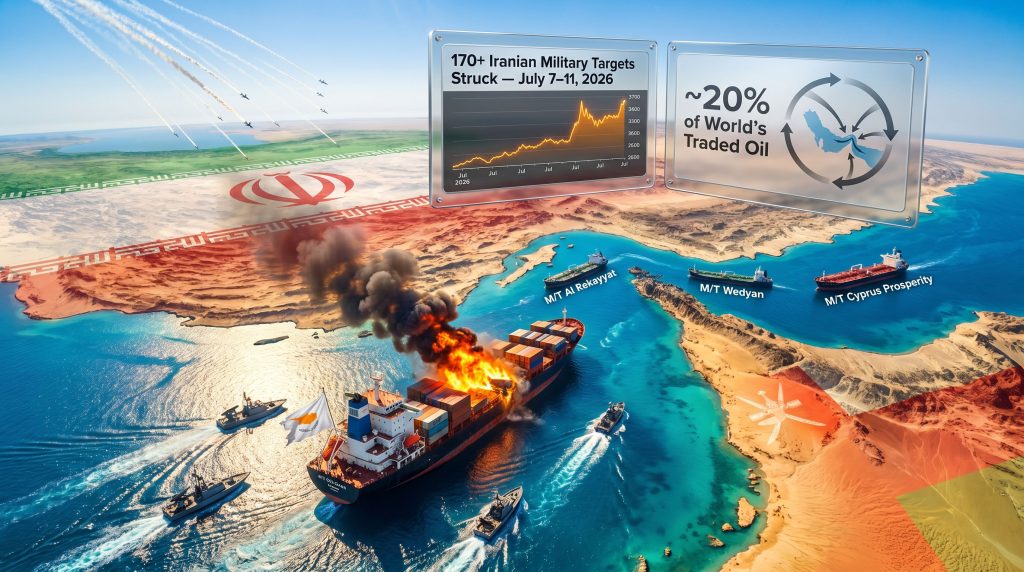
Approximately 20% of the world's traded oil passes through the strait daily, alongside a substantial share of global liquefied natural gas exports. For East Asian economies including China, Japan, South Korea, and India, this waterway is not a footnote in energy policy. It is the primary artery through which their industrial base breathes. Any sustained disruption to transit through Hormuz does not merely inconvenience markets — it triggers supply chain shockwaves that ripple through pricing, logistics, and geopolitical stability simultaneously.
Understanding the current crisis requires stepping back from the individual incidents and recognising the deeper structural tension. Iran has long viewed the strait as its most potent strategic instrument, and Washington has now declared, through both policy statements and military action, that this leverage will be permanently dismantled. The intersection of oil prices and geopolitics makes this standoff one of the most consequential energy crises in modern history.
When big ASX news breaks, our subscribers know first
Iran's Hormuz Doctrine and Why It Has Always Been Structurally Unstable
How Tehran Has Used the Strait as a Geopolitical Bargaining Tool
Iran's approach to the Strait of Hormuz has never been purely defensive. For decades, Tehran has treated the waterway as a pressure valve — something to be threatened during periods of sanctions escalation or diplomatic isolation, and occasionally actuated through direct military harassment of commercial shipping.
The Islamic Revolutionary Guard Corps Navy, known as the IRGCN, has developed a specialised capability set designed precisely for strait interdiction. This includes fast attack craft, antiship missile systems, naval mines, and sophisticated coastal radar networks. These are not conventional blue-water naval assets. They are purpose-built tools for asymmetric maritime warfare in confined, shallow waters, and they have made the IRGC a uniquely difficult adversary in this specific theatre.
Iran's insistence that commercial vessels transit through the northern route — which runs through its territorial waters rather than the internationally recognised shipping lanes closer to Oman's coast — reflects more than a jurisdictional preference. It is a sovereignty assertion layered with economic ambition. Tehran's interest in establishing a navigational fee system for strait transit has been an underlying current in diplomatic discussions for years, representing an attempt to convert geographic position into recurring revenue.
The fundamental problem with this doctrine is that it directly conflicts with international maritime law, which classifies the Strait of Hormuz as an international waterway subject to transit passage rights under the United Nations Convention on the Law of the Sea. The U.S. and most of the international community reject any unilateral Iranian claim to toll or restrict this passage. Furthermore, the broader geopolitical trade tensions surrounding this dispute have only hardened positions on both sides.
What Triggered the July 2026 U.S. Airstrikes Against Iran
The Attack on the M/V GFS Galaxy and the Collapse of the June Agreement
The immediate trigger for the latest round of U.S. military action was an Iranian attack on the M/V GFS Galaxy, a Cyprus-flagged container ship transiting the Strait of Hormuz. According to U.S. Central Command (CENTCOM), the strike caused an onboard fire and inflicted significant damage to the vessel's engine room, rendering the ship unable to continue its voyage. A civilian crew member was reported missing following the incident.
This attack did not occur in isolation. It came against the backdrop of a collapsed diplomatic framework that had briefly appeared to offer a path toward de-escalation.
On June 17, 2026, the United States and Iran signed a memorandum of understanding intended to reopen the Strait of Hormuz and guarantee safe passage for commercial vessels. The agreement included Iran's commitment to use its best efforts to ensure safe transit and a 60-day moratorium on any navigational tolls.
The agreement's critical structural flaw was one of omission. It failed entirely to define which transit routes vessels would use, leaving unresolved the core dispute between Washington's insistence on international shipping lanes and Tehran's demand for northern routing through Iranian territorial waters.
David Goldwyn, who served as the U.S. State Department's Special Envoy for International Energy Affairs under President Obama, characterised the MOU's fundamental weakness clearly. He noted that the agreement failed to reach any genuine understanding on the management of ship traffic through the strait, effectively deferring the central problem rather than solving it.
The agreement's fragility became apparent almost immediately. Iranian forces attacked three additional commercial vessels in early July: the M/T Al Rekayyat, the M/T Wedyan, and the M/T Cyprus Prosperity. The U.S. responded by revoking its oil sanctions waiver and formally declaring the peace deal void, representing a significant oil market disruption with far-reaching consequences.
A Breakdown of U.S. Military Operations: July 7 to 11, 2026
Scale, Sequencing, and Targets of the Airstrike Campaign
The U.S. military response unfolded across three operational phases in rapid succession, representing one of the most intensive campaigns against Iranian military infrastructure since the two nations' decades-long adversarial relationship began.
| Operation Phase | Date | Approx. Targets Struck | Key Infrastructure Hit |
|---|---|---|---|
| First Strike | July 7, 2026 | ~80 targets | Air defence systems, radar networks |
| Second Strike | July 7-8, 2026 | ~90 targets | 60+ IRGC patrol boats, missile storage, naval facilities |
| Third Strike | July 11, 2026 | Ongoing | Coastal military capabilities, logistics nodes |
| Cumulative Total | July 7-11 | 170+ targets | Full-spectrum IRGC degradation |
The campaign systematically targeted the IRGC's capacity to threaten commercial shipping rather than pursuing broader strategic objectives. Coastal radar and air defence networks were struck to blind Iran's maritime surveillance capability. Missile and drone storage facilities were hit to reduce its ability to arm and launch attacks against vessels. More than 60 IRGC small patrol and attack boats were destroyed, directly dismantling the fast-attack capability the Guard has long relied upon for strait harassment operations.
CENTCOM framed the campaign's objective as degrading Iran's ability to attack civilian mariners and commercial ships transiting the strait freely. This framing was consistent with a policy posture articulated by Energy Secretary Chris Wright on June 24, when he stated that Iran would not retain the ability to close the Strait of Hormuz going forward, describing strait access as Tehran's key source of leverage and explicitly stating the U.S. intention to remove it.
Iran's Response: Closure Declaration and Regional Retaliation
What the IRGC's Strait Closure Announcement Means in Practice
Following the July 11 U.S. strikes, the Islamic Revolutionary Guard Corps announced through Iranian state media outlet PressTV that the Strait of Hormuz was closed to all vessel traffic until further notice. The statement left no ambiguity: no vessel would be permitted to transit the strait.
Whether Iran retains the practical military capability to enforce a full closure following the sustained U.S. strikes on its naval assets is a separate question from the declaration itself. However, the announcement carries significant weight for shipping insurers, tanker operators, and energy traders who must price risk on the basis of stated intent as much as demonstrated capability.
Iran also conducted retaliatory strikes targeting Bahrain, Jordan, Kuwait, and Qatar, broadening the geographic scope of the conflict and introducing risk calculations for Gulf states that had previously avoided direct targeting.
Iran's Ministry of Health reported 17 fatalities and 115 injuries across six Iranian cities resulting from U.S. strike operations — figures that will shape domestic political dynamics and Tehran's negotiating posture in any subsequent diplomatic engagement.
Diplomatic Pathways and the Role of Oman
Back-Channel Negotiations and the IMO Fee Proposal
Even as military operations continued, diplomatic activity accelerated in parallel. Iranian Foreign Minister Abbas Araghchi travelled to Oman on July 11 for direct talks with Omani Foreign Minister Sayyid Badr bin Hamad Al Busaidi. Oman has historically occupied a unique position in U.S.-Iran relations, serving as a trusted neutral intermediary through multiple cycles of escalation and negotiation.
Notably, a U.S. technical negotiations team was not present at the Oman talks — a gap that signals a meaningful disconnect between the military and diplomatic tracks currently operating simultaneously.
France and the United Kingdom are reported to be studying proposals drafted by Oman that would allow navigational fees to be charged within the strait, subject to two critical conditions:
- The fees must be non-compulsory in nature
- They must carry the endorsement of the UN's International Maritime Organization, the body that governs international sea transport
This framework, if formalised, would offer Iran a revenue mechanism tied to strait transit without requiring vessels to accept compulsory tolls, which would violate international maritime law. It represents a potential face-saving architecture for Tehran while preserving the principle of open passage.
The next major ASX story will hit our subscribers first
Global Energy Market Exposure: What a Hormuz Disruption Actually Means
Shipping, Insurance, and Crude Price Sensitivity
The energy market implications of a prolonged Hormuz disruption extend well beyond headline oil price movements. The operational and financial consequences cascade across multiple layers of the global supply chain. In addition, the broader LNG supply outlook for Asia-Pacific markets faces acute pressure should the crisis persist.
War risk insurance premiums for vessels operating in the Persian Gulf are already under significant upward pressure. Lloyd's List has reported that tankers are exploiting every navigational opening as the strait remains in operational limbo — a dynamic that speaks to the acute tension between commercial urgency and physical risk.
The rerouting alternative for tankers that would ordinarily transit Hormuz involves sailing around the Cape of Good Hope, adding approximately 15 to 20 days to voyage times and substantially increasing fuel and operating costs. For time-sensitive LNG cargoes with contractual delivery windows, this is not merely expensive. It risks triggering force majeure clauses and supply shortfall events.
| Disruption Scenario | Estimated Market Impact |
|---|---|
| Partial disruption with active rerouting | Moderate Brent crude premium; supply delivery delays |
| Full closure sustained beyond 30 days | Significant price spike; global supply shock conditions |
| Diplomatic resolution with IMO framework | Rapid premium compression; market normalization |
Which Economies Bear the Greatest Risk
The geographic distribution of Hormuz exposure is highly asymmetric. East Asian economies carry disproportionate vulnerability:
- China is the world's largest crude oil importer, with a substantial share of its imports transiting Hormuz
- Japan and South Korea remain heavily dependent on Gulf energy, with limited domestic production buffers
- India has been rapidly expanding its Gulf energy imports as its economy grows
- European markets face secondary exposure primarily through LNG pricing and supply chain knock-on effects
- The United States, as a major domestic producer, holds a partial structural buffer, though global benchmark pricing ensures American consumers are not insulated from Brent crude movements
Three Geopolitical Scenarios and Their Probability Assessments
Mapping the Paths Forward From the Current Standoff
The current situation does not have a single probable resolution. Three distinct scenarios represent the realistic range of outcomes, each with meaningfully different implications for energy markets, regional security, and the long-term governance of the strait.
Scenario 1: Oman-Brokered Navigational Fee Framework
If the IMO-endorsed fee proposal gains multilateral traction, Iran could secure a revenue stream from strait transit without imposing compulsory tolls. This would provide Tehran with a defensible political victory domestically while preserving the international community's principle of open passage. The probability of this outcome is moderate, contingent on U.S. willingness to accept some form of fee legitimacy and Iranian restraint from further attacks on shipping.
Scenario 2: Prolonged U.S. Military Attrition Campaign
The U.S. continues targeting IRGC naval and missile infrastructure until Iran's practical capacity to threaten commercial shipping is functionally eliminated. Energy Secretary Wright's June statement aligns with this trajectory. The primary risk in this scenario is escalation spillover through Iranian proxy networks operating across the broader Middle East, which could draw additional states into active conflict roles.
Scenario 3: UN-Mediated Multilateral Governance Framework
International pressure from affected Asian and European economies, combined with IMO institutional involvement, produces a broader multilateral negotiation on strait transit governance. This outcome would be the most durable from a legal and structural standpoint, but it requires de-escalation as a prerequisite and carries a longer implementation timeline measured in months rather than weeks. Furthermore, OPEC's market influence over production decisions during any prolonged disruption will add another layer of complexity to energy price outcomes under all three scenarios.
The fundamental dispute at the core of this crisis — specifically who holds authority over the terms of transit through the Strait of Hormuz — was not resolved by the June 2026 MOU and cannot be resolved through military operations alone. Degrading Iran's capability changes the power balance but does not substitute for a legally binding navigational governance framework that all major maritime stakeholders can accept.
Frequently Asked Questions
Why Did the U.S. Launch Airstrikes Against Iran in July 2026?
The U.S. conducted multiple rounds of airstrikes following a series of Iranian attacks on commercial vessels transiting the Strait of Hormuz, including the Cyprus-flagged M/V GFS Galaxy. The stated objective was to degrade Iran's military capacity to threaten international shipping in the strategically critical waterway. U.S. airstrikes against Iran after Strait of Hormuz ship attack incidents represent a significant escalation in the two nations' long-standing adversarial relationship.
How Many Targets Did U.S. Forces Strike in Total?
Across operations conducted between July 7 and July 11, 2026, U.S. forces struck more than 170 Iranian military targets, including air defence systems, missile storage facilities, coastal radar networks, and over 60 IRGC patrol and attack boats.
Has Iran Officially Closed the Strait of Hormuz?
The IRGC announced a formal closure of the strait to all vessel traffic until further notice following the July 11 U.S. strikes. The declaration was published by Iranian state media outlet PressTV. Whether Iran retains sufficient military capability to enforce this closure following the U.S. campaign against its naval assets remains a contested question.
What Was the June 2026 MOU Between the U.S. and Iran?
Signed on June 17, 2026, the memorandum of understanding was intended to reopen the Strait of Hormuz and ensure safe transit for commercial vessels. The agreement included a 60-day moratorium on navigational tolls but critically failed to define specific transit routes, leaving the core jurisdictional dispute unresolved and the agreement structurally vulnerable from the outset.
What Role Is Oman Playing in the Crisis?
Oman is serving as a key neutral mediator. Iranian Foreign Minister Araghchi met with Omani counterparts on July 11 to explore diplomatic pathways. Oman has reportedly drafted proposals involving IMO-endorsed navigational fees as a potential compromise mechanism, which France and the U.K. are now studying.
How Does a Strait Closure Affect Global Oil Prices?
The Strait of Hormuz handles approximately 20% of globally traded oil. Even partial disruption forces costly rerouting, elevates war risk insurance premiums, and introduces supply uncertainty that typically drives Brent crude prices higher. A sustained closure lasting more than 30 days would represent one of the most significant energy supply disruptions in modern history.
Key Takeaways: Understanding the Strategic Fault Lines
- The June 2026 MOU's failure to define transit routes created the structural conditions for renewed conflict within weeks of its signing
- U.S. airstrikes against Iran after Strait of Hormuz ship attack operations struck more than 170 Iranian military targets across three operational phases, with a policy objective of permanently removing Iran's capacity to close the strait
- Iran's formal closure declaration and retaliatory regional strikes represent a significant escalation beyond previous episodes of Hormuz brinkmanship
- Diplomatic pathways remain active through Oman, but bridging the fundamental disagreement over navigational sovereignty requires concessions neither side has yet shown willingness to make
- East Asian economies face the most acute energy supply chain exposure if the disruption extends beyond the near term
- A durable resolution will ultimately require a legally binding multilateral framework governing strait transit — something that military operations alone cannot deliver
This article is intended for informational purposes only and does not constitute financial or investment advice. Energy market projections and geopolitical scenario assessments involve inherent uncertainty and should not be relied upon as predictions of future outcomes. Readers should consult qualified advisers before making decisions based on information contained herein.
Want to Track the ASX Mining Stocks Moving on Global Energy Disruptions?
When geopolitical crises like the Strait of Hormuz standoff send shockwaves through commodity markets, Discovery Alert's proprietary Discovery IQ model scans ASX announcements in real time, delivering instant alerts on significant mineral discoveries that may offer compelling opportunities amid the volatility — explore historic discoveries and their market returns to see what's possible. Begin your 14-day free trial at Discovery Alert and position yourself ahead of the market.