August 9, 2026
When Open Means Closed: Decoding the Strait of Hormuz Crisis
Few geopolitical concepts generate more confusion than a waterway that is simultaneously declared open and shut by different branches of the same government. That paradox sits at the centre of the current situation where the Strait of Hormuz remains open despite Iran closure declaration, and understanding it requires moving beyond headline-level analysis into the mechanics of how maritime coercion actually operates. The distinction between a physically passable corridor and a legally and operationally safe one is not semantic. For shipping operators, energy traders, and the policymakers managing the world's most consequential oil chokepoint, it is the difference between a functioning supply chain and a crisis.
When big ASX news breaks, our subscribers know first
The Waterway the World Cannot Afford to Lose
Geography as Destiny
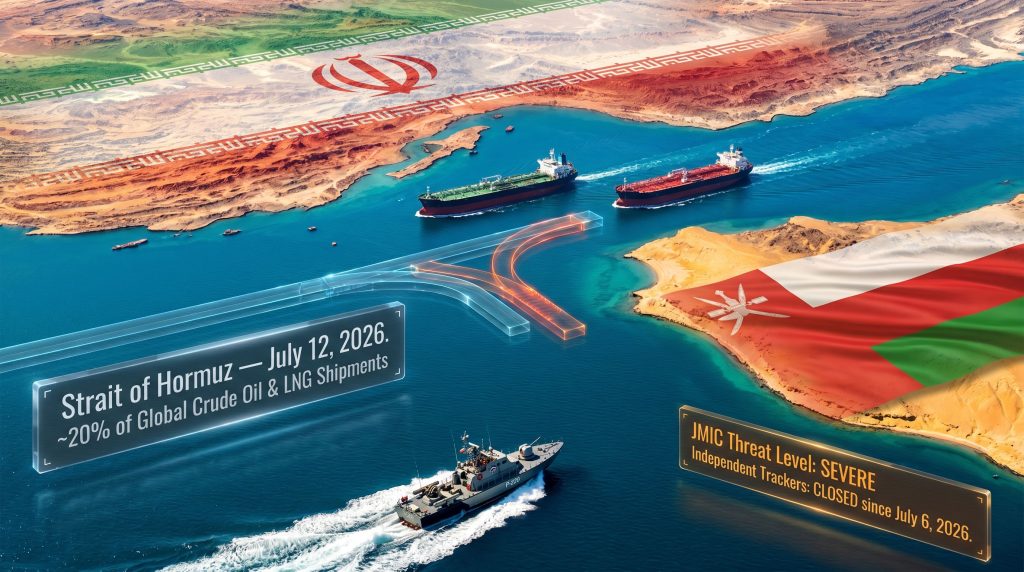
The Strait of Hormuz occupies a geographic position with no parallel in global energy infrastructure. Connecting the Persian Gulf to the Gulf of Oman and the broader Arabian Sea, it serves as the sole maritime exit route for the crude oil and liquefied natural gas produced across the Gulf region. Approximately one-fifth of global crude oil and LNG shipments have historically transited this corridor, making any meaningful disruption a systemic event for energy pricing worldwide rather than a contained regional incident.
Several structural facts about this waterway are frequently misunderstood:
- The navigable shipping channel runs along the Omani coastline, not through Iranian territorial waters
- A formal traffic separation scheme governs inbound and outbound shipping lanes
- Iran to the north and Oman and the UAE to the south flank the waterway
- The US Energy Information Administration classifies it as the world's most critical oil chokepoint by volume
That final point carries enormous analytical weight. No pipeline network, alternative shipping route, or strategic reserve release can fully substitute for Hormuz volume at scale. The Suez Canal and overland pipeline options through Saudi Arabia and the UAE offer partial relief but cannot absorb the full volume of disrupted Gulf exports, particularly for LNG. Furthermore, understanding crude oil volatility trends helps contextualise just how quickly market conditions can deteriorate when this chokepoint is threatened.
Who Depends Most on Hormuz?
The geographic concentration of exposure among importing nations creates asymmetric vulnerability:
| Importing Region | Hormuz Dependency | Key Exposure Factors |
|---|---|---|
| China | Very High | Largest single importer of Gulf crude |
| India | Very High | Near-total Gulf crude reliance; crew safety incidents |
| Japan | High | Structural dependence on Gulf LNG and crude |
| South Korea | High | Refinery supply chains tied to Gulf crude grades |
| European markets | Moderate | Indirect exposure via LNG pricing and refined products |
India faces a compounded exposure dynamic. Beyond the energy supply dimension, Indian authorities confirmed on July 12, 2026 that one Indian national who had been aboard the attacked Cyprus-flagged container vessel remained unaccounted for, adding a humanitarian dimension to an already complex geopolitical calculation for New Delhi.
The Contradiction at the Core: Two Irans, One Strait
What the IRGC Declared vs. What the Foreign Ministry Said
The defining analytical challenge on July 12, 2026 was not a shortage of information. It was the presence of two contradictory information streams emanating from the same state. Iran's Islamic Revolutionary Guard Corps announced that no vessels would be permitted to transit the strait until what it described as foreign interference in the region ceased. The IRGC explicitly framed this as a response to US actions, characterising American military presence as a source of regional destabilisation.
Simultaneously, Iran's Foreign Ministry maintained a position that commercial shipping remained operational under the terms of a framework agreed on June 6, 2026, a ceasefire-linked Memorandum of Understanding that had temporarily underpinned supervised passage arrangements. Iran's official reaffirmation that the strait was open stood in direct contradiction to IRGC enforcement actions on the water.
| Dimension | Foreign Ministry Position | IRGC Enforcement Reality |
|---|---|---|
| Official Status | Open under MOU framework | Closed until US blockade lifted |
| Transit Conditions | Supervised passage permitted | IRGC permits required; fees applied |
| Enforcement Actions | Shipping described as ongoing | Gunboats fired on vessels; ships struck |
| Tracker Data | Reaffirmed open through late June | Effectively closed from July 6, 2026 |
| Legal Basis Claimed | MOU ceasefire terms | Unilateral military authority |
This is not an unusual pattern in coercive diplomacy. Maintaining diplomatic ambiguity while conducting military enforcement preserves negotiating flexibility. Iran can claim to international bodies and trading partners that it has not officially closed an internationally recognised waterway while simultaneously using force to make transit untenable for commercial operators.
Critical Distinction: A waterway being physically passable and a waterway being safely transitable under established international maritime law are fundamentally different conditions. Conflating them produces dangerous misreading of operational risk for shipping operators, energy traders, and policymakers.
What the JMIC Advisory Actually Communicated
The Joint Maritime Information Center, a multinational maritime security coordination body that issues navigational advisories and threat assessments for high-risk corridors, confirmed on July 12, 2026 that the southern transit lane running along the Omani coastline remained physically navigable. However, the JMIC simultaneously maintained the threat classification at severe, its highest operational risk rating.
Mariners were specifically advised to:
- Prepare for direct radio communications from naval forces during transit
- Maintain heightened vigilance regarding sea mine hazards in the corridor
- Treat vessel interception as an operationally credible risk at all stages of approach
The advisory's dual message reflected a carefully calibrated legal and operational position. By confirming physical passability while issuing the most serious risk classification available, the JMIC effectively told commercial operators that the strait was open in the narrowest technical sense and dangerous in every practical sense.
A Week of Escalation: The Military Timeline
How the Crisis Compressed Into Seven Days
The IRGC closure declaration did not emerge from a static standoff. It followed a rapid compression of military actions across a single week that systematically dismantled the conditions under which commercial transit had remained viable:
- Third US strike operation on Iranian targets conducted overnight, marking the third such action within seven days
- Cyprus-flagged container ship attack approximately nine nautical miles off the Omani coast; crew abandoned the vessel after fire broke out
- Cargo vessel interception by IRGC following a warning shot against a ship attempting transit without prior clearance; vessel subsequently boarded
- Second vessel struck and halted by Iranian forces, with Iranian state media reporting the incident while withholding specific vessel details
- Attacks on five US-allied regional states including Qatar, Kuwait, and Oman, placing the June ceasefire framework under acute structural strain
The Collapse of the June 6 MOU Framework
The ceasefire-linked Memorandum of Understanding reached the previous month had created a narrow operational window. Under its terms, Iran conditionally permitted supervised commercial passage, providing a diplomatic rationale for the Foreign Ministry's continued insistence that the strait remained open. The coordinated attacks on multiple US-allied Gulf states on July 12 effectively rendered this framework inoperative by destroying the political conditions that had made it viable.
Notably, the UN agency responsible for coordinating ship evacuations in the region suspended its operations due to active attack risks during this period, signalling that even humanitarian maritime operations had become untenable. That suspension represents a threshold rarely crossed in modern maritime crises and reflects the degree to which normal operational assumptions had broken down. However, The Guardian reported on earlier periods when commercial vessels had been able to transit, illustrating how rapidly conditions can shift.
Shipping Traffic Response: The Market Verdict
What Vessel Tracking Data Revealed
Commercial shipping operators do not wait for diplomatic clarity before adjusting exposure. Independent vessel tracking data captured on July 12, 2026 showed a near-complete withdrawal of traffic from the strait's approach zones. The observable picture was stark:
- Only two oil products tankers were positioned in proximity to the waterway's approach
- Effectively zero commercial traffic was visible across the broader transit corridor
- The overall pattern reflected a rational industry-level risk calculation rather than a regulatory prohibition
This behavioural withdrawal is significant because it occurred before any formal international prohibition on transit. Shipping companies, war risk insurers, flag state authorities, and cargo owners collectively determined that the combination of severe threat rating, active enforcement operations, sea mine warnings, and absent passage guarantees made transit commercially and legally indefensible under standard operating procedures.
The Persian Gulf Strait Authority: An Institutional Red Flag
Perhaps the least discussed but most consequentially significant development in this crisis is the establishment of a new Iranian administrative body called the Persian Gulf Strait Authority. This entity issued formal warnings that any vessel transiting outside IRGC-approved designated routes would be operating in conditions described as extremely dangerous and prohibited.
The creation of this authority is not merely a procedural development. It represents a deliberate attempt to construct a permanent institutional architecture for unilateral Iranian administrative control over passage through an internationally recognised strait. Under the United Nations Convention on the Law of the Sea (UNCLOS), all states retain the right of transit passage through international straits used for international navigation. Iran's establishment of a permit-issuing, fee-collecting authority that can designate approved routes and halt non-compliant vessels directly conflicts with this framework.
Structural Escalation Signal: Previous Iranian Hormuz closure threats were rhetorical instruments. The Persian Gulf Strait Authority represents an attempt to normalise enforcement-backed control as a permanent administrative function, not a temporary crisis measure.
Energy Market Implications and Supply Chain Risk
Quantifying the Exposure
The energy market consequences of a sustained Hormuz disruption scale rapidly with duration. Considering broader global crude market trends provides essential context for understanding how acute supply shocks of this nature propagate through interconnected commodities markets:
| Supply Category | Estimated Hormuz Exposure |
|---|---|
| Global crude oil seaborne shipments | Approximately 20% of total volume |
| Gulf Cooperation Council export dependency | Near-total for seaborne crude |
| Gulf-origin LNG shipments | Significant share of global trade |
| Alternative routing capacity | Partial relief only via overland pipelines and Suez |
Historical scenario modelling and market precedent consistently suggest that a Hormuz closure sustained beyond two to four weeks generates crude price responses in the range of $20 to $50 or more per barrel above baseline, with the actual outcome dependent on the pace of strategic petroleum reserve releases, alternative supply activation, and demand-side responses among major importing economies.
The Strategic Petroleum Reserve as a Buffer, Not a Solution
A coordinated strategic petroleum reserve release among International Energy Agency member nations represents the primary policy lever available to consuming economies in a disruption scenario. This mechanism was activated during the 2022 supply disruption associated with Russia's invasion of Ukraine. However, SPR capacity is measured in weeks of buffer rather than months of replacement, and it addresses volume rather than the logistical reality that Gulf crude grades cannot always be substituted by reserve-released alternatives with different quality profiles.
The fundamental constraint is geological as much as political. Major Asian refineries have been configured over decades to process specific Gulf crude grades characterised by their API gravity and sulphur content. Substituting alternative crude supplies requires either refinery reconfiguration or acceptance of processing inefficiencies, both of which carry cost implications that ripple through to refined product pricing.
The next major ASX story will hit our subscribers first
The US Strategic Position and the Blockade-Closure Loop
Competing Legal and Operational Realities
US Central Command has maintained a consistent public position: Iran does not hold legal authority over the Strait of Hormuz under international maritime law, and the waterway remains open. This position is grounded in UNCLOS transit passage rights. It is, however, operationally complicated by the fact that Iranian naval forces are physically present in the corridor and actively conducting enforcement operations against commercial vessels.
The gap between legal position and operational reality is precisely where the crisis resides. In addition, the oil geopolitics analysis surrounding US-Iran tensions reveals how deeply structural these dynamics have become. The IRGC's stated justification for closure is the existence of what it characterises as a US blockade on Iranian ports, framing Hormuz closure as proportional counter-leverage. This creates a compressing escalation loop with no internal self-correcting mechanism:
- US port blockade constrains Iranian export capacity
- Iran declares Hormuz closed as counter-leverage
- US military strikes continue on Iranian targets
- Iran escalates vessel interceptions and attacks on allied states
- Commercial shipping withdraws; energy market pressure intensifies
- Ceasefire frameworks collapse; diplomatic off-ramps narrow
Resolution of this loop requires political intervention at a level above current operational command decisions. The military actions on both sides are expressions of a political impasse, not independent drivers capable of generating their own resolution.
Scenario Analysis: Three Pathways Forward
Scenario A: Rapid Diplomatic De-escalation
Conditions required include a US-Iran back-channel agreement on port blockade terms, reactivation of the June 6 ceasefire framework, and a stand-down of IRGC enforcement operations. Given the pace of military exchanges and the collapse of the prior ceasefire, this pathway carries low probability in the immediate term.
Scenario B: Sustained Partial Closure With Selective Enforcement
The IRGC continues permit-based interception while Iran's Foreign Ministry maintains the diplomatic fiction of an open strait. Commercial shipping remains effectively suspended. Energy markets price in prolonged supply uncertainty. This represents the most behaviourally consistent near-term trajectory based on observable patterns as of July 12, 2026.
Scenario C: Comprehensive Military Escalation and Extended Closure
Further US strike operations trigger a comprehensive IRGC enforcement response; all commercial transit suspended; IEA SPR releases activated; UN Security Council emergency engagement initiated. This tail-risk scenario carries disproportionate global economic consequences given the volume of supply concentrated through a single narrow waterway.
FAQ: Key Questions on the Hormuz Closure Declaration
Is the Strait of Hormuz Currently Open or Closed?
As of July 12, 2026, the strait exists in a state of contested operational status. The JMIC confirmed the southern lane along the Omani coast remains physically navigable. Independent vessel tracking shows near-zero commercial traffic. The threat level is rated severe. Iranian forces are actively intercepting non-permitted vessels. For commercial shipping operators, the practical answer is that the strait is effectively non-operational for standard transit.
Has Iran Closed the Strait of Hormuz Before?
Iran has repeatedly threatened closure during periods of heightened US-Iran tension, including during the 2012 sanctions period and following the January 2020 killing of IRGC commander Qasem Soleimani. What distinguishes the current situation is the combination of active enforcement-backed vessel interception at scale and the institutional establishment of the Persian Gulf Strait Authority as a permanent administrative control mechanism, both of which go beyond previous threat cycles. Furthermore, the broader geopolitical trade tensions reshaping global commerce in 2025 and 2026 have created the conditions in which such escalation was increasingly probable.
What Is the June 6 MOU?
The June 6 Memorandum of Understanding was a ceasefire-linked framework under which Iran conditionally agreed to permit supervised commercial passage through the strait. Subsequent IRGC enforcement actions and the re-closure declaration suggest this framework has been either suspended or is being applied selectively as a permit-based control instrument rather than a genuine restoration of free passage under international norms.
Why Does Vessel Tracking Data Matter?
Commercial shipping behaviour is among the most reliable real-time indicators of operational risk assessment. When operators with access to war risk insurance, legal counsel, flag state guidance, and live intelligence simultaneously withdraw from a corridor, that collective judgement carries analytical weight that official statements cannot override. On July 12, 2026, tracking data showed that the industry had rendered its verdict regardless of what diplomatic statements claimed.
The Operative Framework for Understanding This Crisis
The central analytical conclusion from the July 12, 2026 situation is straightforward but frequently obscured by competing official statements. The Strait of Hormuz remains open despite Iran closure declaration in the narrowest physical and legal sense confirmed by the JMIC. It is simultaneously closed in every operationally meaningful sense confirmed by vessel tracking data, active IRGC enforcement, severe threat ratings, sea mine warnings, and the suspension of humanitarian maritime operations.
Iran's dual-track strategy, maintaining diplomatic messaging through the Foreign Ministry while conducting military enforcement through the IRGC, is a deliberate architecture designed to preserve maximum coercive leverage while minimising the international legal and diplomatic exposure that comes with formally closing an internationally recognised strait. Moreover, OPEC's market influence adds another layer of complexity to how supply disruptions of this magnitude are ultimately absorbed or amplified across global energy markets.
For energy market participants, shipping operators, war risk insurers, and policymakers, the operative analytical framework must be grounded in what Iranian military forces are doing on the water rather than what Iranian diplomatic officials are saying in statements. Those two things are not currently aligned, and the gap between them is where the crisis lives.
Disclaimer: This article contains forward-looking assessments, scenario projections, and market analysis based on information available as of the stated dates. Energy price forecasts and geopolitical scenario outcomes involve significant uncertainty. Readers should not rely on this content as the basis for investment, operational, or security decisions without consulting qualified professional advisers.
Want to Stay Ahead of the Next Major Commodity Shock?
Geopolitical crises like the Strait of Hormuz standoff can trigger rapid, dramatic shifts across commodities markets — and Discovery Alert's proprietary Discovery IQ model continuously scans ASX announcements in real time, instantly identifying significant mineral discoveries and actionable opportunities before the broader market reacts. Explore historic examples of major discovery returns and begin your 14-day free trial at Discovery Alert to ensure you are positioned ahead of the next market-moving event.