May 20, 2026
The Quiet Transformation of MENA Resource Diplomacy
Across the global commodities landscape, a structural shift is underway that transcends individual project announcements or bilateral trade figures. Nations that once competed primarily for export markets are now competing for something more fundamental: the technical expertise, geological data, and institutional frameworks needed to extract maximum value from mineral endowments that were barely understood a generation ago. Nowhere is this dynamic more visible than in the relationship taking shape between Egypt and Turkey, two countries whose combined resource profile, geographic positioning, and industrial capabilities create a genuinely complementary partnership in the emerging critical minerals demand landscape.
What makes Egypt and Turkey mining and energy cooperation strategically significant is not simply the volume of investment flowing between them, though that is substantial. It is the architecture being built beneath the surface: joint working groups, regulatory harmonisation efforts, geological survey technology transfers, and energy infrastructure deployments that collectively signal a relationship moving well beyond ceremonial memoranda of understanding.
When big ASX news breaks, our subscribers know first
Why Complementarity Matters More Than Capital in Resource Partnerships
Most bilateral resource partnerships fail not because of insufficient funding but because the two parties bring overlapping capabilities rather than interlocking ones. Egypt and Turkey avoid this trap in a structurally important way.
Egypt holds a geological endowment that is arguably among the most underexplored of any country its size. The Eastern Desert alone contains documented occurrences of gold, copper, zinc, iron ore, phosphates, and rare earth elements, many of which have not been systematically assessed since colonial-era surveys. The Sinai Peninsula adds further complexity and potential. Yet despite this geological wealth, Egypt has historically lacked the technical infrastructure, survey technology, and regulatory architecture needed to attract world-class mining investment at scale.
Turkey, by contrast, has developed exactly these capabilities through decades of domestic mining development. The country holds roughly 70% of global boron reserves, operates significant chrome and gold mining industries, and has generated a private sector mining community with genuine international operating experience. Turkish state and private sector entities have developed geological survey methodologies, airborne geophysics capabilities, and regulatory frameworks that map directly onto Egypt's identified gaps.
This is not simply a capital-seeking-assets relationship. It is a capabilities-exchange model, and that distinction matters enormously for long-term durability. Furthermore, MENA exploration licences across the region are increasingly structured around exactly this kind of technical partnership model.
Egypt's most recent national aerial geological survey was conducted in 1984, meaning the country has been attracting mining investment for four decades based on geological data that predates satellite-assisted resource mapping, modern geophysical survey techniques, and advances in subsurface modelling. A new aerial survey represents one of the most consequential unlocks for Egypt's mining investment story.
Egypt's Geological Frontier: What the Data Actually Shows
Understanding Egypt's mineral potential requires moving beyond headline figures and examining what the geological record actually supports. Egypt ranks among the world's significant phosphate producers, with annual output of approximately 6 to 7 million tonnes of phosphate rock, placing it consistently in the top five globally according to United States Geological Survey data. Phosphate is increasingly strategic given its essential role in fertiliser production and its emerging applications in lithium iron phosphate battery chemistry.
The gold story is perhaps the most instructive. The Sukari Gold Mine in the Eastern Desert, operated through a joint venture structure involving Centamin and the Egyptian Mineral Resources Authority, has established itself as one of Africa's leading gold producers, with annual output in the range of 600,000 to 700,000 ounces, representing a world-class operation by any metric. Egypt's Minister of Petroleum and Mineral Resources Karim Badawi has publicly described Sukari as a proof-of-concept that should be replicable across other Eastern Desert geological zones with similar host rock characteristics, citing both the geological potential and the legislative and investment climate reforms underway to facilitate comparable projects (Daily News Egypt, April 2026).
What is less widely understood is the geological basis for this replication thesis. Sukari is hosted in a Neoproterozoic basement complex that extends across large portions of the Eastern Desert. The same geological terrane contains numerous known mineralisation occurrences that have never progressed beyond early-stage assessment. Updated aerial survey data would allow systematic prioritisation of the most prospective zones, dramatically accelerating the exploration pipeline.
What About Rare Earth Elements?
Egypt's rare earth supply chains potential adds another dimension. The Eastern Desert contains documented occurrences of REE-bearing minerals including monazite and xenotime, though independent resource estimation in line with international reporting standards has not been completed for most identified zones. This gap between geological occurrence and bankable resource estimate is precisely where Turkish geological survey expertise could accelerate progress.
The Sukari Investment Model: A Replication Blueprint
For investors assessing Egypt's mining potential, Sukari's operational history provides several instructive reference points. The mine required initial development capital in excess of $700 million during its construction phase, establishing a precedent for large-scale capital commitment in Egyptian mining. Its continued production at world-class volumes demonstrates that Egypt can host and sustain complex mining operations across extended timeframes.
The joint venture structure between a foreign operator and the Egyptian Mineral Resources Authority has also served as a template for subsequent licensing discussions. This production-sharing model gives Egypt direct revenue participation and resource sovereignty while providing foreign operators with defined commercial terms and a degree of legal certainty. Understanding this structure is essential for any investor evaluating entry into the Egyptian mining market.
Key elements of the replication thesis include:
- The Eastern Desert basement complex hosts similar geological features across multiple untested zones
- Updated survey data would enable systematic comparison of geological signatures with Sukari's known ore body characteristics
- Regulatory reforms currently underway aim to reduce concession award timelines and clarify royalty and tax treatment
- Turkish geological expertise could be deployed specifically to accelerate target generation from survey data
Turkey's Energy Infrastructure Export: Understanding the FSRU Model
One of the most technically significant elements of Egypt and Turkey mining and energy cooperation is the deployment of a Floating Storage and Regasification Unit by BOTAŞ, Turkey's state-owned oil and gas pipeline corporation, marking the company's first overseas FSRU operation.
For readers unfamiliar with FSRU technology, a Floating Storage and Regasification Unit is a vessel-based alternative to onshore LNG terminals. Rather than building permanent coastal infrastructure, which requires years of construction and billions in capital expenditure, an FSRU can be moored offshore and begin operations within months of arrival. The vessel receives LNG from carrier ships, stores it in cryogenic tanks, and regasifies it back into pipeline-ready natural gas on demand.
The strategic logic for Egypt is straightforward. Egypt experiences significant seasonal peaks in natural gas demand, particularly during summer months when power generation requirements spike due to air conditioning load. The FSRU provides flexible, scalable regasification capacity that can be deployed quickly to address these peaks without the capital commitment of permanent terminal infrastructure.
For Turkey, the BOTAŞ deployment represents something equally significant: validation of its capacity to execute energy infrastructure projects internationally, establishing a commercial and technical reference case for future overseas deployments across North Africa and beyond. This energy infrastructure export model complements Turkish mining sector engagement in a way that creates genuine multi-sector bilateral depth.
The Bilateral Framework: From Agreements to Working Groups
The institutional architecture supporting Egypt and Turkey mining and energy cooperation has developed across multiple formal agreements and coordination mechanisms.
| Agreement or Mechanism | Sector Coverage | Status |
|---|---|---|
| May 2025 MoU on Hydrocarbons and Mining | Oil, gas, geothermal, hydrogen, mining | Active, implementation phase |
| September 2024 MoU on Electricity and Renewable Energy | Renewables, green hydrogen, nuclear | Active, national focal points appointed |
| BOTAŞ FSRU Deployment Agreement | LNG storage and regasification | Operational, first Turkish overseas FSRU |
| Joint Working Groups on Mineral Exploration | Exploration, licensing, regulatory frameworks | Formation stage |
| High-Level Strategic Cooperation Council | Whole-of-government bilateral coordination | Second meeting completed |
What distinguishes this framework from typical bilateral diplomatic agreements is the explicit mandate of the joint working groups to move beyond policy statements into operational coordination. The groups are designed to align geological survey methodologies, create shared data protocols, harmonise licensing standards, and facilitate private sector joint venture formation between Egyptian and Turkish mining and energy companies.
Ministerial discussions in Istanbul in April 2026, conducted on the sidelines of the OECD Critical Minerals Forum, reinforced the private sector dimension of this framework. Egypt's Minister Badawi engaged directly with executives from Turkish mining and energy companies including OZ Minerals, Tüprag Mining (a subsidiary of Canada's Eldorado Gold Corporation), and Sanko Energy, signalling that ministerial-level commitment is being deliberately connected to private sector deal pipelines (Zawya, April 2026).
The OECD Critical Minerals Forum in Istanbul served as a catalyst for translating bilateral political momentum into specific private sector conversations, with Egypt's Mineral Resources Authority positioned as the operational counterpart for foreign mining company engagement.
The next major ASX story will hit our subscribers first
Egypt's Renewable Energy Ambition and the Technology Transfer Opportunity
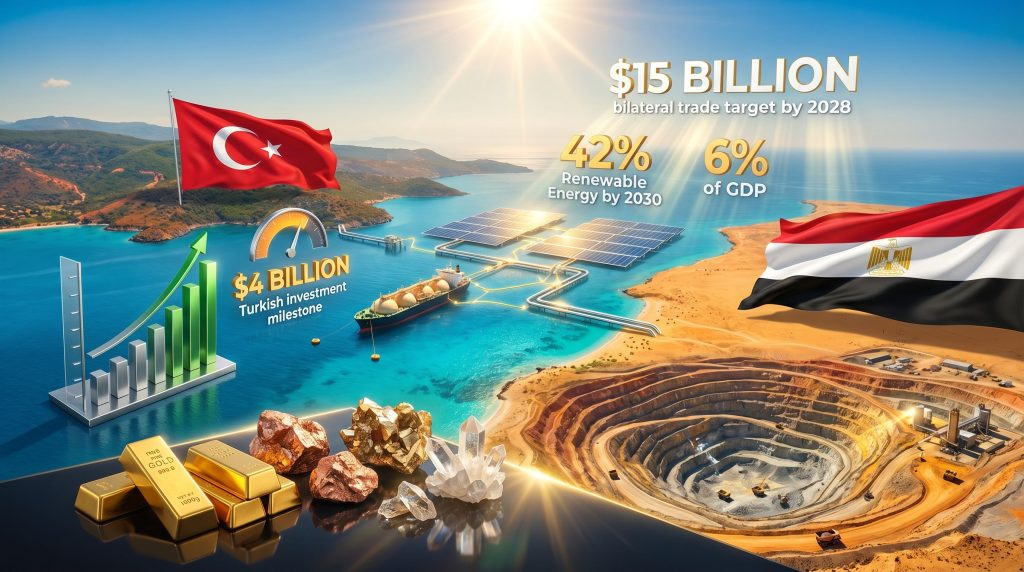
Egypt's commitment to generating 42% of electricity from renewable sources by 2030, enshrined in the country's Integrated Sustainable Energy Strategy, represents one of the most ambitious renewable energy targets in the MENA region relative to current baseline. Renewable energy currently accounts for approximately 15 to 17 percent of Egypt's electricity generation, with hydropower from the Aswan High Dam contributing the majority of that share and solar and wind projects making up the remainder.
Closing the gap between current reality and the 2030 target requires not just capital but technology, project development expertise, and grid integration capability. In this context, renewable mining solutions are increasingly relevant to how Egypt structures its broader energy transition programme. Turkish companies with renewable energy experience are positioned to contribute across multiple dimensions:
- Large-scale solar project development and engineering, procurement and construction delivery
- Wind energy feasibility assessment and turbine deployment in Egypt's high-resource coastal and desert zones
- Grid integration technology to manage variable renewable output
- Project financing structures adapted to Egypt's currency and repatriation environment
Sanko Energy's engagement in Egypt's renewable energy deployment pipeline is one concrete expression of this opportunity set. The broader implication is that Turkey's domestic energy transition experience, which has included rapid deployment of utility-scale solar and wind capacity, creates directly transferable knowledge for Egypt's programme.
Beyond renewables, both governments have explicitly incorporated green hydrogen into their cooperation agenda. Egypt's geographic advantages for green hydrogen production are considerable: abundant solar irradiance, available land in desert zones, proximity to European markets via the Mediterranean, and access to Suez Canal shipping infrastructure. Turkey's interest in green hydrogen as both a domestic energy source and an export commodity aligns with Egypt's production potential, creating a possible long-term supply relationship that would give both countries roles in Europe's emerging hydrogen import supply chain.
Eastern Mediterranean Gas: Three Scenarios for Bilateral Cooperation
The Eastern Mediterranean gas sector provides a third axis of Egypt and Turkey mining and energy cooperation, beyond mining and renewables. The two countries hold complementary infrastructure assets and geographic positions that create genuine optimisation potential.
Scenario One: Incremental Infrastructure Sharing
The BOTAŞ FSRU deployment suggests this pathway is already operational. Coordinating existing pipelines, storage facilities, and regasification capacity reduces capital expenditure while enhancing throughput and supply security for both parties. This scenario is near-term implementable and low capital intensity, though its upside is constrained if Eastern Mediterranean gas politics remain contested.
Scenario Two: Joint Upstream Exploration
Coordinated offshore and onshore exploration programmes leveraging Turkish geological expertise across Egypt's less-explored Mediterranean and Eastern Desert zones. This pathway carries a three to five year development horizon and medium capital intensity, with regulatory complexity and competing territorial claims representing the primary risk factors.
Scenario Three: Integrated Energy Transition Platform
Egypt and Turkey co-developing green hydrogen export infrastructure targeting European demand, aligned with both countries' 2030-plus energy roadmaps. This is a high capital intensity, long-duration strategic play that depends on European hydrogen import policy certainty and the availability of concessional or blended financing.
The formation of joint working groups covering hydrogen and low-carbon solutions indicates both governments are simultaneously exploring Scenario Three pathways even as Scenario One is being executed.
Key Barriers That Could Slow Execution
Despite the structural logic of Egypt and Turkey mining and energy cooperation, several material barriers warrant careful assessment.
Regulatory and Investment Climate Constraints
Egypt's mineral concession framework has historically presented complexity for foreign operators, with licensing timelines and royalty structures that compare unfavourably with regional peers in some assessments. Ongoing legislative reforms aim to address these gaps, however the gap between announced reform and operational implementation is a consistent risk in emerging market mining jurisdictions. The broader mining commodity outlook for the region reinforces why resolving these constraints is so commercially time-sensitive.
Currency and Capital Repatriation Risk
Turkish investors operating in Egypt face Egyptian pound volatility and repatriation considerations that affect project economics. This is not unique to Turkish investors but represents a structural feature of the Egyptian investment environment that bilateral cooperation frameworks cannot fully mitigate.
Workforce Development Gaps
Egypt's technical workforce in advanced mining and energy technologies requires sustained investment in training and knowledge transfer. Minister Badawi explicitly acknowledged the importance of human capital development as a precondition for sustainable sector growth, recognising that equipment and capital without trained operators creates fragile operational outcomes.
Eastern Mediterranean Geopolitical Complexity
Historical tensions between Egypt and Turkey, while substantially reduced through diplomatic normalisation, have not entirely disappeared. Offshore energy cooperation in the Eastern Mediterranean intersects with contested maritime boundary questions involving multiple regional actors, creating political risk that bilateral working groups cannot fully insulate from.
The Strategic Outlook: What Comes Next
The near-term milestones most worth monitoring across 2025 and 2026 include the formalisation of joint working group structures and their first substantive outputs, FSRU operational performance data and any announced expansion of LNG infrastructure cooperation, new mining concession awards to Turkish-affiliated entities, and specific project announcements emerging from the EMRA-Turkish private sector engagement pipeline initiated in Istanbul.
Over the medium term, the trajectory of bilateral trade toward the stated target and the emergence of first joint upstream exploration programmes in the Eastern Desert will serve as the most meaningful indicators of whether ministerial ambition is translating into operational investment.
| Key Metric | Figure or Detail |
|---|---|
| Egypt renewable energy target by 2030 | 42% of electricity generation |
| Egypt mining GDP contribution ambition | 6% of GDP |
| Last Egyptian aerial geological survey | 1984, with new survey planned |
| Sukari Gold Mine annual production | Approximately 600,000 to 700,000 ounces |
| Egypt phosphate production | Approximately 6 to 7 million tonnes annually |
| Turkey boron reserves share | Approximately 70% of global reserves |
| Key MoUs signed | Hydrocarbons and Mining, May 2025; Electricity and Renewables, September 2024 |
| BOTAŞ FSRU deployment | First overseas Turkish FSRU operation |
The combination of Egypt's geological endowment, strategic Mediterranean location, and accelerating regulatory reform programme, paired with Turkey's capital deployment capacity, technical mining expertise, and energy infrastructure export capability, creates a structurally compelling bilateral resource partnership. The central question is not whether the strategic logic is sound, it clearly is. The question is whether the institutional frameworks being assembled can bridge the consistent gap between diplomatic commitment and operational investment at the scale that both countries' ambitions require.
This article is intended for informational purposes only and does not constitute financial or investment advice. Forward-looking statements, scenario projections, and assessments of bilateral cooperation frameworks involve inherent uncertainty and should not be relied upon as predictions of future outcomes. Readers should conduct independent research and seek professional advice before making investment decisions. Further coverage of MENA mining and energy project developments is available through Zawya's projects section at zawya.com.
Want to Capitalise on the Next Major Mineral Discovery Before the Market Moves?
Discovery Alert's proprietary Discovery IQ model delivers real-time alerts on significant ASX mineral discoveries, turning complex geological data into actionable investment insights for both short-term traders and long-term investors — explore historic examples of major discovery returns to understand the opportunity, then begin your 14-day free trial at Discovery Alert to position yourself ahead of the broader market.