
July 26, 2026
The global energy landscape operates through complex interdependencies where supply disruptions in one region cascade across international markets, creating vulnerability patterns that traditional forecasting models struggle to predict. The EIA boosts US jet fuel price forecast due to Iran war, demonstrating how oil price movements amplify through critical infrastructure chokepoints, refinery economics, and strategic inventory management systems. Furthermore, understanding these systemic risks requires examination of how geopolitical tensions create cascading effects across interconnected supply networks.
How Do Geopolitical Tensions Drive Aviation Fuel Market Volatility?
Understanding Energy Information Administration Forecasting Methodology
The US Energy Information Administration integrates multiple variables beyond immediate supply disruptions when revising price forecasts through its Short-Term Energy Outlook framework. Recent forecast adjustments demonstrate how the agency incorporates both direct supply losses and secondary market responses into comprehensive price modelling.
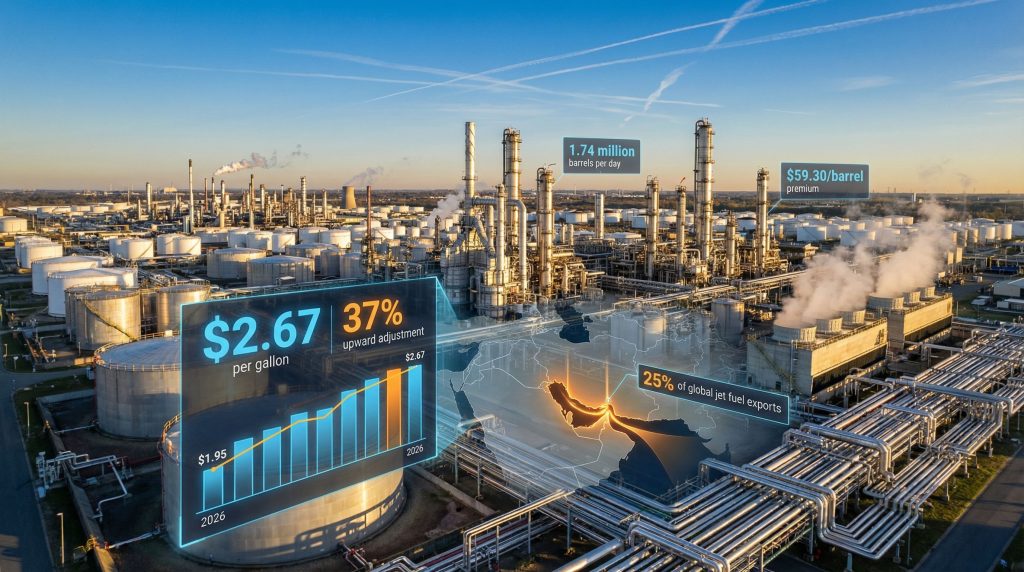
The EIA's March 2026 STEO revision methodology revealed sophisticated risk assessment protocols. The agency increased its 2026 jet fuel price forecast to $2.67 per gallon from the previous $1.95 per gallon, representing a 37% upward adjustment. For instance, 2027 projections rose to $2.28 per gallon from $1.97 per gallon, marking a 15.7% increase.
These revisions incorporate supply disruption scenarios that extend beyond transportation corridor closures. The forecasting framework accounts for:
- Regional refinery response patterns and capacity utilisation optimisation
- Domestic production capacity deployment under enhanced margin conditions
- Import substitution dynamics affecting net trade flows
- Strategic petroleum reserve management protocols
Moreover, oil futures analysis provides crucial insights into how price discovery mechanisms operate under stress conditions, revealing geopolitical risk premiums through market fundamentals.
Middle East Supply Chain Concentration Risks
Critical infrastructure vulnerabilities create amplification effects where localised disruptions generate disproportionate global market impacts. The Strait of Hormuz serves as a primary example, facilitating transit for approximately 25% of global jet fuel exports through a narrow geographic corridor susceptible to geopolitical interference.
Regional refinery infrastructure concentration compounds these transportation risks. Processing capacity clustering in politically volatile regions creates secondary vulnerability layers where production facilities become strategic targets during conflicts. The February 2026 military actions affecting Iranian infrastructure demonstrated how quickly supply chains can fragment when key processing nodes face operational disruptions.
Alternative routing economics reveal the true cost of supply chain diversification. Transportation rate analysis shows dramatic cost increases when normal shipping patterns face disruption:
| Route Type | Normal Rates | Crisis Rates | Multiplier Effect |
|---|---|---|---|
| Middle East-Pakistan Gasoline | $400,000 per 35,000t cargo | $1.2-1.5 million | 3x to 3.75x increase |
| Standard Tanker Charter | Baseline pricing | Geopolitical premium | 200-275% surge |
| Alternative Corridor Premium | Historical spreads | Crisis adjustments | Multi-fold increases |
Price Discovery Mechanisms Under Stress
Market pricing mechanisms reveal geopolitical risk premiums through crack spread analysis, providing quantitative measures of supply disruption impacts. The jet fuel-WTI crude premium expanded to $59.30 per barrel during the March 2026 assessment period, compared to February's $34.40 per barrel average.
Monthly average premiums since March 1 reached $66.30 per barrel, representing a 93% surge from the previous month's baseline. This crack spread widening creates profit incentives for domestic refiners to maximise production capacity utilisation, partially offsetting international supply constraints through increased domestic output.
The mechanism operates through multiple feedback loops:
- Supply disruption creates immediate price spikes in affected products
- Margin expansion incentivises capacity optimisation at available facilities
- Domestic production responses help stabilise regional supply balances
- Strategic inventory management provides buffer capacity during transition periods
When big ASX news breaks, our subscribers know first
What Economic Factors Amplify Aviation Fuel Price Forecasts?
Demand-Supply Imbalance Dynamics
Fundamental supply-demand relationships drive price forecast revisions when geopolitical events disrupt normal market equilibriums. US consumption patterns show remarkable stability despite price volatility, with projected demand of 1.74 million barrels per day for 2026, increasing modestly to 1.75 million barrels per day in 2027.
This demand stability amid significant price increases suggests low near-term price elasticity in aviation fuel markets. Commercial aviation, military operations, and freight transportation maintain operational requirements regardless of fuel cost fluctuations, creating inelastic demand patterns that amplify price movements when supply constraints occur.
Domestic production capacity demonstrates more responsive behaviour under enhanced margin conditions. The EIA projects US refinery output of 1.83 million barrels per day in 2026, representing an 80,000 barrel per day increase from previous forecasts. This production optimisation occurs as refiners capitalise on improved crack spreads to maximise facility utilisation rates.
Import Dependency Transformation
Net import forecasts reveal how domestic production responses can reshape regional energy security profiles. The revised outlook projects net imports of negative 100,000 barrels per day in 2026, representing a 70,000 barrel per day improvement in self-sufficiency compared to prior expectations.
This transformation from net importer to net exporter status demonstrates how price signals incentivise domestic capacity deployment. Enhanced refinery margins encourage:
- Facility optimisation and increased run rates at existing plants
- Product slate adjustments to favour high-value jet fuel production
- Inventory management strategies supporting export capability development
- Investment acceleration in domestic processing infrastructure
Additionally, this shift reflects broader energy export challenges that nations worldwide face when balancing domestic energy security with export opportunities during periods of global supply uncertainty.
Strategic Reserve Management Integration
Strategic petroleum reserve projections incorporate both emergency release protocols and inventory building strategies. US jet fuel stocks are projected to reach 42.1 million barrels by end-2026, compared to the previous forecast of 38.9 million barrels.
This 3.2 million barrel increase (8.2% upward revision) in projected inventory levels suggests confidence in domestic supply chain resilience despite ongoing geopolitical tensions. The inventory build occurs even as prices remain elevated, indicating expectations that:
- Emergency reserve releases will remain limited in scope
- Domestic production gains will support inventory accumulation
- Long-term supply security takes precedence over short-term price relief
- Buffer capacity requirements increase during periods of global uncertainty
How Do Regional Supply Disruptions Create Global Market Effects?
Asia-Pacific Production Constraints
Regional government interventions demonstrate how supply security concerns override market participation incentives during geopolitical crises. Chinese authorities implemented export restrictions whilst prioritising domestic supply allocation, whilst Thai refineries reduced run rates citing feedstock availability concerns.
These production cutbacks represent secondary effects propagating from primary supply disruptions. Rather than attempting to maintain export commitments through alternative sourcing or accepting higher input costs, regional governments elected supply security protocols that further constrained global markets.
The cascading effect operates through multiple channels:
- Primary disruption: Strait of Hormuz closure affecting 25% of global jet fuel exports
- Secondary response: Asian refiners cutting production rather than securing alternative feedstocks
- Tertiary impacts: Global buyers competing for reduced available supply from remaining sources
- Quaternary effects: Price spikes triggering demand destruction and strategic inventory management
Supply Chain Resilience Testing
Market stress conditions reveal the limitations of interconnected supply networks when multiple disruption points activate simultaneously. The combination of Middle Eastern production constraints and Asian export reductions created supply shortfalls that exceeded traditional buffer capacity mechanisms.
Transportation infrastructure became a critical bottleneck as available tanker capacity faced competing demands for alternative routing. Shipping rates experienced dramatic increases:
- Pakistan gasoline import costs increased from $400,000 to $1.2-1.5 million per 35,000-ton cargo
- Tanker charter rates reflected geopolitical risk premiums of 200-275%
- Alternative corridor utilisation required significant cost premiums for route diversification
Consequently, effective market volatility hedging becomes essential for companies operating in these interconnected global supply chains.
Government Response Protocols
National governments implemented diverse response strategies reflecting varying levels of energy security vulnerability. Some countries prioritised domestic supply allocation through export restrictions, whilst others implemented demand management measures to reduce consumption pressure.
Pakistan's response illustrates comprehensive demand-side management approaches:
- Workweek reduction to four days for government and private sector employees
- Remote work mandates for 50% of non-essential personnel
- Educational institution closures for two weeks with online learning transitions
- Government vehicle fleet restrictions and official travel limitations
- Senior official salary cuts as symbolic cost-sharing measures
These measures followed a 20% retail fuel price increase (55 rupees per litre) that triggered supply security concerns as consumers rushed to secure fuel supplies before further price increases.
What Investment Implications Emerge from Aviation Fuel Market Dynamics?
Refinery Sector Value Creation
Enhanced crack spreads create significant profit opportunities for domestic refining operations with available capacity flexibility. The $66.30 per barrel monthly average premium to crude oil costs represents substantial margin expansion compared to the $34.40 per barrel February baseline.
Investment opportunities emerge across multiple refinery operational areas:
- Capacity utilisation optimisation through debottlenecking projects and maintenance deferrals
- Product slate flexibility improvements allowing rapid adjustment to high-value products
- Storage infrastructure expansion supporting inventory management and export development
- Processing technology upgrades enabling feedstock diversification capabilities
Refiners with spare capacity or flexible operations gain competitive advantages during supply disruption periods. Facilities capable of increasing jet fuel yields through process optimisation capture enhanced margins whilst supporting regional supply security objectives.
Transportation and Logistics Infrastructure
Supply chain disruptions reveal the strategic value of transportation flexibility and storage positioning. Companies with diverse routing capabilities and strategic inventory locations demonstrate superior resilience during geopolitical crisis periods. Learn more about global airline hedge strategies.
Key investment themes include:
- Alternative transportation routes development reducing dependence on single corridors
- Strategic storage facilities positioning near consumption centres and transportation hubs
- Logistics technology systems enabling rapid supply chain reconfiguration
- Emergency response capabilities including expedited permitting and crisis management protocols
Marine transportation sector faces particular opportunity and risk dynamics. Tanker operators benefit from elevated charter rates but must manage geopolitical risks affecting vessel security and insurance costs.
Energy Security Infrastructure Development
Long-term energy security considerations drive infrastructure investment priorities beyond traditional economic optimisation models. The transition from net importer to net exporter status in jet fuel markets demonstrates how geopolitical events accelerate domestic production capacity development.
Strategic infrastructure priorities include:
Domestic Production Enhancement:
- Refinery capacity expansion projects with emphasis on product flexibility
- Pipeline infrastructure connecting production centres with consumption markets
- Emergency response capabilities including rapid capacity deployment protocols
Storage and Distribution Systems:
- Strategic petroleum reserve capacity optimisation for multiple product types
- Regional distribution networks reducing transportation vulnerability
- Emergency allocation systems supporting critical sector priorities
Alternative Supply Development:
- Sustainable aviation fuel production capacity as long-term security enhancement
- Feedstock diversification reducing dependence on single supply regions
- Technology development supporting domestic resource utilisation
How Do Macroeconomic Indicators Influence Long-Term Energy Forecasting?
Federal Policy Integration Mechanisms
Energy forecasting models incorporate policy response functions that anticipate government intervention thresholds during supply security events. The EIA's forecast revisions reflect expectations about strategic reserve management, trade policy adjustments, and international coordination mechanisms.
Policy integration operates through multiple channels:
- Strategic reserve release protocols with specific trigger conditions and volume parameters
- Trade policy modifications including tariff adjustments and export/import licensing requirements
- International cooperation frameworks coordinating response measures among major consuming nations
- Emergency authority activation enabling rapid regulatory adjustment during crisis periods
The March 2026 forecasts suggest limited expectations for strategic reserve releases despite elevated prices, indicating confidence in market-based adjustment mechanisms and domestic production response capabilities. However, US economic tariffs create additional complexity layers that must be factored into long-term energy planning.
Market Structure Evolution Under Stress
Geopolitical disruptions accelerate market structure changes as participants adapt to new risk environments. Traditional long-term supply contracts face renegotiation pressure whilst spot market activity increases during periods of supply uncertainty.
Structural evolution patterns include:
- Contract renegotiation incorporating geopolitical risk premiums and force majeure provisions
- Spot market expansion as buyers seek supply flexibility during uncertain periods
- Financial instrument development including new hedging products for geopolitical risk management
- Regional market segmentation reducing interdependence through local supply chain development
Price discovery mechanisms demonstrate increasing sophistication as markets incorporate complex risk factors beyond traditional supply-demand fundamentals.
Economic Multiplier Effect Analysis
Aviation fuel price increases generate cascading effects throughout interconnected economic sectors, creating multiplier impacts beyond direct fuel cost increases. Commercial aviation, freight transportation, and military operations face operational cost pressures that transmit through economic networks.
Primary Economic Impacts:
- Airlines face direct operating cost increases affecting route profitability and capacity deployment
- Freight carriers adjust pricing structures and service levels to maintain margin requirements
- Military operations require budget adjustments to maintain readiness levels under higher fuel costs
Secondary Economic Effects:
- Tourism sector demand adjusts to higher travel costs through price elasticity mechanisms
- Business travel budgets face reallocation pressure affecting meeting frequency and location selection
- Regional economic development patterns shift based on transportation cost accessibility changes
Tertiary Adjustment Mechanisms:
- Consumer spending patterns adjust to accommodate higher transportation-related costs
- Industrial location decisions incorporate transportation cost changes into facility planning
- Supply chain optimisation accelerates as companies seek cost reduction opportunities
What Risk Management Strategies Address Aviation Fuel Volatility?
Corporate Hedging Evolution
Traditional hedging approaches require enhancement to address geopolitical risk factors that conventional financial instruments may not adequately capture. The 37% price forecast increase for 2026 demonstrates volatility levels that challenge standard risk management frameworks. Furthermore, the EIA boosts US jet fuel price forecast due to Iran war, highlighting the need for sophisticated risk management strategies.
Advanced hedging strategies incorporate multiple risk management layers:
Financial Instrument Diversification:
- Futures contracts and options strategies providing price protection within normal volatility ranges
- Exotic derivatives designed for extreme event scenarios and tail risk management
- Correlation-based instruments linking fuel costs to operational revenue streams
Physical Risk Management:
- Strategic inventory positioning reducing exposure to supply chain disruptions
- Alternative supplier qualification and contract arrangements providing supply flexibility
- Emergency procurement protocols enabling rapid sourcing during crisis periods
Operational Flexibility Enhancement:
- Fuel efficiency improvements reducing consumption exposure to price volatility
- Route optimisation systems minimising fuel requirements for equivalent service levels
- Capacity management protocols allowing service adjustments during high-cost periods
Government Policy Tool Deployment
National governments maintain various policy instruments for energy market stabilisation, though deployment decisions require balancing market intervention with long-term price signal integrity. Emergency response capabilities include both supply-side and demand-side management tools.
Supply-Side Interventions:
- Strategic petroleum reserve releases providing temporary supply augmentation during crisis periods
- Emergency import facilitation including expedited permitting and transportation corridor security
- International coordination mechanisms enabling collective response to supply disruptions
Demand-Side Management:
- Fuel consumption restrictions prioritising essential services during supply constraints
- Price stabilisation mechanisms including temporary subsidies or tax adjustments
- Alternative transportation promotion reducing fuel demand pressure during crisis periods
The effectiveness of policy tools depends on timing, scale, and coordination with market-based adjustment mechanisms to avoid creating additional distortions or unintended consequences.
Market Stabilisation Architecture
International cooperation frameworks provide coordinated response capabilities when individual national actions prove insufficient to address global supply disruptions. The G7 readiness to support supply whilst ruling out immediate emergency stock releases demonstrates sophisticated crisis management approaches.
Stabilisation mechanisms operate through multiple institutional channels:
International Energy Agency Coordination:
- Collective action protocols enabling coordinated strategic reserve releases
- Market monitoring systems providing real-time supply and demand assessment
- Emergency sharing agreements redistributing available supplies during crisis periods
Bilateral and Multilateral Arrangements:
- Naval security cooperation protecting critical transportation corridors
- Diplomatic initiatives addressing root causes of supply disruptions
- Trade agreement modifications facilitating emergency supply arrangements
Private Sector Integration:
- Industry cooperation frameworks enabling voluntary supply sharing during emergencies
- Technical assistance programs supporting rapid capacity deployment
- Information sharing systems improving market transparency during crisis periods
Market participants increasingly recognise that effective risk management requires integration of traditional financial hedging with geopolitical risk assessment, supply chain diversification, and emergency response planning. The complexity of modern energy markets demands comprehensive risk frameworks addressing multiple failure modes simultaneously. Additionally, recent conflict developments expose critical vulnerabilities in global energy supply networks that require immediate attention from policymakers and industry leaders alike.
The next major ASX story will hit our subscribers first
Conclusion: Navigating Energy Market Uncertainties
The EIA boosts US jet fuel price forecast due to Iran war represents more than a simple price adjustment; it reflects fundamental changes in global energy market dynamics that require sophisticated response strategies. The forecast revisions demonstrate how geopolitical events cascade through interconnected supply networks, creating amplification effects that traditional modelling approaches struggle to predict accurately.
Investment decisions should consider the inherent uncertainties in energy market forecasting, particularly during periods of geopolitical instability. The projections and analysis presented reflect current market conditions and government forecasts, which may change rapidly based on evolving situations. However, the EIA boosts US jet fuel price forecast due to Iran war serves as a crucial indicator of how energy security concerns continue shaping global markets in 2026 and beyond.
Investment decisions should consider the inherent uncertainties in energy market forecasting, particularly during periods of geopolitical instability. The projections and analysis presented reflect current market conditions and government forecasts, which may change rapidly based on evolving situations. This analysis is for informational purposes and should not be considered investment advice.
Ready to Capitalise on Energy Market Volatility?
The EIA's dramatic 37% upward revision in jet fuel forecasts demonstrates how geopolitical events create immediate investment opportunities across energy-related sectors. Discovery Alert's proprietary Discovery IQ model delivers real-time alerts on significant ASX mineral discoveries, including energy and strategic commodities that often surge during supply disruption periods. Begin your 14-day free trial at Discovery Alert today to position yourself ahead of market-moving announcements.