
August 8, 2026
Understanding the EIA's 2026-2027 Brent Crude Forecast Framework
Global energy markets operate within complex cycles of supply expansion and demand evolution, creating pricing environments that challenge conventional forecasting methodologies. The EIA Brent price forecast 2026 2027 reflects a fundamental shift toward supply abundance, driven by technological improvements in extraction efficiency and accelerated production capacity development across non-OPEC+ regions. Current market dynamics show how oil price movements interact with geopolitical tensions and supply chain disruptions. These structural changes form the foundation for understanding why major forecasting institutions are projecting sustained price moderation through the remainder of this decade.
Methodological Foundation Behind Energy Price Projections
The U.S. Energy Information Administration's Short-Term Energy Outlook (STEO) operates as the primary quarterly analytical framework for medium-term oil price projections. Released February 10, 2026, the latest STEO integrates supply-demand fundamental analysis with geopolitical risk assessment through dynamic revision protocols that incorporate emerging market data. This methodology acknowledges inherent forecasting uncertainty by implementing quarterly review cycles that adjust projections as new information becomes available.
The EIA's analytical approach demonstrates sophisticated integration of real-time disruption analysis with longer-term structural trends. January 2026 price movements exemplify this integration: Brent crude experienced significant volatility, trading from $62 per barrel on January 2 to $72 per barrel on January 30, reflecting supply disruptions in the United States and Kazakhstan. Despite this 16.1 percent intra-month price swing, the EIA maintained confidence in its declining price trajectory, indicating the organisation's conviction that temporary disruptions will not alter fundamental supply-demand dynamics driving the forecast.
The STEO framework explicitly recognises policy intervention effects on price formation. The EIA noted that crude oil prices rose in response to specific supply disruptions, but emphasised that strong growth in global oil production will result in high global oil inventory builds over the forecast period, ultimately causing crude oil prices to fall despite near-term volatility.
Key Numerical Projections and Timeline Analysis
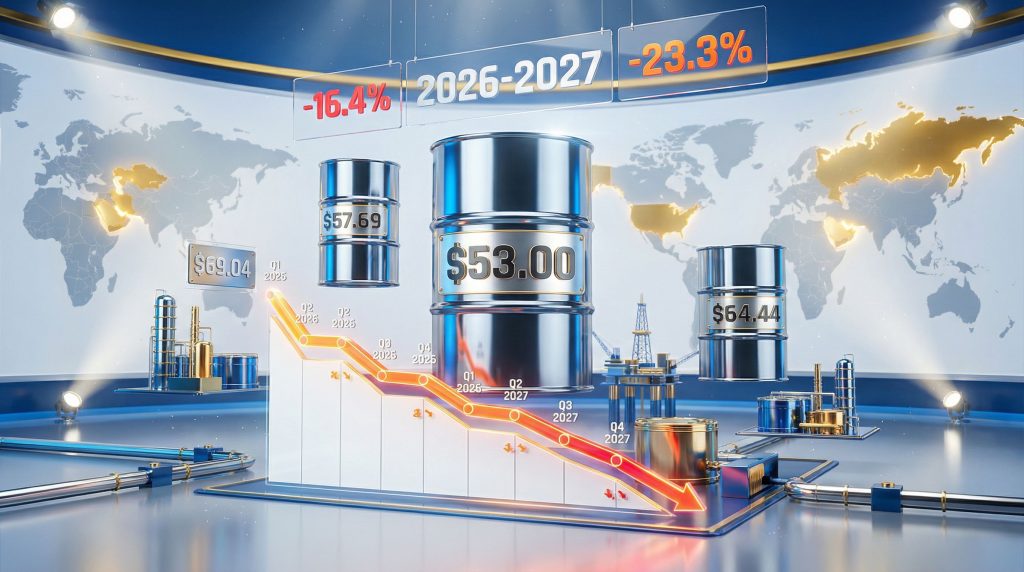
The EIA Brent price forecast 2026 2027 establishes a clear downward trajectory from current pricing levels. The 2025 Brent spot price averaged $69.04 per barrel, serving as the baseline reference point for all subsequent projections. For 2026, the EIA projects an annual average price of $57.69 per barrel, representing a 16.4 percent decline from 2025 levels. The 2027 forecast anticipates an average price of $53.00 per barrel, indicating a 23.3 percent cumulative decline from 2025 pricing.
| Period | Projected Price ($/barrel) | Change from 2025 Average |
|---|---|---|
| 2025 Average | $69.04 | Baseline |
| 2026 Q1 | $64.44 | -6.7% |
| 2026 Q2 | $57.32 | -17.0% |
| 2026 Q3 | $55.35 | -19.8% |
| 2026 Q4 | $54.00 | -21.8% |
| 2026 Annual Average | $57.69 | -16.4% |
| 2027 All Quarters | $53.00 | -23.3% |
The quarterly progression for 2026 reveals accelerating price deterioration throughout the year. First quarter 2026 maintains relative proximity to 2025 averages at $64.44 per barrel, but subsequent quarters show progressive decline: Q2 2026 drops to $57.32 per barrel (17.0 percent reduction), Q3 2026 falls to $55.35 per barrel (19.8 percent reduction), and Q4 2026 reaches $54.00 per barrel (21.8 percent reduction). Notably, all four quarters of 2027 are projected uniformly at $53.00 per barrel, suggesting the EIA expects price stabilisation at substantially lower levels.
Recent price volatility provides important context for these projections. January 2026 demonstrated significant market turbulence, with Brent crude averaging $67 per barrel for the entire month, representing a $4 per barrel premium relative to December 2025 averages. This volatility underscores the challenge of medium-term forecasting in markets subject to supply disruption events, yet the EIA's confidence in declining trends reflects conviction that structural supply expansion will override temporary disruption effects.
When big ASX news breaks, our subscribers know first
What Drives the Predicted Oil Price Decline Through 2027?
Global Production Capacity Expansion Analysis
The fundamental driver of the EIA Brent price forecast 2026 2027 centres on strong growth in global oil production that will generate high global oil inventory builds throughout the forecast period. This supply-side expansion reflects multiple technological and operational improvements across non-OPEC+ producing regions, creating production capacity growth that exceeds demand expansion rates.
Production efficiency gains stem from several technological advances:
- Enhanced extraction technologies reducing per-barrel production costs
- Infrastructure development supporting increased output capacity
- Operational optimisation improving field productivity across existing assets
- New field development bringing additional supply online through 2027
The EIA's confidence in production growth reflects measurable capacity additions across multiple regions, though specific volumetric projections by country were not detailed in the February 2026 STEO release. This production expansion operates independently of OPEC+ quota decisions, representing structural supply growth that creates downward pressure regardless of cartel production policy.
Inventory Accumulation Dynamics and Market Pressure
China's strategic petroleum reserve programme represents the most quantified demand component within the EIA's analytical framework. The organisation disclosed that a large portion of oil inventory builds in 2025 occurred in strategic stockpiles in China, which limited downward price pressures because these builds acted as a source of demand.
Key inventory accumulation metrics include:
- 1.0 million barrels per day – China's projected strategic reserve building rate for 2026
- 365 million barrels annually – Total strategic demand from Chinese reserve filling
- Reduced build rate in 2027 – Anticipated decline in China's strategic accumulation
This strategic reserve demand creates temporary price support by absorbing approximately 1.0 million barrels daily from global markets throughout 2026. However, the EIA projects China will reduce strategic builds in 2027, removing this demand source and contributing to steeper price declines in the second forecast year.
The inventory dynamic operates as both price support and future supply risk. While 2026 strategic reserve building prevents more severe price declines, these accumulated inventories become potential future supply when released to markets, creating additional downward pressure beyond current projections if strategic reserves are accessed during periods of supply disruption or economic stress.
Demand Growth Limitations and Economic Headwinds
Global oil demand growth faces multiple structural constraints that limit consumption expansion relative to production capacity increases. Energy transition initiatives across major economies reduce petroleum consumption in transportation and industrial sectors, while economic growth deceleration affects industrial demand patterns.
Primary demand growth limitations:
- Transportation sector evolution toward electric vehicle adoption
- Industrial efficiency improvements reducing energy intensity per unit of economic output
- Renewable energy substitution in power generation and heating applications
- Economic growth moderation in major consuming economies
These demand constraints operate over multi-year timeframes, creating structural headwinds for oil consumption growth that compound the effects of supply expansion. The combination of accelerating production capacity and moderating demand growth creates the fundamental supply-demand imbalance driving the EIA's price decline projections.
How Will OPEC+ Production Strategy Influence Price Trajectories?
Production Restraint Policy Assessment
OPEC+ production policy forms a critical variable within the EIA Brent price forecast 2026 2027, though the organisation's assumptions extend beyond confirmed cartel commitments. On February 1, 2026, OPEC+ reaffirmed plans to keep production flat in the first quarter of 2026, maintaining existing quota levels through March 31, 2026.
The EIA's 2027 production assumptions reflect analytical judgement rather than formal OPEC+ policy. Despite no plans to announce 2027 targets until the fourth quarter of 2026, the EIA expects OPEC+ will not increase production next year given anticipated large inventory builds over the forecast period. This represents a critical forecasting assumption: the EIA projects cartel production restraint based on rational economic behaviour rather than stated policy commitments.
OPEC+ policy timeline considerations:
- Q1 2026: Confirmed production quota maintenance
- Q2-Q4 2026: No formal policy announcements scheduled
- 4Q 2026: Expected timing for 2027 target announcements
- 2027: EIA assumes continued production restraint despite no formal commitment
Strategic Decision-Making Framework for 2027 Production Targets
The EIA's OPEC+ assumptions reflect understanding of the tension between market share preservation and revenue optimisation during periods of inventory accumulation. If OPEC+ were to increase production during 2026-2027 when global inventory builds create downward pressure, the cartel would capture additional volume but at dramatically lower unit prices.
This strategic framework suggests OPEC+ faces a critical decision point in late 2026:
"Scenario 1: Maintain production restraint to support prices at $53-58 per barrel range"
"Scenario 2: Increase production to capture market share but risk price collapse below $50 per barrel"
The EIA's forecast assumes OPEC+ will prioritise revenue stability over volume expansion, maintaining production discipline to prevent catastrophic price declines during the inventory build period. This assumption proves critical to the overall price trajectory, as OPEC+ production increases could accelerate price declines beyond the 23.3 percent projection.
Geopolitical Risk Factors and Supply Disruption Scenarios
Middle East supply stability represents a significant uncertainty within OPEC+ production capacity. The EIA acknowledged that markets responded to questions over recent U.S. policy action toward Iran, with oil prices easing after initial volatility. Crude oil production in Iran has remained stable, though the organisation assumes continued stability while acknowledging that actions targeting oil infrastructure or conflict affecting flows through the Strait of Hormuz could reduce Middle East oil production and exports.
Critical geopolitical risk factors:
- Strait of Hormuz vulnerabilities affecting approximately 20% of global oil transit
- Iran sanctions policy implications and production capacity constraints
- Regional stability considerations across major OPEC+ producing nations
- Infrastructure security for critical production and export facilities
These geopolitical risks operate as potential upside price catalysts that could override the fundamental supply-demand dynamics driving the EIA's declining price forecast. However, the organisation's base case assumes continued regional stability sufficient to maintain current production capacity levels.
Why Are Energy Analysts Revising Previous Price Expectations?
Recent Market Volatility and Short-Term Disruption Events
The EIA Brent price forecast 2026 2027 incorporates lessons from recent market volatility that demonstrated both the persistence of supply disruption risks and the underlying strength of production capacity expansion. January 2026 price movements provided a real-time laboratory for testing forecast assumptions against market reality.
Brent crude experienced substantial intra-month volatility, with daily prices ranging from $62 per barrel on January 2 to $72 per barrel on January 30. This $10 per barrel swing, representing 16.1 percent volatility within a single month, responded to crude oil production disruptions in the United States and Kazakhstan. The January average of $67 per barrel exceeded December 2025 levels by $4 per barrel, demonstrating market sensitivity to supply interruptions.
January 2026 volatility analysis:
- Opening price: $62/barrel (January 2)
- Peak price: $72/barrel (January 30)
- Monthly average: $67/barrel
- Volatility range: 16.1% intra-month swing
- Supply disruption sources: United States and Kazakhstan production facilities
Despite this significant short-term disruption, the EIA maintained confidence in its declining price trajectory, indicating the organisation's conviction that temporary supply constraints will not alter fundamental market dynamics. This analytical stance reflects the EIA's assessment that global production capacity expansion will reassert downward pressure once disruption events resolve.
Forecast Revision Patterns and Analytical Adjustments
The February 10, 2026 STEO release represents the EIA's integration of January price volatility into medium-term projections. Rather than revising upward in response to the $62-72 per barrel price rally, the organisation maintained its declining forecast trajectory, demonstrating confidence that supply-demand fundamentals will overcome disruption effects.
This forecasting approach reveals several analytical principles:
- Disruption events are temporary – Production interruptions in specific regions do not alter global capacity trends
- Structural trends dominate – Fundamental supply expansion and demand moderation override short-term volatility
- Policy interventions provide price floors – OPEC+ restraint and China's strategic reserves prevent catastrophic declines
- Inventory dynamics create delayed effects – Current builds become future supply when released to markets
The EIA's willingness to maintain declining projections despite recent price strength reflects institutional confidence in analytical methodology and structural market assessment. This approach contrasts with more reactive forecasting that adjusts projections in response to recent price movements.
Integration of Real-Time Data into Medium-Term Forecasting Models
The STEO framework demonstrates sophisticated integration of real-time market data with structural analysis. The organisation explicitly noted that crude oil prices rose in response to disruptions to crude oil production, but emphasised that despite near-term increases in prices and short-term disruptions to oil supply, strong growth in global oil production will result in high global oil inventory builds over the forecast.
This integration process reveals the EIA's analytical hierarchy:
- Short-term disruptions affect daily and weekly pricing
- Medium-term trends driven by production capacity and inventory dynamics
- Long-term structure determined by technology, policy, and demand evolution
- Risk scenarios overlay geopolitical and economic uncertainty
The February 2026 forecast demonstrates this hierarchy in action, acknowledging January volatility while maintaining conviction in medium-term declining trends based on production growth and inventory accumulation dynamics.
What Economic Implications Emerge from Lower Oil Prices?
Consumer and Industrial Cost Structure Benefits
The EIA Brent price forecast 2026 2027 projects oil prices declining from $69.04 per barrel in 2025 to $53.00 per barrel in 2027, creating substantial cost structure improvements across multiple economic sectors. This 23.3 percent price reduction generates cascading effects through transportation, manufacturing, and consumer spending patterns.
Energy-intensive industries experience direct margin expansion:
- Chemical manufacturing benefits from reduced feedstock costs
- Transportation and logistics see fuel cost reductions improving operating margins
- Airlines experience jet fuel cost relief enhancing profitability
- Petrochemical production gains from lower crude oil input costs
Household energy expenditure relief creates increased disposable income for consumer spending in other sectors. Lower gasoline and heating oil costs free household budgets for discretionary spending, potentially stimulating economic sectors beyond energy. The magnitude of this effect depends on the proportion of household income dedicated to energy expenses, which varies significantly across geographic regions and income levels.
Transportation cost reductions create supply chain benefits extending throughout the economy. Lower diesel fuel costs reduce shipping expenses for goods movement, potentially moderating inflation pressures in consumer products. This cascading effect amplifies the direct energy cost savings through indirect price reductions across multiple product categories.
Producer Nation Fiscal Challenges and Adaptation Strategies
Oil-dependent economies face substantial fiscal challenges from the projected price environment. Many producing nations structure government budgets around oil revenue assumptions that exceed the EIA projections, creating potential budget deficits and economic adjustment requirements.
Budget balancing challenges for major producers:
- Revenue shortfalls from lower per-barrel export proceeds
- Infrastructure investment constraints due to reduced government revenues
- Social spending pressures maintaining public services despite lower oil income
- Currency stability risks for nations heavily dependent on petroleum exports
Producer nations may accelerate economic diversification initiatives to reduce dependence on oil revenues. Lower price environments historically incentivise investment in alternative economic sectors, though the capital for diversification investments becomes constrained precisely when oil revenues decline. This creates a policy tension between immediate fiscal needs and longer-term diversification requirements.
Investment capacity constraints in oil sector exploration and development may reduce future production capacity if sustained low prices make marginal projects uneconomical. This creates potential future supply reductions that could eventually support price recovery, though the timing of such effects extends beyond the 2027 forecast horizon.
Global Inflation and Monetary Policy Considerations
Lower oil prices provide central banks increased flexibility in monetary policy implementation by reducing inflationary pressures across multiple economic sectors. The relationship between energy costs and broader economic policies becomes particularly relevant when considering how US tariffs & inflation interact with oil price movements. Energy cost moderation creates room for accommodative monetary policies without triggering inflation concerns, potentially supporting economic growth through lower interest rates.
Central bank policy implications:
- Reduced inflation pressures allowing potential interest rate reductions
- Supply chain cost improvements moderating producer price indices
- Currency stability benefits for oil-importing nations through improved trade balances
- Economic growth support through lower energy input costs
Oil-importing nations experience substantial trade balance improvements from lower petroleum import costs. Countries that import significant quantities of crude oil or refined products benefit from reduced foreign exchange outflows, strengthening currency positions and improving international payment balances.
The magnitude of these effects varies substantially across different economies based on energy intensity, import dependence, and currency relationships. Highly industrialised economies with significant oil imports may experience more pronounced benefits than economies with lower energy consumption or domestic production capacity.
Which Market Factors Could Alter These Price Projections?
Upside Risk Scenarios and Price Support Mechanisms
Several factors could drive oil prices above the forecast projections, creating upside risk scenarios that energy market participants must consider in strategic planning. Trade tensions continue to influence global energy markets, with the US‐China trade war affecting demand patterns and supply chain dynamics. These upside catalysts operate across geopolitical, economic, and operational dimensions.
Geopolitical supply disruption scenarios:
- Middle East conflict escalation affecting production infrastructure or export routes
- Strait of Hormuz disruption impacting approximately 20% of global oil transit
- Iran sanctions intensification removing additional supply from global markets
- Venezuela political instability further constraining production capacity
The EIA explicitly acknowledged that actions targeting oil infrastructure or conflict affecting flows through the Strait of Hormuz could reduce Middle East oil production and exports. This represents a low-probability, high-impact risk that could drive prices substantially above forecast levels if realised.
Accelerated economic recovery could generate demand surge exceeding current projections. If global economic growth exceeds expectations, industrial oil demand might expand faster than supply capacity additions, creating tighter market conditions than the inventory build scenario underlying the EIA forecast.
Economic acceleration scenarios:
- China economic stimulus driving increased oil consumption beyond current projections
- Global manufacturing expansion increasing industrial energy demand
- Transportation sector recovery exceeding efficiency improvement rates
- Strategic reserve release policy reversals eliminating inventory buffer
Downside Risk Amplification Factors
Conversely, multiple factors could accelerate price declines beyond the EIA's projections, creating downside scenarios with prices falling below the $53 per barrel 2027 target. The trade war oil impact continues to create additional uncertainty in global energy markets. These amplification factors primarily relate to supply expansion acceleration and demand destruction mechanisms.
Technology-driven production cost reductions could make previously uneconomical resources profitable at lower price levels, expanding supply capacity beyond current assumptions. Enhanced extraction technologies, operational optimisation, and infrastructure improvements might enable production growth exceeding EIA projections.
Supply expansion acceleration scenarios:
- Breakthrough extraction technologies reducing production costs dramatically
- Infrastructure development enabling faster capacity additions
- New field discoveries adding supply beyond current geological assessments
- OPEC+ production discipline breakdown flooding markets with additional supply
Renewable energy adoption rates exceeding projections could reduce petroleum demand faster than anticipated. Accelerated electric vehicle deployment, renewable power generation expansion, or industrial electrification might create demand destruction beyond the EIA's assumptions.
Demand destruction amplification:
- Electric vehicle adoption acceleration reducing transportation fuel demand
- Renewable energy deployment substituting petroleum in power generation
- Global economic slowdown reducing industrial energy consumption
- Energy efficiency improvements lowering consumption per unit of economic output
The next major ASX story will hit our subscribers first
How Should Energy Market Participants Prepare for This Price Environment?
Investment Strategy Implications for Energy Sector
The declining price trajectory creates specific strategic imperatives for energy sector participants across exploration, production, refining, and service companies. The projected price environment of $57.69 per barrel in 2026 declining to $53.00 per barrel in 2027 requires operational and financial adjustments to maintain profitability.
Capital allocation optimisation strategies:
- Focus on low-cost production assets with break-even points below $50 per barrel
- Accelerate technology adoption to reduce per-barrel extraction costs
- Prioritise operational efficiency over capacity expansion in marginal fields
- Maintain financial flexibility through conservative debt levels and cash reserves
Production companies must reevaluate project economics using the EIA's price assumptions rather than higher price scenarios that may no longer be realistic. Projects requiring $60+ per barrel break-even prices face cancellation or indefinite postponement, concentrating investment in proven, low-cost assets.
Service sector companies experience reduced demand for exploration and development services as producers curtail marginal projects. This creates pricing pressure in the service sector and potential consolidation opportunities as smaller service providers struggle with reduced activity levels.
Technology adoption acceleration priorities:
- Enhanced extraction efficiency reducing production costs per barrel
- Operational automation minimising labour costs and improving consistency
- Predictive maintenance reducing downtime and repair expenses
- Digital optimisation improving field management and production scheduling
Risk Management Framework Development
Energy market volatility requires sophisticated risk management approaches that address both operational and financial uncertainties. The January 2026 price swing from $62 to $72 per barrel within a single month demonstrates the persistence of short-term volatility despite longer-term declining trends.
Hedging strategy considerations for price volatility:
- Fixed-price forward contracts securing revenue at acceptable price levels
- Put option protection establishing price floors for production output
- Collar strategies limiting both upside and downside price exposure
- Basis risk management addressing regional price differentials
Supply chain diversification becomes increasingly important under geopolitical uncertainty. The EIA acknowledged continued risks from Iran policy actions and potential Strait of Hormuz disruptions, indicating that geographic concentration in supply chains creates vulnerability to disruption events.
Supply chain risk mitigation approaches:
- Geographic diversification across multiple supply regions
- Inventory buffer maintenance providing operational flexibility during disruptions
- Alternative supplier qualification enabling rapid sourcing shifts when needed
- Transportation route diversification reducing dependence on critical chokepoints
Financial planning adjustments must account for extended low-price cycles rather than assuming rapid price recovery. The EIA's confidence in declining trends through 2027 suggests price weakness may persist longer than historical cycles, requiring conservative financial assumptions and extended capital preservation strategies.
Frequently Asked Questions About EIA Oil Price Forecasts
How Accurate Are EIA Price Predictions Historically?
The U.S. Energy Information Administration's forecasting accuracy varies significantly across different time horizons and market conditions. Short-term STEO projections (3-6 months) typically demonstrate higher accuracy than medium-term forecasts (12-24 months) due to reduced uncertainty in near-term supply-demand dynamics.
Historical analysis reveals that EIA forecasts perform better during periods of stable market conditions compared to periods of significant disruption or structural change. The organisation's methodology emphasises fundamental analysis of supply-demand trends, which proves more reliable when underlying market structure remains consistent.
Forecast accuracy considerations:
- Short-term accuracy generally higher due to limited variable change
- Medium-term uncertainty increases with longer forecast horizons
- Structural change periods reduce forecast reliability across all timeframes
- Geopolitical events create unpredictable disruptions affecting accuracy
The EIA projection represents medium-term forecasting extending 24 months from the February 2026 release date, placing it in the higher uncertainty category compared to quarterly near-term forecasts. Users should consider forecast ranges rather than specific point estimates when making strategic decisions.
Comparison with other major forecasting institutions provides additional perspective on projection reliability. The International Energy Agency (IEA), OPEC, and major investment banks publish competing forecasts that often differ substantially, particularly for medium-term horizons. Consensus analysis across multiple forecasting sources can provide broader insight than reliance on single institutional projections.
What External Factors Could Invalidate These Projections?
Multiple categories of external factors could render the forecast inaccurate, ranging from high-probability scenarios with moderate impact to low-probability scenarios with severe consequences. Understanding these potential invalidation factors assists strategic planning and risk assessment.
High-impact geopolitical scenarios:
- Major Middle East conflict disrupting production infrastructure across multiple countries
- Strait of Hormuz closure eliminating approximately 20% of global oil transit capacity
- Iran-U.S. military engagement removing Iranian production and threatening regional stability
- Saudi Arabia internal instability affecting the world's largest oil exporter
Economic scenarios could invalidate demand assumptions underlying the forecast. The EIA projects moderate demand growth offset by supply expansion, but severe economic acceleration or contraction could alter consumption patterns substantially.
Economic invalidation scenarios:
- Global recession reducing industrial oil demand beyond forecast assumptions
- China economic collapse eliminating strategic reserve building and reducing consumption
- Hyperinflation periods altering currency relationships and commodity pricing
- Financial system disruption affecting energy project financing and development
Technology disruption represents longer-term invalidation risk that could accelerate demand destruction beyond current projections. Revolutionary advances in renewable energy, electric vehicles, or alternative fuels might reduce petroleum consumption faster than anticipated.
Technology disruption categories:
- Electric vehicle cost parity achieving widespread adoption ahead of projections
- Renewable energy breakthrough making petroleum uncompetitive in additional applications
- Extraction technology revolution dramatically reducing production costs and expanding supply
- Alternative fuel development substituting petroleum in transportation and industrial uses
The EIA explicitly noted that the evolving situation in Venezuela remains a key uncertainty in its forecast, indicating acknowledgment that political developments in major producing nations could alter supply assumptions. Similarly, unexpected supply discoveries or production capacity developments could invalidate supply-side assumptions driving the declining price forecast.
Disclaimer: This analysis relies on publicly available information and industry research as of February 2026. Oil price forecasting involves substantial uncertainty, and actual prices may differ materially from projections due to geopolitical events, economic developments, technology changes, or other unforeseen factors. This content is for informational purposes only and should not be considered as investment advice. Readers should conduct their own research and consult qualified professionals before making investment or business decisions based on energy price projections.
Looking to Capitalise on Global Energy Market Disruptions?
Whilst EIA oil price forecasts provide valuable macro insights, the real opportunities often emerge from micro-level mineral discoveries that drive energy sector supply chains. Discovery Alert's proprietary Discovery IQ model delivers instant notifications on significant ASX mineral discoveries, empowering subscribers to identify actionable trading opportunities before broader market recognition. Begin your 14-day free trial today and position yourself ahead of energy market shifts that create exceptional investment returns.