July 13, 2026
When a Strait Becomes a Stranglehold: Iraq's Oil Export Architecture Under Stress
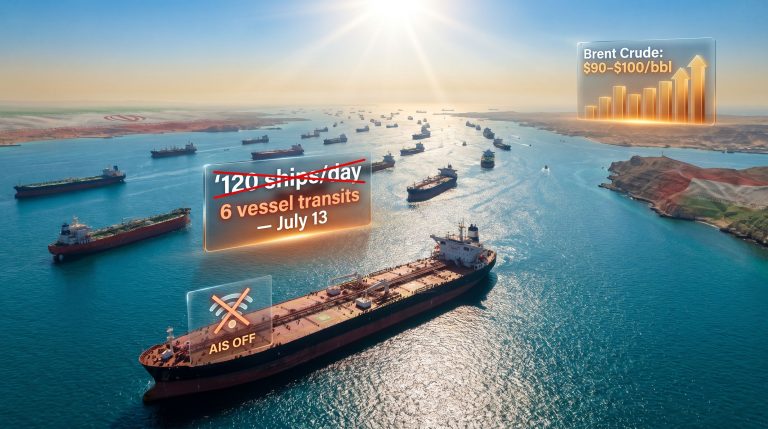
The global oil market operates on the assumption that geography is destiny. For most of the Gulf's major crude producers, that geography converges on a single maritime pinch point: the Strait of Hormuz. Roughly 33 kilometres wide at its narrowest navigable channel, this body of water connecting the Persian Gulf to the Gulf of Oman carries an estimated 20 to 21 million barrels of crude and petroleum products per day under normal operating conditions, equivalent to approximately one-fifth of global daily oil consumption. Iraq oil exports through Strait of Hormuz routes represent a critical vulnerability in this system — when that corridor is disrupted, the consequences are not localised. They are systemic, and for Iraq, they are existential.
Understanding Iraq's current export crisis requires stepping back from the immediate headlines and examining the structural logic that produced this vulnerability in the first place. Iraq's dependence on Gulf-facing maritime routes did not emerge overnight. It is the product of decades of infrastructure investment concentrated in southern terminal facilities, political dysfunction that left alternative corridors dormant, and a fiscal architecture almost entirely dependent on crude export revenues.
When big ASX news breaks, our subscribers know first
The Architecture of Single-Point-of-Failure Dependency
Iraq's export infrastructure reflects a particular historical path. Following the destruction of earlier pipeline networks during successive conflicts and the prolonged suspension of the Kirkuk-Ceyhan northern corridor, Baghdad's export capacity became progressively concentrated in southern offshore loading terminals operating in the Persian Gulf. These terminals, connected to the Basra oil fields, became the dominant mechanism through which Iraqi crude reached global markets.
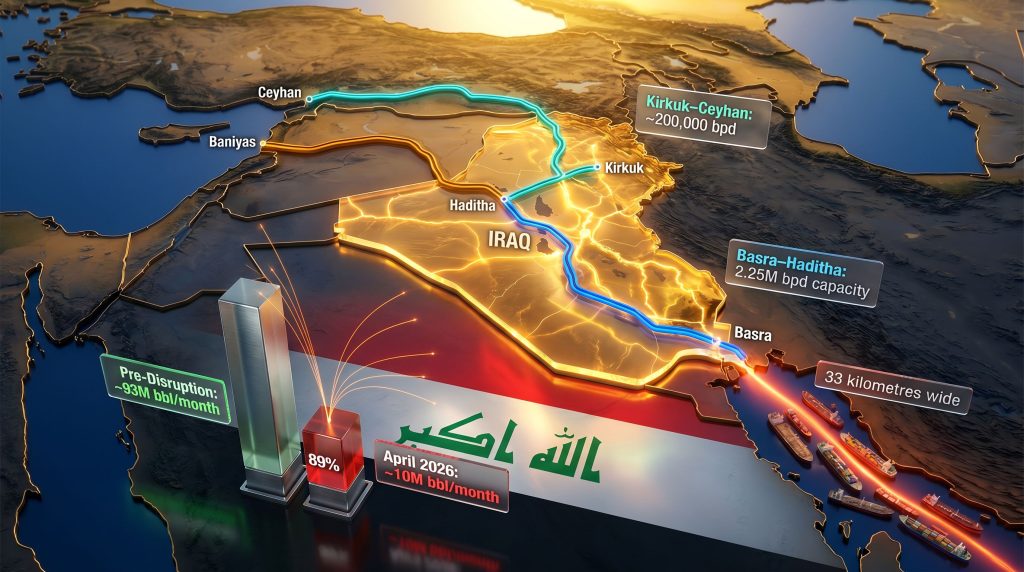
The result of this concentration is stark. Prior to the disruption caused by the Iran conflict, Iraq was exporting approximately 93 million barrels per month through Gulf routes transiting the Strait of Hormuz, a figure representing somewhere between 90 and 93 percent of the country's total crude export volume, according to Iraq's oil minister Basim Mohammed. Furthermore, the crude oil market dynamics underpinning this dependency have long been understood, yet structural remedies remained elusive.
To put this dependency in comparative perspective:
- Saudi Arabia operates the East-West Petroline pipeline with a bypass capacity of approximately 5 million barrels per day, routing crude to Yanbu on the Red Sea coast, providing a meaningful alternative to Hormuz exposure.
- The UAE has developed the Abu Dhabi Crude Oil Pipeline to Fujairah, offering a bypass capacity of roughly 1.5 million barrels per day through the Gulf of Oman, entirely circumventing the strait.
- Iraq, by contrast, entered the current crisis with no functioning large-scale bypass infrastructure and a northern pipeline that had been idle for years due to political disputes.
This structural gap makes Iraq categorically more vulnerable than its Gulf neighbours when Hormuz access is threatened.
Quantifying the Collapse: April 2026 Export Data
The scale of Iraq's export disruption in April 2026 is difficult to overstate. Oil minister Basim Mohammed confirmed at a press conference on 16 May 2026 that Iraq's exports through the Strait of Hormuz fell to just 10 million barrels during the month, compared with approximately 93 million barrels in the pre-disruption monthly baseline. That represents a decline of roughly 89 percent in a single month.
| Metric | Pre-Disruption Baseline | April 2026 Reported Figure | Change |
|---|---|---|---|
| Monthly exports via Hormuz | ~93 million barrels | ~10 million barrels | ~89% decline |
| Kirkuk-Ceyhan pipeline flow | Suspended (pre-March 2026) | ~200,000 bpd (resumed) | Partial recovery |
| Target Ceyhan capacity | Not operational | 500,000 bpd (planned) | Under development |
| Iraq production capacity target | Current levels | 5 million bpd (ambition) | Long-term goal |
The practical consequences of an 89 percent reduction in export throughput cascade rapidly through Iraq's economic system:
- Storage saturation at southern terminal facilities, as production volumes outpace available export capacity and force upstream shut-ins.
- Fiscal compression, given that oil revenues typically underpin the overwhelming majority of Iraq's federal budget, including public sector wages for millions of government employees.
- Upstream investment stagnation, as international oil companies operating fields under technical service contracts face uncertainty about offtake arrangements.
- Social stability risks, in a country where government services and subsidy systems depend almost entirely on crude export receipts.
The Iran conflict's closure of the strait has, in effect, simultaneously stress-tested the entire Gulf export architecture. Iraq has proven the most acutely exposed of all affected producers precisely because of its near-total absence of bypass infrastructure. Consequently, the trade war impact on oil markets has compounded this regional strain considerably.
Three Alternative Corridors: Potential, Constraints, and Timelines
Iraq's response to the crisis has accelerated discussions around three distinct export diversification pathways, each with fundamentally different capacity profiles, political risk dimensions, and development timelines.
The Kirkuk-Ceyhan Pipeline: Fastest Near-Term Recovery
The Kirkuk-Ceyhan pipeline is Iraq's original northern export corridor, running from the Kirkuk oil fields through the Kurdistan Region to the Turkish Mediterranean port of Ceyhan. For years, this pipeline sat effectively dormant, its suspension the product of unresolved disputes between Baghdad and the Kurdistan Regional Government over revenue-sharing arrangements and production rights.
The strategic cost of that political gridlock became painfully apparent once Hormuz access was disrupted. Iraq had sacrificed a functioning alternative export route at precisely the moment it needed one most. The agreement between Baghdad and the KRG reached in early 2026 to restart pipeline flows represents a significant political development, though the durability of such arrangements in the context of historically volatile Baghdad-Erbil relations remains an open question.
Current throughput stands at approximately 200,000 barrels per day, with a stated plan to scale capacity toward 500,000 barrels per day. That uplift, while meaningful, would still represent only a partial offset to the lost Hormuz volume. Additional constraints include:
- Turkish political leverage and transit fee dynamics that give Ankara considerable influence over northern Iraqi export economics.
- Pipeline security challenges in northern Iraq, where the infrastructure traverses complex terrain.
- The infrastructure's rated capacity relative to the investment required to reach 500,000 barrels per day in practice.
According to Reuters reporting on Iraq's export recovery, Iraq could potentially restore exports to pre-war levels within a week should Hormuz reopen, underscoring just how critical the strait remains to near-term volume recovery.
The Syria Overland Corridor: Geopolitically Complex, Operationally Limited
A second emerging route involves transporting fuel oil and crude products across the Iraq-Syria border by road toward the Baniyas Mediterranean terminal. This corridor carries significant operational and political risk despite its geographic logic. Syria's post-conflict infrastructure remains fragile, and using Syrian territory for energy transit introduces dependencies on a state with unresolved political and security challenges.
Longer-term discussions around rehabilitating or constructing pipeline infrastructure linking Iraqi fields to Syrian Mediterranean ports are geopolitically significant as a signal of regional normalisation, but remain at an early conceptual stage. This route is best understood as a supplementary outlet rather than a structural solution.
The Basra-Haditha Pipeline: Transformational but Long-Dated
The most consequential potential diversification project is the proposed Basra-Haditha pipeline, an inland corridor connecting Iraq's southern Basra oil fields to Haditha in western Iraq. With a reported design capacity of up to 2.25 million barrels per day, this project would represent a fundamentally transformational change in Iraq's export architecture, potentially reducing Hormuz dependency from the current 90 percent-plus to a materially lower share.
From Haditha, onward connectivity to Jordan and potentially to Mediterranean or Red Sea export terminals would create a multi-directional export portfolio that no other disruption scenario could simultaneously block. However, the project faces substantial challenges:
- Financing requirements of a scale that demands sovereign-level commitment and likely international investment partners.
- Engineering complexity across challenging terrain.
- A development timeline that, under optimistic assumptions, stretches several years before meaningful throughput becomes possible.
The Basra-Haditha pipeline carries the highest capacity potential of any alternative corridor under consideration, but also the longest lead time before it can contribute meaningfully to Iraq's export resilience.
| Route | Current Capacity | Target Capacity | Timeline | Risk Level |
|---|---|---|---|---|
| Kirkuk-Ceyhan (Turkey) | ~200,000 bpd | ~500,000 bpd | Near-term | Medium |
| Syria-Baniyas (overland) | Limited/early stage | TBD | Short-term | High |
| Basra-Haditha Pipeline | Not operational | ~2.25 million bpd | Long-term | Medium-High |
| Strait of Hormuz (Gulf) | ~93 million bbl/month (pre-crisis) | Disrupted | Uncertain | Very High |
The Global Oil Price Transmission Effect
Iraq's export collapse does not occur in a vacuum. Reduced Gulf supply volumes transmit into global benchmark pricing with remarkable speed, typically within hours of credible threat signals emerging. Traders and futures markets build a risk premium into Brent and WTI pricing that reflects not only actual volume reductions but anticipated duration and the probability of further escalation.
The asymmetric nature of this price impact is worth noting. Producers with functioning bypass infrastructure, or those outside the Gulf region entirely, benefit from higher benchmark prices while facing none of the supply constraints. Iraq, by contrast, experiences both the revenue destruction of near-zero export volumes and the macroeconomic disruption of the broader regional crisis. In addition, the oil price rally under Trump tariffs has introduced yet another layer of complexity to global pricing signals during this period.
For major crude-importing nations, the exposure is substantial:
- China, India, Japan, and South Korea collectively absorb a dominant share of Gulf crude exports under normal conditions.
- India is particularly exposed, with a significant proportion of its crude import requirements historically sourced from Gulf producers whose access to export routes now flows entirely through Hormuz.
- IEA member nations retain strategic petroleum reserves designed to cover approximately 90 days of import requirements, providing a meaningful buffer against acute disruptions but insufficient for prolonged closures measured in months rather than weeks.
Under a scenario where Hormuz disruption extends beyond three to six months, the market dynamics shift from inventory drawdown and risk premium pricing into structural demand destruction, accelerated alternative fuel substitution, and potential reshaping of global refinery feedstock patterns that could persist well beyond the immediate crisis. CommBank's analysis of Iraq's production collapse provides further detail on the downstream financial consequences of a prolonged Hormuz blockage.
OPEC Dynamics and Iraq's Production Ambitions
Oil minister Basim Mohammed confirmed that Baghdad intends to engage with OPEC on boosting Iraq's production and export capacity, with a stated ambition to reach a production capacity of 5 million barrels per day. This creates a notable tension within the OPEC framework. The influence of OPEC on global oil markets means that Iraq's engagement with the organisation carries significant weight for the broader supply outlook.
Iraq's current output sits below that target level, and reaching 5 million barrels per day would require substantial upstream investment, resolution of export infrastructure constraints, and a degree of OPEC quota flexibility that may not be straightforward to negotiate. The organisation's quota compliance framework is designed around orderly supply management rather than emergency export expansion, and Iraq's historical record on quota adherence has generated friction within the group before.
The crisis does, however, create a compelling argument for flexibility. When a member's export capacity is constrained by force majeure conditions rather than voluntary restraint, the case for differentiated quota treatment becomes more credible. How OPEC responds to Iraq's engagement will reveal much about the organisation's capacity to accommodate geopolitical disruption within its production management structure.
The next major ASX story will hit our subscribers first
What This Crisis Demands in Structural Terms
The fundamental lesson of Iraq's April 2026 export collapse is that fiscal sovereignty requires export infrastructure redundancy. A nation whose government revenues depend 90-plus percent on a single commodity flowing through a single corridor has, in practical terms, outsourced a core element of its fiscal security to the geopolitical stability of that corridor.
The contrast with Saudi Arabia's Petroline bypass capacity of approximately 5 million barrels per day illustrates what a credible redundancy framework looks like. The UAE's Fujairah pipeline, with roughly 1.5 million barrels per day of bypass capacity, provides another working model. Iraq has neither equivalent at present.
Near-term priorities are relatively clear: maximise Kirkuk-Ceyhan throughput toward the 500,000 barrel per day target, stabilise the Syria overland route as a supplementary outlet, and seek OPEC flexibility to support revenue recovery. Medium-term structural investments centre on advancing the Basra-Haditha pipeline from concept toward construction, resolving the Baghdad-KRG governance framework on a durable basis, and developing additional Mediterranean-facing pipeline options with Turkey, Jordan, and Syria.
The longer-term vision — a diversified export portfolio where Hormuz-transiting volumes represent no more than 50 to 60 percent of total exports — would require a decade of sustained infrastructure investment and political agreement. However, the 2025 crude oil analysis on trade and geopolitics makes clear that the window for deferring these decisions is narrowing rapidly. The current crisis has demonstrated, with exceptional clarity, the cost of postponing that investment.
Whether Baghdad treats this moment as a catalyst for durable structural change or as a temporary disruption to be managed tactically until Hormuz reopens will define Iraq's energy security posture for a generation.
Frequently Asked Questions: Iraq Oil Exports Through the Strait of Hormuz
How much oil does Iraq normally export through the Strait of Hormuz?
Under pre-disruption conditions, Iraq oil exports through Strait of Hormuz routes amounted to approximately 93 million barrels per month, representing roughly 90 to 93 percent of total national crude exports.
What happened to Iraq's Hormuz exports in April 2026?
Iraq's oil minister confirmed exports of approximately 10 million barrels through the strait in April 2026, a decline of roughly 89 percent from the pre-disruption monthly baseline, following the closure caused by the Iran conflict.
What is the Kirkuk-Ceyhan pipeline?
The Kirkuk-Ceyhan pipeline is Iraq's primary northern export corridor, running from Kirkuk oil fields through Kurdistan to the Turkish Mediterranean port of Ceyhan. After years of suspension due to Baghdad-KRG disputes, flows resumed in March 2026 at approximately 200,000 barrels per day, with plans to scale toward 500,000 barrels per day.
What is the Basra-Haditha pipeline project?
A proposed inland pipeline connecting Iraq's southern Basra oil fields to Haditha in western Iraq, with a design capacity of up to 2.25 million barrels per day. If completed, it would represent the most significant structural reduction in Iraq's Hormuz dependency on record.
How strategically important is the Strait of Hormuz to global oil markets?
An estimated 20 to 21 million barrels per day of crude and petroleum products transit the strait under normal conditions, representing approximately one-fifth of global daily oil consumption. Disruption to Iraq oil exports through Strait of Hormuz passages transmits into global benchmark pricing within hours, illustrating just how indispensable this corridor remains to international energy security.
Disclaimer: This article contains forward-looking scenario analysis, production capacity projections, and price trajectory assessments that involve significant uncertainty. Actual outcomes will depend on geopolitical developments, infrastructure investment decisions, OPEC policy, and market conditions that cannot be predicted with certainty. Nothing in this article constitutes financial or investment advice.
Want to Track the Investment Opportunities Emerging From Global Energy Disruptions?
Discovery Alert's proprietary Discovery IQ model delivers real-time alerts on significant ASX mineral discoveries, instantly translating complex resource data into actionable insights for investors navigating volatile commodity markets — explore historic discoveries and their returns to understand the scale of opportunity, then begin your 14-day free trial to position yourself ahead of the broader market.