
June 8, 2026
When a Mine Becomes a Symbol: The Structural Crossroads Facing Kimberley's Last Diamond Operation
The global diamond industry has spent the better part of a decade navigating a structural identity crisis. The proliferation of laboratory-grown diamonds (LGDs) has reshaped consumer expectations, compressed rough stone pricing, and forced legacy producers to reexamine the economic logic underpinning operations that were once considered generational assets. Against this backdrop, distressed natural diamond mines are not simply commercial failures — they are stress tests for an entire commodity's future viability.
Few situations illustrate this tension more sharply than the current Ekapa mine sale in Kimberley, South Africa. The asset sits at the intersection of geological heritage, community dependency, environmental obligation, and market uncertainty. Understanding what is being sold, why it reached this point, and what the acquisition pathways genuinely mean for investors requires a deeper look than a standard distressed-asset narrative provides.
When big ASX news breaks, our subscribers know first
What Makes the Ekapa Diamond Mine a Significant Asset
Kimberley's place in global mining history is difficult to overstate. The Northern Cape city gave the world its first major diamond rush, inspired the naming of kimberlite as a geological rock type, and produced diamonds that shaped international gem markets for over a century. The Ekapa Diamond Mine is the last remaining active diamond operation to have emerged from this legacy, and its fate carries consequences that extend well beyond a single corporate transaction.
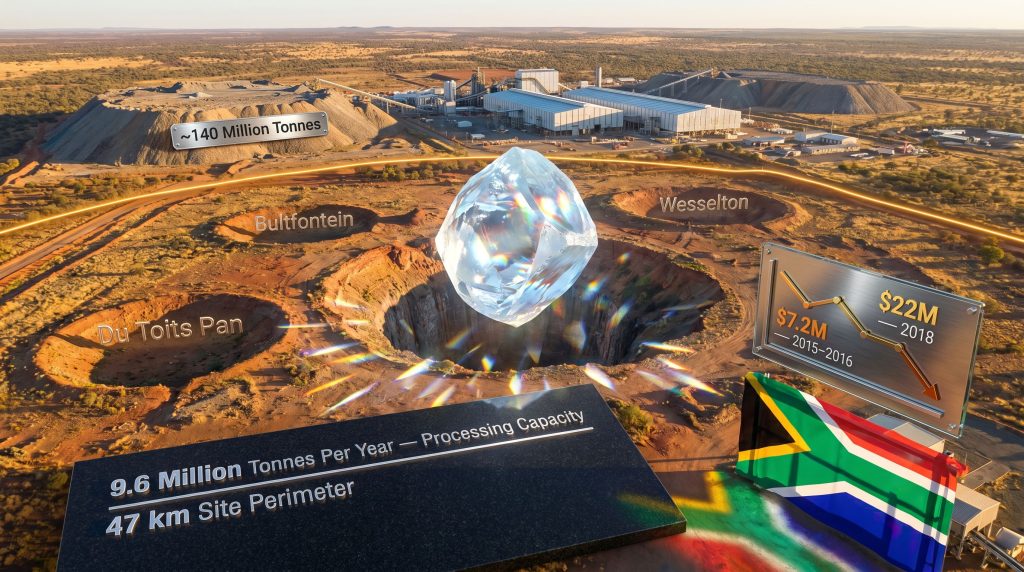
The physical asset profile is substantial. According to Mining Weekly, the operation encompasses approximately 140 million tonnes of tailings mineral resources, a 9.6-million-tonne-per-year processing plant, and three kimberlite pipes: Du Toits Pan, Bultfontein, and Wesselton. These pipes form part of the historically significant "Famous Five" cluster that defined Kimberley's diamond output for generations.
Key Asset Snapshot
| Asset Component | Detail |
|---|---|
| Tailings Resource | ~140 million tonnes |
| Processing Plant Capacity | 9.6 million tonnes per year |
| Kimberlite Pipes | Du Toits Pan, Bultfontein, Wesselton |
| Site Perimeter Under Security | 47 km |
| Remaining On-Site Workforce | ~115 employees |
| Monthly Care and Maintenance Cost | ~R10 million |
What makes this asset particularly interesting from a technical standpoint is the distinction between surface tailings operations and underground kimberlite mining. Tailings retreatment — the reprocessing of previously mined material stockpiled at surface — generally requires significantly lower capital intensity than new underground development. With 140 million tonnes of resource available at surface, a buyer focused on near-term cash generation could potentially pursue a tailings-first strategy before committing to the deeper capital expenditure required for underground recommissioning.
The joint provisional liquidators, represented by Richard Pollock, have noted that the plant and surface infrastructure are well maintained and that the Bultfontein and Wesselton shafts in particular retain potential for relatively prompt reactivation under more favourable market conditions. This selective identification of which infrastructure is closest to operational readiness is strategically significant: it signals to buyers that not every component requires simultaneous rehabilitation, which has important implications for initial capital requirements.
How the Ekapa Mine Arrived at Provisional Liquidation
De Beers' Exit and the Consortium Structure
The Ekapa Diamond Mine's path to its current distressed state traces a trajectory common to many legacy mineral assets: the departure of a major corporate operator, followed by a consortium ownership structure that ultimately struggled to sustain profitability under deteriorating market conditions.
De Beers completed its sale of its Kimberley operations in approximately 2015 to 2016, having operated in the region for more than 125 years. The buyer was a consortium comprising Petra Diamonds (holding approximately 49.9%) and Ekapa Mining (holding approximately 50.1%). The transaction value was reported at around $7.2 million, a figure that, even at the time, reflected the declining commercial attractiveness of mature surface and underground diamond operations relative to their historical significance.
The production context at the time of transfer was not negligible. The operation was producing approximately 722,000 carats annually, with significant additional upside anticipated from tailings retreatment. However, the gap between production potential and the capital demands of sustaining ageing underground infrastructure would prove difficult to bridge sustainably. In many respects, these mining consolidation trends have played out at operations globally, not just in Kimberley.
Petra's Divestiture and Operational Consolidation
In 2018, Petra Diamonds made the strategic decision to exit its Kimberley stake, selling its shareholding for approximately $22 million, equivalent to around R300 million at prevailing exchange rates. The payment was structured across 24 monthly instalments commencing in January 2019. Petra's rationale was consistent with a broader capital reallocation strategy focused on its higher-priority operations at Finsch and Cullinan.
This transaction had two significant consequences. First, it left Ekapa Mining as the sole controlling entity, concentrating operational risk. Second, the payment structure created a financial obligation stream for Ekapa at a time when diamond market conditions were becoming increasingly difficult.
The 2020 Incident and Operational Collapse
The operational crisis that ultimately precipitated the liquidation process began in February 2020, when a mud rush and water inundation event underground trapped five miners at approximately 890 metres below surface. The incident triggered an immediate operational shutdown, the consequences of which were compounded by the simultaneous deterioration of the global diamond market.
The cascading financial deterioration that followed proved insurmountable. Business rescue proceedings were initiated but failed to stabilise the enterprise. The High Court subsequently issued a provisional liquidation order for both Ekapa Minerals and Ekapa Resources. The scale of the initial workforce impact was severe, with more than 1,200 workers affected by unpaid salaries and the operational shutdown.
Union responses were pointed. The abandonment of over a thousand workers' livelihoods without adequate resolution generated significant community and organised labour condemnation in the Kimberley region.
The Structure of the Current Sale Process
Dual Acquisition Pathways
The joint provisional liquidators have designed the current market offering around two distinct acquisition routes, reflecting pragmatic acknowledgement that market conditions may not universally support immediate full-scale recommissioning.
-
Going-Concern Resumption: Acquisition of core assets and mining rights, with the intention of resuming operations within a defined 90-day window
-
Strategic Repositioning: A longer-term platform investment approach, potentially involving phased recommissioning, operational restructuring, or asset optimisation over an extended timeline
The process is being conducted through a jointly mandated auction targeting both domestic and international investors, with full mining rights included in the sale package.
Strategic Buyer Decision Framework
| Acquisition Pathway | Timeline | Capital Intensity | Risk Profile |
|---|---|---|---|
| Going-Concern Resumption | 90-day window | High (immediate capex) | High operational risk |
| Strategic Repositioning | Long-term | Moderate to High | Market-dependent |
| Tailings-Only Operation | Near-term | Lower than underground | Limited upside on gem grade |
What the 90-Day Window Actually Requires
The 90-day operational resumption timeline is not simply a commercial target. It represents a compressed technical, regulatory, and workforce mobilisation challenge that prospective buyers need to assess rigorously before committing capital.
Within that window, a buyer would need to address:
- Regulatory compliance verification and any amended approvals required following the extended suspension period — and the mining permitting hurdles involved should not be underestimated
- Shaft structural integrity assessments, particularly for Bultfontein and Wesselton
- Processing plant recommissioning, equipment testing, and calibration
- Workforce recruitment, induction, and safety protocol reestablishment
- Environmental baseline monitoring and compliance system reactivation
- Continuity of the existing underground water pumping regime without interruption
The liquidators' position that certain shafts could be recommissioned "relatively quickly" suggests that the physical infrastructure in those specific areas is in sufficiently maintained condition to support this timeline, though buyers would be expected to conduct independent technical due diligence to confirm this assessment.
Interim Asset Preservation and Financial Runway
While the sale process is progressed, the mine is being maintained at a cost of approximately R10 million per month, covering security operations across the 47-kilometre perimeter, continuous underground water pumping, and essential energy services. This expenditure generates no current mining revenue.
To extend the financial runway, the liquidators are actively selling selected noncore surface assets — specifically those that do not impair the overall viability of the mine. This represents a carefully managed monetisation strategy: converting peripheral assets to cash without cannibalising the core value proposition being marketed to potential acquirers.
The Investment Challenges a Buyer Cannot Ignore
Structural Disruption from Laboratory-Grown Diamonds
The single most significant structural challenge confronting any natural diamond mining operation today is the accelerating penetration of laboratory-grown diamonds across multiple market segments. LGDs, produced through either high-pressure high-temperature (HPHT) or chemical vapour deposition (CVD) processes, have achieved price parity or better in many industrial and mid-market jewellery categories, fundamentally eroding the demand premium that natural stones once commanded.
The joint provisional liquidators explicitly acknowledge this challenge, noting the growing prevalence of synthetic diamonds particularly in industrial applications as a key headwind. Critically, this is not a temporary pricing cycle but a structural technology substitution dynamic. Unlike supply-side commodity cycles, technology substitution tends to be directional and accelerating, not mean-reverting.
However, the investment thesis for natural diamonds is not uniformly negative. A meaningful distinction exists between commodity-grade natural stones and high-quality gem-grade diamonds, where provenance, natural origin, and rarity continue to command genuine premiums at the luxury end of the market. This bifurcation in demand is central to the liquidators' stated belief that investors pursuing jewellery-grade gem opportunities may still recognise compelling potential in the Ekapa asset.
Kimberley's historical production profile is relevant here. The region has a documented track record of producing gem-quality output from its kimberlite pipes, which is a materially different proposition from operations producing predominantly industrial-grade or lower-quality rough stone. Furthermore, broader recession impact on gold and other commodities demonstrates how macro conditions can reshape the calculus for all resource investments — diamonds included.
Capital Requirements and the Recommissioning Gap
Beyond market dynamics, the capital burden of restoring full underground operations represents a significant barrier to acquisition. The extended care and maintenance period, while preserving structural integrity, does not halt all forms of infrastructure deterioration. Equipment serviceability, shaft liner condition, ventilation systems, and electrical infrastructure all require assessment after prolonged suspension.
Workforce reconstitution is similarly complex. Skilled underground diamond mining workers represent a specialised labour pool, and rebuilding operational capacity after a multi-year suspension involves recruitment, training, and culture-rebuilding timelines that extend beyond the 90-day window for full-scale operations.
Regulatory and Environmental Compliance Costs
South African mining law imposes substantial compliance obligations on recommissioning operations, including updated environmental impact assessments, Social and Labour Plan compliance verification, and safety system certification. Consequently, these mine reclamation obligations represent non-trivial cost items that a buyer must absorb before revenue generation can commence.
The Social and Environmental Stakes of Full Closure
Community and Employment Consequences
The Ekapa mine currently retains approximately 115 employees on site under the care and maintenance programme. This figure, however, understates the breadth of community exposure. Prior to the 2020 operational collapse, the mine employed more than 1,200 workers, many of whom remain economically displaced in a regional labour market with limited alternative employment in the mining sector.
Kimberley's broader economy has historically depended on diamond sector employment. Full mine closure would not simply represent job losses within the entity itself but would accelerate the erosion of the skilled mining workforce base in the Northern Cape, with generational consequences for regional economic resilience.
Environmental Obligations That Persist Beyond Liquidation
One of the less-discussed dimensions of the Ekapa situation is the environmental liability that does not disappear upon closure. South African mining law requires ongoing environmental management obligations that survive the end of mining operations, including rehabilitation of tailings facilities and management of underground water.
The cost of doing nothing is not zero. If continuous underground water pumping ceases, shaft flooding becomes probable, potentially creating long-term groundwater contamination and remediation costs that could far exceed the current R10 million monthly maintenance expenditure. This liability does not evaporate upon liquidation; it transfers to the state and surrounding community in the absence of a responsible party.
The liquidators have stated explicitly that their objective is to avoid full closure, which would carry severe social and environmental consequences. This framing reflects an awareness that the asset's closure would impose costs well beyond the commercial domain.
The next major ASX story will hit our subscribers first
Historical Transaction Context: How Ekapa's Valuation Has Shifted
The trajectory of transaction values associated with Kimberley's diamond operations provides a sobering context for any buyer assessing current acquisition economics.
| Transaction | Year | Reported Value | Context |
|---|---|---|---|
| De Beers exit to Petra/Ekapa consortium | 2015-16 | ~$7.2 million | Major corporate divestiture of 125+ year legacy asset |
| Petra Diamonds stake sale to Ekapa | 2018 | Marginal recovery in perceived value; 24-month payment structure | |
| Current liquidation process | 2026 | Distressed asset pricing | Structural market headwinds compress valuation further |
The downward trajectory in transaction values relative to the asset's physical scale and historical output suggests that market participants have progressively discounted the earnings potential of Kimberley's remaining operations. A liquidation sale will likely reflect further compression, given the absence of competitive tension typical of strategic acquisitions and the added risk premium required by buyers absorbing an asset in provisional liquidation.
Who Could Realistically Acquire the Ekapa Asset
Credible Acquirer Profiles
The financial and operational requirements of a credible Ekapa acquisition narrow the realistic buyer universe considerably. Prospective investors should also be alert to investment red flags that can emerge in distressed-asset transactions of this nature. Key criteria include:
- Capacity to absorb approximately R10 million per month in maintenance costs before generating any mining revenue
- Technical competency in kimberlite pipe mining and diamond processing at scale
- Balance sheet capacity for the capital expenditure required to recommission underground operations
- Appetite for natural diamond market exposure at a time of structural LGD disruption
The most plausible acquirer categories include junior mining companies with specific diamond sector expertise, private equity capital with established resource sector exposure, or vertically integrated operators capable of capturing value from gem-to-retail supply chain integration. The latter category is particularly interesting given the liquidators' explicit reference to jewellery-grade gem opportunities: a buyer with downstream retail relationships could potentially monetise provenance and natural origin in ways that a pure mining operator cannot.
International Investor Interest
Geographic diversity in bidder interest will be a key variable. International capital from diamond-producing or diamond-consuming economies — including India, Belgium, Israel, and the United Arab Emirates — may be attracted to an asset with documented gem-grade production history and a 140-million-tonne tailings resource as a near-term cash generation mechanism.
The liquidators' engagement with unions and government stakeholders, while not confirming any specific support arrangements, reflects appropriate stakeholder management in a transaction with significant community implications.
Frequently Asked Questions: Ekapa Mine Sale in Kimberley
What is the Ekapa Diamond Mine?
The Ekapa Diamond Mine is a fully permitted diamond mining operation located in Kimberley, South Africa. It encompasses surface tailings retreatment and underground kimberlite pipe operations, including the Du Toits Pan, Bultfontein, and Wesselton pipes, which are part of the historically significant Famous Five cluster.
Why is the Ekapa mine being sold?
The mine is being sold through a formal auction process managed by joint provisional liquidators following the placement of Ekapa Minerals and Ekapa Resources into provisional liquidation. The sale aims to preserve the operation as a going concern and protect the interests of creditors, employees, and the broader Kimberley community.
How much does it cost to maintain the Ekapa mine currently?
The care and maintenance programme costs approximately R10 million per month, covering security across a 47-kilometre perimeter, continuous underground water pumping, and essential infrastructure preservation, with no revenue currently being generated from mining activities.
What are the two acquisition options available to buyers?
Prospective investors can either acquire the core assets and mining rights with the intention of resuming operations within a 90-day window, or alternatively pursue a longer-term strategic repositioning of the asset.
What is the biggest risk facing a potential buyer?
The combination of structural headwinds in the global diamond market — particularly the growing prevalence of laboratory-grown diamonds — and the substantial capital required to recommission underground operations represent the most significant barriers to acquisition. These risks are compounded by the compressed timeline of the 90-day operational resumption option.
What happens if no buyer is found for the Ekapa mine sale in Kimberley?
Full closure would trigger severe social consequences for the Kimberley community, significant and ongoing environmental liabilities including probable shaft flooding, and the permanent loss of one of South Africa's most historically significant diamond operations. As reported by Business Tech, environmental rehabilitation and water management obligations do not terminate upon closure.
Key Takeaways: The Ekapa Mine Sale in Strategic Context
-
The Ekapa mine sale in Kimberley is not simply a distressed asset transaction. It is a stress test for the viability of natural diamond mining in an era of laboratory-grown substitution and structural market transformation.
-
The asset's physical profile — 140 million tonnes of tailings, a 9.6 Mtpa processing plant, and three kimberlite pipes — offers genuine optionality, particularly through a tailings-first operational strategy that could reduce initial capital requirements for the right buyer.
-
The dual-pathway sale structure reflects sophisticated liquidator strategy: accommodating both operational acquirers and longer-term strategic capital without foreclosing either option prematurely.
-
The historical transaction trajectory — from De Beers' exit at approximately $7.2 million to Petra's stake sale at $22 million to current distressed pricing — reveals the compounding discount the market has applied to Kimberley's remaining operations over a decade.
-
The true cost of inaction is environmental and social, not just commercial. Continuous underground water pumping, tailings management, and community employment dependency mean that full closure imposes costs that extend far beyond the R10 million monthly maintenance figure.
-
The gem-grade natural diamond differentiation thesis represents the most credible pathway to viable acquisition economics, particularly for buyers with luxury sector relationships capable of capturing provenance premiums that LGDs cannot replicate.
Disclaimer: This article contains forward-looking statements, market projections, and analytical assessments that involve inherent uncertainty. Historical transaction values and operational data referenced in this article are drawn from publicly reported sources and should be independently verified before informing any investment decision. This article does not constitute financial, investment, or legal advice.
Ready to Identify the Next Major Mineral Discovery Before the Market Does?
Discovery Alert's proprietary Discovery IQ model delivers real-time alerts on significant ASX mineral discoveries, transforming complex geological and market data into actionable investment insights for both short-term traders and long-term investors — explore Discovery Alert's dedicated discoveries page to understand how historic finds have generated substantial returns, and begin your 14-day free trial today to secure a market-leading edge.