May 21, 2026
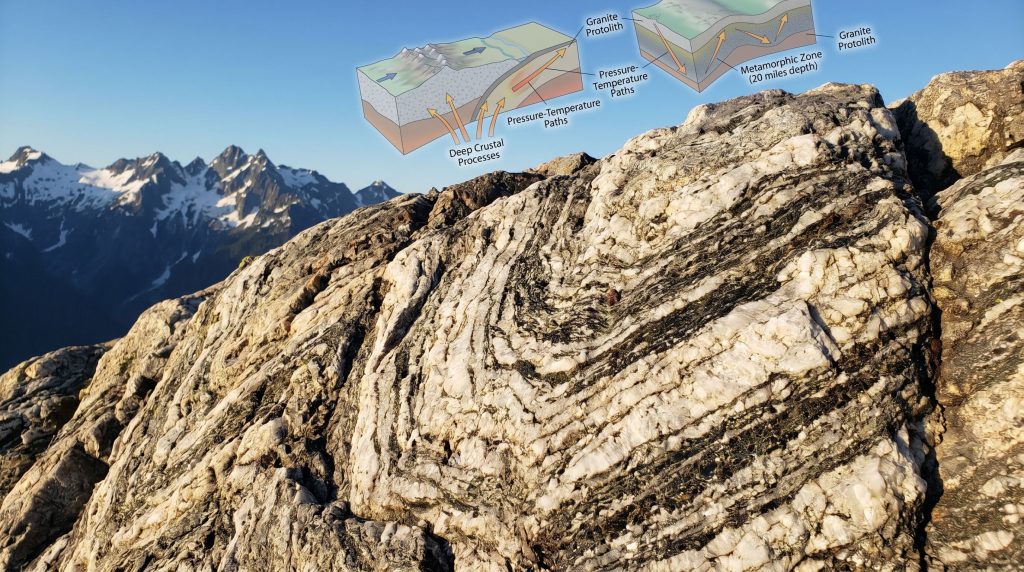
Deep within the Earth's crust, intense heat and pressure transform existing rocks into entirely new materials through a process called metamorphism. When granitic rocks undergo this transformation at depths exceeding 15 miles below the surface, they develop into orthogneiss formations characterized by distinctive banded textures and exceptional structural resistance. These metamorphic processes, occurring over millions of years under temperatures reaching 600-700°C and pressures equivalent to 5-8 kilobars, create some of the most durable foundation materials found in mountain ranges worldwide.
The North Cascades of Washington State showcase this geological phenomenon through extensive exposures of ancient basement rocks that were once buried at crushing depths. Understanding how these formations developed and subsequently reached surface elevations provides critical insights into the dynamic processes that shape mountain landscapes and influence regional topography.
What Is El Dorado Orthogneiss and Why Does It Matter?
Geological Definition and Formation Process
El Dorado Orthogneiss represents a specific type of metamorphic rock that originated from granitic protoliths approximately 90 million years ago. The transformation process involved intense metamorphic conditions that recrystallized the original granite while preserving much of its chemical composition but fundamentally altering its texture and mineral alignment.
| Rock Type | Formation Temperature | Formation Pressure | Protolith Origin | Distinctive Features |
|---|---|---|---|---|
| Orthogneiss | 600-700°C | 5-8 kilobars | Granite | Banded foliation, feldspar-rich |
| Paragneiss | 550-650°C | 4-7 kilobars | Sedimentary rocks | Layered composition |
| Schist | 450-600°C | 3-6 kilobars | Shale/mudstone | Prominent mica foliation |
| Amphibolite | 500-700°C | 4-8 kilobars | Basalt/gabbro | Dark minerals, massive texture |
The metamorphic event that created El Dorado Orthogneiss occurred during a period of intense crustal deformation when the original granite was subjected to regional metamorphism. This process involved the reorientation of mineral grains under directed pressure, creating the characteristic foliated texture that distinguishes orthogneiss from its granitic parent rock.
Formation temperatures and pressure conditions represent typical ranges for metamorphic rock development and may vary based on local geological conditions.
Regional Geological Significance
The El Dorado Orthogneiss forms a crucial component of the North Cascades crystalline core, representing uplifted basement rocks that provide a window into deep crustal processes typically hidden miles below the surface. This formation extends across significant portions of what is now North Cascades National Park, creating a geological foundation that influences both landscape development and ecological patterns.
Furthermore, the orthogneiss represents part of the subflooring beneath the southern Cascade Range, where similar basement rocks remain buried under volcanic cover. The exceptional exposure of these ancient metamorphic rocks in the North Cascades results from dramatic uplift events that brought deep crustal materials to surface elevations exceeding 9,000 feet.
When big ASX news breaks, our subscribers know first
Where Can You Find El Dorado Orthogneiss in Washington State?
Geographic Distribution and Accessibility
El Dorado Orthogneiss exposures concentrate within North Cascades National Park boundaries, forming prominent peaks and ridges that define much of the dramatic high-elevation terrain. The formation extends from Forbidden Peak in the west to Mount Buckner in the east, creating a substantial geological unit that encompasses numerous challenging alpine environments.
| Peak Name | Elevation (feet) | Rock Formation | Access Difficulty | Notable Features |
|---|---|---|---|---|
| El Dorado Peak | ~9,000 | El Dorado Orthogneiss | Backcountry skiing/climbing | Popular winter recreation |
| Forbidden Peak | 8,815 | El Dorado Orthogneiss | Technical climbing | Western formation boundary |
| Mount Buckner | 9,114 | El Dorado Orthogneiss | Moderate climbing | Eastern formation boundary |
| Mixup Peak | ~7,400 | Adjacent formations | Day hiking accessible | Cascade Pass vicinity |
The Cascade Pass area provides the most accessible approach for studying El Dorado Orthogneiss, with the Cascade River Road extending approximately 20 miles from Marble Mount toward the trailhead. During open seasons, visitors can access exposures along roadcuts and trail corridors, though winter closures limit accessibility from typically November through May.
Field Identification Techniques
Identifying El Dorado Orthogneiss in field conditions requires attention to several distinctive characteristics:
-
Foliation patterns: Look for parallel alignment of light and dark mineral bands
-
Mineral composition: Observe predominant feldspar and quartz content with subordinate mica
-
Color variation: Note alternating light-coloured (felsic) and dark-coloured (mafic) mineral layers
-
Textural characteristics: Examine medium to coarse grain size with visible individual crystals
-
Structural orientation: Document foliation attitudes and any cross-cutting relationships
El Dorado Orthogneiss typically exhibits more pronounced banding and higher feldspar content compared to the adjacent Cascade River Schist, which shows finer-grained texture and more prominent mica development. These differences reflect variations in protolith composition and metamorphic conditions during formation.
How Did Ancient Tectonic Forces Create This Rock Formation?
Deep Crustal Processes and Timing
The formation of El Dorado Orthogneiss involved multiple stages of geological development spanning tens of millions of years. The process began with original granite intrusion events that emplaced large volumes of magma within the developing crustal framework of the ancestral North Cascades.
Subsequently, regional metamorphism approximately 90 million years ago transformed these granitic masses under conditions of elevated temperature and pressure. The metamorphic event coincided with broader tectonic processes affecting much of the Pacific Northwest, including subduction-related compression and crustal thickening.
The 50-million-year-old uplift event represented one of the most dramatic episodes of vertical displacement in North American geological history, bringing rocks from depths of 20 miles to current surface elevations.
Tectonic Setting and Regional Context
During the Cretaceous Period, the region that would become the North Cascades experienced active subduction of oceanic plates beneath the continental margin. This tectonic setting generated the heat and pressure necessary for widespread metamorphism while also contributing to crustal thickening through compressive deformation.
The eventual exposure of El Dorado Orthogneiss required subsequent uplift and erosional processes that removed miles of overlying rock. This uplift event, occurring approximately 50 million years ago, elevated the entire North Cascades region and initiated the erosional processes that continue to shape the landscape today.
In addition, the relationship between El Dorado Orthogneiss and the Straight Creek Fault system demonstrates the complex structural evolution of the region. The fault system influenced patterns of uplift and erosion, contributing to the current distribution of orthogneiss exposures within the crystalline core east of the major fault zone.
What Makes El Dorado Orthogneiss Structurally Resistant?
Engineering and Weathering Properties
El Dorado Orthogneiss demonstrates exceptional resistance to erosional processes due to its mineral composition and metamorphic texture. The interlocking crystal structure developed during metamorphism creates a cohesive rock mass capable of withstanding both mechanical and chemical weathering better than many surrounding formations.
| Property | El Dorado Orthogneiss | Cascade River Schist | Typical Granite |
|---|---|---|---|
| Relative Hardness | Very High | High | Moderate-High |
| Erosion Resistance | Excellent | Good | Moderate |
| Foliation Development | Moderate | Strong | None |
| Peak Elevations | 9,000+ feet | 8,200+ feet | Variable |
The structural resistance of El Dorado Orthogneiss directly influences topographic development throughout the region. Peaks composed of this formation consistently reach elevations approximately 1,000 feet higher than adjacent mountains formed from relatively softer metamorphic units such as Cascade River Schist.
Glacial Modification Effects
Despite its structural resistance, El Dorado Orthogneiss has been extensively modified by glacial processes throughout multiple ice age cycles. Continental ice sheets flowing from Canada carved broad valleys and smoothed previously sharp ridges, while alpine glaciers created the dramatic cirques and arêtes characteristic of the current landscape.
Continental vs. Alpine Glaciation Impacts:
Continental glaciation produced broad, U-shaped valley profiles and beveled ridges where ice flowed across the landscape. Cascade Pass itself represents a location where continental ice crossed the Cascade Crest, flowing from west to east and creating a relatively gentle topographic saddle.
Alpine glaciation carved steep-walled cirques and sharp ridges through localised ice accumulation in high-elevation basins. This process created the jagged skylines and dramatic relief that characterise much of the El Dorado Orthogneiss terrain.
Furthermore, the interaction between structural resistance and glacial erosion explains why orthogneiss peaks maintain their elevation advantage despite millions of years of ice-age modification. The formation's durability allowed it to better withstand glacial quarrying and abrasion compared to adjacent, less resistant rock units.
How Does El Dorado Orthogneiss Compare to Other North Cascades Rocks?
Metamorphic Rock Suite Analysis
The North Cascades contain a diverse assemblage of metamorphic rocks representing different protoliths and metamorphic conditions. Understanding the relationships between these units provides insight into the complex geological evolution of the region. This analysis benefits from understanding 3D geological modelling techniques that help visualise complex structural relationships.
| Formation | Protolith | Age of Metamorphism | Predominant Location | Structural Characteristics |
|---|---|---|---|---|
| El Dorado Orthogneiss | Granite | ~90 million years | North of Cascade River | Banded, feldspar-rich, very resistant |
| Cascade River Schist | Oceanic sediments/volcanics | >100 million years | Mount Johannesburg area | Foliated, mica-rich, moderately resistant |
| Skagit Gneiss | Mixed protoliths | Variable | Regional basement | Complex banding, variable composition |
Mount Johannesburg serves as an excellent representative of Cascade River Schist, demonstrating the textural and compositional differences between this formation and El Dorado Orthogneiss. The schist originated from oceanic arc sediments and volcanic rocks, contrasting with the granitic parentage of the orthogneiss.
Key distinguishing characteristics include:
-
Mineral composition: Orthogneiss contains higher feldspar and quartz content, while schist shows greater mica development
-
Foliation intensity: Schist typically displays more pronounced foliation due to abundant mica minerals
-
Weathering patterns: Orthogneiss weathers more uniformly, while schist may develop preferential weathering along foliation planes
-
Topographic expression: Orthogneiss forms higher, more massive peaks compared to schist terrain
Structural Geology and Deformation History
Both El Dorado Orthogneiss and Cascade River Schist record complex deformation histories involving multiple episodes of folding, faulting, and metamorphic recrystallisation. However, their different protoliths and metamorphic conditions resulted in distinct structural characteristics.
The vertical foliation observed in many orthogneiss exposures indicates intense deformation during metamorphism, with mineral alignment reflecting the principal stress directions active during formation. These structural features provide valuable information about the orientation and intensity of ancient tectonic forces. Proper documentation requires understanding geological logging codes for systematic recording.
Foliation patterns in metamorphic rocks serve as geological compasses, preserving information about stress directions and deformation processes that occurred millions of years ago.
What Role Did Younger Intrusions Play in the Region?
Cascade Pass Dike Complex
The Cascade Pass Dike represents a significantly younger geological feature that cuts through the ancient metamorphic terrain. This granitic intrusion, approximately 18 million years old, provides evidence of continued magmatic activity long after the formation of El Dorado Orthogneiss.
18-Million-Year-Old Granitic Intrusion Characteristics:
The dike follows an unusual diagonal orientation across the Cascade Crest, extending from the area between the Triplets and Mixup Peak directly through Cascade Pass. This orientation contrasts with typical north-south trending features in the region and reflects the specific stress conditions present during Miocene time.
Cross-Cutting Relationships with Orthogneiss:
The dike's relationship with surrounding metamorphic rocks demonstrates its younger age through clear cross-cutting contacts. The granitic material shows no metamorphic alteration, confirming its post-metamorphic emplacement and providing important age constraints on regional geological evolution.
| Geological Event | Age (Million Years) | Rock Type | Significance |
|---|---|---|---|
| Granite intrusion (protolith) | >90 | Igneous | Original magmatic event |
| Regional metamorphism | ~90 | Metamorphic | El Dorado Orthogneiss formation |
| Major uplift event | ~50 | Structural | Exposure of basement rocks |
| Cascade Pass Dike | ~18 | Igneous | Late Cenozoic magmatism |
Mining History and Mineral Resources
The structural complexity and varied rock types in the region attracted historical mining activities, particularly in areas where younger intrusions intersected metamorphic formations. These intersections often concentrated metallic minerals through hydrothermal processes. Understanding these formations benefits from modern drill results interpretation techniques.
Historical extraction activities in orthogneiss terrain included:
-
Scadget Queen mine operations in the Thunder Creek drainage
-
Mount Johannesburg backside development with extensive tram systems
-
Multiple mineral claims throughout the Cascade Pass vicinity
-
Double Diamond operations and associated infrastructure
The mineral assemblages associated with El Dorado Orthogneiss formation include typical metamorphic minerals such as feldspar, quartz, biotite, and hornblende. Secondary mineralisation related to younger intrusions occasionally introduced economic concentrations of metallic minerals, though large-scale extraction proved economically challenging given the remote locations and difficult access conditions.
Current mining activity in the region has ceased due to National Park protection status and economic considerations related to transportation and environmental constraints.
The next major ASX story will hit our subscribers first
How Do Modern Research Methods Study El Dorado Orthogneiss?
Analytical Techniques and Dating Methods
Contemporary geological research employs multiple analytical approaches to understand the formation and evolution of El Dorado Orthogneiss. These methods combine field observations with laboratory analyses to reconstruct the complex history preserved within the metamorphic rocks.
Radiometric age determination process involves:
-
Sample collection from fresh, unweathered rock exposures
-
Mineral separation to isolate datable phases such as zircon, biotite, or hornblende
-
Isotopic analysis using techniques such as uranium-lead or potassium-argon dating
-
Age calculation based on radioactive decay rates and measured isotope ratios
-
Interpretation of ages in terms of metamorphic or crystallisation events
Geochemical fingerprinting approaches analyse major and trace element compositions to understand protolith characteristics and metamorphic processes. These analyses help distinguish different orthogneiss units and correlate them across the region. Moreover, such studies contribute to understanding the mineral deposit tiers guide for regional classification.
Modern analytical techniques can detect age differences as small as 1-2 million years, allowing researchers to reconstruct detailed timing relationships between geological events.
Ongoing Research Questions
Pressure-Temperature Path Reconstruction:
Researchers continue investigating the specific pressure and temperature conditions experienced by El Dorado Orthogneiss during metamorphism. This work involves analysing mineral assemblages and chemical zoning patterns to reconstruct the thermal history of the rocks.
Regional Correlation Studies:
Current research focuses on correlating El Dorado Orthogneiss with similar formations throughout the Pacific Northwest. These studies help understand the regional extent of metamorphic events and their relationship to broader tectonic processes. Understanding these patterns contributes to supercontinent cycles insights that explain global geological evolution.
Future research directions include high-resolution geochronology studies, detailed structural analysis of deformation patterns, and integration of geophysical data to understand the three-dimensional distribution of orthogneiss units beneath the North Cascades.
What Can Visitors Expect When Exploring These Formations?
Practical Field Experience Guidelines
Exploring El Dorado Orthogneiss formations requires careful preparation and appropriate equipment for high-elevation alpine environments. The remote location and challenging terrain demand respect for both geological features and natural hazards. For those interested in proper orthodontic care before embarking on such expeditions, Eldorado Orthodontics provides comprehensive dental services.
Essential items for orthogneiss field study:
-
Geological map and compass for navigation and orientation
-
Hand lens for examining mineral textures and foliation patterns
-
Field notebook for documenting observations and sketches
-
Sampling tools including rock hammer and collection bags
-
Safety equipment appropriate for alpine conditions
-
Weather protection suitable for rapidly changing mountain conditions
-
Emergency communication devices for remote area safety
Safety considerations in high-elevation terrain include awareness of rapidly changing weather conditions, proper route-finding skills, and understanding of avalanche hazards during snow season. The technical nature of access routes requires appropriate mountaineering experience for many locations.
| Season | Road Access | Trail Conditions | Recommended Experience Level |
|---|---|---|---|
| Spring | Limited/closed | Snow-covered | Advanced |
| Summer | Full access | Clear trails | Intermediate |
| Fall | Full access | Variable conditions | Intermediate |
| Winter | Closed | Snow/ice covered | Expert |
Educational Value and Interpretation
Reading the story in the rocks requires careful observation of foliation patterns, which reveal ancient stress directions and provide clues about the forces that shaped these formations millions of years ago.
Field study of El Dorado Orthogneiss offers exceptional opportunities to observe metamorphic processes and their results. The clear exposure of foliation patterns, mineral banding, and cross-cutting relationships provides an excellent natural laboratory for understanding geological principles. Individuals requiring dental treatment before field work might consider the orthodontic services in El Dorado, Arkansas for comprehensive care.
Creating field sketches and notes involves:
-
Orientation measurement using compass to record foliation attitudes
-
Scale documentation through inclusion of objects for size reference
-
Texture description noting grain size, mineral alignment, and banding
-
Relationship mapping showing contacts with adjacent rock units
-
Photographic documentation with appropriate scale and lighting
Photography tips for documenting metamorphic textures include using oblique lighting to enhance foliation patterns, including scale objects such as coins or pencils, and capturing both close-up detail shots and broader context views showing geological relationships.
Why Is El Dorado Orthogneiss Important for Understanding Regional Geology?
Broader Implications for Cascade Range Evolution
Basement Rock Exposure Significance:
El Dorado Orthogneiss exposures provide a unique window into the deep crustal foundation underlying the entire Cascade Range. While similar basement rocks exist throughout the region, they remain buried beneath volcanic cover in most areas, making the North Cascades exposures critically important for understanding regional geological architecture.
Relationship to Modern Volcanic Arc:
The ancient basement rocks preserve evidence of much older magmatic and tectonic processes that predate the current Cascade volcanic arc by tens of millions of years. Understanding these older events provides context for interpreting the modern volcanic system and its relationship to ongoing subduction processes.
The absence of stratovolcanoes in the North Cascades crystalline core area contrasts dramatically with the volcanic-dominated landscape of the southern Cascades, highlighting the importance of underlying geological structure in controlling surface features.
Climate and Landscape Evolution Connections
The exceptional resistance of El Dorado Orthogneiss to erosional processes has profoundly influenced landscape development and continues to control elevation patterns throughout the North Cascades. This relationship between rock type and topography affects local climate patterns, vegetation distribution, and ecological zonation.
| Elevation Zone | Typical Elevation (feet) | Dominant Rock Type | Landscape Character |
|---|---|---|---|
| High peaks | 8,500-9,200 | El Dorado Orthogneiss | Jagged ridges, cirques |
| Upper valleys | 6,000-8,500 | Mixed metamorphic | U-shaped profiles |
| Lower valleys | 2,000-6,000 | Various formations | Forested slopes |
| River valleys | 1,000-3,000 | Alluvial deposits | Broad floodplains |
The elevation differences created by varying rock resistance influence precipitation patterns, with higher orthogneiss peaks receiving greater snowfall and supporting more extensive glaciation. These factors create feedback loops that enhance erosional contrasts and maintain the dramatic relief characteristic of the region.
Future landscape evolution predictions suggest that El Dorado Orthogneiss peaks will continue to resist erosion relative to surrounding formations, potentially increasing their topographic prominence over geological time scales. However, ongoing glacial recession may reduce the erosional protection previously provided by permanent ice cover.
Conclusion: The Enduring Legacy of Deep Crustal Processes
Summary of Key Geological Insights
Major takeaways about El Dorado Orthogneiss formation and significance:
-
Ancient origins: The formation represents 90-million-year-old metamorphism of even older granitic rocks, preserving evidence of deep crustal processes
-
Exceptional exposure: Dramatic uplift 50 million years ago brought these basement rocks from depths of 20 miles to current surface elevations
-
Structural resistance: The orthogneiss demonstrates superior resistance to erosion, creating the highest peaks in the North Cascades
-
Regional framework: These exposures provide crucial insights into the geological foundation underlying much of the Pacific Northwest
-
Ongoing evolution: Continued erosional processes and climate change continue to modify these ancient formations
From 20 miles underground to towering peaks reaching 9,000 feet elevation, El Dorado Orthogneiss represents one of the most remarkable journeys of any rock formation, showcasing the immense forces capable of reshaping Earth's crust over geological time.
The integration of El Dorado Orthogneiss within the broader North Cascades geological framework demonstrates the complex interplay between tectonic processes, metamorphism, uplift, and erosion that shapes mountain landscapes. Understanding these relationships provides valuable insights into both past geological events and ongoing processes that continue to modify the region.
Future Research and Conservation Considerations
Ongoing scientific value of El Dorado Orthogneiss exposures extends beyond basic geological research to include applications in understanding metamorphic processes, tectonic evolution, and landscape development. The formation serves as a natural laboratory for studying deep crustal processes rarely exposed at Earth's surface.
| Research Institution | Current Focus | Key Contributions |
|---|---|---|
| University of Washington | Structural analysis | Regional correlation studies |
| Western Washington University | Geochronology | Age determination projects |
| USGS | Regional mapping | Geological framework development |
| Various International | Comparative studies | Global metamorphic processes |
Conservation importance within National Park boundaries ensures protection of these geological resources for future scientific study and public education. The remote location and challenging access conditions provide natural protection while maintaining opportunities for qualified researchers and experienced visitors to study these remarkable formations.
Research opportunities continue expanding as new analytical techniques become available and global comparative studies provide broader context for understanding North Cascades geology. The integration of traditional field methods with modern analytical approaches promises continued advances in understanding the formation and significance of El Dorado Orthogneiss.
The following research was compiled from field observations and geological survey data. Time-sensitive information regarding access conditions and trail status should be verified through current National Park Service publications and local ranger stations. Geological interpretations represent current scientific understanding and may be subject to revision as new research becomes available.
Ready to Capitalise on the Next Major Geological Discovery?
Just as El Dorado Orthogneiss reveals ancient geological processes through careful analysis, Discovery Alert's proprietary Discovery IQ model identifies significant ASX mineral discoveries the moment they're announced. Powered by advanced technology that transforms complex geological data into actionable investment insights, Discovery Alert provides subscribers with immediate market advantages in the rapidly evolving minerals sector. Begin your 14-day free trial today and discover why major mineral discoveries can generate substantial returns by exploring our dedicated discoveries page.