June 13, 2026
Why Porphyry Copper Deposits Define the Future of Global Metal Supply
Few geological formations carry more weight in the global metals economy than the porphyry copper system. These large-scale, low-to-moderate grade deposits account for approximately three-quarters of the world's mined copper supply, and their development timelines stretch across decades of geological study, engineering design, community engagement, and capital mobilisation. When a porphyry deposit of exceptional scale sits undeveloped for over a decade, the gap between resource potential and production reality becomes a story not just about one project, but about the structural forces shaping global copper supply for years to come.
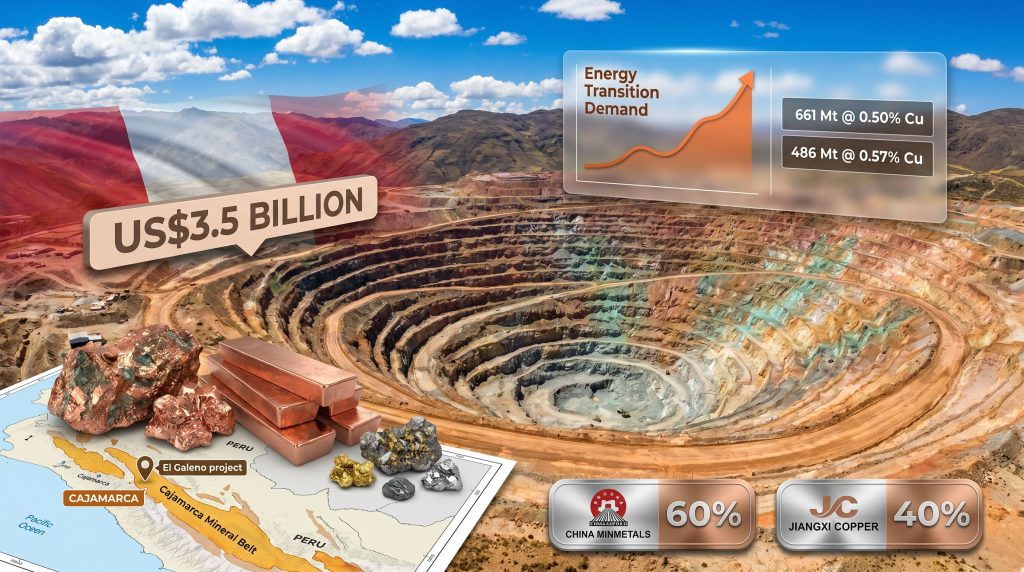
The El Galeno copper project in Peru sits precisely at this intersection. With an estimated resource base ranging between 486 million and 661 million tonnes of copper-bearing ore and a projected development cost of approximately US$3.5 billion, it represents one of the largest copper mines and undeveloped copper assets in Latin America. Its advancement to technical evaluation in 2026, after more than thirteen years of effective dormancy, marks the most significant development signal the project has produced since Chinese state-owned enterprises secured ownership in 2008 and 2009.
Understanding what this moment means requires looking beyond the headline and examining the geology, the ownership structure, the community context, and the global supply dynamics that give El Galeno its considerable strategic weight.
When big ASX news breaks, our subscribers know first
What Are the Core Resource Fundamentals Behind the El Galeno Copper Project?
Deposit Classification: Open-Pit Porphyry Cu-Au-Mo-Ag Architecture
El Galeno is classified as a large-tonnage, open-pit porphyry copper deposit hosting meaningful concentrations of gold, molybdenum, and silver alongside its primary copper resource. This polymetallic character is not incidental. In porphyry systems, gold and molybdenum frequently occur within distinct alteration zones that can be selectively targeted through mine sequencing, and their presence fundamentally alters the project economics in ways that copper grade alone cannot capture.
The deposit sits within the Cajamarca mineral province of northern Peru, a region recognised globally for its Cenozoic magmatic arc geology and the hydrothermal copper systems it has generated across millions of years of Andean geological evolution.
Resource Scale and Grade Estimates Across Technical Study Periods
Different study periods and methodologies have produced varying resource estimates, and understanding the range is important for contextualising the project's economic potential.
| Study Period | Estimated Resource | Copper Grade | Key Co-Products |
|---|---|---|---|
| 2007 Prefeasibility | ~661 million tonnes | ~0.50% Cu | Gold, Molybdenum, Silver |
| Alternative Estimate | ~486 Mt | ~0.57% Cu | Gold, Molybdenum, Silver |
| Current Status | On Hold – No Updated PFS Published | – | – |
Note: Resource figures are based on historical technical studies. No updated prefeasibility or feasibility study has been published since the project's development was placed on hold. Investors should treat historical resource estimates as indicative only and not as current definitive reserves.
How El Galeno's Multi-Metal Profile Strengthens Its Long-Term Economic Case
The polymetallic nature of El Galeno provides a natural hedge against single-commodity price cycles. When copper prices soften, gold and molybdenum credits can sustain project economics at margins that would otherwise compress severely for a pure-play copper operation at comparable grades.
Key Insight: El Galeno's combination of copper, gold, molybdenum, and silver within a single deposit means that net smelter return calculations per tonne of ore processed are materially higher than the copper grade alone would suggest. This co-product premium is a critical but frequently underappreciated element of the project's fundamental value proposition.
Molybdenum deserves particular attention in this context. Often overshadowed by copper and gold in polymetallic deposit discussions, molybdenum serves as a critical alloying agent in high-strength steel production and is increasingly recognised as a strategic industrial metal. Its price behaviour is largely independent of copper cycles, meaning it provides genuine diversification benefit to El Galeno's revenue profile rather than simply amplifying existing commodity exposure.
Co-Product Economics: Understanding Metal Credits in Porphyry Systems
In the mining industry, a metal credit refers to the revenue generated from a co-product mineral that offsets the cost of producing the primary metal. For large porphyry systems like El Galeno, calculating the net cash cost per pound of copper equivalent requires assigning market-value-based credits to gold, silver, and molybdenum recoveries. At elevated gold prices, these credits can reduce the effective copper production cost by a meaningful percentage, improving the project's position on the global copper cost curve and making it more resilient to copper price downturns.
Who Owns El Galeno? Unpacking the Chinese State Capital Ownership Structure
The 2008 to 2009 Acquisition: How State Capital Secured a Tier-1 Latin American Asset
El Galeno's current ownership structure was established during a particularly active period of Chinese outbound resource acquisition. Between 2008 and 2009, two of China's largest state-owned enterprises completed their acquisition of the project, establishing a dual ownership model that has persisted without fundamental change for over fifteen years.
The ownership breakdown is straightforward but its implications are complex:
- China Minmetals Corporation holds approximately 60% of the project as controlling shareholder
- Jiangxi Copper Corporation holds approximately 40% as strategic co-investor
- Together, these two Chinese state-owned enterprises hold 100% of El Galeno
Why Dual State-Enterprise Ownership Creates Unique Decision-Making Dynamics
The decision-making architecture of a dual state-enterprise ownership model differs fundamentally from the governance structures found in publicly listed mining companies or private equity-backed projects. Commercial mining companies operating under shareholder accountability typically face pressure to advance or divest assets within defined timeframes. State-owned enterprises, by contrast, operate within a different mandate framework where strategic resource security considerations can justify extended holding periods without active development.
This means El Galeno's prolonged dormancy is not necessarily evidence of a failing asset. It may instead reflect a deliberate strategic posture, one that prioritises securing long-term copper supply optionality over optimising near-term capital deployment. Furthermore, the copper project partnerships that typically characterise large porphyry development elsewhere are notably absent here, reinforcing the unique nature of this ownership model.
Strategic Observation: State-backed resource investors operating with sovereign time horizons are structurally better positioned to absorb the extended pre-production timelines of complex porphyry projects than commercially-oriented capital constrained by defined return windows. This is not a weakness of the ownership structure. It is arguably its most significant strength when evaluated against the multi-decade development timelines inherent to projects of El Galeno's scale.
Comparing El Galeno's Ownership Model to Other Chinese-Controlled Latin American Copper Assets
China's state-owned enterprises have assembled a substantial portfolio of copper assets across Latin America. Most notably, Chinese investment has positioned Peru to potentially become the world's second-largest copper producer, with Las Bambas — operated by MMG Limited, a subsidiary of China Minmetals — achieving first production in 2016. This precedent is instructive. MMG navigated similarly complex community relations challenges and substantial capital requirements in bringing Las Bambas into production, suggesting that when Chinese state capital makes a committed development decision, it possesses both the financial capacity and institutional persistence to deliver large-scale copper projects in challenging jurisdictions.
What Has Kept El Galeno on Hold Since 2013? A Multi-Variable Delay Analysis
The Four Structural Barriers Preventing Development Advancement
El Galeno's extended pause reflects not a single failure point but the compounding effect of four distinct structural barriers operating simultaneously:
-
Community and Social Licence Complexity – Cajamarca carries the weight of a deeply contested mining history. The region became a focal point of anti-mining sentiment partly due to conflicts at other major projects in the area, creating a community relations environment that demands extraordinary stakeholder engagement before any large-scale open-pit operation can realistically proceed.
-
Capital Commitment Thresholds – A US$3.5 billion capital commitment requires a degree of financing certainty that extends beyond conventional project finance structures. For state-owned enterprises, this typically requires alignment between multiple institutional financing layers, including state development bank credit facilities, which demand comprehensive technical, social, and environmental validation before commitment.
-
Permitting and Regulatory Sequencing – Peru's environmental and social impact assessment framework for large-scale open-pit mining operations in sensitive highland ecosystems is among the most complex in Latin America. The sequencing of approvals, community consultation requirements, and potential legal challenges from affected communities creates timelines that are difficult to compress regardless of political or commercial urgency.
-
Commodity Cycle Timing – Project economics for large porphyry operations are acutely sensitive to long-run copper price assumptions embedded in feasibility models. When those assumptions cannot confidently support the project's target return thresholds, development decisions are deferred.
The Cajamarca Mining Conflict Legacy: How Regional Sentiment Shapes Project Timelines
The Cajamarca region's relationship with large-scale mining is layered with historical grievance, environmental concern, and political complexity. The region has experienced significant social mobilisation against mining projects, including high-profile conflicts that attracted international attention and influenced how Peruvian regulatory authorities approach environmental assessment for new large-scale projects in the area.
This legacy means that any developer seeking to advance El Galeno must invest heavily in Free, Prior, and Informed Consent (FPIC) processes with affected communities — a legal and ethical framework derived from international conventions that requires genuine participation rather than perfunctory consultation.
Scenario Analysis: Copper Price Thresholds and Development Economics
Scenario Modelling Note: At sustained copper prices above approximately US$4.50 per pound, the internal rate of return for large porphyry open-pit projects of El Galeno's scale typically crosses thresholds that justify state-backed capital deployment, particularly for entities operating with strategic resource security mandates rather than purely commercial return targets. At prices below this range, the combination of high capital intensity and long development lead times suppresses project returns to levels that challenge investment committee approval, even within state enterprise frameworks.
Disclaimer: Copper price thresholds and internal rate of return estimates referenced above are indicative industry benchmarks based on comparable large porphyry project economics and do not constitute financial advice or project-specific financial modelling.
What Does Technical Evaluation Actually Mean for a Project at El Galeno's Stage?
Defining the Technical Evaluation Phase in Large-Scale Mining Project Development
The term technical evaluation is often used loosely in mining industry communications, but in the context of a project that has been dormant for over a decade, it carries a specific and important meaning. Technical evaluation represents the systematic reassessment of a project's geological, engineering, and economic parameters using current data, methodologies, and cost environments, rather than relying on studies that may be ten or more years old.
For El Galeno, this phase is particularly significant because the gap between the project's last substantive technical work and current conditions encompasses substantial changes across multiple dimensions, including construction cost inflation, updated geological modelling standards, revised metallurgical understanding of the ore body, and evolved environmental and social impact assessment requirements.
Key Deliverables Expected from a Technical Evaluation Process
A comprehensive technical evaluation for a project of El Galeno's complexity would typically be expected to produce:
- Updated resource and reserve estimation using current geological modelling standards including modern geostatistical techniques
- Revised capital cost estimation incorporating post-2013 construction cost inflation across materials, labour, and equipment categories
- Processing route optimisation studies examining conventional flotation circuits versus hydrometallurgical alternatives for different ore types
- Updated mine scheduling and pit optimisation modelling incorporating current equipment productivity benchmarks
- Infrastructure corridor reassessment covering power supply options, water sourcing and management, tailings storage facility design, and access road routing
- Environmental baseline data refresh to support updated environmental impact assessment submissions
- Community and social impact assessment updates reflecting current demographics and community priorities
What Advancement to Technical Evaluation Signals About Ownership Intent
The decision to advance a long-dormant project to formal technical evaluation represents a meaningful but carefully bounded signal of intent. It indicates that the project owners are sufficiently convinced of the asset's strategic relevance to invest in the substantial technical work required, while stopping well short of a construction commitment. This distinction matters. Technical evaluation is a prerequisite for any subsequent feasibility study, but it does not guarantee one will follow.
How Does El Galeno Compare to Peru's Active and Developing Copper Project Landscape?
Peru's Copper Development Pipeline: Positioning El Galeno Among Peer-Scale Projects
| Project | Estimated CAPEX | Status | Primary Owner |
|---|---|---|---|
| El Galeno | ~US$3.5 billion | Technical Evaluation | China Minmetals / Jiangxi Copper |
| Michiquillay | TBD | Development Stage | Anglo American |
| Coroccohuayco | ~US$1.5 billion | Feasibility | Glencore |
| Los Chancas | ~US$2.6 billion | Pre-Feasibility | Southern Copper |
Note: CAPEX figures are indicative based on publicly available project disclosures and are subject to revision as project studies are updated.
Within this competitive pipeline, El Galeno stands out for both its scale and its delay. Projects like Los Chancas and Coroccohuayco are backed by established copper majors with proven track records of project delivery in Peru, while El Galeno's state enterprise ownership creates a distinct decision-making dynamic that does not map neatly onto commercial development timelines. In addition, the Reko Diq copper-gold project offers a useful international comparison of how state-backed capital navigates similarly complex porphyry development environments.
Why Peru Remains a Tier-1 Copper Jurisdiction Despite Persistent Challenges
Peru consistently ranks among the world's top two or three copper producing nations, driven by the geological richness of its Andean mineral belt and decades of accumulated mining infrastructure, technical expertise, and regulatory framework development. Despite well-documented challenges around community relations and regulatory complexity, the country's copper endowment continues to attract major capital from global mining companies and state-owned enterprises alike. El Galeno's location within this proven jurisdiction is itself a fundamental value driver that supports the case for eventual development.
The next major ASX story will hit our subscribers first
What Is the Global Copper Supply Context That Makes El Galeno's Development Increasingly Urgent?
The Structural Copper Supply Deficit Narrative
The global copper industry faces a gathering supply challenge that has been building for years but is now attracting mainstream attention from investors, policymakers, and industrial consumers. The combination of declining ore grades at existing mines, extended development timelines for new projects, and accelerating demand from electrification and renewable energy infrastructure is creating conditions that many analysts describe as a structural copper supply crunch in the making.
Large undeveloped deposits like the El Galeno copper project in Peru are increasingly central to discussions about whether the global mining industry can deliver sufficient copper supply to meet projected demand through the 2030s and beyond.
Energy Transition Demand Drivers and Their Implications for Projects Like El Galeno
The copper intensity of energy transition infrastructure is substantial and frequently underappreciated by general investors:
- Electric vehicle battery systems require approximately 83 kilograms of copper per unit across motors, wiring, and charging infrastructure
- Grid-scale renewable energy installations demand approximately 4 to 5 tonnes of copper per megawatt of installed capacity
- Offshore wind installations are among the most copper-intensive power generation technologies, requiring significantly more copper per megawatt than onshore alternatives
- Grid modernisation and expansion programmes required to accommodate distributed renewable generation represent a sustained long-duration demand driver independent of vehicle electrification trends
- Projected copper demand from energy transition scenarios suggests a potential supply gap exceeding 10 million tonnes annually by the mid-2030s
Why Chinese State Enterprises Are Strategically Positioned to Advance El Galeno
China's industrial economy is simultaneously the world's largest consumer of copper and a major holder of undeveloped copper assets through its state-owned enterprise investment portfolio. This creates a structural alignment between China's domestic industrial needs and the strategic rationale for advancing projects like El Galeno. Furthermore, understanding the broader copper price growth drivers reinforces why state enterprises are accelerating their evaluation of dormant assets. State enterprises holding copper assets do not need to justify development solely on commercial return grounds, as the value of securing future copper supply for Chinese industrial consumers represents a strategic benefit that operates outside conventional project IRR calculations.
What Are the Key Risk Vectors Investors and Analysts Should Monitor?
Political and Regulatory Risk in Peru's Evolving Mining Policy Environment
Peru's mining policy landscape has experienced periods of significant volatility, with changes in government bringing shifts in attitude toward large-scale resource extraction. Investors and analysts monitoring El Galeno's development trajectory should track not just project-specific milestones but also broader indicators of Peru's regulatory environment, including environmental assessment processing times, judicial treatment of mining permits, and the tenor of government-industry dialogue on social licence frameworks.
Community Relations and FPIC Requirements
Free, Prior, and Informed Consent requirements represent both a legal obligation and a practical development prerequisite for projects operating in regions with significant indigenous and rural community populations. El Galeno's development pathway will depend materially on the quality of the social engagement programme deployed by its owners, and any deterioration in community relations could extend development timelines or impose structural changes on project design.
Key Risk Factors Warranting Ongoing Monitoring
- Infrastructure gap assessment: Power supply, water sourcing, tailings management, and access road logistics in northern Peru's highland terrain create technical and cost risks that are sensitive to regulatory requirements and environmental conditions
- Currency and sovereign risk: Chinese capital deployed in Andean projects faces exposure to Peruvian sol volatility, potential changes in royalty and taxation frameworks, and sovereign risk factors that influence the effective return on capital invested
- Environmental permitting complexity: Large open-pit operations in high-altitude Andean ecosystems face heightened scrutiny from environmental regulators and international civil society organisations, creating approval risk that is difficult to fully quantify in advance
- Commodity price sensitivity: The project's economics remain highly sensitive to long-run copper price assumptions, and any sustained period of copper prices below development threshold levels could defer or reverse technical evaluation outcomes
Disclaimer: The risk factors outlined above are illustrative rather than exhaustive. Investors undertaking analysis of El Galeno or related entities should conduct independent due diligence and seek professional financial advice.
Frequently Asked Questions: El Galeno Copper Project
What is the El Galeno copper project?
The El Galeno copper project in Peru is a large-scale open-pit copper-gold-molybdenum-silver porphyry deposit located in the Cajamarca region of northern Peru. With an estimated development capital expenditure of approximately US$3.5 billion, it ranks among the most significant undeveloped copper assets in Latin America. Detailed project technical data confirms the deposit's exceptional scale relative to comparable porphyry systems globally.
Who owns the El Galeno copper project?
The project is jointly held by two Chinese state-owned enterprises. China Minmetals Corporation controls approximately 60% of the project, with Jiangxi Copper Corporation holding the remaining 40%. Both entities established their positions through acquisitions completed during 2008 and 2009.
How large are El Galeno's copper resources?
Historical technical studies have estimated resources ranging from approximately 486 million tonnes at 0.57% copper to approximately 661 million tonnes at 0.50% copper, depending on the cut-off grade and study methodology applied. No updated resource estimate has been published since the project was placed on hold.
Why has El Galeno remained on hold since 2013?
The project's extended pause reflects overlapping factors including complex community relations in Cajamarca, the substantial capital commitment required, sequential permitting and regulatory challenges, and copper price cycle timing that has not consistently supported the project's economic thresholds.
What does the current technical evaluation phase mean for the project's future?
Advancement to technical evaluation indicates that the project's owners are systematically reassessing geological, engineering, and economic parameters using current data and methodologies. This is a prerequisite step before any formal feasibility study or construction decision, but it does not guarantee either outcome will follow.
How does El Galeno fit into the global copper supply outlook?
Given accelerating demand from energy transition infrastructure and electrification programmes, large undeveloped porphyry deposits like El Galeno are increasingly viewed as strategically critical assets. Reports on Chinese business interest in advancing the project underscore the urgency with which state-owned enterprises are approaching the development decision. Their advancement timelines will materially influence whether the global copper market can avoid a structural supply deficit through the 2030s.
The Path Forward: What Would It Take for El Galeno to Reach a Construction Decision?
Milestone Sequencing: From Technical Evaluation to Feasibility to Construction Approval
The pathway from technical evaluation to a construction decision at El Galeno involves multiple sequential and parallel workstreams, none of which can be meaningfully accelerated without risking the quality of outcomes that underpin investor and regulator confidence.
| Scenario | Technical Evaluation Completion | Feasibility Study | Construction Decision | First Production |
|---|---|---|---|---|
| Optimistic | 2026 to 2027 | 2028 to 2029 | 2030 | 2034 to 2035 |
| Base Case | 2027 to 2028 | 2030 to 2031 | 2032 | 2036 to 2038 |
| Conservative | 2029+ | 2032+ | Post-2034 | 2038+ |
Disclaimer: Timeline scenarios presented above are indicative projections based on comparable porphyry project development histories and are not statements of confirmed project schedules. Actual timelines will depend on technical, regulatory, community, and financial factors that are subject to material uncertainty.
The Critical Role of Social Licence Restoration in Cajamarca
No technical evaluation, however comprehensive, resolves the social licence challenge. El Galeno's owners will need to demonstrate sustained and credible commitment to community engagement, benefit-sharing frameworks, and environmental protection measures that address the specific concerns of Cajamarca's communities. This process cannot be manufactured or compressed. It requires years of consistent behaviour and genuine partnership with affected populations.
Capital Structure Scenarios: State-Bank Financing and Hybrid Models
The US$3.5 billion capital requirement will almost certainly require a structured financing arrangement combining equity contributions from the Chinese state-enterprise owners with debt facilities from development-oriented lenders. The China Development Bank has historically provided financing frameworks for Chinese state enterprise resource projects internationally, and its involvement in any El Galeno financing structure would represent a critical enabler of project advancement. However, the specific terms and conditions of any such financing remain subject to commercial negotiation and institutional approval processes that operate independently of project technical progress.
Key Takeaways: El Galeno's Strategic Position in the Global Copper Landscape
- The El Galeno copper project in Peru is a world-class porphyry copper deposit with meaningful gold, molybdenum, and silver credits, located within the Cajamarca mineral province of northern Peru
- Estimated resources of up to 661 million tonnes and a projected development capital expenditure of approximately US$3.5 billion position it among Latin America's largest and most capital-intensive undeveloped copper assets
- Chinese state enterprise ownership, with China Minmetals holding approximately 60% and Jiangxi Copper holding approximately 40%, creates a capital deployment dynamic tied to strategic resource security rather than purely commercial return mandates
- The project has remained effectively on hold since approximately 2013, with social licence complexity, permitting requirements, and capital commitment thresholds identified as the primary drivers of delay
- Advancement to technical evaluation in 2026 represents the most meaningful development signal in over a decade, suggesting the project owners are reassessing development parameters against current geological, technical, and market conditions
- Against a backdrop of accelerating copper demand from energy transition infrastructure, El Galeno's eventual development carries significant implications for global copper supply adequacy through the 2030s and beyond
- The polymetallic character of the deposit, combining copper with gold, molybdenum, and silver, provides a structural revenue hedge that strengthens the project's long-term economic case relative to comparable single-commodity copper projects
This article is intended for informational purposes only and does not constitute investment advice or a recommendation to buy, sell, or hold any financial instrument. Forward-looking statements and scenario projections involve inherent uncertainty and should not be relied upon as predictions of actual outcomes. Readers should seek independent financial advice before making investment decisions.
Want to Stay Ahead of the Next Major Copper Discovery on the ASX?
Discovery Alert's proprietary Discovery IQ model delivers real-time alerts the moment significant mineral discoveries — including copper, gold, and polymetallic systems — are announced on the ASX, transforming complex geological data into clear, actionable insights for investors at every level. Explore how historic mineral discoveries have generated substantial returns and begin your 14-day free trial today to position yourself ahead of the broader market.