August 14, 2026
The Hidden Cost of a Pacific Ocean Anomaly: Why Africa Bears a Disproportionate Climate Burden
Every decade or so, a warming of the central and eastern Pacific Ocean quietly reshapes weather systems across the entire planet. For most advanced economies, the resulting shifts in rainfall and temperature are inconvenient at worst. For large parts of Africa, the same atmospheric disruption can unravel years of economic progress, push tens of millions of people into food insecurity, and force governments into a fiscal spiral that proves far harder to escape than the weather event itself.
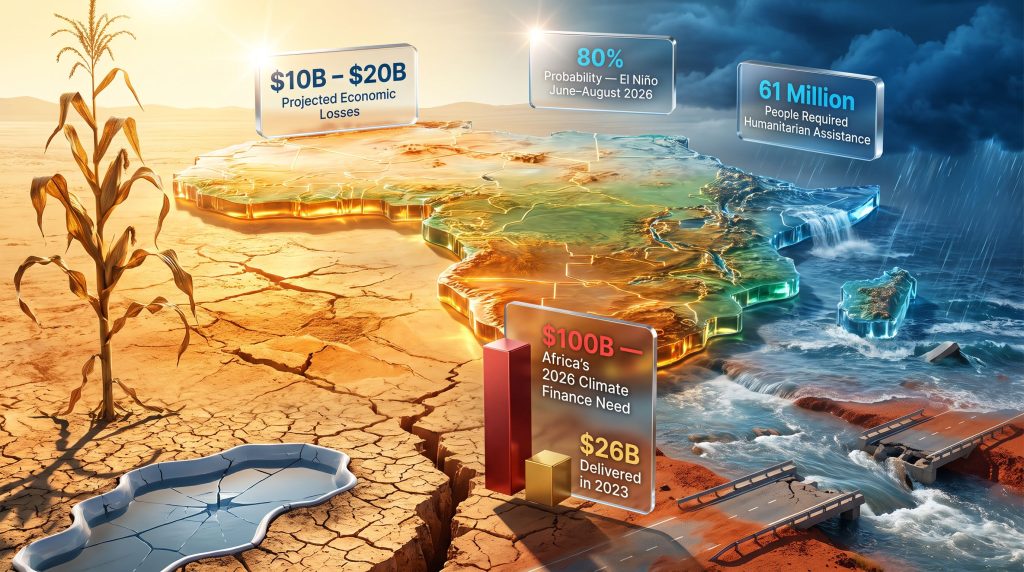
This is the structural reality that makes the El Niño economic impact in Africa so consequential, and so poorly understood outside development finance circles. The 2026 episode now taking shape is not a distant weather forecast. It is a measurable, quantifiable economic risk that the African Development Bank (AfDB) has placed at the centre of its near-term policy warnings, with loss estimates ranging from $10 billion to $20 billion across the continent and GDP contractions of 1% to 2% in the hardest-hit nations.
To understand why those numbers carry such outsized consequences, it helps to first understand what makes African economies structurally different from other regions facing the same climatic event.
When big ASX news breaks, our subscribers know first
Why African Economies Convert Weather Into Economic Crises
The Architecture of Vulnerability
Rain-fed agriculture remains the foundation of food production across most of Sub-Saharan Africa. Unlike irrigated farming systems common in parts of Asia and the Americas, rain-fed systems carry no mechanical buffer against rainfall deficits. When rainfall fails, yields collapse almost immediately, and the effects radiate outward through household income, rural consumption, and national output.
The energy dimension adds a second layer of fragility that is often underappreciated. Several of Africa's largest economies depend on hydropower for the majority of their electricity generation. Zambia, Zimbabwe, Mozambique, Ethiopia, and the Democratic Republic of the Congo each rely heavily on reservoir-based hydroelectric capacity. When drought drains those reservoirs, electricity generation falls, load-shedding intensifies, manufacturing slows, and mining productivity drops.
A rainfall deficit in the Zambezi basin is not simply an agricultural problem. It is an industrial problem, an investment climate problem, and ultimately a fiscal problem. Furthermore, the energy transition challenges facing resource-dependent economies compound these vulnerabilities significantly.
Infrastructure deficits compound both dynamics. Roads, drainage systems, and irrigation networks in many African countries remain inadequate to absorb either prolonged drought or acute flooding. The same infrastructure gap that amplifies drought damage also amplifies flood damage, meaning El Niño's geographically inverted impacts across the continent both translate into disproportionate economic harm.
El Niño's Asymmetric Geography Across Africa
A critical but underappreciated feature of El Niño is that it does not impose a uniform shock across Africa. Its effects are almost geographically inverted between the continent's sub-regions, which complicates both economic forecasting and policy response.
- Southern Africa experiences drought, harvest contraction, livestock stress, and hydropower shortfalls during El Niño years
- East Africa typically faces excess rainfall, flooding, infrastructure destruction, and population displacement
- West Africa and the Sahel face secondary but real exposure through rainfall variability and commodity market disruptions
- Fragile and conflict-affected states experience the same physical shocks but with far less institutional and fiscal capacity to absorb them
The 2023-2024 El Niño episode illustrated this geographic divergence with unusual severity. Southern African countries reported harvest losses exceeding 50% of annual production in the worst-affected areas, while East Africa simultaneously faced destructive flooding that damaged transport corridors and urban markets. According to the UN's Office for the Coordination of Humanitarian Affairs, the Southern African impact was characterised as among the most severe in over a century.
Quantifying the 2026 Threat: What the Numbers Actually Mean
AfDB Loss Projections in Context
The AfDB's estimate of $10 billion to $20 billion in aggregate economic losses deserves careful interpretation rather than simple citation. African economic growth is projected at 4.2% in 2026 and 4.4% in 2027, representing one of the continent's more promising growth windows in recent years. A climate shock that strips 1% to 2% from the GDP of multiple countries simultaneously does not merely slow growth; it disrupts the compounding dynamic that allows development gains to build on each other over time.
A 2% GDP loss in a high-exposure economy is not a one-year setback. It triggers chain reactions across fiscal balances, debt servicing capacity, and social spending programmes that compress development gains accumulated over several years.
The AfDB has estimated that African agricultural producers could lose approximately $327 million to $330 million in income from the anticipated disruptions. The fisheries sector faces additional pressure, with rising sea temperatures and storm events projected to reduce productivity by 1% to 4%.
| Sector | Estimated Economic Impact | Primary Driver |
|---|---|---|
| Agricultural producer income | ~$327-$330 million in losses | Drought-driven crop failure and flood damage |
| Maize prices | 2%-20% increase in strong El Niño years | Supply contraction in Southern Africa |
| Fisheries productivity | 1%-4% reduction | Sea temperature rise and storm disruption |
| GDP contraction (worst-affected countries) | 1%-2% | Multiple transmission channels |
| Aggregate continental losses | $10B-$20B | Combined agricultural, energy, and fiscal impacts |
The 2026 Probability Assessment
The World Meteorological Organization (WMO) has assigned an 80% probability to El Niño developing between June and August 2026, with the likelihood of the event persisting through November approaching or exceeding 90%. The anticipated intensity is classified as moderate-to-strong. The WMO has explicitly noted that the term super El Niño, which circulates widely in public discourse, does not represent an official scientific classification and should not be used as a technical benchmark.
A moderate-to-strong event is sufficient to activate the full range of agricultural, hydrological, and fiscal transmission channels documented in previous episodes. The 2023-2024 episode, which serves as the most recent empirical reference point, demonstrated that even a single El Niño cycle can push 61 million people across Southern Africa alone into requiring humanitarian assistance.
The AfDB has scheduled a formal portfolio impact assessment for September 2026 to evaluate exposure across its active investment operations and identify necessary adjustments.
Five Transmission Channels: How Weather Becomes a Fiscal Crisis
Channel 1: Agricultural Output Collapse
Rain-fed farming systems that dominate food production across Sub-Saharan Africa have no mechanical buffer against rainfall deficits. Drought reduces yields, destroys livestock, and eliminates the seasonal income that rural households rely on for a significant portion of their annual consumption. Flooding in East Africa simultaneously destroys standing crops, degrades soil quality, and disrupts planting cycles for subsequent growing seasons.
Channel 2: Food Price Inflation and Urban Purchasing Power Erosion
As agricultural supply contracts, staple food prices rise. This dynamic disproportionately affects urban low-income households that spend the highest share of their income on food. Maize price increases of 2% to 20% in strong El Niño years have been documented across Southern African markets. Food inflation reduces real household incomes, suppresses consumer spending, and can contribute to social instability in urban centres already under economic pressure.
Channel 3: Hydropower Shortages and Industrial Disruption
Drought reduces reservoir levels, cutting electricity generation capacity and forcing load-shedding that affects manufacturing, mining, and services simultaneously. Businesses dependent on continuous power face higher operating costs as they switch to backup generation. The energy transition in mining and related industries is consequently further complicated by climate-driven energy instability. Persistent power instability deters investment and reduces the competitiveness of export-oriented industries.
Channel 4: Infrastructure Damage and Emergency Fiscal Pressure
Flooding in East Africa and storm events along coastal regions damage roads, bridges, drainage infrastructure, and urban markets. Reconstruction costs divert government capital budgets away from planned development expenditure. Emergency response requirements force fiscal reallocation that crowds out health, education, and productive infrastructure investment.
Channel 5: The Climate Finance Trap
Anthony Nyong, Director of the AfDB's Climate Change and Green Growth Department, has identified a structural dynamic that explains why El Niño's fiscal consequences often exceed its direct physical damage. When governments are forced to redirect pre-allocated development budgets toward disaster response, they erode the long-term fiscal architecture of planned growth.
Countries without adequate insurance instruments or contingency reserves face the hardest trade-offs between immediate relief and sustained development investment. This pattern compounds across multiple El Niño cycles, progressively narrowing fiscal space.
The Countries Facing the Greatest Exposure
A Regional Risk Framework
Southern Africa: Drought, Harvest Collapse, and Energy Shortfalls
Zambia, Zimbabwe, Mozambique, Malawi, and Madagascar face the most consistent drought exposure during El Niño years. Hydropower dependency amplifies the economic impact beyond agriculture into energy and industrial sectors. The 2023-2024 episode produced harvest losses exceeding 50% of annual production in the worst-affected areas.
East Africa: Flooding, Infrastructure Destruction, and MSME Disruption
Kenya, Tanzania, Ethiopia, Somalia, and Uganda face elevated flood risk during El Niño years. Flooding damages transport networks, disrupts urban commerce, and creates displacement that reduces labour market participation. Micro, small, and medium enterprises, which form the backbone of urban economic activity across East Africa, face acute disruption from flooding and market closures.
Fragile and Conflict-Affected States: Compounded Vulnerability
The AfDB has specifically identified Sudan, South Sudan, the Democratic Republic of the Congo, Mali, Burundi, and Nigeria as among the countries most exposed to the anticipated impacts. In fragile states, climate shocks interact with pre-existing governance deficits, displacement crises, and food insecurity to produce disproportionately severe outcomes. These countries also have the least fiscal capacity to self-finance recovery and the most constrained access to international capital markets.
Africa's Climate Finance Gap: A Structural Inequity
The Numbers That Reveal a Systemic Failure
| Financing Metric | Figure |
|---|---|
| UN estimated annual climate finance need for developing countries by 2035 | ~$365 billion |
| International public climate adaptation finance delivered in 2023 | ~$26 billion |
| AfDB estimate of Africa's climate financing need in 2026 | ~$100 billion |
| Previous AfDB climate financing estimates for Africa | ~$50 billion |
| UN CERF preventive mobilisation for highest-risk countries | Up to $100 million |
The gap between what is needed and what is being delivered is not a marginal shortfall. International public adaptation finance of $26 billion delivered in 2023 represents less than 7% of the $365 billion annual requirement projected for 2035. Africa's estimated 2026 climate financing need of $100 billion represents a doubling of previous estimates, reflecting both escalating climate risk and the accumulated deficit of underinvestment in adaptation infrastructure.
Why Adaptation Financing Consistently Lags Behind Mitigation
A less commonly understood dynamic within climate finance is the persistent structural imbalance between mitigation spending and adaptation spending. Global climate finance flows have historically favoured mitigation projects, which reduce greenhouse gas emissions, over adaptation projects, which build resilience to the climate change already locked in.
The reasons are partly financial. Mitigation projects such as solar farms and wind energy installations generate revenue streams, attract private co-investment, and can be structured for commercial returns. Adaptation investments such as flood barriers, drought-resistant crop varieties, and early warning systems generate economic value by preventing losses rather than creating new income streams.
This distinction makes adaptation harder to monetise and less attractive to private capital. However, the El Niño economic impact in Africa demonstrates precisely why sustained adaptation investment is essential. For a continent that contributes a small fraction of global emissions yet absorbs a disproportionate share of climate impacts, this imbalance represents a fundamental equity failure in the international climate finance architecture.
In addition, the growing importance of critical minerals and energy security means that climate disruptions increasingly threaten strategic supply chains that extend well beyond Africa's own borders. Furthermore, renewable energy solutions designed to reduce hydropower dependency are increasingly being considered as a structural hedge against El Niño-driven energy instability.
Mechanisms Being Mobilised Ahead of the 2026 Peak
The AfDB is facilitating access to several international financing instruments for affected member states:
- Green Climate Fund targeting both adaptation and mitigation in vulnerable developing nations
- Adaptation Fund focused specifically on countries with the least capacity to self-finance resilience building
- Climate Investment Funds providing multi-donor capital for low-carbon and climate-resilient development
- Loss and Damage Mechanisms offering compensation for climate impacts beyond adaptive capacity
- UN Central Emergency Response Fund (CERF) mobilising up to $100 million for preventive measures in the highest-risk countries
The next major ASX story will hit our subscribers first
Embedding Climate Risk Into African Development Planning
The Case for Treating El Niño as a Fiscal Variable, Not an Exceptional Event
One of the least-discussed but most consequential shifts in African public finance management concerns how climate risk is categorised within government planning frameworks. Treating El Niño as a recurring fiscal variable rather than an unpredictable exceptional event changes everything from budget reserve requirements to debt sustainability assessments.
Countries that establish contingency reserves, parametric insurance instruments, and pre-arranged emergency credit lines are measurably better positioned to absorb climate shocks without derailing multi-year development trajectories. Parametric insurance, which triggers automatic payouts when pre-defined weather thresholds are crossed rather than requiring lengthy loss assessments, is particularly relevant for African economies because it delivers capital precisely when it is needed most.
Preparedness Investment as a Fiscal Efficiency Measure
Evidence from disaster risk economics consistently demonstrates that pre-event investment in preparedness generates substantially higher returns than post-event reconstruction spending. Irrigation infrastructure, drought-resistant crop varieties, early warning systems, and flood-resilient road construction each reduce the economic cost of El Niño events in ways that reconstruction spending cannot replicate after the fact.
For African governments, the structural challenge is financing preparedness during periods of fiscal constraint. This is precisely the window before an El Niño peak when investment would generate the greatest returns. Bridging this timing gap requires concessional pre-event financing that existing multilateral instruments have not consistently delivered at scale.
Research on El Niño's economic devastation further confirms that the El Niño economic impact in Africa is not simply a humanitarian concern but a macroeconomic one, with effects that reverberate through fiscal systems for years after the weather event subsides. Consequently, the critical minerals demand picture is also affected, as climate disruptions to mining and energy infrastructure interrupt the supply of materials essential to the global clean energy transition.
The AfDB's planned September 2026 portfolio review signals an institutional shift toward treating climate risk as a standing variable in development finance planning, rather than a one-off emergency to be managed after impact.
Key Statistics at a Glance
- $10B-$20B in projected aggregate economic losses across Africa
- 1%-2% GDP contraction in the hardest-hit countries, against a continental growth projection of 4.2% for 2026
- $327-$330 million in estimated agricultural income losses for African producers
- 61 million people required humanitarian assistance during the 2023-2024 El Niño across Southern Africa
- 80% probability assigned by the WMO to El Niño developing between June and August 2026
- $26 billion in international public adaptation finance delivered in 2023, against a $365 billion annual need by 2035
- $100 billion in climate financing estimated as Africa's requirement for 2026, double previous estimates
- Up to $100 million being mobilised through the UN CERF for preventive measures in the highest-risk countries
Disclaimer: All loss projections, GDP impact estimates, and probability assessments referenced in this article reflect forward-looking forecasts from multilateral institutions including the AfDB and WMO. Actual outcomes will depend on the intensity, duration, and geographic distribution of any El Niño event, as well as the policy and financing responses mobilised before and during the episode. This article does not constitute financial or investment advice.
Want to Identify the ASX Mineral Discoveries Most Exposed to Shifting Commodity Dynamics?
Climate disruptions like El Niño directly affect the supply of critical minerals and energy resources that underpin global markets, making real-time discovery intelligence more valuable than ever. Discovery Alert's proprietary Discovery IQ model instantly identifies significant ASX mineral discoveries, translating complex data into actionable insights — explore the historic returns major discoveries have generated and begin your 14-day free trial to stay ahead of market-moving announcements.