June 20, 2026
Why the Mining Industry's Diesel Problem Is More Expensive Than Most Operators Realise
The true cost of running a diesel-dependent mine fleet extends well beyond the fuel pump. When engineers and financial analysts pull apart the total cost of ownership across a conventional diesel-powered operation, the numbers routinely reveal that fuel is only one layer of a far deeper expenditure structure. Maintenance cycles on diesel drivetrains, ventilation infrastructure sized to handle exhaust heat and particulate load, and the mounting burden of carbon compliance reporting are collectively reshaping the economics of mine operations in ways that simple fuel-price modelling has historically failed to capture.
Diesel engines convert only 30 to 40% of their fuel energy into useful mechanical work. The remainder is lost as heat, vibration, and exhaust gases that must then be actively managed, particularly in underground environments where those byproducts accumulate in confined spaces. This thermodynamic inefficiency is not a minor engineering footnote. It is the foundational reason why the transition to electric mining transport, and specifically to industrial-grade AC drive architectures, has moved from a long-range decarbonisation ambition into an active capital allocation decision across Tier 1 and Tier 2 operations globally.
The conversation around electric mining Siemens drives represents a safer, more efficient, and more sustainable operation model has gained considerable traction across Latin America's copper and lithium sectors, where high-altitude, high-gradient haul roads create operating conditions that expose diesel dependency at its most costly.
When big ASX news breaks, our subscribers know first
Understanding How Electric Drive Systems Actually Work in Mining Contexts
Electric mining is not a single technology. It encompasses a spectrum of electrification strategies, from diesel-electric hybrid configurations and trolley-assist infrastructure on open-pit haul roads, through to fully battery-electric underground fleets and mine-wide automation platforms built on electric drive foundations.
At the core of most industrial electric drive systems is the variable frequency drive (VFD), a power electronics component that controls the speed, torque, and energy consumption of electric motors with high precision. By adjusting the frequency of electrical current supplied to a motor, a VFD enables the motor to operate at exactly the speed and torque required for a given task, eliminating the energy waste inherent in fixed-speed diesel drivetrain configurations. Furthermore, variable frequency drives represent one of the most immediately deployable electrification tools available to mine operators today.
Advanced permanent magnet (PEM) motor configurations take this efficiency further. Unlike conventional induction motors, which generate rotor current through electromagnetic induction and carry associated energy losses, permanent magnet motors use embedded rare-earth magnets to create the rotor magnetic field, allowing them to achieve efficiencies of up to 97% within their optimal operating speed range. For underground mining applications where motor heat generation directly translates into ventilation load, this distinction has tangible financial consequences.
The table below summarises how different drive system architectures compare across the key performance dimensions relevant to mine planners:
| Drive System Type | Typical Efficiency Range | Primary Application | Key Advantage |
|---|---|---|---|
| Diesel-Mechanical | 30–40% | Surface and underground haulage | Established infrastructure |
| Diesel-Electric (AC Drive) | 85–92% | Large surface trucks, underground LHDs | Reduced fuel use, lower maintenance |
| Trolley-Assist AC Drive | Up to 97% (on trolley) | Open-pit haul roads | Dramatic fuel reduction on grade |
| Full Battery-Electric | 85–95% | Underground light and medium vehicles | Zero direct emissions |
Safety Engineering: How Electrification Removes Workers from Harm
Mine safety economics are often framed around incident frequency rates and regulatory compliance. The deeper value of electric drive systems, however, lies in how they structurally reduce worker exposure to the conditions that cause harm in the first place.
Diesel particulate matter (DPM) is classified by the International Agency for Research on Cancer (IARC) as a Group 1 carcinogen, meaning there is sufficient evidence of its capacity to cause cancer in humans. Underground mine workers operating in poorly ventilated environments with high diesel equipment density represent one of the most consistently exposed occupational groups globally. Transitioning to diesel-electric or fully electric drive systems eliminates the source of DPM at the point of generation, rather than relying on ventilation infrastructure to dilute it after the fact.
Beyond air quality, electric drives contribute to underground safety through several additional mechanisms:
- Reduced heat generation: Electric motors operating at 90%+ efficiency produce dramatically less waste heat than diesel engines running at 35% efficiency, lowering ambient underground temperatures and heat stress risk for workers
- Lower noise levels: Electric drivetrains operate at significantly reduced acoustic levels compared to internal combustion engines, reducing long-term occupational noise exposure and improving communication in working zones
- Fewer mechanical failure points: AC drive systems contain fewer moving parts than diesel-mechanical drivetrains, reducing the frequency of unexpected equipment failures that create proximity hazards
- Digital predictive diagnostics: Drive system monitoring platforms can detect performance anomalies before they manifest as equipment failures, enabling maintenance intervention during planned windows rather than during active production cycles
When combined with automated haulage systems (AHS), electric drive architecture enables the removal of personnel from high-risk collision and proximity zones entirely. This convergence represents the most structurally transformative safety advance in surface mining since the introduction of seat-belt interlock systems. Indeed, the shift toward safer mining has accelerated considerably as electrification technology matures and adoption widens across the industry.
The Financial Architecture of Electrification: Where the Numbers Compound
The business case for electric drive systems in mining is rarely built on fuel savings alone. The compounding effect across multiple cost categories is what makes the total cost of ownership analysis compelling at the 10 to 15-year asset life horizon that defines major mining capital decisions.
Ventilation: The Hidden Dividend of Underground Electrification
Ventilation infrastructure in deep underground mines is one of the largest and least-discussed fixed cost components in mine design. In hard-rock underground operations, ventilation systems can account for 25 to 40% of total energy consumption, with the system sized primarily around the heat and exhaust load generated by diesel equipment fleets. As mines extend to greater depths, the cost of forcing sufficient air volume to dilute diesel exhaust to permissible exposure limits escalates rapidly.
Transitioning to diesel-electric or battery-electric drive systems reduces both the heat load and the contaminant generation that ventilation systems must manage. This creates a compounding benefit: lower energy consumption for ventilation fans, smaller duct infrastructure requirements, and in some cases the ability to defer ventilation capital expansion projects that would otherwise be triggered by fleet growth.
Cost Category Breakdown: Where Electrification Delivers Returns
- Fuel consumption: Trolley-assisted haul trucks operating on overhead electrical supply during loaded uphill segments can reduce per-cycle diesel consumption by up to 90% on the trolleyed portion of the haul road
- Scheduled maintenance: Fewer moving parts and the absence of engine oil, fuel injection systems, and exhaust aftertreatment components reduce both scheduled maintenance intervals and parts inventory requirements
- Tyre and brake wear: Smoother torque delivery profiles from AC drive systems reduce the mechanical shock loads transmitted through drivetrain components, extending tyre life and reducing brake system wear rates
- Carbon compliance costs: As Scope 1 emission reduction obligations tighten under national and corporate net-zero commitments, every tonne of CO₂ avoided through fleet electrification represents avoided carbon cost exposure
Mining operations that treat the ventilation dividend, maintenance cost reduction, and carbon liability avoidance as separate line items frequently underestimate the aggregate financial case for electrification. A properly structured 15-year TCO model that integrates all three typically presents a materially stronger investment return than fuel savings alone would suggest.
Trolley-Assist Technology: The Bridge Strategy for Open-Pit Operations
For large open-pit mines operating fleets of ultra-class diesel-electric haul trucks, a full transition to battery-electric vehicles remains constrained by battery energy density limitations and the charging infrastructure requirements of high-payload, high-cycle operations. Trolley-assist technology offers a proven intermediate pathway that captures a substantial share of the electrification benefit without requiring full fleet replacement.
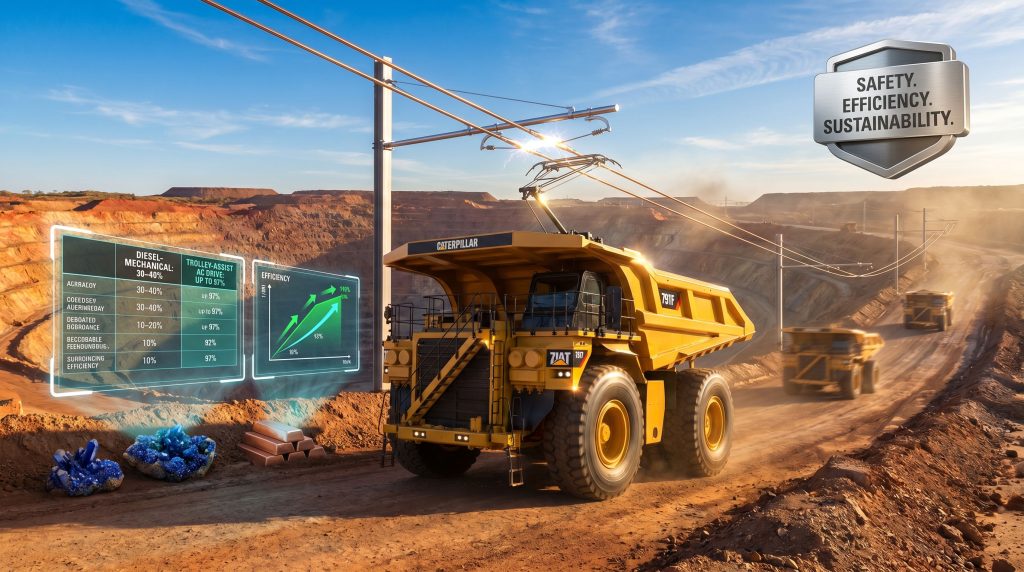
In a trolley-assist configuration, diesel-electric haul trucks are fitted with pantograph collectors that connect to overhead electrical lines installed along the primary loaded uphill haul road. During this phase of the haul cycle, the truck's diesel engine is throttled back or shut down entirely, with traction power drawn directly from the grid through the trolley system. On the downhill return, regenerative braking can return electrical energy to the trolley line, further improving overall system efficiency.
The loaded uphill haul is the most energy-intensive phase of the open-pit haul cycle, consuming the majority of per-cycle fuel. By electrifying this specific segment, trolley-assist systems deliver disproportionate fuel and emissions reductions relative to their infrastructure footprint.
Trolley-Assist vs. Battery-Electric: A Strategic Comparison
| Criterion | Trolley-Assist | Full Battery-Electric |
|---|---|---|
| Capital outlay | High (overhead infrastructure) | High (vehicle battery + charging) |
| Operational flexibility | Moderate (fixed haul road routes) | High (route-flexible) |
| Fuel reduction potential | Very high (on trolley segment) | Complete (zero direct fuel use) |
| Technology maturity | Proven at commercial scale | Emerging at large payload scale |
| Best fit | Large open-pit, consistent gradients | Underground, shorter duty cycles |
Decarbonisation, ESG, and the Sustainability Co-Benefits of Electric Mining
The relationship between mine fleet electrification and corporate sustainability reporting is more structurally significant than it may appear from the surface. Transitioning diesel haulage equipment to electric drive configurations generates Scope 1 emission reductions directly, as the diesel combustion that occurs on-site is replaced by electrical energy. The broader mining electrification trend is increasingly driven by investor expectations and tightening regulatory frameworks, as much as by operational efficiency gains. When that electrical supply is sourced from renewable power for mines, the Scope 2 emission reduction compounds the overall decarbonisation impact.
Beyond carbon metrics, electric drive systems deliver a cluster of sustainability co-benefits that are increasingly material to ESG scoring frameworks:
- Air quality: Elimination of diesel exhaust in underground workings and open-pit environments removes occupational and community exposure to carcinogenic particulate matter
- Noise pollution: Electric drivetrains operate at substantially lower acoustic levels, reducing the environmental footprint of operations in regions with adjacent communities or protected ecosystems
- Hydrocarbon spill risk: Simplified drivetrain architecture reduces the volume of hydraulic and engine oils circulating in the equipment, lowering the probability and magnitude of hydrocarbon release events
- Social licence: A measurably lower environmental impact profile strengthens a mining company's standing with local communities, regulators, and increasingly with debt and equity capital providers applying ESG screens to investment decisions
Latin America has emerged as one of the most active proving grounds for electric mining technology adoption, driven by the specific operating conditions of its major copper and lithium producing regions. Chile's Atacama Desert and northern mining districts, Peru's high-altitude polymetallic belt, and Brazil's deep underground iron ore operations each present distinct electrification challenges and opportunities that have accelerated real-world technology validation at commercial scale.
The next major ASX story will hit our subscribers first
Digital Integration: How Drive System Data Creates Compounding Operational Value
The shift to electric drive systems does not simply swap one motive power source for another. It introduces a continuous stream of high-resolution operational data that diesel-mechanical systems were structurally incapable of generating. Every variable frequency drive operating in a mine fleet monitors motor current, voltage, temperature, torque output, and vibration signature in real time, creating a sensor network that underpins predictive maintenance, performance optimisation, and energy management at the fleet level.
Integration of this drive system data with mine-wide SCADA platforms, fleet management systems, and process automation infrastructure enables data-driven mining operations to make decisions based on actual equipment condition rather than scheduled maintenance intervals. The practical consequence is higher mechanical availability, fewer unplanned production stoppages, and a maintenance expenditure profile that shifts from reactive to planned. Consequently, AI mining efficiency tools are increasingly being layered onto electric drive data streams to accelerate predictive analytics capabilities.
Digital twins, simulation environments that mirror the real-world behaviour of drive systems under site-specific load conditions, are increasingly used during the design phase of electrification projects to validate technology selection and infrastructure sizing before capital is committed. This approach substantially reduces the technology maturity risk that has historically been cited as a barrier to electrification adoption.
Evaluating Electrification Readiness: A Practical Framework for Mining Decision-Makers
Mine electrification projects succeed or fail during the planning phase. The following structured assessment process is designed to guide operations teams through the key evaluation steps before capital commitments are made:
- Baseline audit: Quantify current diesel consumption, maintenance expenditure, and ventilation energy costs by operating zone and equipment category
- Haul road analysis: Map gradient profiles, cycle times, loaded and empty segment energy consumption, and identify the haul road segments where electrification delivers the highest return
- Technology matching: Align drive system architecture to site-specific parameters, with trolley-assist evaluated for large open-pit operations and battery-electric assessed for underground and shorter-cycle applications
- Infrastructure assessment: Evaluate grid connection capacity, substation requirements, overhead line feasibility, and battery charging infrastructure requirements
- Financial modelling: Construct a full 10 to 15-year TCO model incorporating fuel savings, maintenance cost reductions, ventilation savings, and carbon pricing scenarios at multiple price points
- Pilot deployment: Commission a controlled trial on a defined haul segment to validate performance assumptions and identify site-specific integration challenges before fleet-wide commitment
- Workforce transition planning: Develop technical competency frameworks for operating and maintaining electric drive systems, engaging OEM training resources at the earliest possible stage
Common Barriers and How Leading Operations Are Addressing Them
| Barrier | Underlying Cause | Mitigation Strategy |
|---|---|---|
| High upfront capital cost | Infrastructure and fleet investment | Phased rollout; OEM lease and service models |
| Grid reliability at remote sites | Variable power supply | Hybrid grid plus battery storage configurations |
| Workforce skills gap | Limited electric systems expertise on-site | OEM-led certification and training programs |
| Technology maturity uncertainty | Limited large-scale operational references | Pilot programs; reference site benchmarking |
| Organisational inertia | Established diesel procurement cycles | Executive-level decarbonisation mandates |
The Long-Term Outlook: Structural Shift, Not Incremental Upgrade
The trajectory of electric mining technology investment points toward a structural reconfiguration of mining's operating model rather than an incremental efficiency improvement cycle. Early adopters of electric drive systems are accumulating operational data, technical competency, and supplier relationships that will compound into durable competitive advantages as electrification requirements tighten under both regulatory and investor pressure.
The convergence of trolley-assist infrastructure, battery-electric underground fleets, renewable energy procurement, and mine-wide digital automation platforms represents a fundamentally different operating architecture from the diesel-mechanical model that has defined the industry for a century. Mining companies that treat this convergence as an integrated operational and financial strategy, rather than a compliance obligation to be managed at minimum cost, are best positioned to outperform on both productivity and sustainability metrics across the decade ahead.
Mining operations that build electrification investment into their fleet replacement cycles, rather than treating it as a parallel capital program, consistently achieve lower implementation costs and faster time-to-benefit than those pursuing electrification as a standalone initiative. Alignment of technology deployment with natural asset retirement timelines is among the most financially consequential decisions in the electrification planning process.
The data, technology, and financial frameworks needed to make that transition successfully are available now. The primary variable separating leading operations from laggards is the quality of the analytical process applied before capital is committed — not the availability of the technology itself. Electric mining Siemens drives represent a safer, more efficient, and more sustainable operation precisely because they address the underlying structural inefficiencies of diesel dependency across every cost dimension simultaneously.
This article is intended for informational purposes only and does not constitute financial, investment, or operational advice. Readers should conduct independent due diligence and consult qualified advisors before making capital allocation decisions. Performance figures cited reflect published industry benchmarks and may vary depending on site-specific operating conditions.
Want to Know Which ASX Companies Are Leading the Mining Electrification Revolution?
Discovery Alert's proprietary Discovery IQ model scans ASX announcements in real time, instantly identifying significant mineral discoveries across the commodities powering the electric mining transition — from copper to lithium and beyond. Explore how historic discoveries have generated extraordinary returns for early investors, and begin your 14-day free trial at Discovery Alert to position yourself ahead of the broader market.