
June 9, 2026
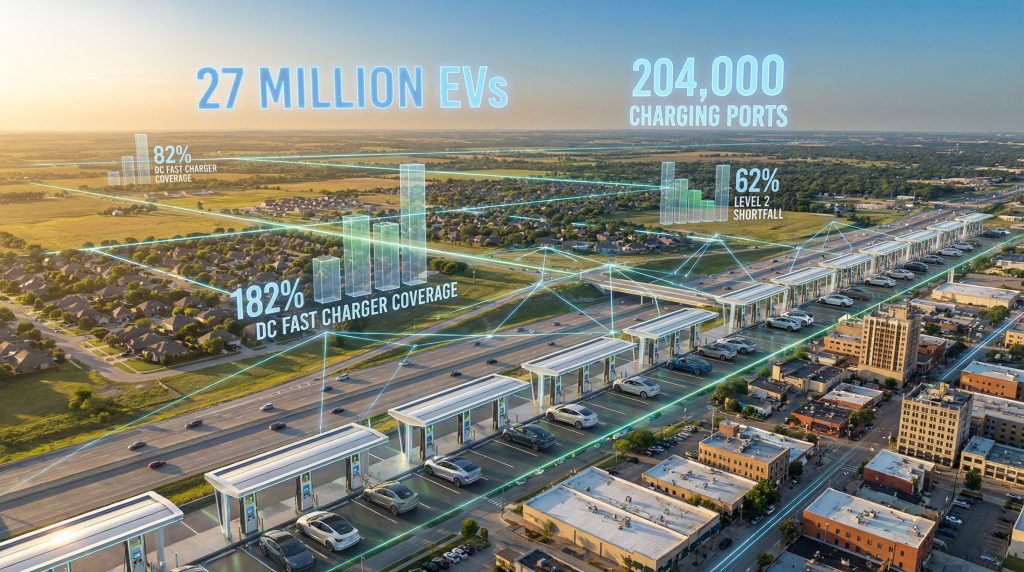
Electric vehicle charging infrastructure expansion remains one of America's most pressing logistical challenges as the nation transitions toward widespread EV adoption. With current deployment patterns revealing systematic inadequacies, the gap between existing capacity and future requirements presents a formidable obstacle that extends far beyond simple installation numbers. Furthermore, energy transition challenges and macroeconomic factors continue to influence the strategic planning required for this massive infrastructure undertaking.
The Strategic Gap: Current Capacity vs. Future Requirements
The mathematics of America's electric vehicle charging infrastructure expansion present a formidable challenge that extends far beyond simple installation numbers. Current deployment patterns reveal systematic inadequacies that threaten to constrain the nation's electrification timeline. Regional disparities create a patchwork of accessibility that could fundamentally reshape EV adoption trajectories across different demographics and geographies.
Analyzing the Infrastructure Density Challenge
America's existing charging network comprises approximately 62,000 public charging ports across 26,000 locations, serving an estimated 3 million electric vehicles currently on the road. This baseline infrastructure must accommodate projections ranging from 18 to 29 million EVs by 2030, depending on policy scenarios and market adoption rates. The scale of this expansion requirement becomes clearer when examining current utilisation patterns and future demand modelling.
The charging port distribution reveals significant technological imbalances that impact user experience and network efficiency:
• Level 2 charging (240V): Approximately 48,000 ports representing 77% of public infrastructure
• DC fast charging: Roughly 13,000 ports comprising 21% of available capacity
• Level 1 charging (120V): Minimal public deployment at approximately 5% of total ports
These ratios suggest a fundamental mismatch between charging technology deployment and user behaviour patterns. DC fast charging serves intercity travel and rapid charging needs, while Level 2 infrastructure supports longer-duration charging sessions typical of workplace and retail environments.
Investment Pipeline Assessment Through 2030
Market analysis indicates that current infrastructure investment trajectories fall short of meeting projected demand requirements. The charging network requires expansion ratios varying significantly by technology type and geographic region. Urban metropolitan areas demonstrate higher utilisation rates for existing infrastructure, averaging 20-35% capacity utilisation. However, rural corridor installations operate at substantially lower efficiency rates of 3-8%.
| Charging Type | Current Infrastructure | 2030 Requirement | Gap Analysis |
|---|---|---|---|
| DC Fast Charging | 13,000 ports | 75,000-100,000 ports | 480% expansion needed |
| Level 2 Public | 48,000 ports | 200,000-300,000 ports | 315% expansion needed |
| Corridor Coverage | 72% adequacy | 95% target coverage | 32% improvement required |
The investment capital required for this expansion has been estimated between $40-60 billion through 2030, with federal funding programmes contributing approximately $7.5 billion through the National Electric Vehicle Infrastructure (NEVI) programme. This funding gap necessitates substantial private sector investment, contingent on improved profitability models and risk mitigation strategies.
When big ASX news breaks, our subscribers know first
What Economic Factors Are Reshaping Charging Network Deployment?
Economic fundamentals governing charging infrastructure deployment have shifted materially since 2022, with investment sentiment reflecting increased caution around demand forecasting accuracy and operational profitability timelines. These changes represent structural adjustments rather than temporary market conditions, influencing long-term strategic planning across the charging ecosystem. In addition, broader investment market trends continue to shape capital allocation decisions within this sector.
Market Dynamics and Investment Sentiment Shifts
S&P Global Mobility revised their EV sales growth projections downward from 15% compound annual growth rate to 12% for the 2024-2030 period. This translates to proportional reductions in charging infrastructure installation forecasts. This revision reflects market realities around price sensitivity in mainstream vehicle segments and charging behaviour patterns that differ from early adoption phases.
Investment capital deployment in EV charging infrastructure declined 22% year-over-year, from $3.1 billion in 2022 to $2.4 billion in 2023. This contraction occurred despite increased federal funding availability, suggesting that private sector risk assessment has become more stringent around charging network profitability assumptions.
The economic model for charging station operations faces three primary challenges:
• Utilisation rate uncertainty: Current public chargers operate at 8-15% average utilisation nationally
• Technology obsolescence risk: Rapid power output evolution creates 10-year investment horizon concerns
• Grid integration costs: Electrical infrastructure upgrades required for 60-75% of DC fast charger locations
Policy Environment Impact on Infrastructure Acceleration
Federal funding allocation through the NEVI programme has demonstrated both opportunities and implementation challenges. Of the $7.5 billion allocated over five years, approximately $1.2 billion has been obligated to states, with $400 million reaching construction phase by late 2024. State-level implementation timelines have extended 12-18 months beyond initial projections due to permitting complexity and local regulatory requirements.
The regulatory framework continues evolving around interoperability standards and payment system requirements, creating operational uncertainty for network operators. These evolving standards impact investment decisions, as operators must balance current deployment needs with future compliance requirements that could necessitate costly retrofitting of existing installations.
How Are Geographic and Demographic Disparities Affecting Network Expansion?
Geographic distribution patterns reveal systematic inequities in charging access that extend beyond simple urban-rural divides. Population density correlates strongly with charging port availability, but demographic factors including income levels and housing types create additional barriers. Traditional market-driven deployment approaches fail to address these barriers effectively. Meanwhile, global industry evolution trends demonstrate how technological advancement can help overcome infrastructure disparities.
Urban vs. Rural Infrastructure Distribution Challenges
The charging port density varies dramatically across geographic regions, creating accessibility barriers that could constrain EV adoption in specific areas. Metropolitan areas with populations exceeding one million residents average one public charger per 2,500-5,000 residents. Rural counties demonstrate ratios of one charger per 80,000-150,000 residents.
Interstate corridor coverage presents a mixed picture of progress and persistent gaps:
| Interstate Corridor | Coverage Percentage | Critical Gaps |
|—|—|—|—|
| I-5 (WA-CA) | 94% | Oregon rural segments |
| I-95 (ME-FL) | 87% | South Carolina, Georgia |
| I-90 (WA-NY) | 72% | Montana, Wyoming, South Dakota |
| I-70 (UT-MD) | 58% | Colorado mountains, Kansas |
| I-40 (CA-NC) | 51% | Arizona, New Mexico, Texas |
These gaps constrain long-distance EV travel options and create psychological barriers to EV adoption among consumers who occasionally require intercity travel capabilities. The infrastructure development required for comprehensive corridor coverage involves substantial investment in locations with uncertain utilisation patterns.
Socioeconomic Access Barriers and Market Solutions
Income-based disparities in charging access represent perhaps the most significant equity challenge in electric vehicle charging infrastructure expansion. High-income neighbourhoods with median household incomes exceeding $100,000 demonstrate charging port ratios of one per 8,000 residents. Low-income areas show ratios approaching one per 50,000 residents.
Housing type creates additional access barriers, particularly for multifamily dwelling residents who comprise approximately 35% of U.S. households. Current public charging infrastructure serves only 15-20% of multifamily dwelling residents adequately. This creates dependence on workplace charging or public networks for daily charging needs.
New York City's Department of Transportation has implemented targeted approaches for underserved neighbourhoods, including:
• Curbside charging pilot programmes in residential areas with limited off-street parking
• Public housing authority partnerships for dedicated resident charging access
• Small business location incentives encouraging charging installation in commercial corridors
These approaches demonstrate scalable models for addressing equity concerns while maintaining economic viability for charging network operators.
What Technology and Operational Models Will Drive Future Growth?
Technological advancement in charging capabilities continues accelerating, with power output specifications evolving rapidly enough to influence infrastructure investment decisions and network design strategies. Operational model innovation encompasses retail integration, utility partnerships, and revenue diversification approaches. These address profitability challenges in traditional charging-only business models.
Charging Technology Evolution and Capacity Scaling
Power output advancement represents the most significant technical factor influencing infrastructure efficiency and user adoption. Current DC fast chargers average 150-250 kW output, while next-generation installations increasingly feature 300-500 kW capabilities. Ultra-rapid charging stations exceeding 500 kW have entered limited deployment through Tesla's Supercharger V4 network and Electrify America's premium corridor locations.
These power output increases translate to substantial improvements in charging session duration. Furthermore, 300+ kW chargers enable 10-80% battery charging in 15-25 minutes for compatible vehicles. However, this technological advancement creates infrastructure obsolescence concerns for existing installations and requires substantial electrical grid capacity upgrades.
Grid integration challenges intensify with higher-power charging installations, requiring utility coordination and infrastructure investment that can add $30,000-$100,000 per location for electrical capacity upgrades. Utility interconnection timelines have extended from 3-6 months in 2020 to 6-18 months currently, constraining deployment schedules.
Business Model Innovation in Charging Network Operations
Revenue diversification strategies have emerged as essential components of sustainable charging network operations. Traditional charging-only revenue models face profitability challenges due to relatively low utilisation rates and high infrastructure costs. Successful operators increasingly integrate additional revenue streams:
• Retail partnerships: Charging stations co-located with shopping centres, restaurants, and convenience stores
• Energy storage integration: Battery systems providing grid services and demand management
• Fleet charging contracts: Dedicated capacity for commercial and municipal vehicle fleets
• Utility partnership models: Revenue sharing arrangements with electric utilities
Automaker direct investment approaches represent an alternative to third-party operator models, with manufacturers including Tesla, Ford, and General Motors expanding charging network ownership. These vertical integration strategies aim to ensure charging availability for brand-specific vehicle owners while potentially excluding competitors.
Which Strategic Scenarios Could Accelerate Infrastructure Development?
Multiple scenarios could substantially accelerate charging infrastructure deployment beyond current baseline projections. These range from policy interventions and technology breakthroughs to market-driven demand acceleration through commercial fleet electrification. Understanding these potential catalysts assists stakeholders in strategic planning and risk assessment, particularly considering the broader energy transition outlook affecting infrastructure priorities.
High-Growth Deployment Scenarios
Accelerated federal funding release represents the most immediate catalyst for deployment acceleration. Streamlined permitting processes at state and local levels could reduce project timelines by 6-12 months. This translates to significant cost savings and faster market responsiveness. Simplified environmental review processes specifically for charging infrastructure could eliminate regulatory bottlenecks that currently constrain NEVI programme implementation.
Corporate fleet electrification decisions could drive substantial demand increases for commercial charging infrastructure. Large fleet operators including Amazon, FedEx, UPS, and postal services have announced electrification timelines that require dedicated charging capacity beyond current public network planning assumptions. This commercial demand could improve utilisation economics for charging stations located in industrial and logistics corridors.
Technology breakthrough scenarios include battery technology advances that reduce charging time requirements or increase vehicle range capabilities. Solid-state battery commercialisation could enable charging speeds that fundamentally alter infrastructure requirements. Extended range capabilities might reduce total charging frequency demands.
Risk Mitigation Strategies for Infrastructure Investors
Portfolio diversification across charging types and geographic regions represents the primary risk mitigation approach for infrastructure investors. Balanced exposure to urban high-utilisation locations and strategic corridor positions can optimise risk-adjusted returns while supporting network connectivity objectives.
Demand forecasting accuracy improvement requires sophisticated modelling that incorporates local demographic factors, existing charging access, and regional EV adoption patterns. Successful operators utilise data analytics platforms that monitor utilisation patterns in real-time and adjust capacity planning accordingly.
Partnership structures can reduce individual operator exposure through shared investment models, utility collaboration agreements, and anchor tenant arrangements. These approaches distribute capital requirements and operational risks while maintaining adequate returns for all participants.
How Can Stakeholders Navigate the Infrastructure Investment Landscape?
Strategic decision-making in electric vehicle charging infrastructure expansion requires comprehensive evaluation frameworks that account for technology evolution, regulatory changes, and market dynamics. Successful navigation demands understanding of location optimisation, technology selection, and timing considerations that influence long-term profitability and operational sustainability.
Strategic Decision Frameworks for Market Participants
Location selection criteria have evolved beyond simple traffic volume metrics to incorporate demographic analysis, competitive positioning, and grid capacity assessment. Premium locations demonstrate consistent characteristics including high population density, significant dwell time opportunities, and adequate electrical infrastructure capacity for expansion.
Optimal charging station locations typically feature:
• Retail integration opportunities with 30-60 minute average customer visits
• Interstate corridor positioning within 50 miles of major metropolitan areas
• Workplace accessibility in business districts and industrial parks
• Multifamily housing proximity serving residents without home charging options
Technology platform selection requires balancing current capabilities with future-proofing considerations. Modular charging systems that enable power output upgrades without complete replacement provide flexibility for evolving vehicle requirements. Interoperability standards compliance ensures broad vehicle compatibility and reduces user friction.
Performance Metrics and Success Indicators
Utilisation rate benchmarks vary significantly by location type and charging technology. DC fast chargers require 18-22% utilisation rates for profitability, while Level 2 installations achieve profitability at 8-12% utilisation. Premium urban locations can achieve 35-40% utilisation rates, substantially exceeding profitability thresholds.
Customer satisfaction metrics increasingly influence network competitiveness, with reliability standards becoming differentiating factors. Network availability rates exceeding 95% uptime demonstrate operational excellence. Payment system simplicity and charging session predictability impact user retention rates.
Market share dynamics in local markets determine pricing power and utilisation optimisation opportunities. Networks achieving local market dominance can implement premium pricing strategies while maintaining high utilisation rates through superior location positioning.
The next major ASX story will hit our subscribers first
What Does Success Look Like for America's Charging Infrastructure by 2030?
A successful charging infrastructure outcome by 2030 encompasses network connectivity, user experience standardisation, and economic sustainability across diverse market segments. This vision requires coordination between public policy, private investment, and technological advancement that addresses current gaps while anticipating future requirements.
Integrated Network Vision and Connectivity Standards
Seamless user experience across different operators represents a fundamental requirement for widespread EV adoption. Interoperability protocols that enable universal access cards, standardised payment systems, and consistent charging session procedures reduce user friction. These eliminate network-specific compatibility concerns.
National connectivity standards should ensure that intercity travel remains viable for all electric vehicle owners, regardless of their home charging situation or preferred charging network. This requires strategic corridor development that prioritises coverage gaps in underserved regions while maintaining profitable operations for network operators. For instance, New South Wales has launched comprehensive EV infrastructure planning to address similar connectivity challenges across regional areas.
Grid stability integration becomes increasingly critical as charging infrastructure scales to serve millions of vehicles. Smart charging networks that coordinate with utility demand management systems can provide grid services while optimising charging costs for consumers. Renewable energy integration through solar installations and battery storage creates additional value propositions for charging locations.
Economic Impact Assessment and Job Creation Potential
Employment generation across the charging infrastructure value chain extends from manufacturing and installation to ongoing operations and maintenance. The National Renewable Energy Laboratory estimates that achieving 2030 infrastructure targets could support 150,000-200,000 jobs across multiple skill levels and geographic regions.
Regional economic development opportunities through infrastructure investment concentrate in areas with existing electrical and automotive industry capabilities. States with established utility workforces and electrical contracting capacity demonstrate advantages in scaling charging infrastructure deployment efficiently.
Supply chain localisation provides strategic benefits including reduced equipment costs, shorter delivery timelines, and enhanced supply chain resilience. Domestic manufacturing of charging equipment components could reduce import dependency while supporting manufacturing employment in regions transitioning from traditional automotive production. Additionally, Australia's national electric vehicle strategy demonstrates how coordinated policy frameworks can accelerate infrastructure development across multiple sectors.
Disclaimer: This analysis contains forward-looking projections and scenarios based on current market conditions and policy frameworks. Actual infrastructure deployment rates, technology adoption timelines, and investment outcomes may vary significantly from these projections. Investors should conduct independent analysis and consider multiple scenarios when making infrastructure investment decisions. Market conditions, regulatory requirements, and technology standards continue evolving rapidly in the electric vehicle charging sector.
Want to Capitalise on the Electric Vehicle Infrastructure Boom?
The massive $40-60 billion infrastructure expansion represents unprecedented opportunities for savvy investors, but success requires identifying the right companies at the optimal moment. Discovery Alert's proprietary Discovery IQ model delivers instant notifications when ASX-listed companies announce significant mineral discoveries essential for EV battery production, helping subscribers position themselves ahead of major market movements before broader investor awareness develops.