June 8, 2026
The Engineering Physics Behind Electric Vehicle Energy Storage Systems
Modern transportation electrification relies fundamentally on electrochemical energy density optimisation, where battery pack engineering determines vehicle operational parameters through precise capacity calibration. Electric vehicle battery capacity represents the total energy storage potential measured in kilowatt-hours (kWh), forming the cornerstone of EV performance characteristics across diverse vehicle segments and operational environments.
Contemporary electric vehicles deploy sophisticated battery architectures ranging from compact 30 kWh urban-focused systems to premium 200+ kWh configurations designed for extended-range performance. The relationship between capacity specifications and real-world operational efficiency reveals complex engineering trade-offs involving weight penalties, thermal management requirements, and charging infrastructure compatibility that fundamentally shape vehicle design philosophy.
When big ASX news breaks, our subscribers know first
Battery Capacity Fundamentals and Market Distribution Patterns
Electric vehicle battery capacity deployment reached unprecedented scale in 2025, with global automotive manufacturers implementing over 1 terawatt-hour of battery systems across their vehicle lineups. This represents nearly quadruple the 286 gigawatt-hours deployed in 2021, demonstrating the accelerating transition toward electrified transportation solutions.
Current market segmentation reveals distinct capacity tiers aligned with specific use cases and consumer requirements. Urban-focused vehicles typically operate within the 30-55 kWh range, supporting 150-230 miles of operational range under standard conditions. These systems prioritise cost optimisation and charging efficiency over maximum range capabilities, reflecting the daily travel patterns of city-based users averaging 25-40 miles per day.
Mainstream vehicle segments gravitate toward 60-77 kWh battery configurations, representing approximately 45-50% of global EV deployments. This capacity band delivers 230-320 miles of rated range while maintaining acceptable cost structures for middle-market consumers. Premium vehicle segments increasingly specify 80-100+ kWh systems, achieving 280-380+ mile range capabilities that eliminate charging anxiety for long-distance travel scenarios.
Energy Density Technology Evolution
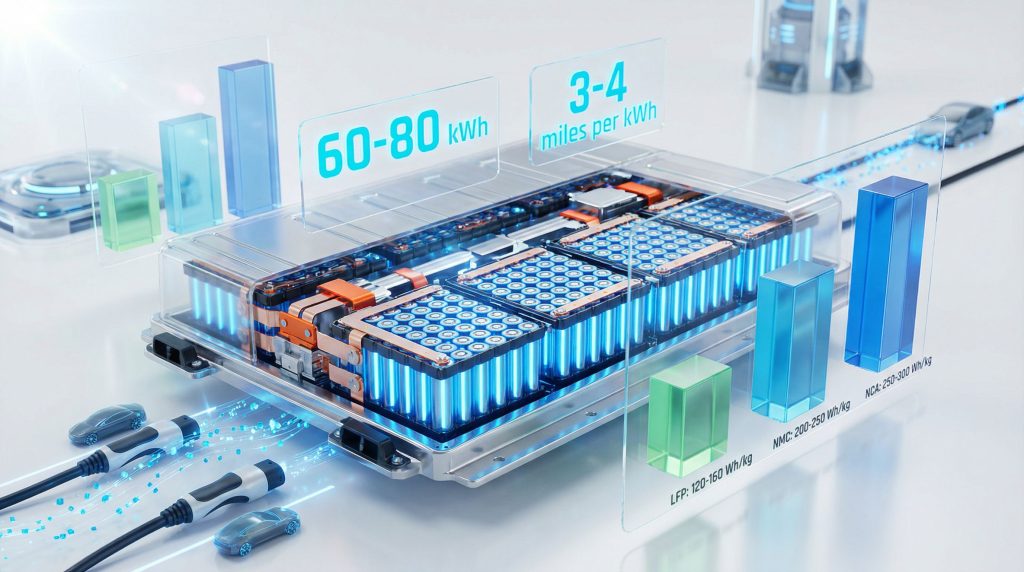
Battery chemistry variations significantly impact capacity efficiency and vehicle performance characteristics. Lithium iron phosphate (LFP) systems deliver 120-160 watt-hours per kilogram, providing excellent cycle life exceeding 3,000 charge cycles while maintaining moderate capacity density ratios suitable for cost-effective city vehicles.
Nickel manganese cobalt (NMC) chemistry achieves 200-250 Wh/kg energy density with 1,000-2,000 cycle durability, representing the dominant technology for mainstream performance electric vehicles. Advanced nickel cobalt aluminum (NCA) formulations reach 250-300 Wh/kg density levels, optimising maximum range applications in premium long-range vehicles despite reduced cycle life characteristics.
| Battery Chemistry | Energy Density (Wh/kg) | Cycle Life | Primary Applications |
|---|---|---|---|
| Lithium Iron Phosphate | 120-160 | 3,000+ cycles | Cost-effective urban vehicles |
| Nickel Manganese Cobalt | 200-250 | 1,000-2,000 cycles | Mainstream performance EVs |
| Nickel Cobalt Aluminum | 250-300 | 500-1,000 cycles | Premium long-range applications |
Manufacturing Cost Dynamics and Supply Chain Integration
Despite the quadrupling of electric vehicle battery capacity deployment between 2021 and 2025, total raw material expenditure by automotive manufacturers decreased approximately 50% from 2022 peak levels. This counterintuitive cost reduction reflects sophisticated supply chain optimisation, alternative chemistry adoption, and manufacturing economies of scale implementation.
Leading manufacturers implementing vertical integration strategies achieve substantial cost advantages in battery production systems. BYD's integrated operations spanning lithium mining, processing, cell manufacturing, and vehicle assembly enable average battery costs of approximately $6,000 per vehicle, significantly below competitors like Tesla at $7,000 and traditional automakers ranging from $10,000-13,000 for equivalent capacity systems.
Vertical Integration Impact Analysis
Vertically integrated manufacturers control component costs across the entire production chain, enabling price optimisation while maintaining quality standards and profitability margins. BYD operates proprietary lithium mines, lithium processing facilities, battery cell production lines, computer chip manufacturing, electric motor assembly, and electronic control systems manufacturing.
This comprehensive integration model delivers 30-40% cost advantages compared to traditional outsourced supply chain approaches. Furthermore, the integration strategy also provides supply security benefits, reducing exposure to commodity price volatility and supply chain disruptions that have affected conventional automotive manufacturers.
Vehicle Segment Optimisation and Performance Characteristics
Electric vehicle battery capacity optimisation varies substantially across vehicle classifications, with each segment exhibiting distinct performance requirements and operational parameters that drive capacity specification decisions.
Compact Urban Vehicle Configuration
Compact electric vehicles prioritising urban mobility deploy 30-55 kWh battery systems optimised for daily commuting patterns. These vehicles typically achieve 3.5-4.5 days of normal urban driving on single charges, aligning with established consumer charging frequency expectations of every 2-3 days.
Real-world usage data indicates urban vehicles travel average daily distances of 35-50 kilometres, with 85% of daily journeys remaining under 60 kilometres. Battery capacity in this segment translates to operational range of 200-280 kilometres under mixed driving conditions, providing adequate buffer for unexpected trip extensions while minimising system cost and weight penalties.
Mid-Range Performance Vehicles
The 60-77 kWh capacity segment has emerged as the dominant market category, representing 45-55% of global EV sales by volume. Vehicles including mainstream sedans and crossovers achieve 280-320 kilometres of measured range under standardised testing conditions, with real-world consumer experience typically ranging from 220-290 kilometres depending on driving patterns, weather conditions, and charging infrastructure utilisation patterns.
Fleet operators report that 90% of daily driving events by vehicles in this capacity range remain below 250 kilometres, with charging occurring at designated endpoints rather than requiring mid-journey charging stops. For instance, this operational pattern validates the capacity optimisation for typical consumer use cases while maintaining acceptable cost structures.
Premium Long-Range Applications
Premium electric vehicles deploying 80-100+ kWh battery systems target consumers prioritising maximum range capability and minimal charging frequency requirements. These vehicles support 380-450 kilometres of measured range under standardised conditions, with premium segment consumers reporting utilisation patterns emphasising weekend long-distance travel and infrastructure independence.
Premium segment buyers typically accept $8,000-15,000 cost premiums for 20-30 kWh additional capacity compared to mainstream alternatives, indicating willingness to prioritise range headroom over cost optimisation. This market segment demonstrates that psychological factors including range anxiety significantly influence purchasing decisions independent of actual utilisation requirements.
Technical Performance Factors and System Integration
Electric vehicle battery capacity directly correlates with vehicle weight distribution, thermal management requirements, and charging performance characteristics that fundamentally impact real-world operational efficiency and user experience.
Weight Penalty Relationships
Modern battery packs average 4.5-5.5 kilograms per kWh when including protective structures, thermal management systems, and integration hardware. A 40 kWh system imposes approximately 180-220 kg total system weight, while equivalent 100 kWh systems reach 450-550 kg including all subsystems.
This weight differential directly impacts vehicle efficiency, with every 100 kg of added mass requiring approximately 4-5% additional energy consumption for equivalent driving patterns. However, oversized battery systems therefore generate efficiency penalties that extend charging times and reduce operational vehicle range, creating counterintuitive outcomes where larger capacity systems may deliver equivalent practical range through reduced energy efficiency.
Thermal Management System Requirements
High-capacity battery systems generate substantial thermal loads during rapid charging operations and sustained high-power driving conditions. Advanced thermal management systems employ liquid cooling circuits integrated throughout battery pack structures, maintaining optimal operating temperatures within 20-35°C ranges for maximum performance and longevity.
These thermal management systems consume 2-4% of total battery capacity during normal operating conditions, with consumption increasing to 8-12% during extreme weather conditions or rapid charging scenarios. Consequently, battery management system reserves typically allocate 5-15% of total capacity for thermal regulation and longevity optimisation, reducing usable capacity below rated specifications.
Economic Optimisation and Cost-Benefit Analysis
Battery capacity optimisation requires careful evaluation of cost-to-benefit relationships, as capacity expansion costs create diminishing marginal returns for range improvement while imposing weight and efficiency penalties that affect overall vehicle performance.
Marginal Cost Analysis
Battery system costs have declined to $80-100 per kWh for mainstream NMC chemistry as of March 2026, while complete system-level costs including thermal management, electronics, and vehicle integration reach $95-120 per kWh. Incremental capacity expansion therefore costs approximately $9,500-12,000 per additional 100 kWh of capacity.
Nevertheless, range improvement per additional kWh declines with increasing vehicle weight, such that the 100th kWh provides only 8-12% range improvement compared to baseline vehicle performance, while the 40th-50th kWh typically provides 20-25% range enhancement. This declining marginal benefit drives economic optimisation toward moderate capacity specifications rather than maximum capacity implementations.
Charging Infrastructure Considerations
Battery capacity directly influences charging duration and infrastructure compatibility. A 40 kWh battery charged at typical 7 kW home charging rates requires approximately 5-6 hours to full charge, while 100 kWh systems require 14-15 hours for complete charging cycles.
For rapid DC charging at 150 kW rates, 40 kWh systems reach 80% charge state in 20-25 minutes, while 100 kWh systems require 35-40 minutes to equivalent charge levels. These timing differences have operational implications: urban vehicles benefiting from overnight home charging experience minimal time constraints, while long-distance vehicles optimise for rapid public charging infrastructure availability and compatibility.
The next major ASX story will hit our subscribers first
Market Evolution and Consumer Behaviour Patterns
Electric vehicle battery capacity preferences demonstrate complex relationships between stated consumer preferences and actual purchasing behaviour, revealing psychological factors that significantly influence capacity specification decisions across different market segments.
Consumer Preference Research Findings
Market research consistently indicates consumer stated preference for 300+ mile (approximately 480 kilometre) range capabilities across demographic and geographic segments. This preference remains largely disconnected from actual travel behaviour patterns, suggesting psychological factors and range anxiety management strongly influence stated capacity requirements independent of real-world utilisation needs.
Despite stated preferences for maximum range, actual purchasing decisions increasingly reflect pragmatic capacity optimisation considerations. Mainstream market consumers frequently select 60-75 kWh systems even when 90+ kWh alternatives are available at comparable price points, indicating evolving attitudes toward realistic range sufficiency versus theoretical maximum capability.
Fleet Manager Strategic Perspectives
Commercial fleet operators provide valuable insights into optimal capacity selection based on operational rather than psychological factors. Fleet managers consistently identify 70-80 kWh capacity as providing optimal balance for mixed-use vehicles supporting both urban delivery operations and regional route flexibility.
Fleet operators report that vehicles within this capacity band permit same-day charging cycles supporting 300+ kilometre daily operational distances while maintaining depot-based charging infrastructure efficiency. Over-specification to 90+ kWh capacity creates excess weight penalties and extended charging times without proportional operational benefits for typical fleet utilisation patterns.
Technological Advances in Energy Storage and Recycling
The electric vehicle battery capacity sector continues to benefit from revolutionary technological developments in both new battery technologies and end-of-life processing solutions. Emerging solid-state technologies promise to fundamentally transform capacity optimisation equations through improved energy density, reduced charging times, and enhanced durability characteristics.
Meanwhile, Chinese researchers have achieved a significant battery recycling breakthrough that enables 95% material recovery rates from lithium-ion batteries. This advancement substantially improves the environmental sustainability profile of high-capacity battery deployments while reducing long-term material cost pressures.
Innovation in Manufacturing and Processing
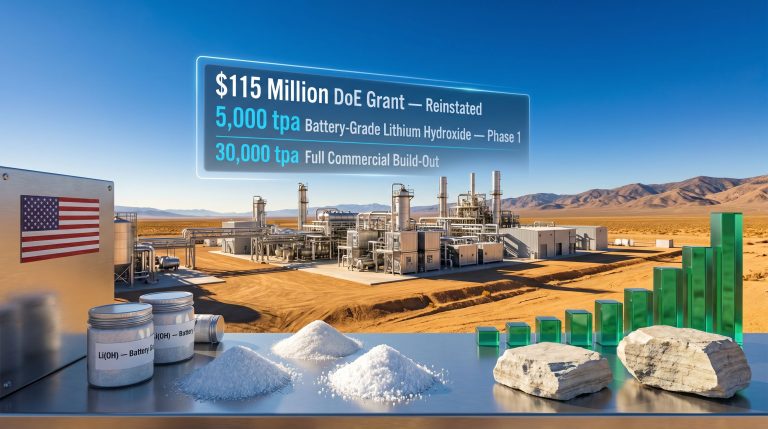
Parallel developments in lithium refinery innovations are establishing new processing facilities capable of producing battery-grade lithium hydroxide with 50% reduced energy consumption compared to traditional methods. These efficiency improvements directly translate to lower battery costs and improved sustainability metrics across all capacity segments.
Furthermore, advancements in direct lithium extraction technologies are revolutionising the speed and efficiency of lithium procurement from brine sources. This technological progress enables more responsive supply chain adjustments to meet growing capacity demands while maintaining cost competitiveness.
End-of-Life Processing Infrastructure
The establishment of advanced battery recycling facility networks addresses one of the key long-term sustainability concerns associated with large-capacity battery deployments. These facilities process thousands of end-of-life battery packs monthly, recovering valuable materials for reintegration into new battery production cycles.
The circular economy approach to battery materials significantly improves the environmental profile of high-capacity systems while reducing dependence on virgin mining operations. In addition, this closed-loop processing model creates economic incentives for proper battery disposal and recycling compliance across all vehicle segments.
Integration with Mining and Transportation Systems
The electric vehicle battery capacity expansion intersects significantly with mining industry transformation and transportation electrification initiatives. Advanced EV mining integration projects demonstrate how large-capacity electric vehicles can replace diesel-powered mining equipment while creating synergies between battery production and mining operations.
These integration projects utilise 200-400 kWh battery systems in heavy-duty mining vehicles, demonstrating the viability of electric powertrains in demanding industrial applications. The operational data from these deployments provides valuable insights for optimising battery capacity in commercial and industrial vehicle segments.
Energy Storage as a Service Models
Emerging business models treat high-capacity battery systems as distributed energy storage assets that provide grid services in addition to transportation functions. Electric vehicle batteries deployed in fleet operations increasingly participate in demand response programs and peak shaving services during stationary periods.
This dual-purpose utilisation model improves the economic justification for larger capacity systems while providing additional revenue streams that offset higher initial investment costs. Vehicle-to-grid integration transforms battery capacity from a cost centre into a revenue-generating asset for fleet operators and individual consumers.
Regional Market Dynamics and Policy Implications
Global electric vehicle battery capacity deployment varies significantly across regional markets due to infrastructure development, regulatory frameworks, and consumer preference patterns that create distinct optimisation requirements for different geographic markets.
Chinese Market Integration Strategies
China's electric vehicle market, representing approximately 60% of global EV sales volume, demonstrates preference for moderate capacity systems optimised for urban and regional travel patterns. Chinese manufacturers like BYD have achieved market leadership through capacity optimisation strategies prioritising cost-effectiveness over maximum range specifications.
The Chinese market's comprehensive charging infrastructure development enables smaller capacity systems to meet long-distance travel requirements through frequent charging opportunities. This infrastructure advantage creates market conditions favouring 50-70 kWh capacity systems that balance performance requirements with affordability objectives for mass-market adoption.
European Regulatory Environment Impact
European emissions regulations and urban vehicle access restrictions create market incentives favouring electric vehicle adoption across diverse capacity ranges. European consumers demonstrate willingness to accept moderate capacity systems when supported by comprehensive public charging infrastructure development and favourable policy frameworks.
Volkswagen's emergence as the largest battery metals buyer in 2025, surpassing Tesla in raw material procurement volume, reflects European automotive industry commitment to securing supply chain access for expanded electric vehicle production across multiple capacity segments and vehicle classifications.
Investment Implications and Market Outlook
Electric vehicle battery capacity trends create significant investment opportunities and risks across the mining, manufacturing, and automotive sectors as capacity deployment continues expanding while cost optimisation pressures intensify.
Raw Material Supply Chain Investment
Despite quadrupling battery capacity deployment, raw material costs have declined substantially through improved extraction efficiency, alternative chemistry adoption, and supply chain optimisation. Mining companies focused on lithium, nickel, and cobalt production face complex market dynamics balancing volume growth against price compression from efficiency improvements.
Automotive manufacturers increasingly pursue direct mining partnerships to secure reliable material access while maintaining cost competitiveness. These vertical integration strategies create both opportunities and challenges for independent mining operations as automakers seek greater supply chain control and cost optimisation.
Technology Development Investment Priorities
Battery technology advancement focuses on energy density improvement, charging speed enhancement, and cost reduction rather than raw capacity expansion. Investment opportunities concentrate on solid-state battery development, advanced cell format optimisation, and manufacturing process efficiency rather than traditional capacity scaling approaches.
The transition toward moderate capacity optimisation suggests that future growth will emphasise efficiency and performance improvements over absolute capacity expansion, creating investment implications favouring technology advancement over raw material volume scaling.
However, understanding useable battery capacity remains crucial for investors evaluating market opportunities, as the difference between total and useable capacity significantly impacts real-world vehicle performance and consumer satisfaction metrics.
Disclaimer: This analysis contains forward-looking statements and projections based on current market conditions and technological development trends. Battery technology advancement, regulatory changes, and market dynamics may significantly impact actual outcomes compared to projections discussed herein. Investment decisions should consider comprehensive risk assessment beyond the scope of this technical analysis.
Considering Investments in Battery Technology and Mining Sectors?
Discovery Alert's proprietary Discovery IQ model delivers real-time alerts on significant ASX mineral discoveries across lithium, nickel, and cobalt sectors that power the electric vehicle revolution, providing subscribers with actionable insights into opportunities ahead of the broader market. Begin your 14-day free trial today to position yourself at the forefront of the battery materials supply chain transformation.