July 19, 2026
Global steel markets operate through complex pricing mechanisms that extend far beyond simple supply and demand calculations. The electrical steel segment, particularly cold-rolled grain-oriented (CRGO) varieties, represents one of the most sophisticated pricing frameworks in the metals industry. Understanding these dynamics requires examining the technical specifications, trade flows, and market structures that influence cost formation across international borders. Moreover, the tariffs impact investment markets significantly, creating additional layers of complexity for steel pricing assessments.
The intricate relationship between manufacturing capabilities, import dependencies, and price discovery mechanisms creates unique challenges for market participants. In Asia-Pacific regions where industrial transformation accelerates rapidly, these pricing systems become even more critical for strategic planning and risk management.
Understanding Cold-Rolled Grain Oriented Steel Market Fundamentals
The foundation of electrical steel CFR India price assessment begins with comprehending the technical specifications that define market-grade CRGO products. These specialized steel grades undergo precise manufacturing processes designed to optimize magnetic properties for transformer core applications.
Technical Specifications Defining CRGO Quality Standards
CRGO electrical steel operates under stringent quality parameters that directly influence pricing structures. The 23 HP85d grade specification represents the standard quality benchmark for Indian market assessments, featuring width dimensions ranging from 900-1000mm. These dimensional tolerances reflect manufacturing precision requirements that impact both production costs and end-user performance expectations.
The grain orientation process involves controlled silicon content levels, typically ranging between 2.8% to 3.5% silicon by weight. This silicon integration reduces eddy current losses while enhancing magnetic permeability in the rolling direction. Manufacturing facilities must maintain precise temperature control during the secondary recrystallization process, where grain structure alignment occurs at approximately 1,200°C.
Core loss specifications for transformer-grade CRGO typically measure below 0.85 watts per kilogram at 1.7 Tesla magnetic flux density. These performance characteristics justify the substantial price premiums over conventional steel grades, often representing 3-5 times the cost of standard flat steel products.
IS 3024 Compliance Requirements for Indian Electrical Steel Imports
Indian Standard 3024 establishes the regulatory framework governing CRGO imports into the domestic market. This specification system ensures compatibility with local transformer manufacturing requirements while maintaining quality consistency across supply chains.
Key compliance parameters under IS 3024 include:
• Magnetic flux density: Minimum 1.85 Tesla at 800 A/m magnetizing force
• Core loss limits: Maximum 0.85 W/kg at 50Hz frequency and 1.7T flux density
• Thickness tolerances: ±0.02mm variation allowance for consistent lamination stacking
• Coating specifications: Insulation layer requirements for electrical isolation between laminations
• Dimensional accuracy: Length and width tolerances within 0.5% of specified dimensions
Thickness Variations and Their Impact on Transformer Efficiency
Thickness control represents a critical factor in CRGO pricing and performance optimization. Standard electrical steel thicknesses range from 0.23mm to 0.35mm, with thinner gauges commanding premium pricing due to manufacturing complexity.
The relationship between thickness and core losses follows an exponential pattern. Reducing thickness from 0.30mm to 0.23mm typically decreases eddy current losses by approximately 35%, significantly improving transformer efficiency. This performance enhancement justifies price premiums of 15-25% for ultra-thin CRGO grades.
Manufacturing thin-gauge CRGO requires specialized rolling equipment capable of maintaining uniform thickness across wide strips. The precision rolling process increases production time by 40-60% compared to standard thickness grades, directly impacting manufacturing costs and market pricing.
When big ASX news breaks, our subscribers know first
How Does India's Import Dependency Shape CFR Pricing?
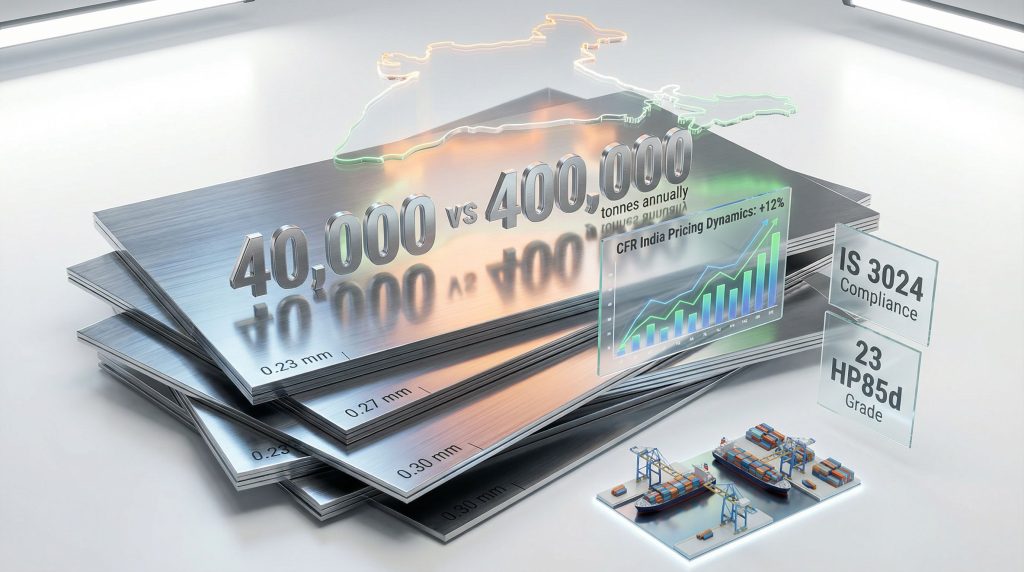
India's structural reliance on imported CRGO creates unique pricing dynamics that reflect both domestic capacity constraints and international supply chain vulnerabilities. The country's annual production of 40,000 tonnes against import requirements approaching 400,000 tonnes establishes a fundamental supply gap that influences all pricing mechanisms.
Production Capacity Gap Analysis: 40,000 vs 400,000 Tonnes Annually
The dramatic imbalance between domestic production and consumption creates a 90.9% import dependency ratio that fundamentally shapes market pricing dynamics. This structural deficit means that Indian buyers operate as price-takers in the global CRGO market, with limited domestic alternatives to influence pricing negotiations.
Domestic capacity utilization typically operates at 85-95% throughout the year, indicating minimal room for production expansion without significant capital investment. The specialized nature of CRGO manufacturing requires sophisticated secondary recrystallization furnaces and precision coating equipment, creating substantial barriers to rapid capacity expansion.
The capacity gap represents approximately $360 million annually in import value at current market pricing levels, assuming average CFR costs of $900-1,000 per tonne. This substantial foreign exchange outflow creates policy implications for trade balance management and industrial self-reliance initiatives.
Key Supplier Countries and Their Market Share Distribution
Global CRGO supply concentrates among a limited number of technologically advanced producers. Japan, South Korea, and China dominate the export market, collectively accounting for over 75% of international trade volumes.
Japanese producers maintain premium positioning through superior grain orientation technology, achieving core loss values below 0.75 W/kg. Korean manufacturers focus on high-volume production with consistent quality standards, while Chinese suppliers compete primarily on price competitiveness with improving quality metrics.
The supplier concentration creates pricing power dynamics that can significantly impact CFR India assessments. Furthermore, supply disruptions from any major producing country can trigger price volatility exceeding 20-30% within quarterly periods, particularly when combined with US steel tariffs analysis affecting global trade flows.
Logistics Cost Components in CFR India Assessments
CFR (Cost and Freight) pricing incorporates multiple logistics elements that fluctuate based on shipping route optimization and seasonal demand patterns. Ocean freight typically represents 8-12% of total CFR cost, varying with vessel capacity utilization and fuel price movements.
Container optimization plays a crucial role in cost efficiency, with standard 20-foot containers accommodating approximately 18-22 tonnes of CRGO depending on packaging configuration. Specialized handling requirements for electrical steel, including moisture protection and damage prevention, add premium charges of $15-25 per tonne to standard shipping rates.
Port selection significantly impacts total logistics costs, with major Indian destinations including Chennai, Mumbai, and Kolkata offering varying handling efficiencies and inland transportation connectivity. Port congestion can add delays of 5-10 days, impacting working capital requirements for importers.
What Are the Current CRGO Price Assessment Methodologies?
Professional price reporting agencies employ sophisticated methodologies to ensure accurate and representative pricing for electrical steel CFR India price assessment. The MB-STE-0941 specification represents the industry standard for transparent price discovery in the Indian CRGO market.
Fastmarkets MB-STE-0941 Specification Breakdown
The comprehensive assessment framework covers multiple dimensions of market activity to ensure pricing accuracy and representativeness. The methodology incorporates both transaction-based data and indicative pricing from qualified market participants, as outlined in Fastmarkets' electrical steel pricing assessment documentation.
Key assessment parameters include:
• Quality specification: 23 HP85d grade (900-1000mm width) per IS 3024 standards
• Minimum quantity threshold: 10 tonnes for price assessment inclusion
• Delivery terms: CFR Indian ports with freight included
• Timing basis: Spot market pricing for immediate delivery
• Currency denomination: USD per tonne for international comparability
• Assessment frequency: Fortnightly publication cycle
The assessment incorporates price data from multiple market participants, including producers, traders, and end-users. Data validation processes ensure accuracy through cross-referencing and outlier analysis, maintaining assessment integrity.
Fortnightly Pricing Cycles and Their Market Implications
The fortnightly publication schedule aligns with typical CRGO trading patterns, where price negotiations often occur on two-week cycles due to the specialized nature of the product. This timing framework provides sufficient market activity accumulation for accurate assessment while maintaining relevance for trading decisions.
Publication timing at 4-6pm Shanghai time on Fridays coincides with peak Asian market activity, ensuring maximum market participation in price discovery processes. The timing allows European and North American participants to contribute pricing intelligence while accommodating Asian market closing procedures.
Fortnightly cycles create pricing stability compared to daily assessments, reducing noise from temporary market fluctuations while capturing genuine trend movements. This approach proves particularly valuable for procurement planning and contract negotiations spanning multiple months.
Minimum Order Quantities and Their Effect on Spot Pricing
The 10-tonne minimum quantity requirement reflects practical trading realities in the CRGO market, where smaller parcels often carry premium pricing due to handling inefficiencies and transportation optimization challenges.
Transactions below minimum thresholds typically occur at 5-10% premium pricing, reflecting:
• Container utilization inefficiencies for partial loads
• Administrative cost allocation across smaller volumes
• Supplier preference for larger, more efficient transactions
• Quality assurance requirements maintaining consistency across smaller batches
The minimum quantity framework ensures assessment representativeness by focusing on commercially significant transactions that reflect genuine market conditions rather than specialized or distressed trading scenarios.
Which Factors Influence Electrical Steel Import Costs to India?
Multiple cost components interact to determine final CFR pricing for CRGO imports, creating a complex web of factors that buyers must navigate for effective procurement strategies. Additionally, the US tariffs and inflation dynamics further complicate global steel pricing mechanisms.
Raw Material Input Costs
Silicon steel substrate pricing forms the foundation of CRGO cost structures, with silicon content adding approximately $150-200 per tonne compared to standard steel grades. Silicon prices fluctuate based on global supply-demand balance and energy costs in major producing regions.
The grain orientation processing adds substantial manufacturing complexity, requiring specialized annealing cycles and magnetic domain refinement. Processing premiums typically range from $300-500 per tonne above standard cold-rolled steel, reflecting the sophisticated metallurgical requirements.
Energy costs significantly impact CRGO production economics, with electricity consumption 3-4 times higher than conventional steel processing. Energy price volatility in major producing countries directly translates to CRGO pricing fluctuations, particularly during periods of supply constraint or regulatory changes.
Manufacturing yield rates average 75-85% for CRGO production, meaning substantial material waste must be absorbed in final pricing. The specialized nature of rejected material limits recycling options, further increasing cost pressure on acceptable production.
Trade Policy Impact Analysis
Indian trade policy significantly influences CRGO import economics through multiple regulatory mechanisms designed to protect domestic industry while ensuring supply security for downstream manufacturers. However, the broader Trump tariffs market impact creates additional uncertainty for global steel trade patterns.
Import duty structures create cost layers that must be factored into procurement planning:
• Basic customs duty: Typically 7.5-10% on electrical steel imports
• Social welfare surcharge: Additional 10% on customs duty amount
• Goods and Services Tax: 18% GST on landed value including duties
• Port handling charges: Variable costs based on specific port and handling requirements
Anti-dumping investigations periodically target specific countries or suppliers, creating supply chain risks and pricing volatility. These investigations can result in provisional duties ranging from 15-40%, substantially altering competitive dynamics among supplier countries.
BIS (Bureau of Indian Standards) certification requirements add compliance costs and timeline delays for new suppliers or product specifications. The certification process typically requires 4-6 months and costs $20,000-50,000 per specification, creating barriers to entry for smaller suppliers.
Currency and Freight Considerations
USD denomination of CFR pricing creates direct exposure to INR/USD exchange rate movements, which can significantly impact rupee-equivalent costs for Indian buyers. Historical volatility ranges of 15-25% annually in the USD/INR exchange rate directly translate to cost uncertainty for importers.
Freight rate volatility has increased substantially in recent years, with container rates fluctuating by 200-400% during peak volatility periods. Long-term shipping contracts provide some cost stability but typically command premiums of 10-20% over spot rates.
Currency hedging strategies become crucial for large-volume importers, with options including:
• Forward contracts for known import schedules
• Options strategies for flexible procurement timing
• Natural hedging through export revenues in USD
• Supplier financing in INR terms with negotiated exchange rate mechanisms
How Do CRGO Prices Compare to Non-Grain Oriented Steel?
Price differentiation between grain-oriented and non-grain-oriented electrical steel reflects fundamental performance characteristics that justify substantial premium pricing for transformer applications. These price dynamics are further influenced by broader market trends, including the oil price rally affecting energy-intensive steel production costs.
Premium Analysis Between CRGO and NGO Electrical Steel Grades
CRGO typically commands premiums of 250-350% above NGO electrical steel pricing, reflecting the sophisticated manufacturing processes and superior magnetic properties. This premium structure remains relatively stable across market cycles, indicating the essential nature of CRGO performance characteristics for transformer applications.
The premium breakdown includes:
• Manufacturing complexity: 150-200% premium for grain orientation processing
• Silicon content optimization: 50-75% premium for precise alloy composition
• Quality assurance: 25-50% premium for specialized testing and certification
• Yield losses: 25-40% premium allocation for production waste and rejects
Premium stability occurs because substitution between CRGO and NGO grades is technically limited. Transformer manufacturers cannot easily switch between grades without significant design modifications and performance compromises.
Performance Justification for Transformer Manufacturers
The substantial price premium for CRGO becomes economically justified through superior electrical performance characteristics that reduce total cost of ownership for transformer applications.
Key performance advantages include:
• Core losses: 40-60% lower than NGO alternatives
• Magnetizing current: 50-70% reduction compared to NGO steel
• Transformer efficiency: 0.3-0.5% improvement in overall efficiency
• Operating temperature: Lower heat generation extending component life
For large power transformers, the efficiency improvements justify CRGO premiums through reduced lifetime operating costs. A 1% efficiency improvement in a 100MVA transformer can save $50,000-100,000 annually in electricity costs, far exceeding the material cost premium over the transformer's 25-30 year operating life.
Market Substitution Dynamics During Price Volatility
During periods of extreme CRGO price volatility, some transformer manufacturers explore design modifications to utilize NGO alternatives, though technical constraints limit substitution opportunities.
Substitution considerations include:
• Design modifications: Core size increases of 15-25% to maintain performance
• Efficiency trade-offs: Accepting 1-2% efficiency reductions for cost savings
• Application limitations: Restricting substitution to smaller, less critical transformers
• Customer acceptance: Negotiating performance specifications with end-users
Market experience suggests that CRGO substitution typically occurs only during price spikes exceeding 50-75% of historical averages, and often reverses when pricing normalizes due to performance and reliability considerations.
What Are the Key Price Drivers for 2026?
Looking ahead through 2026, multiple supply and demand factors will influence electrical steel CFR India price assessment trends, creating both opportunities and challenges for market participants.
Supply-Side Dynamics
Global CRGO production capacity utilization currently operates at approximately 85-90%, indicating limited spare capacity for demand growth without new facility commissioning. This tight supply situation creates upward pricing pressure during demand increases.
New facility commissioning schedules include several significant projects:
• South Korean expansion: 50,000 tonnes additional capacity by Q3 2026
• Chinese modernization: Quality upgrades targeting export markets
• Japanese efficiency improvements: Cost reduction initiatives for competitive positioning
Technology improvements focus on reducing manufacturing energy consumption and improving yield rates. Advanced annealing techniques show potential for 10-15% energy cost reductions, though implementation timelines extend over 2-3 years for most facilities.
Production cost inflation continues affecting all major producing regions, with energy costs, labour expenses, and raw material prices all trending upward. These inflationary pressures create baseline upward pricing momentum independent of supply-demand dynamics.
Demand-Side Projections
India's power infrastructure expansion remains the primary demand driver for CRGO consumption, with government targets calling for 500GW renewable energy capacity by 2030. This expansion requires substantial transformer capacity additions, directly driving CRGO demand growth.
Renewable energy transformer demand creates specific growth patterns:
• Wind power: Grid integration requirements driving step-up transformer demand
• Solar installations: Distributed generation requiring numerous smaller transformers
• Grid modernisation: Smart grid implementations requiring advanced transformer technology
• Energy storage: Battery system integration demanding specialised transformer configurations
Electric vehicle charging infrastructure represents an emerging demand source, with national targets calling for extensive charging network deployment. Each fast-charging station requires dedicated transformer capacity, creating incremental CRGO demand growth.
Industrial expansion in manufacturing sectors including data centres, semiconductor fabrication, and chemical processing drives additional transformer demand beyond power sector requirements.
The next major ASX story will hit our subscribers first
Where Can Buyers Access Reliable CRGO Price Data?
Accurate price information forms the foundation for effective procurement strategies and risk management in CRGO trading. Multiple data sources offer varying levels of detail and market coverage.
Professional Price Reporting Agency Services
Fastmarkets provides comprehensive CRGO pricing through their MB-STE-0941 assessment, covering CFR India pricing with fortnightly publication schedules. The service includes historical data analysis, methodology transparency, and market commentary supporting trading decisions.
The platform offers multiple access options:
• Dashboard interface for real-time price monitoring and trend analysis
• Excel integration for seamless data incorporation into internal models
• API connectivity for automated data feeds to enterprise systems
• Mobile applications for on-the-go market monitoring
Professional price reporting agencies maintain rigorous data validation processes, including cross-referencing multiple sources and outlier analysis to ensure accuracy. Their methodology documentation provides transparency for users understanding how prices are derived and validated.
Market Intelligence Platforms and Their Coverage Scope
Comprehensive market intelligence extends beyond simple price reporting to include supply chain analysis, demand forecasting, and competitive dynamics evaluation. These platforms serve strategic planning requirements rather than just tactical trading needs. For instance, S&P Global's India steel market analysis provides detailed insights into the broader steel ecosystem.
Coverage typically includes:
• Production capacity analysis by region and producer
• Trade flow tracking including import/export volumes and destinations
• Demand forecasting based on downstream industry analysis
• Regulatory monitoring for trade policy changes and their market impact
Integration with broader steel market coverage provides context for CRGO pricing relative to other steel products, helping buyers understand value relationships and substitution possibilities.
Industry Association Price Benchmarking Resources
Industry associations provide collective pricing benchmarks that reflect member experience and trading patterns. These sources offer valuable validation for professional price assessments and internal benchmarking exercises.
Association resources typically include:
• Quarterly price surveys among member companies
• Regional benchmarking comparing prices across different markets
• Historical analysis providing long-term trend context
• Market outlook reports incorporating member company perspectives
While association data may lack the frequency and detail of professional services, it provides valuable peer validation and industry consensus perspectives on market conditions and pricing trends.
Future Outlook: CRGO Market Evolution in India
India's CRGO market stands at a transformational inflection point, with domestic production expansion initiatives potentially reshaping the import-dependent market structure over the next decade.
Domestic Production Expansion Plans
Government initiatives under the Production Linked Incentive (PLI) scheme target electrical steel manufacturing as a strategic priority for import substitution. Proposed incentives include capital subsidies, tax benefits, and infrastructure support for new facility development.
Investment requirements for meaningful capacity expansion exceed $500 million for a world-scale CRGO facility, creating substantial financing challenges that require both private investment and government support mechanisms.
Technology transfer agreements with international producers offer pathways for accessing advanced manufacturing know-how while building domestic capabilities. Several negotiations are reportedly underway between Indian industrial groups and established global producers.
The timeline for significant domestic capacity expansion extends 3-5 years from investment commitment to full production, meaning import dependency will persist through at least 2028-2030 even under aggressive development scenarios.
Market Structure Transformation
Consolidation trends among Indian transformer manufacturers create larger, more sophisticated buyers with enhanced negotiating power and supply chain management capabilities. This consolidation may lead to more strategic supplier relationships and longer-term contract structures.
Long-term supply agreements are becoming more prevalent as buyers seek supply security and price stability. These contracts typically span 12-24 months with volume commitments and price adjustment mechanisms based on raw material cost movements.
Price risk management strategies are gaining adoption among larger buyers, including:
• Financial hedging using currency derivatives and commodity price swaps
• Supply diversification across multiple countries and suppliers
• Inventory optimisation balancing carrying costs with price volatility protection
• Contract timing strategies to take advantage of market cycles
Frequently Asked Questions About CRGO CFR India Pricing
What quality specifications define CRGO for Indian imports?
Indian CRGO imports must meet IS 3024 standard requirements, specifically the 23 HP85d grade with width specifications of 900-1000mm. The material must demonstrate core losses below 0.85 W/kg at 1.7 Tesla and maintain dimensional tolerances within ±0.02mm for thickness consistency. Magnetic property certifications include minimum flux density of 1.85 Tesla at 800 A/m magnetising force, ensuring transformer application suitability.
How often are CFR India electrical steel prices updated?
Electrical steel CFR India price assessment follows a fortnightly publication schedule, with updates released every Friday between 4-6pm Shanghai time. This bi-weekly frequency aligns with typical CRGO trading cycles and provides sufficient market activity data for accurate assessment. Spot market pricing reflects immediate delivery requirements, though long-term contract pricing may differ based on volume commitments and price adjustment mechanisms.
What minimum quantities affect CRGO import pricing?
The 10-tonne minimum threshold represents the standard for price assessment inclusion, reflecting practical container loading and handling efficiencies. Smaller quantities typically command 5-10% price premiums due to administrative costs and transportation inefficiencies. Volume discounts become available for larger procurement lots exceeding 50-100 tonnes, with pricing advantages increasing for orders above 500 tonnes. Container optimisation strategies significantly impact per-tonne costs, with standard 20-foot containers accommodating 18-22 tonnes depending on packaging configuration.
Disclaimer: This analysis incorporates market data and projections based on current industry conditions. Steel pricing involves multiple variables including raw material costs, currency fluctuations, trade policies, and supply-demand dynamics that can change rapidly. Readers should verify current pricing and market conditions before making procurement or investment decisions. This content is for informational purposes and should not be considered as financial or trading advice.
Ready to Capitalise on ASX Steel and Mining Opportunities?
Discovery Alert's proprietary Discovery IQ model delivers real-time alerts on significant mineral discoveries, helping investors identify actionable steel and commodities opportunities ahead of the broader market. Discover why major mineral discoveries can generate substantial returns by exploring Discovery Alert's dedicated discoveries page, showcasing historic examples of exceptional outcomes. Begin your 30-day free trial today at Discovery Alert to position yourself ahead of the market.