June 13, 2026
## Mining haulage decisions rarely fail because a site picked the wrong truck. They fail because planners framed the problem too narrowly. In practice, electrified mine haulage alternatives to diesel trucks are really about system architecture: how ore or waste moves across a mine life shaped by fuel volatility, labour scarcity, ramp geometry, power access, ventilation limits, and throughput targets.
That is why interest in electrification has expanded beyond emissions reporting. Mines are increasingly testing whether it can lower cost per tonne moved, reduce exposure to diesel market shocks, improve automation readiness, and create a more stable operating model over time.
A useful decision lens starts with one question: is haulage best served by a flexible mobile fleet, or by a more fixed, electrified transport system designed around repeatable movement? The answer depends less on marketing claims and more on duty cycle, elevation gain, material volumes, mine layout, and life-of-mine planning.
Practical takeaway: the strongest haulage option is usually the one that best matches route stability, throughput consistency, and site constraints, not the one with the most aggressive decarbonisation branding.
## Why mines are reassessing diesel truck haulage now
Diesel truck haulage remains highly flexible. However, that flexibility comes with cost volatility. In haulage-heavy operations, diesel is often one of the most exposed operating inputs because it is influenced by oil prices, freight disruption, regional fuel logistics, and onsite storage requirements.
For mines with steep loaded hauls, remote fuel delivery chains, or underground ventilation burdens, diesel is more than an energy cost. It becomes a source of budget uncertainty. Consequently, a mine can sometimes tolerate high costs more easily than unpredictable costs.
Haulage is also one of the first places operators look for controllable savings because it sits at the intersection of:
- fuel use
- labour demand
- equipment maintenance
- road upkeep
- dispatch performance
- cycle-time efficiency
Certain mine types feel diesel pressure more acutely than others:
- Deep open pits with long uphill hauls and high grade resistance
- Underground mines where diesel fleets raise ventilation load, cooling demand, and heat management complexity
- Remote operations that depend on long fuel supply chains and face logistics bottlenecks
- Labour-constrained sites where operator availability and wage inflation are already affecting fleet utilisation
### Exposure profile by haulage setting
| Haul setting | Major cost drivers | Diesel exposure | Labour exposure | Infrastructure constraints | Decarbonisation upside |
|---|---|---|---|---|---|
| Deep open pit | Fuel, tyres, engine wear, ramp time | High | High | Medium | High |
| Underground mine | Fuel, ventilation, heat, maintenance | Very high | High | High | Very high |
| Remote greenfield | Fuel logistics, power buildout, uptime risk | High | Medium to high | High | Medium to high |
| Stable bulk movement corridor | Throughput, uptime, fixed asset efficiency | Medium | Medium | High | High |
## What are the main electrified mine haulage alternatives to diesel trucks?
The leading electrified mine haulage alternatives to diesel trucks fall into two broad groups: mobile electrified fleets and fixed infrastructure haulage systems. Each solves a different operational problem. In addition, many operators now assess them alongside broader mining automation trends, because electrified systems often work best when dispatch, monitoring, and control are also upgraded.
### Battery-electric haul trucks
Battery-electric haul trucks are usually best suited to shorter cycles, controlled charging windows, and mines seeking fleet flexibility without full fixed-route buildout. Recent Pilbara deployment signals, including battery-electric haul trucks entering the Pilbara, show how quickly this segment is moving from pilots towards real operating environments.
Key considerations include:
- charging strategy during or between shifts
- battery swap logistics where applicable
- payload trade-offs from battery mass
- ramp constraints on long uphill loaded hauls
- charger redundancy and power quality
Battery-electric trucks can be attractive where mine geometry changes frequently. However, they may become less compelling if haul distances are long and charging congestion disrupts production.
### Trolley-assist haulage systems
Trolley assist partially electrifies truck haulage by using overhead lines on energy-intensive ramp sections, especially loaded uphill travel. This can reduce diesel burn materially without eliminating trucks altogether. It also complements sites considering hydrogen-powered haul trucks as part of a staged low-emissions fleet transition.
It tends to work well when:
- uphill segments are repeatable
- haul roads can accommodate overhead infrastructure
- mines want a staged transition rather than a full fleet reset
- existing truck fleets remain strategically useful
Trolley assist preserves truck flexibility. Even so, it still depends on mobile fleets, tyres, roads, and many of the maintenance inputs associated with trucking. For operators comparing electrification pathways, this overview of electrifying haulage systems also highlights how staged infrastructure can improve efficiency without a complete fleet overhaul.
### In-pit crushing and conveying
IPCC replaces a large portion of truck movement by crushing material near the mining face and conveying it onward. For large, stable, high-throughput operations, this can transform haul economics.
Its strengths include:
- lower operating cost in repeatable high-volume flows
- strong energy efficiency versus truck haulage
- reduced haul road traffic
- good alignment with long mine lives
Its main challenges are capital intensity, crusher relocation complexity, and reduced flexibility if pit geometry changes faster than expected.
### Rail-based and hybrid light-rail conveyor systems
Hybrid systems that combine rail-like guidance with conveyor-style material movement offer a fixed-path electrified solution for repetitive mine-to-plant logistics. These systems are especially relevant where planners want automation, predictable power use, and lower mechanical wear than truck fleets.
They can also pair well with centralised monitoring and remote software support. Furthermore, this aligns with the rise of autonomous mining trucks and other digitally managed mobile systems, where control architecture increasingly matters as much as hardware choice.
### Conveyor-dominant haulage systems
Conveyors, including overland and some steep-angle formats, can outperform trucks where terrain and ore flow support continuous movement. They are not universally applicable, but on the right route they can materially improve energy intensity and cost predictability.
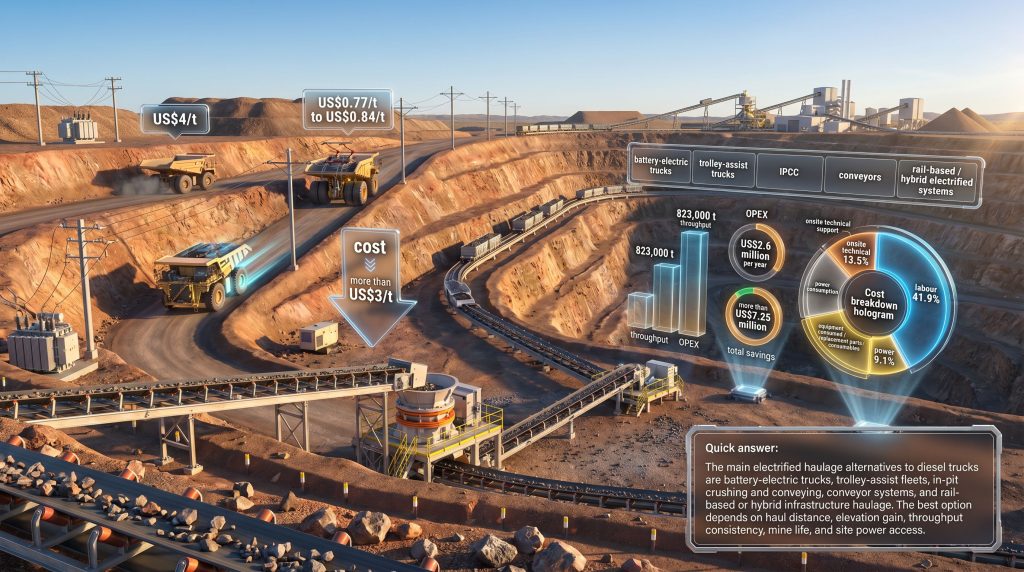
Quick answer: the main electrified haulage alternatives to diesel trucks are battery-electric trucks, trolley-assist fleets, in-pit crushing and conveying, conveyor systems, and rail-based or hybrid infrastructure haulage. The best option depends on haul distance, elevation gain, throughput consistency, mine life, and site power access.
## How electrified haulage changes cost structure, not just fuel use
The central mistake in many haulage comparisons is treating electrification as a fuel-substitution story. In reality, the bigger shift is in cost shape.
Diesel fleets are typically exposed to variable costs such as:
- fuel price swings
- tyre consumption
- engine and transmission maintenance
- rebuild cycles
- road maintenance
- operator scaling as fleet size grows
Electrified infrastructure often requires more upfront commitment, but can create a steadier operating profile once installed. That is why total cost of ownership matters more than headline equipment prices.
### Benchmark economics from an operating case
A site-based operational analysis reported by Global Mining Review on 29 April 2026 described an existing mining installation where an electrified hybrid haulage system was modelled against conventional trucking.
The reported economics were as follows:
| Haulage option | Indicative cost per tonne | Major OPEX sensitivity | Labour scaling | Maintenance intensity | Price volatility exposure | Underground ventilation burden | Automation readiness |
|---|---|---|---|---|---|---|---|
| Diesel truck haulage | US$4/t | Fuel, tyres, rebuilds | Often rises with tonnage | High | High | High if underground | Medium |
| Electrified hybrid infrastructure system | US$0.77/t to US$0.84/t | Labour, power, technical support | Can grow more slowly than tonnage | Lower in suitable designs | Lower | Lower if diesel displaced | High |
Using annual throughput of 823,000 t, the implied avoided haulage cost was approximately US$2.6 million per year. Over three years, the estimated cumulative savings exceeded US$7.25 million.
These figures are useful, but they should be read carefully. The same analysis stated that truck rebuild costs and underground ventilation costs were not included. In other words, diesel trucking may have looked cheaper in the model than it would under a more complete life-of-mine comparison.
Practical warning: mines often understate diesel haulage costs by excluding ventilation, tyre supply risk, road upkeep, and rebuild schedules. A credible comparison should model full-system economics over the life of mine.
### Hidden cost categories that distort diesel comparisons
When mines compare options, the following items are often undercounted or treated inconsistently:
- Truck rebuild cycles and major component replacement
- Tyre consumption and procurement lead times
- Haul road maintenance and water use for road management
- Fuel storage and transport logistics
- Ventilation and cooling in underground operations
- Downtime from drivetrain complexity
## Which operating cost categories matter most?
The same operating case identified five core cost buckets for the electrified system:
- labour
- power consumption
- equipment consumed, replacement parts, and consumables
- remote software support
- onsite technical support
### Labour and operator dependency
Labour was the largest cost line at 41.9% of attributable OPEX. That does not necessarily mean the system was labour-heavy compared with trucks. Rather, labour may scale less directly with tonnage in automated or fixed-infrastructure systems than it does in expanding truck fleets.
That distinction is especially important in regions where skilled operators, maintainers, and dispatch personnel are scarce or expensive.
### Power consumption and tariff exposure
Power represented 9.1% of OPEX in the cited electrified case. For many operators, the advantage is not simply lower energy cost, but improved predictability. Industrial electricity tariffs can still vary. However, they are often less exposed to the same global shocks that affect diesel markets.
Power due diligence should include:
- tariff structure
- reliability of supply
- grid carbon intensity
- backup generation needs
- potential renewable power for mines or behind-the-meter supply
### Specialist support and digital systems
Onsite technical support accounted for 13.5% of OPEX. Remote software support was also identified as a distinct operating line item, highlighting a less obvious trend in modern mining: digital optimisation now has real economic weight.
Remote monitoring, condition tracking, and predictive maintenance in mining can reduce field intervention, improve dispatch precision, and help contain failure cascades before they affect tonnes moved.
## Where electrified alternatives tend to outperform diesel trucks
Electrified systems often look strongest under the following conditions:
- High-throughput, repeatable haul routes where fixed paths stay relevant for years
- Underground mines where removing diesel equipment can reduce ventilation load and heat
- Remote operations facing labour pressure or technician shortages
- Automation-focused sites that value centralised monitoring and stable duty cycles
They can also outperform in investor or board-level planning because they may improve budget confidence. That matters in periods of commodity price uncertainty, when management teams prefer cost bases that are easier to forecast.
## Where diesel or hybrid trucking may still be the better fit
Not every mine should electrify haulage aggressively. Diesel or hybrid systems may remain preferable when:
- mine life is short
- pit geometry changes rapidly
- ore movement is fragmented or intermittent
- power supply is weak or unreliable
- capital preservation matters more than long-term efficiency
In those cases, a flexible truck fleet can still outperform a fixed system that lacks enough stable throughput to justify infrastructure intensity.
## A step-by-step framework for evaluating haulage options
### Step 1: Map actual haul profiles
Measure the physical task first:
- grade
- elevation gain
- average distance
- tonnes per hour
- route stability
- shift duration
- queueing and bottlenecks
### Step 2: Build a life-of-mine cost model
Include both CAPEX and OPEX, then model:
- fuel and power scenarios
- maintenance cycles
- component replacement intervals
- discount rate assumptions
- workforce scaling
- infrastructure relocation or expansion needs
### Step 3: Stress-test volatility
Avoid relying on a single base case. Test:
- oil price spikes
- labour shortages
- tariff changes
- throughput swings
- unplanned downtime
- grid outages or charging congestion
### Step 4: Price the site-specific externalities
Commonly missed items include:
- ventilation
- heat load underground
- road maintenance
- water management
- noise constraints
- internal carbon pricing or emissions targets
### Step 5: Rank options by operational fit
Evaluate each candidate against:
- flexibility
- scale potential
- automation compatibility
- energy resilience
- execution risk
- maintainability
- mine-life alignment
## FAQ: electrified mine haulage alternatives to diesel trucks
### What is the cheapest alternative to diesel haul trucks?
There is no universal cheapest option. For stable, high-throughput routes, fixed electrified systems such as conveyors, IPCC, or rail-based hybrids can achieve lower cost per tonne than trucks.
### Are battery-electric haul trucks better than trolley assist?
Battery-electric trucks generally offer more route flexibility. Trolley assist often performs better on steep, repeatable uphill hauls where trucks can draw power directly from overhead lines.
### Can underground mines save more from electrification than open pits?
Often yes, because underground operations may benefit not only from lower direct diesel use but also from reduced ventilation and heat-management requirements.
## The clearest takeaway for mine operators
The choice between diesel and electrified haulage is not simply a truck replacement exercise. It is a broader mine design decision involving labour intensity, power strategy, mechanical complexity, automation compatibility, and life-of-mine economics.
The strongest electrified mine haulage alternatives to diesel trucks win when they reshape the whole system: lower cost per tonne, steadier operating inputs, fewer wear-heavy components, and improved resilience in the face of oil volatility and labour pressure.
But suitability remains site-specific. Geometry, throughput, mine life, ventilation burden, and power quality will determine whether diesel trucks, battery-electric fleets, trolley assist, conveyors, IPCC, or rail-based hybrids provide the best answer.
Disclaimer: cost figures and operating benchmarks cited above are derived from a published site-based operational analysis reported by Global Mining Review on 29 April 2026. They should be treated as illustrative rather than universally transferable. Mine planners should validate all assumptions with site-specific engineering, power, ventilation, and financial modelling before making capital or operating decisions.
Want Earlier Insight Into Mining Shifts?
For investors tracking the technologies, commodities, and ASX companies reshaping mining economics, Discovery Alert delivers real-time mineral discovery alerts powered by its proprietary Discovery IQ model to help identify actionable opportunities faster. To see how major discoveries have historically driven exceptional returns, explore Discovery Alert’s discoveries page and start a 14-day free trial today.