August 22, 2026
Understanding the Electrochemical Bottleneck in Hydrogen Production
The transition toward sustainable energy systems reveals complex interdependencies between material science, industrial scaling, and economic feasibility. At the intersection of these challenges lies a fundamental constraint that threatens to limit green hydrogen adoption: the critical reliance on iridium for efficient water electrolysis. This precious metal dependency creates a cascading series of technical and economic barriers that extend far beyond simple material costs.
Modern proton exchange membrane (PEM) electrolysers operate under extreme conditions that demand exceptional catalyst performance. Within highly acidic environments where pH levels approach zero, traditional catalyst materials succumb to corrosion, dissolution, or structural degradation. The electrochemical demands of oxygen evolution reactions require materials capable of maintaining both catalytic activity and structural integrity across thousands of operational hours.
Iridium's unique properties stem from its position among the platinum group metals, where its electronic structure enables superior oxygen evolution reaction kinetics whilst resisting the corrosive effects of acidic electrolytes. Current density requirements of 2-5 A/cm² in commercial PEM systems create oxidising conditions that would rapidly degrade alternative catalyst materials, making iridium not merely preferred but functionally irreplaceable in conventional designs.
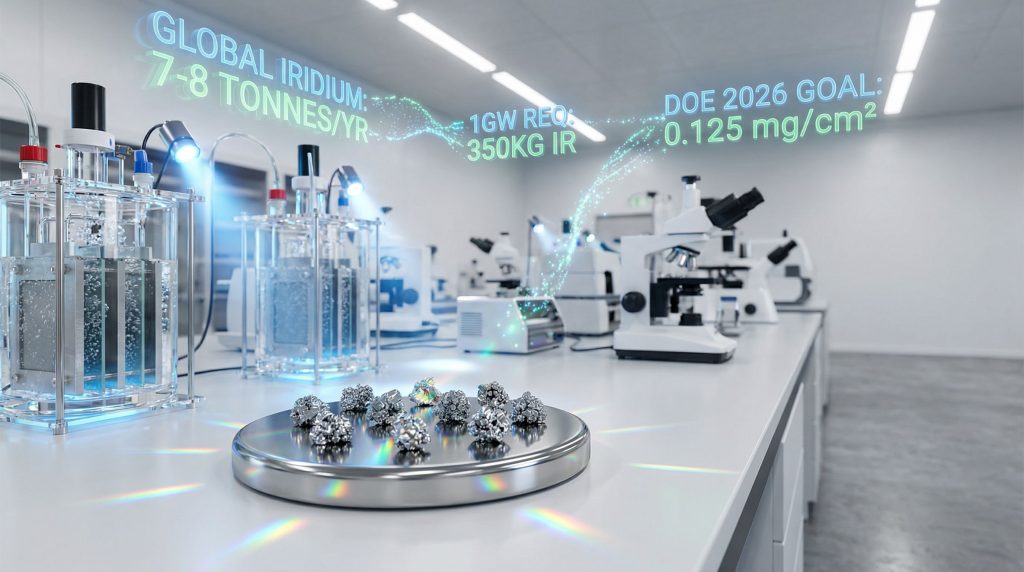
The green hydrogen iridium barrier becomes apparent when examining global supply constraints against projected electrolyser deployment scenarios. With approximately 7-8 metric tons of iridium produced annually worldwide, and each 1GW hydrogen production facility requiring 350 kilograms of iridium, the mathematics reveal a stark limitation. At current market prices of $150 per gram, the iridium content alone for a single gigawatt installation exceeds $52 million.
Geographic concentration of iridium supply adds another layer of complexity to this constraint. South Africa dominates global production with approximately 40% of annual output, whilst Russia, Zimbabwe, and Peru contribute most remaining supply. This concentration creates vulnerability to geopolitical disruptions, mining accidents, or regulatory changes that could further restrict already limited availability.
When big ASX news breaks, our subscribers know first
Revolutionary Nanoscale Engineering Approaches
The solution to iridium scarcity lies not in replacement but in optimisation through advanced materials engineering. Nanoscale catalyst design fundamentally alters the relationship between material quantity and catalytic performance by maximising surface area per unit of precious metal. This approach leverages the fact that catalytic reactions occur at material surfaces rather than within bulk structures.
Fraunhofer IAP's breakthrough demonstrates this principle through practical application. Their continuously-synthesised catalyst layers contain only 7 milligrams of iridium across 25 square centimetres, achieving performance equivalent to conventional layers with four times greater iridium content. This translates to 0.028 mg/cm² loading compared to standard 0.112 mg/cm² requirements, representing a 75% reduction in precious metal usage.
The continuous-flow synthesis process enables unprecedented control over nanoparticle characteristics. Unlike traditional batch chemical methods that produce size distributions with ±5-10 nm variance, microfluidic synthesis achieves ±1-2 nm precision. This precision matters critically because nanoparticle size directly influences electronic properties, surface chemistry, and catalytic activity.
Advanced support architectures multiply these benefits through synergistic effects. Furthermore, the breakthrough brings green hydrogen production closer to commercial viability through innovative approaches. Titanium dioxide (TiO₂) and tin dioxide (SnO₂) substrates provide more than structural support, they contribute electronic interactions that enhance catalytic performance beyond what unsupported nanoparticles achieve alone.
| Nanotechnology Approach | Iridium Reduction | Loading Rate | Durability | Commercial Status |
|---|---|---|---|---|
| Nanoporous layers | 90% reduction | 0.1-0.4 mg/cm² | 500+ hours | Pilot validation |
| Supported nanostructures | 85% reduction | 0.125 mg/cm² | 1,000+ hours | Development phase |
| Hybrid oxide systems | 80% reduction | 0.15 mg/cm² | 1,500+ hours | Industrial testing |
Surface area optimisation through nanoscale design can achieve theoretical improvements exceeding 2,000-fold compared to bulk materials. Nanoparticles in the 2-5 nm diameter range reach surface areas above 200 m²/g compared to bulk iridium at approximately 0.1 m²/g. This dramatic difference explains why nanotechnology provides such leverage in reducing total material requirements whilst maintaining or improving catalytic performance.
Alternative Catalyst Development and Performance Validation
Whilst iridium optimisation offers immediate benefits, parallel development of alternative catalyst systems addresses long-term sustainability concerns. Earth-abundant metal catalysts present attractive cost profiles but face significant technical hurdles in matching iridium's unique combination of activity and stability.
Cobalt phosphide (CoP) catalysts demonstrate promising oxygen evolution reaction activity, achieving overpotentials around 330-370 mV at 10 mA/cm² compared to iridium oxide's approximately 350 mV. However, stability represents the critical differentiator. Cobalt-based systems typically show significant degradation after 100-500 hours in acidic PEM environments, with dissolution rates of 10-100 micrograms per hour under standard operating conditions.
Ruthenium-based compounds offer the most viable near-term alternative, achieving performance within 10-20% of iridium oxide whilst costing approximately 8% of iridium's price at $12/gram. Furthermore, engineers slash green hydrogen costs by developing innovative catalyst solutions. Ruthenium oxide (RuO₂) faces limitations under highly oxidising conditions where it converts to volatile ruthenium tetroxide (RuO₄), but hybrid iridium-ruthenium systems can achieve 80% precious metal reduction whilst maintaining reasonable durability.
Performance validation protocols require extensive testing beyond simple activity measurements. Accelerated degradation studies simulate months or years of operation through elevated temperature, pressure, and current density conditions. These tests reveal failure mechanisms including:
- Particle agglomeration: 3-5 nm particles coalescing into 10-20 nm structures with reduced surface area
- Support corrosion: TiO₂ converting to soluble Ti⁴⁺ species under acidic oxidising conditions
- Metal dissolution: Formation of soluble metal complexes through reaction intermediates
- Ostwald ripening: Smaller particles dissolving and redepositing on larger particles
Scaling Manufacturing for Commercial Deployment
Transitioning from laboratory breakthroughs to industrial production presents complex engineering challenges that often determine technology adoption success. Moreover, the critical minerals strategy plays a vital role in ensuring sustainable supply chains. Continuous-flow synthesis processes offer theoretical advantages in scalability, but practical implementation requires substantial development investment and manufacturing expertise.
The precision achieved in laboratory-scale microfluidic reactors becomes increasingly difficult to maintain as production volumes increase. Scaling from millilitre to kilogram quantities whilst preserving nanoparticle size distributions and catalytic performance requires sophisticated process control, quality assurance systems, and manufacturing infrastructure.
Fraunhofer IAP's approach addresses these challenges through modular reactor designs that can be parallelised for higher throughput whilst maintaining individual reactor performance characteristics. This continuous-flow methodology enables:
- Precise stoichiometric control: Exact reactant ratios maintained across all production runs
- Rapid reaction kinetics: Sub-second mixing times preventing uncontrolled particle growth
- Scalable architecture: Multiple reactor modules operating simultaneously
- Consistent quality: Reduced batch-to-batch variation compared to traditional methods
Manufacturing cost considerations extend beyond raw material expenses to include energy consumption, solvent usage, waste treatment, and facility requirements. In addition, the mining industry innovation continues to drive efficiency improvements. Whilst iridium costs dominate current electrolyser economics, reducing material requirements through nanotechnology creates opportunities for optimising other cost components.
The institute's partnership strategy reflects industry recognition that successful commercialisation requires collaboration between research institutions, electrolyser manufacturers, and catalyst suppliers. This collaborative approach distributes development risks whilst leveraging complementary expertise across the value chain.
How Can Economic Thresholds Transform the Market?
Green hydrogen competitiveness depends on achieving cost parity with conventional hydrogen production methods, primarily steam methane reforming at $1.50-2.50/kg. Current green hydrogen production costs of $3-6/kg reflect multiple factors including electricity prices, electrolyser capital costs, and operational expenses.
Catalyst costs represent approximately 15-25% of total electrolyser system expenses, making iridium reduction strategies particularly valuable for improving project economics. A 75-90% reduction in catalyst material requirements can lower overall system costs by 10-20%, significantly improving return on investment calculations.
The Department of Energy's 2026 catalyst loading targets of 0.125 mg/cm² represent aggressive efficiency goals that would reduce iridium consumption by approximately 90% compared to current commercial systems. However, achieving these targets requires continued advancement in nanoscale synthesis, support material optimisation, and catalyst layer architecture.
Market penetration scenarios depend on reaching specific price thresholds that enable adoption across different applications:
- Industrial hydrogen applications: $2.50/kg enables steel production and chemical manufacturing
- Transportation fuel systems: $3.00/kg competitive for heavy-duty vehicles and shipping
- Grid-scale energy storage: $2.00/kg necessary for power sector applications
Investment framework implications extend beyond immediate project economics to include infrastructure development, supply chain resilience, and technology risk assessment. Consequently, the critical minerals exploration programme becomes increasingly important. Reduced catalyst costs improve project bankability whilst decreasing exposure to precious metal price volatility.
Electrolyser System Integration and Performance Optimisation
Advanced catalyst systems require corresponding innovations in electrolyser design and manufacturing to fully realise their potential benefits. Membrane electrode assembly (MEA) integration becomes more complex when accommodating nanostructured catalyst layers with different physical and chemical properties.
Catalyst layer thickness optimisation requires balancing multiple competing factors. Thinner layers reduce material costs and improve mass transport but may compromise durability or current distribution uniformity. Advanced manufacturing techniques enable controlled porosity gradients that optimise both performance and material efficiency.
Thermal management considerations become critical as enhanced catalyst activity increases reaction rates and heat generation. System designs must accommodate higher power densities whilst maintaining temperature control and preventing catalyst degradation from thermal cycling.
What Operational Parameters Maximise Efficiency?
Operational parameter optimisation involves adjusting current density profiles, pressure conditions, and temperature ranges to maximise catalyst utilisation efficiency. These optimisations can improve overall system efficiency by 5-15% whilst extending catalyst lifetime through reduced stress conditions.
Stack design modifications accommodate new catalyst architectures whilst maintaining manufacturing compatibility and serviceability. Modular approaches enable catalyst replacement without complete system rebuilds, reducing maintenance costs and improving operational flexibility.
The next major ASX story will hit our subscribers first
Market Applications Driving Innovation Priorities
Different end-use applications create distinct requirements for catalyst performance, durability, and cost characteristics. Understanding these application-specific demands helps prioritise research and development efforts toward commercially viable solutions.
Steel production decarbonisation represents one of the highest-volume potential hydrogen applications, requiring consistent supply of large quantities at competitive prices. Steel industry hydrogen consumption could exceed 50 million tons annually by 2050, demanding massive electrolyser deployment and corresponding catalyst volumes.
Chemical manufacturing processes including ammonia and methanol production offer established industrial hydrogen markets with existing infrastructure and logistics systems. These applications typically operate continuously with high utilisation rates, emphasising catalyst durability over peak performance.
Transportation fuel systems for heavy-duty vehicles, maritime shipping, and aviation require high-purity hydrogen with reliable supply chains. For instance, these applications can often accommodate higher fuel costs compared to industrial users, creating market opportunities for premium catalyst technologies.
Geographic market considerations reflect different policy environments, industrial structures, and energy resource availability. The energy transition minerals sector continues to evolve rapidly. European Union hydrogen strategies emphasise rapid deployment through regulatory support and infrastructure investment, whilst Asian markets focus on industrial decarbonisation and manufacturing competitiveness.
Technical Standards and Certification Pathways
Industry standardisation efforts establish performance benchmarks, testing protocols, and certification requirements that guide catalyst development priorities. The Department of Energy's Hydrogen and Fuel Cell Technology Office provides specific targets for catalyst loading, durability, and cost reduction.
Accelerated testing methodologies simulate long-term operational conditions through elevated stress testing that compresses months or years of operation into weeks of laboratory evaluation. These protocols enable rapid assessment of catalyst degradation mechanisms and lifetime predictions.
Performance benchmarking systems establish standardised comparison frameworks that enable objective evaluation of different catalyst technologies. Key metrics include:
- Mass activity: Catalytic current per gram of precious metal
- Specific activity: Current per unit of catalyst surface area
- Durability: Performance retention after specified operational hours
- Cost effectiveness: Performance per dollar of catalyst material
Certification pathways for commercial deployment require demonstrated performance under realistic operating conditions, comprehensive safety evaluations, and manufacturing quality assurance systems. These requirements often represent the longest development phase for breakthrough technologies.
Investment and Partnership Strategies for Technology Transfer
Successful commercialisation of advanced catalyst technologies requires strategic partnerships that combine research capabilities, manufacturing expertise, and market access. Fraunhofer IAP's approach of seeking industrial partners reflects the complexity of transitioning from laboratory proof-of-concept to commercial production.
Technology transfer pathways typically involve licensing agreements, joint development programmes, or strategic equity investments that provide research institutions with commercialisation resources whilst giving industrial partners access to breakthrough innovations. These arrangements distribute risks whilst accelerating time-to-market.
Pilot project implementations serve as critical validation steps that demonstrate real-world performance under commercial operating conditions. These projects provide essential data for scaling manufacturing processes, optimising system integration, and validating economic models.
How Do Risk-Sharing Consortiums Accelerate Development?
Risk-sharing consortium approaches enable multiple stakeholders to participate in high-risk, high-reward technology development whilst spreading financial exposure across various organisations. Furthermore, the renewable energy transformations sector benefits significantly from collaborative approaches. These structures particularly suit breakthrough technologies with uncertain commercialisation timelines.
Consequently, overcoming the green hydrogen iridium barrier requires coordinated efforts across multiple sectors. Investment decisions increasingly consider not only immediate returns but also long-term sustainability impacts and supply chain resilience.
The green hydrogen iridium barrier represents both a challenge and an opportunity for the energy transition. Through innovative nanotechnology approaches, alternative catalyst development, and strategic partnerships, the industry continues advancing toward economically viable solutions.
Finally, addressing the green hydrogen iridium barrier through technological innovation remains critical for achieving widespread hydrogen economy deployment. These developments will ultimately determine whether green hydrogen can fulfil its potential as a cornerstone of global decarbonisation efforts.
Disclaimer: This analysis involves technical projections and market forecasts based on current research and industry trends. Actual commercial deployment timelines, performance characteristics, and economic outcomes may differ significantly from projections. Catalyst technology development involves substantial technical risks and uncertain regulatory environments that could affect market adoption.
Exploring Opportunities in Critical Minerals and Green Energy Technologies?
Discovery Alert's proprietary Discovery IQ model delivers real-time alerts on significant critical mineral discoveries, instantly empowering subscribers to identify actionable opportunities ahead of the broader market as the green hydrogen sector drives unprecedented demand for precious metals like iridium. Begin your 14-day free trial today and secure your market-leading advantage in this rapidly evolving landscape.