July 22, 2026
Understanding the Electromagnetic Foundation of Modern Powertrains
The evolution of automotive propulsion has reached a critical juncture where electromagnetic performance fundamentally determines vehicle efficiency and market viability. Neodymium-iron-boron (NdFeB) permanent magnets have emerged as the technological cornerstone enabling rare earth magnets in hybrid vehicles to achieve their remarkable fuel economy through sophisticated electromagnetic systems. These advanced materials facilitate the creation of compact, high-torque electric motors that seamlessly integrate with internal combustion engines, delivering the smooth power transitions that define contemporary hybrid driving experiences.
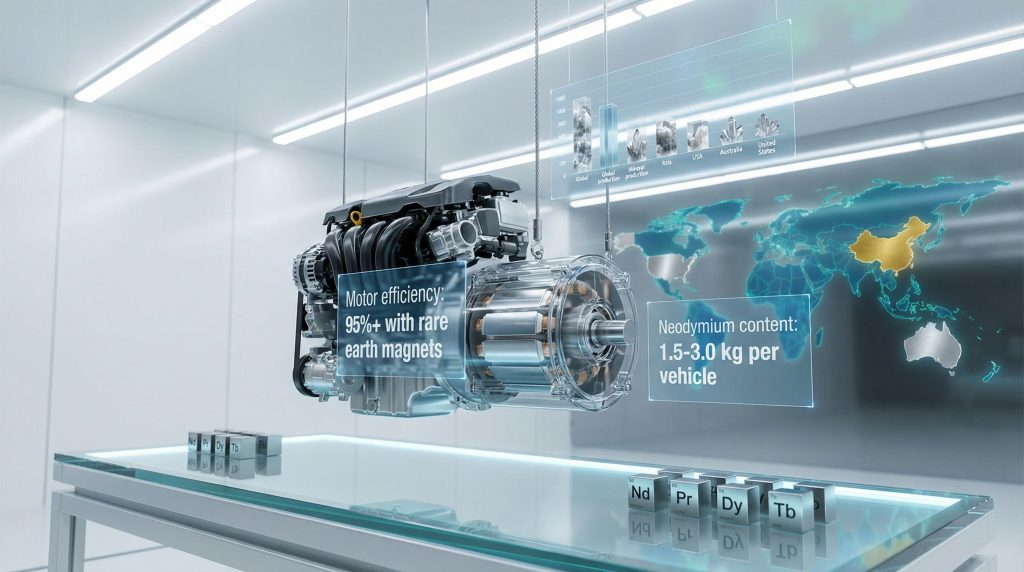
The performance advantages manifest through quantifiable engineering improvements that showcase the mining industry evolution toward more sophisticated materials. Motor efficiency rates consistently exceed 95 percent when incorporating rare earth permanent magnets, compared to 85-90 percent efficiency achieved with conventional ferrite-based alternatives. This efficiency differential translates directly into enhanced fuel economy and reduced emissions across varied driving conditions.
Weight reduction represents another crucial advantage, with rare earth magnet motor designs achieving 40-60 percent weight savings compared to ferrite-based configurations. This mass reduction proves particularly valuable in hybrid applications where every kilogram influences overall vehicle efficiency and performance characteristics. Furthermore, temperature tolerance capabilities enable operational stability up to 200°C in hybrid vehicle applications, maintaining magnetic properties under the thermal stress generated during aggressive acceleration and regenerative braking events.
Critical Rare Earth Element Composition in Hybrid Systems
| Element | Primary Function | Typical Content per Vehicle |
|---|---|---|
| Neodymium (Nd) | Core magnetic strength | 1.5-3.0 kg |
| Praseodymium (Pr) | Magnetic enhancement | 0.3-0.6 kg |
| Dysprosium (Dy) | High-temperature stability | 0.1-0.2 kg |
| Terbium (Tb) | Thermal resistance | 0.05-0.1 kg |
The magnetic foundation of hybrid efficiency derives from the exceptional energy density characteristics of rare earth permanent magnets relative to their physical volume and weight. In addition, this enables manufacturers to design compact, lightweight electric motors producing high torque output while maintaining space efficiency within constrained vehicle architecture. The transition from earlier nickel-metal hydride battery systems to lithium-ion chemistry has not diminished rare earth magnets in hybrid vehicles dependence in hybrid powertrains; rather, it has reinforced the critical nature of magnetic performance in motor efficiency and responsiveness.
When big ASX news breaks, our subscribers know first
Distributed Magnetic Systems Across Hybrid Vehicle Architecture
Modern hybrid vehicles utilize rare earth magnets in multiple interconnected systems, creating a distributed architecture that optimizes performance while maintaining redundancy and specialized functionality. The primary traction motor represents the largest single application, typically containing 2-3 kilograms of neodymium-based materials configured in permanent magnet synchronous motor (PMSM) architecture.
Primary Powertrain Applications
The main electric motor functions as the heart of hybrid propulsion systems, delivering instantaneous torque while maintaining exceptional efficiency across varying load conditions. These rare earth permanent magnet motors contrast sharply with induction motor designs that require complex electronic field generation, providing immediate response capabilities particularly valuable during regenerative braking operations and acceleration events where rapid power transfer between internal combustion engines and electric motors optimises fuel consumption.
Regenerative braking systems employ sophisticated electromagnetic energy conversion processes where rare earth magnets in hybrid vehicles create the magnetic fields necessary for efficient energy recovery during deceleration events. Rather than simply converting braking energy through mechanical friction, hybrid systems utilise electric motor-generator configurations that transform kinetic energy back into stored electrical energy, extending vehicle range and improving overall efficiency.
Secondary System Integration and Performance Optimisation
Climate Control and HVAC Systems:
• Compressor motors incorporate 200-400 grams of rare earth content for efficient refrigerant circulation
• Blower fan assemblies require 100-200 grams per unit for variable speed control
• Variable refrigerant flow systems utilise magnetic actuators for precise temperature regulation
Steering and Safety Systems:
• Electric power steering motors contain 300-500 grams of rare earth magnets for responsive steering assistance
• Anti-lock braking sensors employ small rare earth magnets for precise position detection
• Electronic stability control systems rely on magnetic sensors for rapid response capabilities
The distributed approach to rare earth magnet utilisation enables engineers to match magnet specifications precisely to each application's thermal, operational speed, and power delivery requirements. However, HVAC compressor motor optimisation exemplifies this principle, as compressors operate at relatively consistent speeds and moderate temperatures, permitting use of standard-grade magnets, whereas main traction motors require high-temperature grades capable of maintaining magnetic properties during extreme thermal conditions.
Advanced Sensor Networks and Position Detection
Contemporary hybrid vehicles incorporate dozens of magnetic sensors throughout their electronic architecture, each requiring small but precisely calibrated rare earth magnets for optimal performance in detecting position, speed, and torque measurements. These sensor applications, while individually requiring minimal rare earth content, collectively contribute 500-800 grams of magnetic material per vehicle across throttle position sensors, transmission control modules, and various actuator feedback systems.
Variable refrigerant flow climate control systems employ electronically controlled valve modulation, where rare earth magnets in solenoid configurations control fluid routing and flow rates. Consequently, these applications prioritise response speed and precision control rather than raw magnetic strength, permitting smaller magnet quantities with highly optimised dimensional specifications.
Advanced Manufacturing Processes for Automotive-Grade Magnets
The transformation from raw rare earth oxides to finished automotive-grade magnets requires sophisticated process control and capital-intensive infrastructure that explains why magnet manufacturing capacity remains concentrated among specialised producers despite geographic diversification of mining operations.
Powder Metallurgy and Crystalline Structure Development
Manufacturing specialists recognise that final magnet properties, particularly coercivity, magnetic flux density, and thermal stability, depend critically on processing parameters including temperature profiles, cooling rates, powder grain size distribution, and crystalline phase composition. Furthermore, the journey begins with controlled melting and rapid cooling processes that establish foundational crystalline microstructure determining subsequent magnet properties.
Critical Processing Stages:
-
Alloy Preparation: Raw rare earth metals undergo controlled melting and rapid cooling to create specific crystalline structures optimised for magnetic performance
-
Powder Processing: Hydrogen decrepitation and controlled grinding reduce particle size to 3-5 micrometres for optimal magnetic domain alignment
-
Magnetic Field Pressing: External magnetic field application during compaction ensures proper crystal orientation and anisotropic properties
-
Sintering Operations: High-temperature processing at 1000-1100°C creates dense, mechanically robust magnet bodies with controlled microstructure
Strip-casting or ingot-casting approaches create ingots containing multiple rare earth elements in precisely balanced proportions. Moreover, hydrogen decrepitation, involving hydrogen absorption and desorption cycling, facilitates controlled powder generation while managing particle morphology and preventing excessive oxidation that could degrade magnetic properties.
Quality Control and Performance Validation Protocols
Magnetic field alignment during the pressing stage represents a critical process control point where powder particles are compressed under external magnetic field application, causing particles to orient with their easy magnetisation axes aligned. This anisotropic orientation typically increases magnetic strength by 10-20 percent compared to isotropic alternatives, directly translating into motor performance improvements essential for hybrid vehicle applications.
Advanced Testing Parameters:
• Inductively coupled plasma spectrometry for elemental composition verification
• Scanning electron microscopy for microstructural analysis and grain boundary examination
• SQUID magnetometry for precise magnetic property measurement across temperature ranges
• Curie temperature determination for thermal stability validation under automotive conditions
Sintering atmosphere composition requires careful control, typically employing high-purity hydrogen or nitrogen atmospheres to prevent oxidation of reactive rare earth elements. Temperature profiles involve controlled heating rates to avoid thermal shock, maximum temperature holds of 1-2 hours at peak temperature for optimal densification, and controlled cooling rates influencing final grain structure and magnetic properties.
Geographic Concentration and Supply Chain Vulnerabilities
The global supply chain for rare earth magnets in hybrid vehicles remains characterised by significant geographic concentration that creates both economic opportunities and strategic vulnerabilities for automotive manufacturers worldwide.
Mining and Primary Processing Distribution
China maintains dominant control over approximately 70 percent of global rare earth mining operations and nearly 90 percent of refining and magnet precursor production capacity. This concentration creates substantial bottlenecks despite primary mining occurring across multiple geographic regions, including significant operations in Australia, the United States, and emerging African sources.
Regional Production Breakdown:
• China: 70% of global mining, 90% of processing capacity
• Australia: 12% of mining through Lynas Corporation operations
• United States: 8% of mining via Mountain Pass facility
• Other regions: 10% combined including Myanmar, Brazil, and India
The critical raw materials facility development in Germany exemplifies integrated magnet production capabilities outside Chinese control. VAC's recent expansion into finished magnet manufacturing represents a strategic move toward vertical integration, reducing geographic concentration of refining capacity while serving European automotive manufacturers with locally produced components.
Magnet Manufacturing Landscape and Emerging Capacity
Transformation of processed rare earths into finished magnets remains heavily concentrated in Asian manufacturing facilities, creating supply chain vulnerabilities that automotive manufacturers actively address through diversification strategies and strategic partnerships.
Leading Global Magnet Producers:
• VAC (Germany): European automotive market focus with integrated production capabilities
• Shin-Etsu Chemical (Japan): High-performance magnet applications with advanced metallurgy
• Noveon Magnetics (USA): Domestic automotive supply through GM partnership agreements
• Arnold Magnetic Technologies (USA): Specialised motor applications and custom configurations
Noveon Magnetics' expanded U.S.-based manufacturing operations, secured through General Motors' multi-year supply agreement, demonstrate emerging North American sintering and magnet manufacturing capacity. However, this facility represents intentional geographic diversification away from China-centred production, reflecting both supply security concerns and government industrial policy support for critical mineral supply chains.
Strategic Supply Security Initiatives by Major Automakers
The projected expansion of hybrid vehicle markets has compelled automotive manufacturers to move beyond traditional procurement models toward strategic partnerships and vertical integration initiatives that ensure supply security while reducing exposure to price volatility and geopolitical disruptions.
Direct Supplier Partnerships and Long-Term Agreements
General Motors' comprehensive approach exemplifies industry-wide recognition of supply chain vulnerabilities. The company secured a multi-year deal with Noveon Magnetics for U.S.-manufactured rare earth magnets while simultaneously investing in Niron Magnetics for rare earth-free alternative development, creating both immediate supply security and longer-term technological hedging strategies.
Toyota's diversification strategy, informed by experience during China's 2010 export embargo, represents one of the industry's most comprehensive approaches to supply chain resilience. Furthermore, through Toyota Tsusho, the company sources rare earths from Australia, India, and Angola via UK-based Pensana, creating mine-to-magnet supply corridors largely independent of Chinese control.
Strategic Partnership Examples:
• General Motors: Noveon Magnetics partnership for North American production
• Toyota: Diversified sourcing through Australian, Indian, and African operations
• Ford: Alternative technology development programmes as supply security hedge
• European automakers: VAC partnerships for regional supply chain localisation
Government Policy Support and Industrial Development
The U.S. and European Union have implemented substantial funding programmes supporting domestic processing, magnet manufacturing, and recycling infrastructure under industrial policy frameworks targeting critical mineral security. These initiatives provide financial support for private sector investments while creating regulatory frameworks favouring domestic supply chain development that align with strategic minerals reserve concepts.
Japan's government backing for Lynas Corporation and other non-Chinese rare earth suppliers demonstrates coordinated national industrial policy supporting automotive sector competitiveness. Long-term offtake agreements backed by government credit facilities enable mining companies to invest in expanded production capacity while providing automakers with supply security assurances.
Alternative Technologies and Rare Earth-Free Solutions
Research into alternatives to rare earth magnets in hybrid vehicles has accelerated significantly, driven by supply security concerns, cost optimisation objectives, and technological advancement opportunities that could fundamentally reshape hybrid vehicle architecture.
Emerging Permanent Magnet Technologies
Iron-Nitrogen Compounds: Advanced research programmes are developing iron-nitrogen-based permanent magnets with energy products potentially comparable to neodymium-iron-boron alternatives. These materials could provide magnetic performance suitable for hybrid applications while eliminating rare earth dependence entirely.
Manganese-Based Alloys: Lower-cost manganese-aluminium-carbon compounds offer acceptable magnetic properties for certain hybrid vehicle applications, particularly in secondary systems where maximum performance is not required.
Enhanced Ferrite Technologies: Nanostructuring techniques applied to traditional ferrite magnets are improving performance characteristics, potentially making them suitable for hybrid applications previously requiring rare earth alternatives.
Tesla's selective application strategy provides instructive perspective on technology transition possibilities. Consequently, while investing substantially in rare earth-free induction motor development for certain applications, Tesla continues utilising rare earth magnets in performance variants and high-efficiency configurations where weight and space constraints justify material costs.
Motor Design Innovation and Performance Trade-offs
Switched Reluctance Motors:
• Eliminate permanent magnet requirements entirely through electromagnetic field generation
• Variable efficiency characteristics across different operating ranges
• Increased electronic control complexity and associated system costs
Induction Motor Adaptations:
• Proven technology with established rare earth-free operation
• Weight and size penalties compared to permanent magnet motor designs
• Reduced efficiency at partial load conditions affecting hybrid fuel economy benefits
General Motors' investment in Niron Magnetics represents strategic hedging against rare earth supply vulnerabilities while maintaining current hybrid vehicle performance capabilities. This dual-track approach enables continued production using established rare earth magnet technology while developing alternative solutions for future product generations alongside developments in critical minerals recycling.
The next major ASX story will hit our subscribers first
Market Growth Dynamics and Rare Earth Demand Projections
The hybrid vehicle market's projected expansion creates sustained demand growth for rare earth magnets that extends well beyond traditional automotive supply cycles, establishing structural demand patterns influenced by regulatory frameworks, consumer preferences, and technological development trajectories.
Regional Market Expansion and Penetration Rates
European markets have achieved approximately 33 percent of new vehicle registrations incorporating hybrid technology, representing the highest regional penetration rates globally. This adoption reflects stringent emissions regulations, fuel efficiency mandates, and consumer preference for environmental performance combined with operational flexibility.
Regional Hybrid Adoption Metrics:
• Europe: 33% new registrations with hybrid powertrains
• Japan: 30-35% market penetration with full hybrid systems
• China: 20% plug-in hybrid adoption rate in recent sales periods
• United States: 1.2 million hybrid sales in 2023 with accelerating growth trends
The global hybrid vehicle market valuation of approximately $272 billion in 2023 is projected to exceed $500 billion by 2032, representing annual growth rates around 7 percent. This expansion translates directly into increased rare earth demand, with each hybrid vehicle requiring 3-5 kilograms more rare earth content than conventional internal combustion vehicles.
Regulatory Frameworks and Market Acceleration
Emissions regulations and fuel economy mandates across major automotive markets are creating structural demand for hybrid technology that extends beyond consumer choice considerations. Corporate Average Fuel Economy (CAFE) standards in the United States, EU emissions regulations, and China's New Energy Vehicle mandate collectively establish regulatory floors for hybrid adoption regardless of pure consumer preference patterns.
Toyota's strategic shift toward comprehensive lineup hybridisation exemplifies how regulatory compliance intersects with technological capability and market positioning. The manufacturer has transitioned from introducing hybrids as specialty models toward systematic portfolio hybridisation, directly translating into proportionally increased rare earth magnet procurement volumes.
Ford's announced plans for a largely hybrid portfolio in North America by 2030 demonstrate how automaker strategic positioning fundamentally shapes rare earth supply demand trajectories. These portfolio composition decisions create multi-year demand visibility for magnet suppliers while establishing predictable procurement volumes supporting supply chain investment decisions.
Circular Economy Development and Magnet Recycling Systems
As first-generation hybrid vehicles reach end-of-life status after 10-15 years of service, magnet recovery and recycling programmes are becoming economically viable, offering automotive manufacturers partial supply chain independence from primary mining operations.
End-of-Life Vehicle Processing and Material Recovery
Magnet extraction from retired hybrid vehicles achieves material recovery rates between 85-95 percent, with reprocessing capabilities enabling direct reuse in new magnet production. This circular approach becomes cost-competitive with virgin materials at sufficient scale, creating economic incentives for systematic end-of-life vehicle processing programmes.
Recycling Process Advantages:
• Material recovery rates exceeding 85% efficiency
• Direct reuse capabilities in new magnet manufacturing
• Cost competitiveness with virgin rare earth materials at production scale
• Reduced environmental impact from primary mining operations
The development of closed-loop manufacturing systems offers enhanced supply security through domestic material flows, cost stability independent of commodity price fluctuations, and reduced environmental impact from primary extraction operations. Moreover, European and Japanese recycling programmes have achieved technical feasibility demonstrations, with commercial scale-up dependent on sufficient end-of-life vehicle volumes.
Economic Viability and Scale Requirements
Rare earth magnet recycling requires substantial initial investment in specialised processing equipment and technical expertise, creating economies of scale that favour centralised processing facilities serving multiple automotive manufacturers. Regional recycling hubs could process end-of-life vehicles from multiple brands while supplying recycled rare earth materials back to magnet manufacturers.
The integration of recycling programmes with existing automotive recycling infrastructure enables cost-effective material recovery without requiring entirely new processing facilities. In addition, partnerships between automotive manufacturers, recycling companies, and magnet producers create value chains supporting circular economy development while reducing dependence on primary rare earth mining operations.
Thermal Performance and Operating Environment Challenges
Hybrid powertrains subject rare earth magnets to significant thermal stress, electromagnetic interference, and mechanical vibration that require specialised material grades and protective measures to maintain performance over vehicle operational lifetimes exceeding 100,000 miles.
High-Temperature Operation and Magnetic Stability
Rare earth magnets in hybrid applications must maintain magnetic properties during continuous operation up to 180°C and peak temperature exposures exceeding 200°C during extreme acceleration and regenerative braking events. Dysprosium and terbium additions specifically address these thermal challenges by maintaining coercivity and magnetic flux density at elevated temperatures.
Operating Temperature Specifications:
• Continuous operation: Up to 180°C ambient temperature
• Peak temperature exposure: 200°C+ during extreme driving conditions
• Thermal cycling: Thousands of heating and cooling cycles over vehicle lifetime
• Temperature stability: Maintaining magnetic properties across operational ranges
The selection of appropriate magnet grades depends on specific application requirements and thermal environments. For instance, standard grades prove suitable for mild hybrid applications with limited thermal exposure, while high-temperature grades become necessary for performance hybrid systems experiencing frequent temperature cycling and peak thermal conditions.
Performance Optimisation Across Diverse Operating Conditions
Magnet grade selection involves balancing material costs against performance requirements and operational durability. Ultra-high temperature grades incorporating substantial dysprosium and terbium content provide maximum thermal stability but at significantly increased material costs, making them economically justified only for extreme performance applications or racing environments.
The thermal management systems surrounding rare earth magnets in hybrid powertrains include active cooling circuits, heat sink designs, and thermal barrier materials that protect magnets from excessive temperature exposure while maintaining optimal operating conditions for maximum efficiency and longevity.
Performance Considerations:
• Standard grades: Cost-effective for mild hybrid applications with moderate thermal exposure
• High-temperature grades: Required for full hybrid systems with frequent thermal cycling
• Ultra-high temperature: Necessary for performance applications and extreme duty cycles
• Protective systems: Active cooling and thermal management supporting magnet longevity
This analysis represents current market conditions and technological developments as of 2025. Rare earth magnet markets remain subject to supply chain disruptions, technological advancement, and regulatory changes that may influence future hybrid vehicle development and material requirements. Investment decisions should consider multiple scenarios and emerging alternative technologies.
Ready to Capitalise on the Next Major Mineral Discovery?
Discovery Alert instantly alerts investors to significant ASX mineral discoveries using its proprietary Discovery IQ model, turning complex mineral data into actionable insights for rare earth and critical mineral investments. Explore Discovery Alert's dedicated discoveries page to understand why historic mineral discoveries can generate substantial returns, then begin your 30-day free trial today to position yourself ahead of the market.