July 8, 2026
The Case for Ionic Clay Rare Earths: Why Deposit Type Determines Everything
Not all rare earth projects are created equal. Within the sector, the distinction between hard-rock mineralisation and ionic clay deposits is arguably the most consequential variable separating high-cost, capital-intensive development programmes from the lean, scalable operations that can genuinely compete on a global stage. Ionic clay deposits represent a fundamentally different extraction paradigm, one that has underpinned China's rare earth dominance for decades, and one that the Western world has been desperately slow to replicate.
The Brazilian Critical Minerals Ema rare earth project, situated in the southeastern portion of Amazonas state, Brazil, is emerging as one of the most compelling cases for ionic clay development outside of China. Following the completion of its Bankable Feasibility Study, the project's economic and technical credentials have been placed under the microscope, and the findings warrant careful examination by anyone tracking the evolution of Western rare earth supply chains.
When big ASX news breaks, our subscribers know first
Understanding What Makes Ionic Clay Deposits Structurally Different
In a conventional hard-rock rare earth operation, mineralisation is locked within resistant mineral structures such as bastnäsite or monazite. Liberating those rare earth elements demands energy-intensive crushing, grinding, and complex flotation or chemical leaching circuits. The capital requirements are substantial, the processing flowsheets are long, and the environmental footprint is considerable.
Ionic clay deposits work on an entirely different physical principle. Rare earth elements are not locked inside rigid mineral lattices. Instead, they are electrostatically adsorbed onto the surfaces of clay minerals, held in place by weak ionic bonds. This means they can be displaced into solution using a simple chemical exchange reaction, without any need for crushing or grinding infrastructure.
This distinction is not merely technical. It is the foundational reason why ionic clay projects can achieve capital costs and operating cost structures that would be impossible for hard-rock peers of comparable resource scale.
The dominant extraction method for ionic clay deposits is in-situ recovery, which has been employed commercially across southern China for several decades. The Ema Project's engineering design draws directly from this established methodology, representing a meaningful technology transfer from the world's most proven ionic clay production region into the Western hemisphere. Furthermore, rare earth processing challenges that typically plague hard-rock operations are largely bypassed through this approach.
Resource Scale and Grade: Putting the Numbers in Context
The Ema Project covers a 189 km² tenement area, of which only approximately 45% has been systematically explored to date. This is a critical detail that tends to be underappreciated in project-level analysis. The current mineral resource estimate is not a ceiling; it reflects the footprint that has been drilled and assessed, leaving more than half the tenement as unexplored upside.
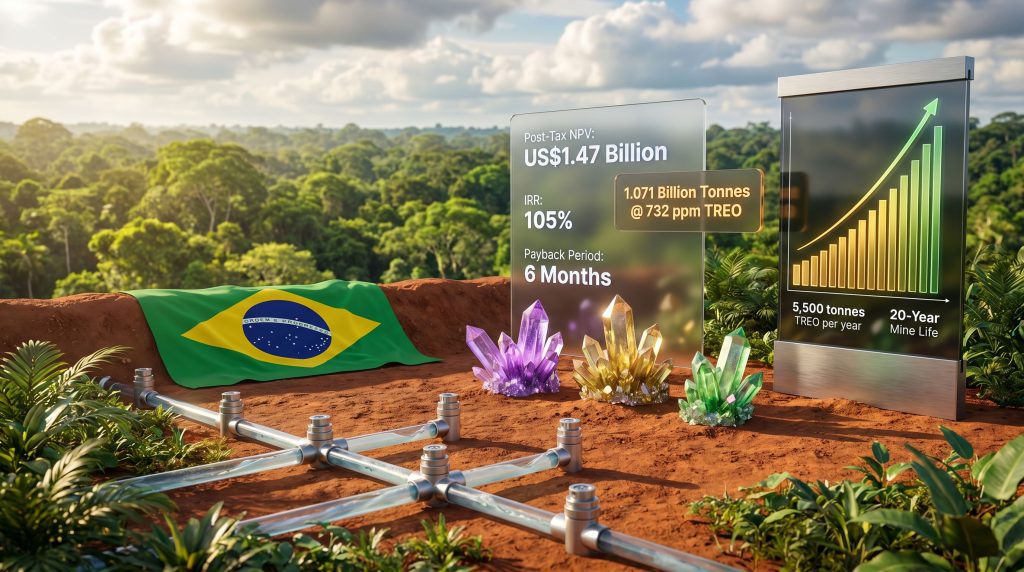
The current resource stands at 1.071 billion tonnes at a grade of 732 parts per million total rare earth oxide (TREO), containing 785,436 tonnes of TREO. Within that total, 41.5% is classified as magnet rare earth oxides (MREO), comprising neodymium, praseodymium, dysprosium, and terbium. These are precisely the four rare earth elements that sit at the core of permanent magnet manufacturing for electric vehicles, wind turbines, and defence systems.
| Metric | Ema Project (BCM) |
|---|---|
| Total Resource | 1.071 billion tonnes |
| Grade | 732 ppm TREO |
| Contained TREO | 785,436 tonnes |
| MREO Content | 41.5% of TREO |
| Tenement Explored | ~45% of 189 km² |
For context, a 41.5% MREO fraction within a TREO resource is considered commercially significant. Many rare earth deposits carry substantial quantities of cerium and lanthanum, which have limited commercial value in current markets, diluting the effective economic grade. The Ema deposit's strong magnet rare earth proportion means a higher share of production revenue is derived from the highest-value rare earth elements.
Why MREO Fraction Is the Metric That Matters Most
A common misconception among investors new to the rare earth sector is treating all TREO as equal. The market reality is sharply different. Cerium oxide, which can represent 40–50% of TREO in some deposits, trades at a fraction of the price commanded by neodymium-praseodymium oxide (NdPr oxide). Dysprosium and terbium, used to enhance magnet performance at elevated temperatures, attract even higher price premiums.
This pricing hierarchy means that two projects with identical TREO grades can have dramatically different revenue profiles depending on their magnet rare earth fraction. Ema's 41.5% MREO composition positions it toward the more economically productive end of that spectrum, a fact that the BFS economics reflect directly. In addition, the surging critical minerals demand for magnet-grade inputs further reinforces the strategic value of this composition.
BFS Economics: Unpacking a 105% IRR
The Bankable Feasibility Study confirmed financial metrics that are exceptional even by the standards of a sector known for occasionally optimistic projections. The key figures are worth examining individually rather than as a list of headline numbers.
| Financial Metric | BFS Outcome |
|---|---|
| Post-Tax NPV | US$1.47 billion |
| IRR | 105% |
| Payback Period | 6 months |
| Stage 1 Capex | US$74 million |
| Stage 2 Capex | US$27 million |
| Life-of-Mine C1 Cost | US$8.84/kg TREO |
| Mine Life | 20 years |
A post-tax NPV of US$1.47 billion derived from a Stage 1 capital commitment of US$74 million represents a capital efficiency ratio that is genuinely unusual in the mining sector. For comparison, most rare earth hard-rock projects require hundreds of millions to over a billion dollars in initial capital before generating any revenue. The Ema model inverts that calculus by leveraging ISR's inherently low infrastructure requirements.
The 105% IRR reflects the combined effect of low capital expenditure, a rapid payback trajectory, and a long mine life generating sustained free cash flow. A six-month payback period on initial capital is among the fastest documented in comparable rare earth development projects globally, and it is this characteristic that fundamentally de-risks the financing conversation.
BCM's managing director has noted publicly that the BFS outcomes reinforce the project's potential to stand among the most attractive rare earth development opportunities globally, specifically highlighting the combination of low capital intensity, low operating costs, and strong projected cash generation as key differentiators relative to both existing producers and emerging project pipelines.
The life-of-mine C1 operating cost of US$8.84 per kilogram of TREO is equally significant. This positions Ema at the lower end of the global rare earth cost curve, creating margin resilience even during periods of rare earth price softness. You can explore BCM's latest project updates directly for the most current technical disclosures.
What the BFS Does Not Yet Capture
The BFS was constructed using conservative assumptions and fundamental cost calculations benchmarked against comparable operations. This is important context for evaluating the stated NPV, because several meaningful upside levers remain outside the base-case model:
- Resource expansion: with 55% of the tenement unexplored, additional drilling could materially increase the resource base beyond the 1.071-billion-tonne estimate currently underpinning the mine schedule.
- Wellfield optimisation: commercial-scale ISR operations typically improve over time as operators refine well spacing, injection pressures, and solution flow management. These improvements can reduce operating costs below the modelled C1.
- Reagent recycling: magnesium sulphate, the lixiviant used in ISR, represents a meaningful component of operating expenditure. Recovery and reuse of this reagent across the wellfield is technically feasible and would reduce unit costs.
- Stage 3 expansion: the BFS covers a two-stage development model reaching full capacity in Year 4. The resource scale is sufficient to support production beyond the base-case scenario if market conditions justify a further expansion.
How In-Situ Recovery Works at Scale: A Technical Walkthrough
Understanding the ISR methodology is essential to evaluating the credibility of Ema's cost projections. The process is less intuitive than conventional mining but considerably more elegant from an infrastructure standpoint.
- A network of injection wells is installed across the mineralised zone. A magnesium sulphate solution is pumped into the deposit through these wells.
- As the solution permeates the clay-rich material, the magnesium ions displace the rare earth ions from the clay mineral surfaces through an ionic exchange reaction.
- The resulting rare earth-bearing solution, known as pregnant leach solution, migrates through the deposit toward a separate network of extraction wells.
- The pregnant leach solution is pumped to surface processing facilities, where the rare earth elements are precipitated as mixed rare earth carbonate.
- The mixed rare earth carbonate concentrate is dried, packaged, and prepared for shipment as the primary saleable product.
BCM completed an extensive three-month in-field ISR trial programme prior to finalising the BFS. This trial confirmed a product quality of 52.5% TREO within the mixed rare earth carbonate product, with 41.5% MREO content. These field-validated metallurgical parameters underpin the BFS assumptions and provide a level of technical de-risking not present in purely desk-based feasibility studies. Notably, BCM's high-grade extraction results have attracted considerable attention from industry analysts monitoring Western supply chain alternatives.
The significance of field trial validation cannot be overstated. Translating laboratory leach results to actual in-ground performance is one of the primary technical risks in ISR project development. Ema's three-month programme demonstrated that solution flow, recovery efficiency, and product grade can be reliably modelled from the hydrogeological data collected across the tenement.
Production Targets and the Staged Development Timeline
The BFS production model is structured around a two-stage development approach:
- Stage 1 (Years 1–2): Initial wellfield development and processing infrastructure commissioned. Production commences and ramps toward first-stage capacity.
- Stage 2 (Years 3–4): A 100% capacity expansion is executed, with full nameplate production achieved by the end of Year 4.
- Life-of-mine average: 5,500 tonnes per year of TREO produced, equivalent to approximately 10,500 tonnes per year of MREC concentrate shipped to downstream customers.
- Mine life: 20 years based on the current mineral resource estimate.
The staged capital deployment structure, total Stage 1 of US$74 million followed by Stage 2 of US$27 million, is deliberately designed to reduce financing execution risk. Rather than committing the full project capital at inception, BCM can demonstrate operational performance in Stage 1 before deploying Stage 2 capital, a model that aligns well with the risk appetites of project finance lenders and strategic partners.
Market Positioning: The 100% Uncommitted Production Opportunity
One of the less-discussed characteristics of the Ema Project at this stage of development is that 100% of forecast production remains uncommitted under offtake agreements. For investors familiar with mining project financing, this can initially appear as a risk. However, in the current rare earth market context, it represents considerable negotiating optionality.
Magnet manufacturers in Japan, South Korea, and Europe, alongside automotive original equipment manufacturers building out EV supply chains, are actively seeking long-term contracts with non-Chinese rare earth producers. With full production uncommitted, BCM retains the ability to structure offtake arrangements that maximise pricing terms, contract duration, and strategic partner alignment rather than accepting early-stage terms under capital pressure.
The next major ASX story will hit our subscribers first
The Strategic Supply Chain Dimension
China's rare earth strategy currently encompasses the dominant share of global ionic clay rare earth production, the vast majority of rare earth separation capacity, and a commanding position in permanent magnet manufacturing. This concentration has prompted sustained concern among policymakers and industrial users across the Western world.
The specific rare earth elements targeted by the Ema Project, NdPr for magnet strength, dysprosium and terbium for high-temperature performance, are the exact inputs for which supply diversification pressure is most acute. Electric vehicle permanent magnets, direct-drive wind turbine generators, and defence-grade electromagnetic systems all require these elements in increasing volumes. Furthermore, the role of green transition metals in decarbonisation agendas continues to intensify demand expectations across major economies.
Demand projections from the rare earth industry consistently point toward significant supply deficits for magnet rare earths through 2030 and into 2035 as EV adoption scales globally. While these projections carry inherent uncertainty and should not be treated as guaranteed outcomes, the structural direction of demand is broadly supported by automotive production commitments and renewable energy installation targets across major economies.
Key Risks That Require Ongoing Monitoring
No objective analysis of the Brazilian Critical Minerals Ema rare earth project would be complete without addressing the risk factors that could affect the path from BFS completion to production.
- Environmental licensing in the Amazon: operating in Amazonas state requires engagement with Brazilian environmental regulators and local communities. Licensing timelines in the Brazilian Amazon can be extended and are subject to community consultation requirements. This is a material execution risk that the BFS schedule should be evaluated against carefully.
- Rare earth price sensitivity: the BFS was constructed on conservative pricing assumptions, but significant price declines for NdPr oxide or heavy rare earths would reduce the project's economic margin. Investors should model downside price scenarios independently.
- ISR scale-up execution: while the field trial results are encouraging, scaling from a trial programme to a commercial wellfield network involves engineering and operational challenges. Solution channelling, uneven permeability across the deposit, and wellfield management complexity are all factors that require careful operational management.
- Project financing structure: the path from BFS to Final Investment Decision requires securing project financing or strategic partnerships. The terms and timeline of this process remain a key variable for the project schedule.
- Offtake negotiation outcomes: the terms at which BCM ultimately secures offtake agreements will significantly influence bankability and lender confidence. This remains an open process.
Frequently Asked Questions: Brazilian Critical Minerals Ema Rare Earth Project
What is the post-tax NPV of the Ema Rare Earth Project?
The BFS confirmed a post-tax NPV of US$1.47 billion, derived under conservative pricing and cost assumptions using a staged two-phase development structure.
What extraction method does the Ema Project use?
Ema uses in-situ recovery (ISR), injecting a magnesium sulphate solution into the ionic clay deposit to displace rare earth elements into solution without conventional open-pit or underground mining infrastructure.
What rare earth elements does Ema produce?
The project targets total rare earth oxides across the deposit, producing a mixed rare earth carbonate product containing 41.5% magnet rare earth oxides, specifically neodymium, praseodymium, dysprosium, and terbium.
How capital-efficient is the Ema Project compared to hard-rock rare earth alternatives?
Stage 1 capital of US$74 million is substantially lower than most hard-rock rare earth projects of comparable resource scale, reflecting the infrastructure advantages of ISR over conventional mining and processing circuits.
Is the Ema Project the same as the Pela Ema project in Goiás?
No. BCM's Ema Project is located in Amazonas state in the Brazilian Amazon. A separate project named Pela Ema, being developed by a different company in Goiás state, is a distinct asset and should not be conflated with BCM's flagship development.
Where is the Ema Project located?
The project sits within a 189 km² tenement in the southeastern portion of Amazonas state, Brazil, with approximately 45% of the area explored to date.
Where Does Ema Fit in the Global Rare Earth Development Landscape?
The Brazilian Critical Minerals Ema rare earth project occupies a distinctive position in the global pipeline of non-Chinese rare earth development candidates. Its combination of low capital intensity, a sub-US$9/kg TREO operating cost, a magnet-critical product specification, and an ISR methodology validated through field trials creates a convergence of attributes that is genuinely uncommon among Western-hemisphere projects.
| Comparison Dimension | Ema Project Positioning |
|---|---|
| Capital Intensity | Among the lowest for comparable resource scale |
| Operating Cost (C1) | US$8.84/kg TREO, competitive with established producers |
| Product Type | High-grade MREC with 41.5% magnet rare earth content |
| Development Risk Profile | ISR reduces surface disturbance and infrastructure requirements |
| Resource Expansion Potential | 55% of tenement unexplored |
| Offtake Flexibility | 100% uncommitted, full negotiating flexibility retained |
The next catalysts for the project include advances in environmental licensing, the structure and timing of a Final Investment Decision, and the announcement of any offtake agreements with downstream partners. Each of these milestones will progressively reduce the risk profile of the development and clarify the path toward what could become one of the most economically significant ionic clay rare earth projects to enter production outside China this decade.
This article is intended for informational purposes only and does not constitute financial advice. All forward-looking statements, financial projections, and production estimates carry inherent uncertainty and should not be relied upon as guarantees of future performance. Readers should conduct independent due diligence and consult qualified financial advisers before making investment decisions. Rare earth prices, permitting outcomes, and operational execution all carry risks that may cause actual results to differ materially from those projected in feasibility studies.
Want to Be First When the Next Major Mineral Discovery Hits the ASX?
Discovery Alert's proprietary Discovery IQ model scans ASX announcements in real time, instantly identifying high-potential mineral discoveries across rare earths and 30+ other commodities — turning complex data into actionable insights before the broader market reacts. Explore historic discoveries and their exceptional returns, then begin your 14-day free trial to position yourself ahead of the market.