August 12, 2026
The Chemistry Problem Reshaping How America Recycles Batteries
For most of the past decade, the economics of lithium-ion battery recycling rested on a single assumption: that cobalt and nickel would always be valuable enough to make the whole process financially viable. Collection costs, logistics, shredding, and separation were all, in effect, underwritten by the premium metal content locked inside NMC and NCA cells. That assumption is now fracturing under the weight of a chemistry shift that nobody in the legacy recycling industry fully anticipated.
Lithium iron phosphate, universally abbreviated as LFP, has emerged as the dominant chemistry across electric vehicles, grid-scale storage, and commercial fleet electrification precisely because it eliminates cobalt and uses negligible nickel. Lower cost, superior thermal stability, and a longer cycle life made LFP irresistible to manufacturers and fleet operators. However, the same attributes that made LFP commercially attractive created a recycling infrastructure gap that is only now beginning to close. The EMCO lithium battery recycling line, developed by Electrified Materials Corp., a subsidiary of American Resources Corp., represents one of the first purpose-built domestic attempts to confront that gap directly.
When big ASX news breaks, our subscribers know first
Why LFP Broke the Legacy Recycling Business Model
To understand why the EMCO lithium battery recycling line matters, it helps to understand exactly how conventional battery recycling economics worked and why they stopped working for the fastest-growing chemistry on the market.
Traditional hydrometallurgical and pyrometallurgical recycling facilities were designed with cobalt recovery as the primary revenue driver. Cobalt prices have historically ranged between $30,000 and $80,000 per metric tonne depending on market conditions, providing a reliable financial anchor that justified the capital and operating costs of breaking down battery packs. Nickel added a secondary revenue layer. Together, these metals could subsidise almost everything else in the processing chain.
LFP batteries contain neither cobalt nor meaningful nickel. Their cathode chemistry is built around lithium, iron, and phosphate, all of which are significantly lower in market value per kilogram than cobalt or nickel. This creates what analysts describe as a structural economic gap in legacy recycling systems: the value recovered from LFP black mass through conventional processing is insufficient to cover collection, transportation, and refining costs without a fundamentally different economic architecture.
Furthermore, the battery raw materials market is shifting in ways that amplify this challenge. As LFP adoption accelerates globally, the volume of end-of-life material requiring economically viable processing pathways is growing faster than legacy infrastructure can accommodate.
"The commercial viability of LFP recycling hinges almost entirely on the downstream platform's ability to economically extract lithium from iron phosphate black mass. This is a hydrometallurgical challenge that has historically limited participation in the LFP recycling segment."
The scale of this problem is growing rapidly. LFP accounted for roughly 40% of global lithium-ion battery deployments by cathode chemistry in 2023, and that share is projected to increase as Chinese and Western manufacturers continue expanding LFP production for both vehicles and stationary storage. Millions of LFP battery systems deployed between 2018 and 2024 are approaching end-of-life windows, creating an accelerating wave of material that existing infrastructure cannot process economically.
How the EMCO Shredding Line Actually Works
Mechanical battery shredding is a deceptively complex process. The public perception of recycling often involves simple mechanical destruction, but a commercial battery shredding line is a precisely sequenced system with tight safety, separation, and yield requirements. American Resources' battery shredding line has been specifically engineered to target the LFP recycling market with this complexity in mind.
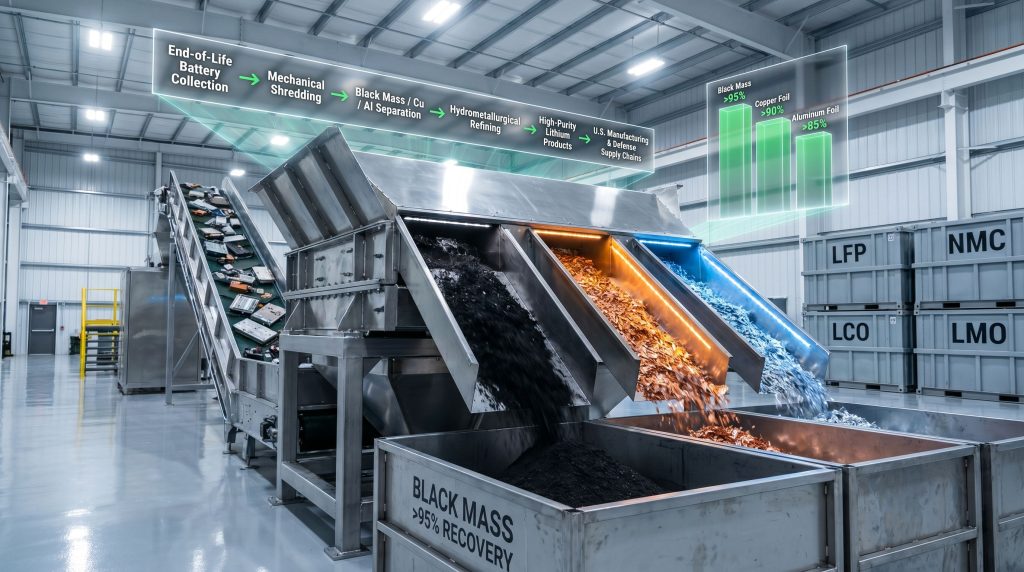
The processing sequence moves through four primary stages:
-
Feeding and discharge management: End-of-life, off-spec, and off-warranty cells, whether cylindrical, prismatic, or pouch format, are received and subjected to controlled discharge protocols before entering the mechanical system. This step is safety-critical because residual charge creates fire and thermal runaway risk during shredding.
-
Primary shredding: Battery modules and packs are mechanically reduced into coarse fragments using industrial shredders. The shredding environment is typically inert-atmosphere controlled for LFP and higher-energy chemistries to prevent combustion.
-
Material separation: The coarse output stream passes through multi-stage separation systems using air classification, density separation, magnetic separation, and screening to isolate distinct material fractions.
-
Fraction recovery: Separated output streams are collected and conditioned for downstream processing. The primary outputs include black mass, copper foil, aluminium foil, and residual plastics and casing materials.
Recovery Rate Benchmarks for Industrial Shredding Lines
| Output Material | Typical Recovery Rate | Primary Downstream Application |
|---|---|---|
| Black Mass | >95% | Hydrometallurgical refining |
| Copper Foil | >90% | Electrical manufacturing |
| Aluminium Foil | >85% | Secondary aluminium production |
| Lithium (via refining) | Variable by chemistry | Battery-grade lithium salts |
| Residual Plastics | 60–80% | Industrial polymer recovery |
One detail rarely discussed in mainstream coverage is the particle morphology challenge specific to LFP black mass. Because iron phosphate cathode particles have different density and morphology characteristics compared to NMC cathode materials, standard air classification and screening equipment tuned for NMC processing can produce lower separation fidelity when running LFP feedstocks. Consequently, LFP-focused shredding lines may require modified or purpose-configured separation stages to achieve commercially viable black mass purity levels.
The Refining-First Architecture That Changes the Investment Logic
The most strategically significant aspect of the EMCO lithium battery recycling line is not the shredding equipment itself. It is the operational philosophy that determines how the equipment fits into a broader system. In addition, the battery recycling process employed here draws on emerging approaches that differ markedly from legacy models.
The conventional approach to building a battery recycling business follows a collection-first logic: secure feedstock supply agreements, build shredding infrastructure, then solve the refining problem. This sequence has contributed to numerous stranded asset situations where shredding capacity exists but economically viable refining pathways for the resulting black mass do not.
The EMCO-ReElement model inverts this sequence entirely.
The refining-first operational sequence works as follows:
-
Establish and validate the hydrometallurgical separation and purification platform before scaling any upstream collection or shredding infrastructure.
-
Confirm that recovered feedstocks, particularly LFP black mass, have an economically sound pathway to finished, saleable products.
-
Use the validated refining capability to de-risk upstream capital investment decisions by eliminating the single largest uncertainty in the value chain.
-
Expand front-end collection and shredding capacity only once back-end economics are confirmed and defensible.
-
Apply the same refining platform across multiple feedstock types, including batteries from various chemistries, permanent magnets, ores, and brines, to maximise asset utilisation and reduce per-unit refining costs.
This approach significantly reduces the risk profile of the shredding line investment because the question of where the black mass goes and what it is worth has already been answered before the shredding equipment is procured.
The Two-Entity Architecture: EMCO and ReElement
Understanding how the EMCO lithium battery recycling line fits into the broader American Resources ecosystem requires clarity on the distinct roles that each operating entity plays.
| Entity | Primary Function | Key Inputs | Key Outputs |
|---|---|---|---|
| Electrified Materials Corp. (EMCO) | Front-end collection, preprocessing, shredding | EOL batteries, magnets, Cu/Al/Fe scrap | Black mass, separated metal fractions, conditioned feedstocks |
| ReElement Technologies Corp. | Separation, purification, refining | Black mass, magnet feedstocks, ores, brines | Battery-grade Li products, rare earth products, technical-grade materials |
American Resources retains a strategic ownership interest in ReElement Technologies, creating an integrated vertical structure that spans from raw recycled material intake through to high-purity refined product output. The combined platform targets U.S. manufacturing, defence supply chains, and energy storage markets.
The material categories that the EMCO platform is designed to handle extend well beyond lithium-ion batteries:
- Permanent magnets including NdFeB and SmCo formulations for rare earth recovery
- Copper scrap for domestic secondary copper supply
- Aluminium scrap for secondary aluminium manufacturing
- Ferrous metals for domestic steel and iron supply chains
- Lithium-ion batteries across LFP, NMC, LCO, LMO, and emerging chemistries
Battery Chemistry Complexity: Why Not All Cells Are Equal
The EMCO shredding line begins with LFP as its initial target chemistry, but the planned expansion to additional lithium-ion formulations introduces a useful framework for understanding the variable economics of battery recycling across chemistry types.
| Chemistry | Key Recoverable Metals | Recycling Economics | Relative Processing Complexity |
|---|---|---|---|
| LFP (Lithium Iron Phosphate) | Li, Fe, P | Lithium-dependent, no Co/Ni subsidy | High |
| NMC (Nickel Manganese Cobalt) | Li, Ni, Mn, Co | Strongest economics due to Co/Ni | Moderate |
| LCO (Lithium Cobalt Oxide) | Li, Co | High Co content supports economics | Lower |
| LMO (Lithium Manganese Oxide) | Li, Mn | Low metal value, weak economics | High |
| Emerging solid-state | Variable | Largely undefined | To be assessed |
A less commonly discussed dynamic in this chemistry comparison is the cycle life asymmetry and what it means for recycling volume timelines. LFP batteries can sustain 2,000 to 4,000 full charge cycles before reaching end-of-life thresholds, compared to 500 to 1,500 cycles for many NMC formulations. This means that LFP batteries deployed in 2020 and 2021 may not generate meaningful recycling feedstock volumes until the late 2020s or early 2030s, giving infrastructure developers a narrow but real window to establish processing capacity ahead of peak volume.
How Does Direct Lithium Extraction Fit Into This Picture?
Furthermore, innovations in direct lithium extraction are beginning to influence how refiners think about processing black mass from LFP sources. Advances in selective extraction technology are making it increasingly feasible to recover battery-grade lithium from iron phosphate matrices at commercially attractive yields, a development that strengthens the economic case for the refining-first model.
The next major ASX story will hit our subscribers first
The Supply Chain Vulnerability That Battery Recycling Addresses
The strategic case for domestic battery recycling infrastructure extends beyond commercial economics. Without processing capability inside U.S. borders, end-of-life LFP battery materials face three outcomes, none of which serve national supply chain objectives:
- Offshore export: Battery materials shipped to overseas processors, primarily in Asia, transfer critical lithium value permanently out of the domestic economy.
- Landfill disposition: Creates long-term environmental liability and results in permanent loss of recoverable lithium, copper, and aluminium.
- Legacy system underutilisation: Processing through facilities configured for NMC chemistry produces economically unviable yields for LFP inputs, effectively destroying value.
The circular economy pathway that the EMCO lithium battery recycling line creates moves materials through a fully domestic chain: collection and discharge at EMCO, mechanical processing and black mass recovery at EMCO, hydrometallurgical refining at ReElement, and high-purity lithium product output for re-entry into U.S. manufacturing and energy storage supply chains.
"As ESG reporting requirements and battery passport regulations expand across global supply chains, the ability to demonstrate fully domestic, traceable, and documented battery recycling becomes a compliance asset rather than simply an environmental preference. This distinction will increasingly separate premium-tier recycling service providers from commodity processors."
The funding structure supporting the shredding line combines private capital raised at the EMCO subsidiary level with an Indiana state recycling grant. This structure reflects both the commercial potential of the platform and the recognition within state economic development frameworks that domestic critical mineral recovery serves broader economic interests. For context, the broader critical minerals demand picture reinforces why domestic processing capability is increasingly viewed as a strategic priority rather than an optional investment.
Customer Segments and the Traceability Advantage
The market for end-of-life battery disposition services is more segmented than it might initially appear. Different customer categories have fundamentally different priorities when selecting a recycling partner.
- Electric vehicle manufacturers and fleet operators managing warranty returns and production rejects prioritise liability transfer and chain-of-custody documentation.
- Energy storage system integrators with degraded or decommissioned stationary assets need compliant, cost-effective disposition with material recovery value.
- Battery manufacturers disposing of off-spec production output require regulatory compliance and often have internal sustainability reporting requirements tied to recycling outcomes.
- Industrial equipment operators retiring LFP-powered machinery need traceable documentation for environmental compliance and corporate ESG reporting.
- Defence and government procurement entities increasingly require domestic sourcing and processing for batteries containing critical materials, driven by supply chain security mandates.
The domestic and transparent nature of the EMCO processing model creates a differentiated value proposition for customers operating under tightening ESG disclosure frameworks or supply chain due diligence requirements. As battery passport regulations advance in the European Union and begin influencing U.S. procurement standards, the ability to provide complete traceability from battery intake through refined product output becomes a competitive moat that purely offshore processing cannot replicate. In addition, recent battery recycling breakthrough developments globally are raising the bar for what sophisticated processing platforms must deliver to remain competitive. For further technical detail on industrial-scale hydrometallurgical battery recycling approaches, publicly available processing comparisons offer useful context on the separation methods underpinning LFP black mass refining.
Frequently Asked Questions: EMCO Lithium Battery Recycling Line
What battery chemistries does the EMCO shredding line accept?
The line begins with LFP chemistry and is designed to expand to NMC, LCO, LMO, and other emerging formulations. Cylindrical, prismatic, and pouch cell formats across all of these chemistries are within scope.
Why is LFP harder to recycle than NMC?
LFP does not contain cobalt or significant nickel, removing the high-value metal credits that traditionally made battery recycling economically self-sustaining. Profitable LFP recycling requires a lithium-focused recovery model anchored by an advanced downstream refining platform capable of extracting value from iron phosphate black mass.
What happens to the black mass after shredding?
Black mass — the fine powder containing active cathode and anode materials including lithium, iron, phosphate, graphite, and trace metals — is conditioned at the EMCO facility and transferred to ReElement's refining platform for hydrometallurgical separation and purification into high-purity lithium products.
What recovery rates are achievable?
Commercial battery shredding systems report black mass recovery exceeding 95%, copper foil recovery above 90%, and aluminium foil recovery above 85%. Actual rates vary based on input chemistry, cell format, discharge completeness, and equipment configuration.
What is the refining-first model?
Rather than building collection and shredding infrastructure and hoping refining economics follow, the refining-first approach validates separation and purification capability before scaling upstream processing. This sequencing eliminates the largest source of stranded asset risk in battery recycling infrastructure development.
How does this support U.S. critical mineral supply chains?
By processing end-of-life batteries domestically and refining recovered materials into battery-grade products within U.S. borders, the integrated EMCO-ReElement system keeps critical lithium and associated materials in domestic supply chains rather than transferring their value to offshore processors.
Want to Track the Next Major Battery Materials Discovery Before the Market Does?
Discovery Alert's proprietary Discovery IQ model delivers real-time alerts on significant ASX mineral discoveries — including lithium and other critical battery materials — turning complex geological data into actionable investment insights the moment announcements hit the exchange. Explore historic discoveries and their returns to see what's possible, then start your 14-day free trial to position yourself ahead of the broader market.