June 24, 2026
The Regulatory Finish Line That Separates Gold Projects From Gold Mines
In gold mining, the difference between a project and a mine is rarely geological. Deposits get discovered, resources get defined, and feasibility studies get completed, yet projects can sit dormant for years while companies navigate the layered complexity of regulatory approval. The permits that ultimately unlock construction represent far more than bureaucratic sign-off. They mark the moment a gold resource transitions from a balance sheet asset into a production-ready operation. For investors evaluating development-stage gold companies on the ASX, understanding where a project sits in that regulatory sequence can be the difference between early positioning and late entry.
It is within this framework that the Emerald Resources Dingo Range Gold Project approval carries meaningful weight. The Western Australian project has now cleared every regulatory hurdle required before ground is broken, a status that places it in a comparatively rare category among Australian development-stage gold assets.
When big ASX news breaks, our subscribers know first
What It Means to Be Fully Permitted in Western Australia
Western Australia operates one of the world's most comprehensive mining regulatory frameworks, administered through the Department of Energy, Mines, Industry Regulation and Safety (DEMIRS). For a gold project to reach construction readiness, it must sequentially satisfy multiple distinct approval categories, each with its own technical, environmental, and community consultation requirements. Understanding why mining permits matter is essential context for evaluating any development-stage asset.
A Mining Proposal establishes the operational blueprint for how the resource will be extracted and how land disturbance will be managed. A Mine Closure Plan details the rehabilitation obligations and financial assurances required to restore the site after operations cease. The Works Approval is the final procedural gate, confirming that the construction activity itself, including all associated infrastructure, processing facilities, and earthworks, is authorised to proceed.
Securing all three simultaneously is not a minor administrative event. For junior and mid-tier gold developers, this combination removes what institutional capital allocators typically identify as one of the most significant obstacles to investment: regulatory uncertainty. A project that has cleared every approval layer presents a materially different risk profile compared with one still awaiting final consent, regardless of how similar the underlying geology might appear.
The Emerald Resources Dingo Range Gold Project approval confirms that all three of these regulatory layers have been satisfied. The project is, by technical definition, construction-ready.
Project Fundamentals: What Dingo Range Actually Looks Like
Scale, Geology, and Resource Definition
Dingo Range sits within the established gold-producing geological province of Western Australia's greenstone belt system, a terrain type that has consistently hosted orogenic gold mineralisation across the state. The project covers a substantial tenure footprint of 1,047 square kilometres, with four granted mining licences encompassing 36 square kilometres of the core project area.
The primary mineralised zone, the Boundary-Bungarra corridor, extends across approximately 6.4 kilometres of strike length, alongside additional prospect zones at Freemans Find and Great Northern. This multi-prospect structure provides optionality beyond the core resource, with exploration upside embedded within the broader tenure package.
The current Mineral Resource Estimate, updated as of June 2025, presents the following picture:
| Resource Category | Tonnage | Grade (g/t Au) | Contained Gold |
|---|---|---|---|
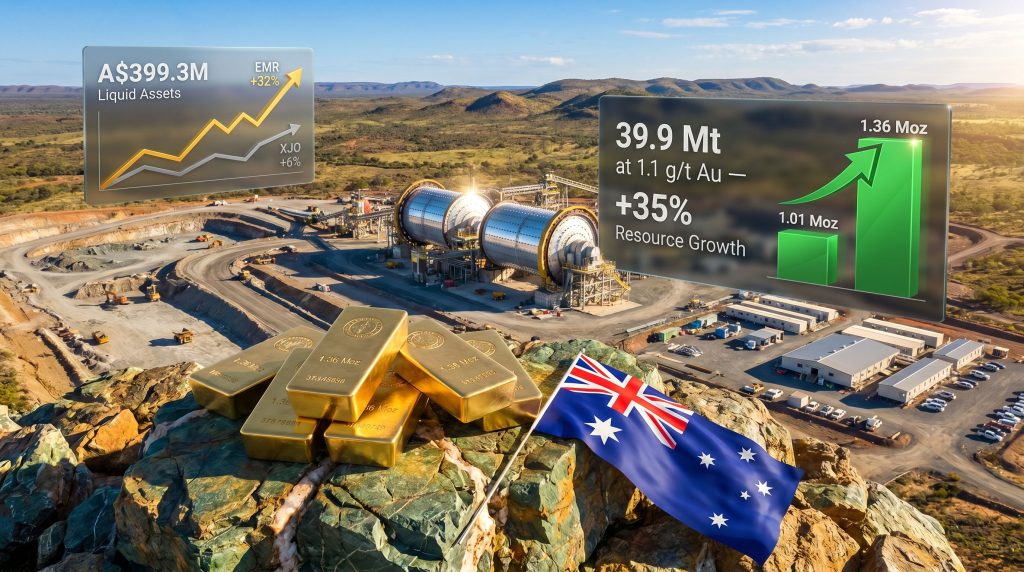
| Total Resource (Measured + Indicated + Inferred) | 39.9 Mt | 1.1 g/t | 1.36 Moz |
| High-Grade Subset | 23.2 Mt | 1.4 g/t | 1.07 Moz |
| Previous Estimate (December 2024) | – | – | 1.01 Moz |
| Growth Over 12 Months | – | – | +35% |
Note: A cut-off grade of 0.45 g/t Au was applied to the resource estimate. Resource estimates are not Ore Reserves and do not have demonstrated economic viability. All resource and reserve figures should be verified against the company's most recent ASX announcements.
The 35% resource growth within a single year is geologically significant. Resource expansion at this rate typically reflects successful step-out drilling that confirms mineralisation continuity beyond previously modelled boundaries, rather than just infill drilling. This distinction matters because it implies the deposit has genuine scale potential that was not fully captured in earlier modelling.
The Resource-to-Reserve Transition: A Critical Technical Threshold
The project is currently advancing toward a Maiden Ore Reserve declaration, which represents a technically distinct and more demanding classification than a Mineral Resource Estimate. While resources are defined based on geological confidence and reasonable prospects for eventual economic extraction, an Ore Reserve requires demonstrated economic viability under a specified set of modifying factors including mining method, processing recovery, capital costs, and operating costs.
For investors, the reserve declaration is not merely a labelling exercise. It is the threshold at which project financing conversations move from conditional to executable. Lenders and institutional co-investors typically require an Ore Reserve as a precondition for debt facility discussions, making this upcoming milestone a genuine commercial inflection point rather than a routine technical update.
A Two-Continent Strategy Built Around Operational Precedent
From Single-Asset Operator to Multi-Mine Producer
To understand why the Emerald Resources Dingo Range Gold Project approval matters beyond the project itself, it helps to examine the strategic architecture it supports. Emerald Resources is not building toward a single mine outcome. The company has articulated a clear production target of 300,000 to 400,000 ounces of gold per year derived from multiple mines across two geographic regions.
The operational foundation for this ambition already exists. Emerald's 100%-owned Okvau Gold Mine in Cambodia provides a functioning operational base from which the company has already demonstrated its capacity to build, commission, and operate a gold processing facility in a developing market jurisdiction. That track record is not incidental to the Dingo Range story. It is what gives management's expansion targets credibility that is typically absent from pure development-stage gold companies.
The Memot Gold Project, also in Cambodia, adds a second development asset to the portfolio. Together with Dingo Range, these three assets form a production pipeline spanning Australia and Southeast Asia, each at a different stage of the development lifecycle.
Jurisdictional Diversification as Risk Architecture
The dual-continent model serves a structural risk management function. Western Australia is widely regarded as one of the most stable mining jurisdictions globally, offering established sovereign risk protection, deep infrastructure networks, and a skilled labour pool concentrated in and around the resources sector. Cambodia presents a different profile: a lower operational cost base, an emerging regulatory environment, and operational complexity that Emerald has already navigated at Okvau.
By distributing production across both environments, the company reduces its exposure to any single jurisdiction's political, regulatory, or cost-structure risks. This approach becomes increasingly relevant as mid-tier gold producers seek to grow production without concentrating all execution risk in a single geography.
Capital Equipment Commitments: Reading the Signal
A$30 Million in Long-Lead Equipment
One of the clearest indicators of development conviction is the timing and scale of capital equipment commitments. Before construction formally commences, a decision to purchase major processing equipment represents an irreversible financial commitment made on the basis of internal project economics. It also locks in delivery schedules that cannot easily be accelerated later, making early procurement a genuine critical path decision.
Emerald has committed approximately A$30 million to purchase two 8,000kW Metso SAG Mills and a crushing circuit. SAG mills (Semi-Autogenous Grinding mills) are the primary grinding workhorses in most modern gold processing circuits, using a combination of ore itself and steel balls to reduce run-of-mine material to the fine particle sizes required for gold recovery. Mill size, measured in installed kilowatt capacity, is a reliable proxy for planned processing throughput. Two mills at 8,000kW each represent a substantial installation suited to processing millions of tonnes of ore annually.
Equipment delivery is expected within 12 to 13 months of the order commitment. This timeline governs the broader construction schedule and reflects Metso's competitive delivery position.
Why Supplier Continuity Matters
The selection of Metso as the equipment supplier is not purely commercial. Emerald's management has explicitly referenced the proven working relationship established during the construction of the Okvau Gold Mine in Cambodia, where Metso equipment was previously deployed. In mine development, equipment supplier familiarity reduces integration risk, simplifies commissioning, and draws on established technical support relationships.
Repeating that relationship across a second project in a different continent signals that the Okvau commissioning experience was sufficiently positive to justify standardising on the same equipment architecture. This type of institutional knowledge transfer between projects is an underappreciated efficiency driver that rarely appears in headline figures.
Infrastructure Sequencing: Camp Completion First
Camp facilities at Dingo Range have been completed and are operational, providing accommodation capacity for construction and operational personnel. While this might appear to be a minor logistics item, its completion before the equipment order is placed reflects disciplined development sequencing. Personnel infrastructure needs to be ready to absorb activity at the start of construction, not retrofitted later when scheduling pressures are at their peak.
Camp completion followed by major equipment procurement represents a methodical, risk-aware approach to mine development scheduling. Projects that reverse this sequence often encounter early-phase delays that compound through the construction timeline.
Balance Sheet Strength as a Development Enabler
Financial Position as at March 2026
| Financial Metric | Value (March 2026) |
|---|---|
| Cash Holdings | A$337.8 million |
| Bullion Inventory | A$39.2 million |
| Listed Investments | A$22.3 million |
| Total Liquid Assets (Approximate) | ~A$399.3 million |
The A$30 million equipment commitment represents approximately 7.5% of the company's total liquid asset base, a proportion that does not require external financing, equity issuance, or debt facility drawdown. For mid-tier gold developers, this financial position is genuinely differentiated. Many projects at equivalent stages carry development ambitions that outpace their balance sheets, creating an inevitable tension between construction timelines and capital raising requirements.
Emerald's position eliminates that tension for the near-term development programme. The company's March 2026 quarterly report confirmed record cash flow generation during the period, indicating that the operational base at Okvau is actively replenishing the treasury rather than drawing it down.
The practical implication is meaningful. A well-capitalised developer can make procurement decisions based on project optimisation rather than cash management constraints. That independence frequently translates into better commercial terms, more competitive delivery schedules, and the ability to act decisively when market conditions favour accelerated activity.
The next major ASX story will hit our subscribers first
Market Pricing of Development Progress
Share Price Performance Against the Benchmark
Over the 12 months preceding the announcement, Emerald Resources (ASX: EMR) shares appreciated by approximately 32%, compared with a 6% return from the S&P/ASX 200 Index (ASX: XJO) over the same period. That 26 percentage point outperformance differential reflects the market's progressive re-rating of the company as development certainty has increased. Furthermore, the broader gold price outlook for 2025 and beyond has provided a supportive backdrop for this re-rating.
This pattern is consistent with how institutional and sophisticated retail investors typically respond to development-stage asset progression. The value of a gold project increases in a stepwise fashion as key risks are retired:
- Resource definition confirms the deposit is real and has scale
- Feasibility work confirms the deposit can be mined economically
- Regulatory approvals confirm the deposit can legally be developed
- Equipment procurement confirms the company is ready to build
- Reserve declaration confirms the economic case is bankable
- Construction commencement confirms capital commitment
- First gold pour confirms operational reality
Each milestone reduces the discount rate applied by the market to future cash flows. The current share price performance suggests the market is actively pricing in the progression from step three to step five, with further potential re-rating events on the horizon.
Forward Milestones and Valuation Inflection Points
Investors should note the following upcoming milestones that could influence market pricing of the Dingo Range asset. In addition, the gold price impact on mining equities means that commodity tailwinds could amplify the re-rating effect of each of these events:
- Maiden Ore Reserve declaration: converts geological confidence into bankable economic units
- A Definitive Feasibility Study (DFS) completion: provides capital cost, operating cost, and return estimates at project-level detail
- Construction commencement announcement: marks the point of no return on capital commitment
- Processing equipment delivery and commissioning: confirms the 12-13 month delivery schedule has been met
- First gold production: transforms the project from development asset to producing mine
- Parallel Memot Project milestones: each Cambodia development update contributes to the multi-mine production narrative
This article contains general information only and does not constitute financial advice. Readers should seek independent professional advice before making any investment decisions. Past share price performance is not indicative of future returns. All financial figures referenced are sourced from company announcements and public disclosures.
Understanding the Risk Landscape
Where Genuine Uncertainty Remains
The completion of all regulatory approvals and the commitment of major capital equipment substantially reduces the development risk profile of the Dingo Range project. However, investors should maintain a clear-eyed view of the risks that remain.
Construction execution risk is inherent in any transition from approved project to operational mine. Cost overruns, schedule delays, and technical complications are standard features of the mine-building process, even for experienced operators. The company's track record at Okvau provides relevant operational experience, but no two mine builds are identical.
Resource-to-reserve conversion remains an outstanding technical milestone. Until the Maiden Ore Reserve is declared, the economic case for Dingo Range rests on resource estimates and internal assessments rather than publicly disclosed bankable numbers. The gap between 1.36 Moz of resource and a declared reserve could be significant depending on the modifying factors applied during the reserve estimation process.
Equipment delivery risk operates on a 12 to 13 month horizon that is subject to global supply chain conditions, manufacturing capacity constraints, and logistics variables. Long-lead equipment delivery timelines have historically proven sensitive to demand cycles in the broader mining equipment market.
Gold price sensitivity underpins all project economics. Sustained movements in the gold price affect both the economic viability of the resource and the market valuation of the company's development assets.
Parallel capital allocation pressure exists between Dingo Range and the Memot Project in Cambodia. Developing two assets simultaneously across different continents creates management bandwidth and capital prioritisation demands that single-project developers do not face.
| Risk Category | Mitigating Factor | Residual Concern |
|---|---|---|
| Regulatory | All approvals secured | Ongoing compliance obligations |
| Construction execution | Okvau track record | No two projects identical |
| Resource-to-reserve | Active maiden reserve work underway | Gap size not yet disclosed |
| Equipment delivery | Competitive Metso delivery schedule confirmed | Supply chain variability |
| Gold price | Strong current price environment | Inherently unpredictable |
| Dual-project management | Strong balance sheet and existing operational team | Management capacity limits |
Dingo Range in the Broader WA Gold Development Context
Where This Project Sits Among Its Peers
Western Australia's greenstone belt system has been producing gold continuously for over a century, and it remains one of the world's most reliably productive gold provinces. New projects entering development within this system benefit from established regional infrastructure, experienced local contractors, and a well-understood regulatory pathway that, while demanding, is at least predictable.
Within this landscape, projects that have cleared all regulatory approvals, secured long-lead equipment, and carry substantial internal funding capacity occupy a genuinely uncommon position. Many WA development projects at similar resource scales are either still working through the permitting sequence, dependent on external financing to fund construction, or awaiting feasibility completion before committing to procurement.
| Comparison Metric | Dingo Range (EMR) | Typical WA Mid-Tier Development Project |
|---|---|---|
| Resource Size | 1.36 Moz | 0.5 to 2.0 Moz |
| Resource Grade | 1.1 g/t Au | 1.0 to 2.5 g/t Au |
| Permitting Status | Fully permitted | Variable |
| Balance Sheet Liquidity | ~A$399 million | Often debt-dependent |
| Equipment Supplier Relationship | Established (proven at Okvau) | Typically first engagement |
Note: Comparison figures represent general industry benchmarks for WA development-stage gold projects. Individual project metrics vary considerably. This table is indicative only and should not be treated as a formal competitive analysis.
The Broader Significance for Australia's Gold Supply Pipeline
The development of new, fully permitted gold projects in Western Australia carries implications beyond any individual company's production targets. Australia is one of the world's largest gold-producing nations, and the pipeline of new supply coming into production in the coming years will partly determine the country's position in the global gold market through the late 2020s and beyond.
Mid-tier developers like Emerald play a structural role in this supply pipeline that is often underappreciated. Major producers are constrained by scale requirements that make sub-two-million-ounce projects commercially unattractive. Junior explorers lack the capital and technical depth to advance projects to production independently. It is the mid-tier cohort — companies with established operational experience, strong balance sheets, and a demonstrated capacity to execute mine builds — that fills the gap between resource discovery and new gold supply.
Consequently, the Emerald Resources Dingo Range Gold Project approval, combined with the concurrent development of Memot and the operational baseline at Okvau, positions the company as a meaningful contributor to that supply pipeline across two continents.
Frequently Asked Questions: Dingo Range Gold Project
What approvals has the Dingo Range Gold Project received?
The project has received all regulatory approvals required before construction can commence, including the Mining Proposal, Mine Closure Plan, and the final Works Approval from Western Australian authorities. This makes Dingo Range fully permitted and development-ready.
What processing equipment has been ordered for Dingo Range?
Emerald has committed approximately A$30 million to purchase two 8,000kW Metso SAG Mills and a crushing circuit. Delivery is expected within 12 to 13 months of the order commitment.
What is the current mineral resource estimate for Dingo Range?
As of June 2025, the project hosts a total Mineral Resource Estimate of 39.9 Mt at 1.1 g/t Au for 1.36 million ounces of gold, reflecting a 35% increase from the December 2024 estimate of 1.01 Moz. A lower cut-off grade of 0.45 g/t Au was applied.
How does Dingo Range fit into Emerald's production goals?
Dingo Range is intended to function as Emerald's primary Australian production asset, complementing the Memot Gold Project in Cambodia. Combined with existing production at the Okvau Gold Mine, these assets are designed to collectively support a company-wide production target of 300,000 to 400,000 ounces of gold per year.
What is Emerald Resources' financial position heading into development?
As at March 2026, Emerald held approximately A$337.8 million in cash, A$39.2 million in bullion, and A$22.3 million in listed investments, providing substantial internal funding capacity that reduces dependence on external financing for the near-term development programme.
What milestones remain before Dingo Range reaches production?
Key remaining milestones include the declaration of a Maiden Ore Reserve, completion of the Definitive Feasibility Study, formal construction commencement, processing equipment delivery and commissioning, and ultimately first gold production from the Dingo Range processing facility.
This article is intended for informational purposes only and does not constitute financial product advice. All investment decisions should be made in consultation with a licensed financial adviser. Mineral resource estimates, financial figures, and share price data referenced in this article are sourced from publicly available company announcements and should be independently verified. Investments in mining and resources companies carry inherent risks including commodity price volatility, operational uncertainty, and capital loss.
Want to Be First When the Next Major ASX Gold Discovery Is Announced?
Discovery Alert's proprietary Discovery IQ model scans ASX announcements in real time, instantly identifying significant mineral discoveries and translating complex data into actionable investment insights — so subscribers are positioned ahead of the broader market before the re-rating begins. Explore historic discoveries and the returns they generated, then begin a 14-day free trial at Discovery Alert to ensure you never miss the next major development-stage opportunity.