June 28, 2026
Mining operations worldwide face unprecedented pressure to reduce greenhouse gas emissions as climate regulations tighten and environmental accountability intensifies. The extractive industry's contribution to global carbon emissions presents a complex challenge, with mining and metallurgy combined representing approximately 11% of worldwide greenhouse gas emissions. Understanding and addressing emissões de gases de efeito estufa na mineração has become critical for operational sustainability, regulatory compliance, and long-term competitiveness in an increasingly carbon-conscious global economy.
How Does the Mining Industry Contribute to Global Climate Change?
The Emissions Landscape in Extractive Operations
The mining sector's contribution to global emissions manifests through multiple operational categories, each requiring specific measurement and mitigation approaches. Non-coal mining contributes approximately 0.54% of global greenhouse gas emissions, whilst fugitive emissions from coal mining represent 2.46% of the global total, primarily due to methane released during extractive processes.
The Greenhouse Gas Protocol establishes three fundamental categories for emissions classification. Furthermore, these categories provide a comprehensive framework for understanding carbon footprints across mining operations.
• Scope 1: Direct emissions from company-controlled sources, including fossil fuel combustion in mobile equipment, explosives for rock blasting, and metallurgical processes
• Scope 2: Indirect emissions resulting from consumption of purchased electricity, steam, and heating from third parties
• Scope 3: Other indirect emissions throughout the value chain, encompassing product transport, downstream processing, and end-use of minerals
Quantification methodologies apply 100-year Global Warming Potential (GWP) factors established by the Intergovernmental Panel on Climate Change (IPCC). For methane, a conversion factor of 28 times CO₂ impact is utilised, whilst nitrous oxide presents a factor of 265 times.
Geographic Distribution of Mining Emissions
The geographic concentration of sectoral emissions reveals significant strategic patterns for decarbonisation policies. Approximately 80% of scope 1 and 2 emissions from mining and metallurgy occur in Asia, reflecting the location of substantial global mining capacity and metal processing infrastructure.
This Asian concentration results from structural factors including available large-scale mineral resources, developed industrial infrastructure for metallurgical processing, energy matrices with high fossil fuel dependency, and industrial policies favourable to productive cluster development.
Regional emissions distribution creates important implications for decarbonisation strategies. Moreover, different jurisdictions apply varying climate regulations, carbon pricing systems, and technological incentives, further complicating global mitigation efforts.
When big ASX news breaks, our subscribers know first
Which Commodities Generate the Greatest Environmental Impact?
Carbon Intensity Hierarchy by Material
Carbon intensity analysis reveals extreme concentration of sectoral emissions in three primary commodities. Steel production, coal mining, and aluminium represent approximately 93% of scope 1 and 2 sector emissions, creating strategic opportunity for focused interventions through targeted energy transition in mining initiatives.
| Commodity | Emissions Intensity | Sectoral Participation | Primary Factors |
|---|---|---|---|
| Steel (Steelmaking) | 1.8-2.5 tCO₂e/t | ~45% | Metallurgical coal, thermal processes |
| Aluminium (Primary) | 8-16 tCO₂e/t | ~25% | Intensive electrolysis, energy matrix |
| Coal (Mining) | Variable by method | ~23% | Fugitive methane emissions |
| Copper | 2-6 tCO₂e/t | ~3% | Concentrated processing, smelting |
| Nickel | 8-15 tCO₂e/t | ~2% | High-temperature processing |
This hierarchy demonstrates that effective decarbonisation strategies can concentrate on disruptive technologies for the "big three" materials. Consequently, this focus can potentially achieve disproportional impact with directed investments.
Extended Value Chain: From Extraction to Final Product
The emissions multiplier in metallurgical processing varies significantly between different technological routes. In addition, steel production alternatives include multiple pathways with distinct carbon footprints.
• Blast furnace + Basic oxygen furnace (BF-BOF): 2.0-2.5 tCO₂e/t (traditional method)
• Electric arc furnace with scrap (EAF): 0.5-1.5 tCO₂e/t (dependent on electrical matrix)
• Direct reduction + EAF: 1.0-2.0 tCO₂e/t (intermediate technology)
The energy transition paradox: Essential minerals for clean technologies frequently present elevated carbon footprints during production, creating structural tension between short and long-term climate objectives that demands innovative technological solutions.
Why Does Brazil Represent a Unique Case in Mining Emissions?
Brazilian Profile: 12.8 Million tCO₂e in Perspective
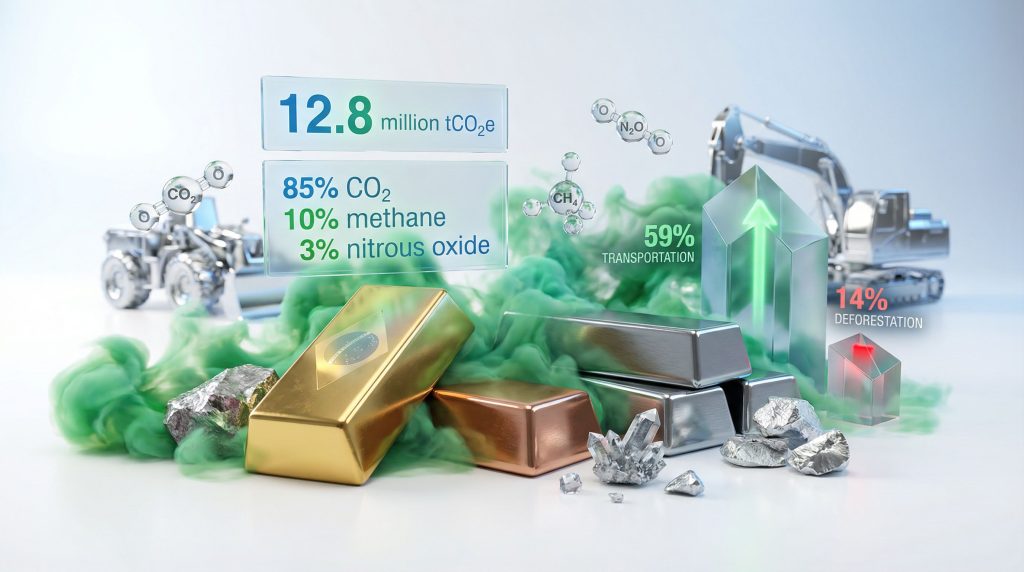
Brazil presents unique characteristics in emissões de gases de efeito estufa na mineração, combining structural advantages with specific challenges. The national sectoral emissions profile totals approximately 12.8 million tCO₂e, with distinct composition: 85% CO₂, 10% methane (CH₄), and 3% nitrous oxide (N₂O).
This distribution indicates predominance of process and energy-related emissions (CO₂) over fugitive emissions (methane). Furthermore, this contrasts with typical coal mining profiles in other regions, highlighting Brazil's unique mineral extraction landscape.
IPCC Global Warming Potential factor applications reveal differentiated impacts across emission types. However, the concentration in CO₂ emissions suggests opportunities for technological interventions in energy systems and industrial processes.
• CO₂ emissions: Originating primarily from diesel combustion in mobile equipment and thermal processes
• Methane emissions: Concentrated in specific operations with lower relative representation
• N₂O emissions: Associated with chemical processes and fertiliser use in revegetation areas
Primary Emission Sources in the National Context
Brazilian emissions structure reflects significant geographical and operational particularities that distinguish the country from other major mining jurisdictions:
Transport and Logistics (59% of direct emissions):
• Extensive distances between mines and ports requiring heavy-duty transport
• Dependence on road modal for input transportation across challenging terrain
• Intensive diesel consumption in large-scale equipment operations
Mineral Processing (27% of emissions):
• Iron ore beneficiation in pelletising plants with high thermal energy requirements
• Concentration operations through flotation and magnetic separation processes
• Thermal processes for drying and calcination of mineral concentrates
Land Use Change (14% of emissions):
• Deforestation for pit expansion and infrastructure development in biodiverse regions
• Native vegetation removal in high-biodiversity ecosystems
• Biogenic emissions from carbon stored in soils and biomass
Brazil benefits from a relatively clean electrical matrix (65-70% renewable), reducing scope 2 emissions compared to other major mineral producers. However, seasonal variations in water availability can increase dependence on thermoelectric plants, creating volatility in annual emissions.
Which Technologies Are Revolutionising Mineral Decarbonisation?
Disruptive Innovations in Development
The mining sector experiences accelerated technological transformation, driven by regulatory pressures, corporate commitments, and operational efficiency opportunities. Emerging technologies concentrate on three primary vectors: fossil fuel substitution, process electrification, and carbon capture technologies.
Green Hydrogen in Metallurgy:
Hydrogen application as a reductant in steelmaking processes represents a paradigmatic shift for deep decarbonisation. Pilot projects demonstrate technical viability at reduced scale but face cost and infrastructure challenges. Green hydrogen, produced through electrolysis powered by renewable energy, presents current costs of $4-8/kg, compared to $1-2/kg for fossil fuel-derived hydrogen.
Practical cases include hydrogen injection tests in blast furnaces (up to 30% coal substitution), development of hydrogen-fed direct reduction reactors, and integration of hydrogen production in steelmaking complexes with solar energy. Moreover, these developments showcase the potential for renewable energy in mining applications.
Fleet and Equipment Electrification:
The transition to electric equipment advances gradually, with current penetration of 5-8% in heavy mining vehicles. Limitations include battery autonomy, recharging time, and load capacity for large-scale equipment. Annual improvements of 5-8% in lithium-ion battery energy density approach total cost of ownership (TCO) parity for 2028-2032 in selected applications.
Energy Transition in Mining Operations
Renewable Energy Integration:
Mining operations in remote locations develop microgrid solutions combining solar, wind, and energy storage sources. These configurations reduce dependence on diesel generators and provide energy cost stability. Consequently, mining innovation trends increasingly focus on sustainable energy integration.
Primary operational benefits include 40-70% energy cost reduction in remote locations, greater operational cost predictability, reduction of logistical risks associated with fuel transport, and improved corporate image with access to sustainable financing.
According to mineral exploration data from CETEM, technological innovations in mineral processing can significantly reduce energy consumption and associated emissions.
How to Measure and Monitor Emissions with Scientific Precision?
Advanced Quantification Methodologies
Precise measurement of emissões de gases de efeito estufa na mineração requires robust methodologies that capture operational, seasonal, and technological variabilities. The Greenhouse Gas Protocol, adapted for mining operations, establishes guidelines for data collection, emissions calculations, and independent verification.
Continuous Monitoring Systems:
Internet of Things (IoT) technologies applied to environmental monitoring enable real-time data collection on energy consumption, fugitive emissions, and equipment efficiency. Connected sensors in mobile equipment, processing facilities, and transport systems generate granular data for precise calculations.
Technological components include combustion sensors for direct CO₂ monitoring, methane detectors for fugitive emissions, electrical energy meters with remote transmission, and integrated management systems for data consolidation. Furthermore, these systems enable the implementation of electric vehicles in mining operations with comprehensive monitoring capabilities.
Sectoral Benchmarking Tools
| Indicator | Unit | Typical Value | Best-in-Class |
|---|---|---|---|
| Energy Intensity | GJ/t product | 15-25 | 8-12 |
| Specific Emissions | tCO₂e/t product | 0.5-2.0 | 0.2-0.8 |
| Water Efficiency | m³/t product | 2-8 | 1-3 |
| Recycling Rate | % processed material | 15-30% | 40-60% |
Performance metrics enable comparisons between similar operations and identification of improvement opportunities. Independent certification systems, such as ISO 14064 for greenhouse gases and ISO 50001 for energy management, provide structured frameworks for implementation and verification.
What Is the Economic Impact of Climate Regulation?
Carbon Pricing and Competitiveness
The introduction of carbon pricing mechanisms fundamentally transforms mining economics, creating direct financial incentives for decarbonisation. Existing systems include emissions trading markets (cap-and-trade), carbon taxes, and carbon border adjustments.
Impact on Operational Costs:
A hypothetical $50/tCO₂e tax would affect commodities differently. Steel would see increases of $100-125 per tonne (4-6% of current price), whilst aluminium would face increases of $400-800 per tonne (15-25% of current price).
Copper would experience increases of $100-300 per tonne (3-8% of current price), and iron ore would see increases of $25-50 per tonne (15-30% of current price). These variations highlight the differential impact across mineral commodities.
Regulatory Risks and Opportunities
Green Taxonomies and Financing:
Environmental, social, and governance (ESG) criteria increasingly influence capital access and financing costs. Low-carbon intensity operations obtain advantages in preferential interest rates in bank financing, access to green and sustainable bonds, premium valuation in capital markets, and preference in institutional investor due diligence processes.
Furthermore, the integration of AI in mining operations supports emissions monitoring and optimisation efforts, enhancing operational efficiency whilst reducing environmental impact.
The next major ASX story will hit our subscribers first
Which Corporate Strategies Are Leading the Transformation?
Circular Business Models in Mining
Circular economy applications in mining develop innovative approaches for material reuse, waste reduction, and resource optimisation. These strategies create economic value simultaneously with emissions reduction through comprehensive resource efficiency.
Tailings and Co-products Reuse:
• Utilisation of steel slag as cementitious material in construction applications
• Recovery of precious metals from electronic waste through urban mining programmes
• Transformation of mining tailings into construction materials and aggregates
• Extraction of critical minerals as co-products from traditional operations
Industrial Symbiosis:
Integrated mining complexes share energy, water, and material resources, optimising global efficiency. Examples include utilisation of waste gases from one operation as fuel for adjacent processes, creating closed-loop systems.
Sectoral Targets and Net-Zero Commitments
| Company | Net-Zero Target | Intermediate Targets | Primary Technologies |
|---|---|---|---|
| Vale | 2050 | -33% by 2030 | Electrification, green hydrogen |
| BHP | 2050 | -30% by 2030 | Renewable energy, efficiency |
| Rio Tinto | 2050 | -50% by 2030 | Disruptive technologies, CCUS |
| Anglo American | 2040 | -50% by 2030 | Hydrogen, electrification |
Alignment with Science Based Targets Initiative (SBTi) provides scientific credibility to corporate targets, establishing trajectories compatible with limiting global warming to 1.5°C. However, achieving these ambitious targets requires significant technological breakthroughs and capital investments.
How Does Technological Innovation Accelerate Decarbonisation?
Digitalisation and Operational Optimisation
Mining's digital transformation creates significant opportunities for emissions reduction through improved operational efficiency. Artificial intelligence, machine learning, and big data analytics technologies optimise processes in real-time, reducing energy consumption and waste generation.
Artificial Intelligence Applications:
• Route optimisation for mobile equipment reducing fuel consumption
• Energy demand forecasting for load balancing and peak shaving
• Early fault detection in equipment preventing efficiency losses
• Mineral processing optimisation through predictive analytics
Digital Twins:
Digital representations of physical operations enable scenario simulation, operational strategy testing, and improvement opportunity identification without production interruption. These technologies support comprehensive operational optimisation across the mining value chain.
Research and Development in Clean Technologies
Innovation Investments:
Major mining companies allocate 1-3% of annual revenue to research and development of sustainable technologies. Partnerships with universities, research centres, and technology startups accelerate development and commercialisation of innovative solutions.
According to Brazil's National Mining Plan 2030, strategic investments in clean technology development are essential for maintaining competitiveness whilst achieving environmental objectives.
Breakthrough Technologies: Emerging technologies such as automated submarine mining, microbial mineral processing, and molecular metal recycling may fundamentally revolutionise the sector's environmental footprint in the coming decades.
Frequently Asked Questions About Mining Emissions
What Is the Difference Between Direct and Indirect Emissions?
Scope 1 (Direct Emissions): Originate from sources directly controlled by the company, including diesel combustion in equipment, explosives for rock blasting, and thermal beneficiation processes. These emissions occur physically at company facilities and are under direct operational control.
Scope 2 (Indirect Emissions – Energy): Result from consumption of electricity, steam, and heating purchased from third parties. Emissions intensity depends on regional energy matrix composition and grid carbon factors.
Scope 3 (Other Indirect Emissions): Encompass the entire value chain, from fuel extraction consumed to end-use of mineral products. These include product transport, downstream processing, and complete life-cycle emissions.
How to Compare Carbon Footprints Between Different Minerals?
Comparison utilises Life Cycle Assessment (LCA) methodology, considering normalisation per functional unit (emissions per tonne of product), system boundaries (clear definition of processes included), substitute consideration (assessment of alternative materials), and ore quality and grade (low-grade ores require more intensive processing).
What Are the Main Challenges for Decarbonisation?
Inherent Energy Intensity: Mineral extraction and beneficiation processes are fundamentally energy-intensive due to physical and chemical properties of processed materials. Remote location challenges arise as many operations are situated in areas with limited access to clean energy infrastructure.
Transition Costs: Investments in clean technologies require significant capital with long-term returns, creating economic viability challenges in volatile markets. Global competitiveness concerns emerge as operations in jurisdictions with stringent climate regulation may face competitive disadvantages.
Conclusion: The Low-Carbon Future of Global Mining
Synthesis of Key Insights
The transformation of the mining sector towards carbon neutrality represents a technical and economic challenge of considerable magnitude. However, it simultaneously offers strategic opportunities for pioneering companies that embrace early adoption of clean technologies.
The concentration of 93% of sectoral emissions in three primary commodities (steel, coal, and aluminium) simplifies investment focus on disruptive technologies. Consequently, this concentration allows disproportional impact with directed resources and strategic intervention points.
Analysis of emissões de gases de efeito estufa na mineração reveals that effective solutions combine technological innovation, operational optimisation, and circular business models. Emerging technologies such as green hydrogen, equipment electrification, and carbon capture present transformative potential but require continuous development to achieve economic viability at commercial scale.
Next Steps for Stakeholders
Implementation Roadmap:
• Short-term (2026-2030): Implementation of energy efficiency, renewable energy, and digitalisation initiatives
• Medium-term (2030-2040): Adoption of electrification technologies and first commercial applications of green hydrogen
• Long-term (2040-2050): Implementation of disruptive technologies and achievement of carbon neutrality
Monitoring Metrics:
Continuous monitoring systems, sectoral benchmarking, and independent verification provide transparency and credibility to decarbonisation efforts. Standardisation of measurement methodologies facilitates comparisons and identifies best practices across the industry.
Sectoral Collaboration:
Clean technology development for mining benefits from collaborative approaches involving companies, research institutions, governments, and international organisations. Research and development cost sharing accelerates innovation and reduces technological risks.
Integration between environmental sustainability and economic competitiveness represents not merely regulatory compliance but lasting strategic advantage in increasingly ESG-oriented markets. Low-carbon intensity operations obtain preferential access to financing, premium valuation, and preference from environmentally conscious customers.
Legal Notice: This article presents analysis based on available data and sectoral trends. Future projections, cost estimates, and technological timelines involve inherent uncertainties and may vary according to technical, regulatory, and economic developments. Investment decisions should consider specific assessments and specialised consultations.
Ready to Capitalise on the Clean Mining Revolution?
The energy transition is creating unprecedented opportunities in critical minerals and sustainable mining technologies, with companies embracing low-carbon strategies positioned to outperform as carbon pricing reshapes industry economics. Discovery Alert's proprietary Discovery IQ model delivers instant notifications on significant ASX mineral discoveries across renewable energy metals, battery minerals, and emerging clean technologies, empowering subscribers to identify actionable opportunities ahead of the broader market. Begin your 14-day free trial today and position yourself at the forefront of mining's sustainable transformation.