June 28, 2026
The Invisible Front: How Drone Warfare Is Rewiring Russia's Energy Economy
Modern conflict rarely announces its most consequential shifts with a single dramatic event. Instead, strategic turning points often emerge through the steady accumulation of targeted, methodical pressure applied against an adversary's economic foundations. The sustained campaign to degrade Russian refining infrastructure represents precisely this kind of slow-burn transformation, one where the battlefield extends thousands of kilometres beyond the front line and the weapons are measured in cost-efficiency rather than explosive yield.
Understanding why Ukraine hits two Russian oil refineries in a single overnight operation, and does so repeatedly across an expanding geographic radius, requires stepping back from the immediate tactical picture and examining the structural logic that makes energy infrastructure such a compelling strategic target.
When big ASX news breaks, our subscribers know first
The Financial Architecture Ukraine Is Trying to Dismantle
Russia's capacity to sustain prolonged military operations is not unlimited. It rests on a revenue base that has historically drawn 40 to 50 percent of federal budget income from hydrocarbon exports, according to data from Russia's Finance Ministry and analyses by the International Monetary Fund. This dependency creates a structural vulnerability that conventional battlefield attrition cannot easily replicate.
Critically, Ukraine's targeting doctrine focuses on refineries rather than oil wells or extraction infrastructure. This distinction matters enormously from a strategic standpoint. Furthermore, understanding the broader oil price movements that accompany these disruptions helps contextualise the full economic picture.
- Crude oil extracted from the ground has limited direct military utility; it must first be processed into usable products such as diesel, aviation fuel, and petrol.
- Refinery capacity is geographically fixed, capital-intensive to replace, and requires specialised engineering expertise to repair rapidly.
- A degraded refinery removes refined product from both the domestic civilian market and the military logistics chain simultaneously, creating compounding pressure across multiple sectors.
- Export revenues from refined products carry higher margin value than crude sales, meaning disruption hits Russian revenue harder than an equivalent reduction in raw extraction would.
This downstream targeting logic distinguishes Ukraine's approach from earlier historical precedents that focused primarily on crude infrastructure.
Mapping the Strike Architecture: From the Black Sea Coast to the Ural Mountains
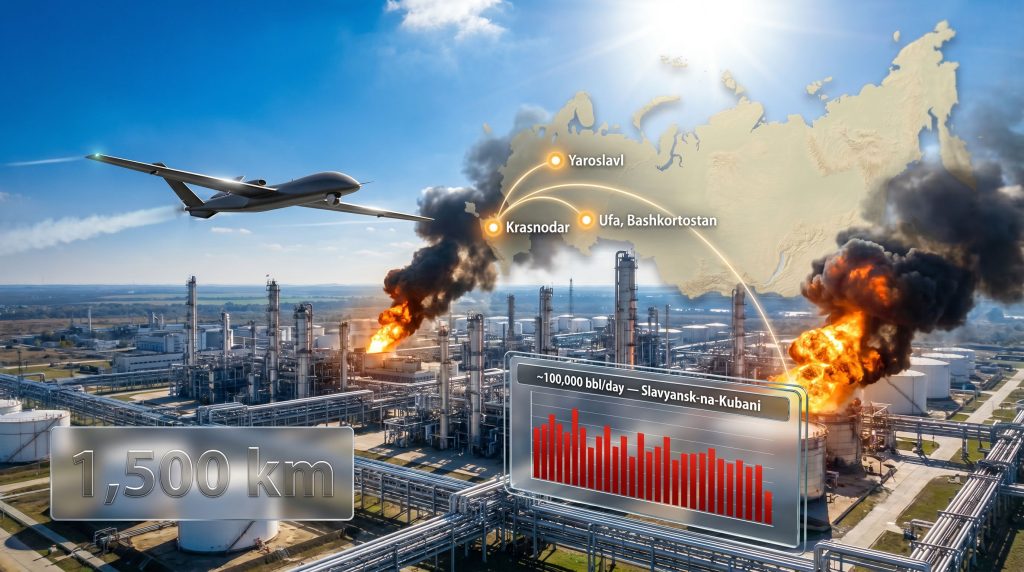
The scale and geographic ambition of the overnight strikes confirmed on 28 June 2026 illustrates how dramatically Ukraine's operational reach has expanded. President Volodymyr Zelenskyy confirmed that Ukraine hits two Russian oil refineries, located approximately 300 kilometres and 700 kilometres from Ukrainian territory, targeting facilities in the Krasnodar and Yaroslavl regions respectively.
These two strikes, however, sit within a broader campaign that has extended far deeper into Russian industrial territory:
| Strike Location | Facility | Reported Distance from Ukraine | Key Detail |
|---|---|---|---|
| Slavyansk-na-Kubani, Krasnodar | Private oil refinery | ~300 km | ~100,000 bbl/day capacity; 1 fatality reported |
| Yaroslavl Region (east of Moscow) | Refinery facility | ~700 km | Road movement restrictions imposed |
| Ufa, Bashkortostan | Bashneft-Ufaneftekhim refinery | ~1,500 km | Explosions and fires confirmed |
| Ufa, Bashkortostan | Bashneft-Novoil refinery | ~1,500 km | Partial interception claimed by Russian authorities |
| Poltavskaya, Krasnodar Krai | Oil storage depot | ~300 km | Fires reported |
| Syzran, Samara Region | Volga corridor refinery | ~800 km | Part of sustained multi-month campaign |
| Tuapse, Black Sea coast | Coastal refinery | ~200 km | Strategically significant for Black Sea export logistics |
The Slavyansk-na-Kubani facility is a privately operated plant processing roughly 100,000 barrels per day, supplying both domestic consumption and export channels. Its disruption alone removes a meaningful volume of refined product from the regional supply chain. The Krasnodar region governor confirmed a fire at the site, with one person killed and another injured in a nearby village.
In Yaroslavl, the regional governor confirmed drone attacks and noted that temporary movement restrictions were placed on road routes connecting the region to Moscow, an administrative response that signals authorities were managing both logistical and security concerns arising from the strike.
The 1,500-Kilometre Threshold and What It Means
While the Krasnodar and Yaroslavl strikes drew significant international attention, the confirmed strikes on the Bashneft refineries in Ufa, located in the Republic of Bashkortostan deep within the Ural region, represent a more consequential development in terms of strategic doctrine.
Reaching targets approximately 1,500 kilometres from Ukrainian-controlled territory signals capabilities that analysts had not widely anticipated at this stage of the conflict. In addition, the trade war impact on oil markets adds another layer of complexity to an already volatile energy environment.
- It demonstrates that Ukraine's domestically produced long-range drone fleet has achieved extended-range autonomous navigation over contested airspace.
- Bashkortostan was widely considered part of Russia's strategic industrial rear, a geographic buffer zone assumed to be insulated from kinetic pressure.
- The Bashneft group operates multiple large-scale refining assets in the Ufa cluster, making concentrated strikes against this node potentially more damaging than hitting geographically dispersed facilities.
- Successful penetration of Russian air defences at this range forces Moscow to extend its defensive perimeter considerably, consuming resources and attention that would otherwise concentrate closer to the front.
Reaching the Ural industrial heartland with sustained drone operations fundamentally changes the risk calculus for Russian industrial planners who previously treated the region as beyond credible threat range.
Why Domestic Drone Manufacturing Is the Strategic Enabler
Ukraine's capacity to execute these operations at scale rests heavily on its development of an indigenous drone production ecosystem. This industrial dimension of the conflict receives far less analytical attention than the strikes themselves, yet it underpins the entire campaign's sustainability.
Several characteristics of domestically manufactured long-range drones make them particularly suited to this mission profile:
- Cost asymmetry: Each drone costs a fraction of the refinery capacity it disrupts. Even partial damage to a facility processing 100,000 barrels per day creates economic harm that vastly exceeds the cost of the weapon system.
- Operational autonomy: Strikes can be authorised and launched without requiring allied approval, giving Ukrainian commanders flexibility that externally supplied munitions do not always permit.
- Production scalability: Indigenous manufacturing can theoretically match or exceed attrition rates without dependence on foreign supply chains subject to political constraints.
- Air defence exhaustion: Simultaneous or sequenced multi-target operations force Russian air defence systems to engage across wide geographic areas, reducing intercept probability for each individual drone.
This combination of factors creates what strategists describe as a favourable exchange ratio for the attacker, a situation where the economic and military cost to the defender of sustaining defences exceeds the cost to the attacker of continuing operations.
Fuel Shortages Inside Russia: From Strategic Theory to Street-Level Reality
The true measure of whether energy warfare is producing strategic effect lies not in the fires visible on satellite imagery but in the downstream economic consequences experienced by ordinary Russians. Available reporting from within Russia documents visible signs of supply constraint consistent with reduced refined product availability.
- Fuel queues at petrol stations in regions connected to affected refinery supply chains have been independently observed and reported.
- Rationing measures at forecourts indicate that the disruption to refining capacity is translating into tangible civilian supply restrictions rather than being fully offset by alternative sources.
- Russia, despite being one of the world's largest crude oil producers, cannot simply substitute unrefined crude for refined products at the retail level, meaning refinery outages create genuine supply gaps that take time to route around.
From a military logistics perspective, the implications are potentially more significant. Diesel fuel is the primary consumable for armoured vehicle operations, artillery logistics, and mechanised troop movements. Any competitive pressure between military and civilian demand for a shrinking refined product pool forces difficult allocation decisions that reduce one sector's operational effectiveness.
The next major ASX story will hit our subscribers first
Historical Parallels and the Limits of Attrition
Ukraine's energy warfare doctrine invites comparison with historical precedents, and those comparisons offer both encouraging patterns and cautionary lessons.
| Historical Campaign | Target | Outcome |
|---|---|---|
| Operation Tidal Wave, 1943 | Romanian refineries at Ploiești | Temporary disruption; German supply chain adapted within months |
| Gulf War coalition strikes, 1991 | Iraqi oil and fuel infrastructure | Rapid degradation of Iraqi military logistics; contributed to swift campaign outcome |
| Ukraine drone campaign, 2024-2026 | Russian national refinery network | Documented fuel shortages; strategic outcome remains open |
The most important lesson from historical energy warfare is that redundancy and adaptability determine whether attrition translates into decisive strategic effect. Russia's refinery network, while under sustained pressure, is geographically dispersed across a vast country with significant logistical depth. Previous strikes have been followed by reported emergency repair efforts and supply rerouting.
The distinguishing variable in Ukraine's favour is the persistence and expanding geographic coverage of the campaign. Unlike single-event strategic bombing raids, a sustained multi-month drone campaign continuously resets the repair timeline and forces Russian industrial managers to operate in a state of chronic uncertainty rather than recovering to a stable baseline.
Global Energy Market Implications
Russia holds a significant position in international refined petroleum markets, particularly in diesel and fuel oil categories where its export volumes carry measurable market share. Sustained damage to domestic refining capacity introduces supply-side variables that international energy markets cannot fully ignore. A thorough geopolitical oil price analysis reveals how these disruptions ripple outward well beyond Russia's borders.
Key market dynamics to monitor include:
- Diesel benchmark sensitivity: European diesel markets, already restructured by post-2022 sanctions, retain residual exposure to Russian refined product availability through third-country routing and price signal transmission.
- Aggregate production loss amplification: Simultaneous strikes across Krasnodar, Yaroslavl, and Bashkortostan create a combined production shortfall larger than any single incident analysis would suggest.
- Short-term price volatility windows: Historical patterns show that confirmed infrastructure disruptions in major producing nations generate short-duration volatility spikes, particularly in heating oil and diesel futures.
Disclaimer: The above market observations reflect analytical assessment of historical patterns and should not be construed as investment advice. Energy markets are subject to multiple intersecting variables, and price outcomes depend on factors extending well beyond any single supply disruption event.
The Dual-Track Pressure Model on Russian War Financing
What makes Ukraine's current strategic posture analytically interesting is the way it interacts with, rather than simply duplicating, Western financial pressure on Russian energy revenues. Furthermore, the evolving landscape of Russian oil trading sanctions compounds the pressure that physical infrastructure strikes are already generating.
Western sanctions on Russian crude exports have sought to cap the price at which Russian oil reaches international markets, limiting per-barrel revenue. Ukraine's physical disruption of refinery capacity operates on a different vector entirely, reducing the volume of higher-value refined products available for both domestic consumption and export.
Russian officials have publicly noted the connection between intensified drone targeting of oil facilities and the broader economic pressure environment, suggesting that Moscow perceives these as coordinated elements of a unified coercive strategy. Whether that perception is strategically accurate or reflects motivated reasoning matters less than the operational reality: Russia is simultaneously managing export price suppression and domestic production disruption. Consequently, analysts tracking the global crude steel outlook have also noted downstream industrial effects as Russian manufacturing capacity comes under related strain.
Frequently Asked Questions
How Far Inside Russia Have Ukrainian Drones Demonstrated the Ability to Strike?
Confirmed strikes range from approximately 300 kilometres in the Krasnodar region to an estimated 1,500 kilometres for the Ufa refineries in Bashkortostan, representing the deepest confirmed penetrations of the conflict to date. Reuters reporting on the Samara strikes provides additional context on the expanding operational radius.
What Is the Processing Capacity of the Slavyansk-na-Kubani Refinery?
The facility is a privately operated plant with a reported capacity of approximately 100,000 barrels per day, serving both domestic fuel markets and export channels.
Did Russian Authorities Confirm the Attacks?
Regional governors in both Krasnodar and Yaroslavl confirmed drone attacks and resulting fires. Bashkortostan authorities acknowledged explosions in an industrial zone in Ufa, with emergency services deployed. Russian authorities claimed partial interception in some instances, though independent verification of the full extent of production disruption remains limited.
What Is the Bashneft Group?
Bashneft is a major Russian petroleum company with multiple refinery assets concentrated in the Republic of Bashkortostan, including the Ufaneftekhim and Novoil facilities. The group represents a substantial component of Russia's Ural-region refining capacity and is majority-owned by Rosneft following a controversial acquisition in 2016.
Are Fuel Shortages Inside Russia Independently Confirmed?
Multiple reports document visible signs of supply constraint including queues at petrol stations and rationing measures at forecourts in regions connected to affected refinery supply chains. These observations are consistent with reduced refined product availability flowing from sustained infrastructure disruption, and when Ukraine hits two Russian oil refineries in a single operation, the cumulative supply impact extends well beyond the immediate blast radius.
Want to Stay Ahead of the Next Major Resource Discovery?
Discovery Alert's proprietary Discovery IQ model scans ASX announcements in real time, instantly converting complex mineral data across 30-plus commodities into clear, actionable insights — so investors can identify high-potential opportunities the moment they emerge. Explore historic discovery returns on Discovery Alert's dedicated discoveries page and begin your 14-day free trial to position yourself ahead of the broader market.