June 28, 2026
The Strait of Hormuz: Why a Single Waterway Can Crash Global Oil Prices in Days
Few mechanisms in global commodity markets are as brutal and immediate as the geopolitical risk premium embedded in crude oil prices. Unlike equities, where sentiment shifts can take weeks to fully reprice, oil futures respond to physical supply signals within hours. The events of late June 2026 delivered a textbook illustration of this dynamic: a sharp, conflict-driven price spike followed by an equally aggressive unwinding as tanker traffic normalised, terminals reopened, and the dominant market narrative pivoted from scarcity to surplus.
Understanding why oil falls as Strait of Hormuz flows ease supply fears requires more than simply tracking price movements. It demands an examination of how chokepoint geography, tanker economics, refinery logistics, and demand-side absorption interact to determine where crude prices settle at any given moment. For broader context on the crude market overview, these mechanisms have been building in complexity throughout 2025 and into 2026.
When big ASX news breaks, our subscribers know first
The Hormuz Chokepoint: A Geography Lesson With Trillion-Dollar Consequences
How the Strait Functions as the World's Oil Valve
The Strait of Hormuz sits between Iran and Oman at the mouth of the Persian Gulf, narrowing to roughly 33 kilometres at its tightest navigable point. Despite its modest physical dimensions, the waterway serves as the exit route for crude exports from Saudi Arabia, Iraq, Kuwait, the UAE, Qatar, and Bahrain combined.
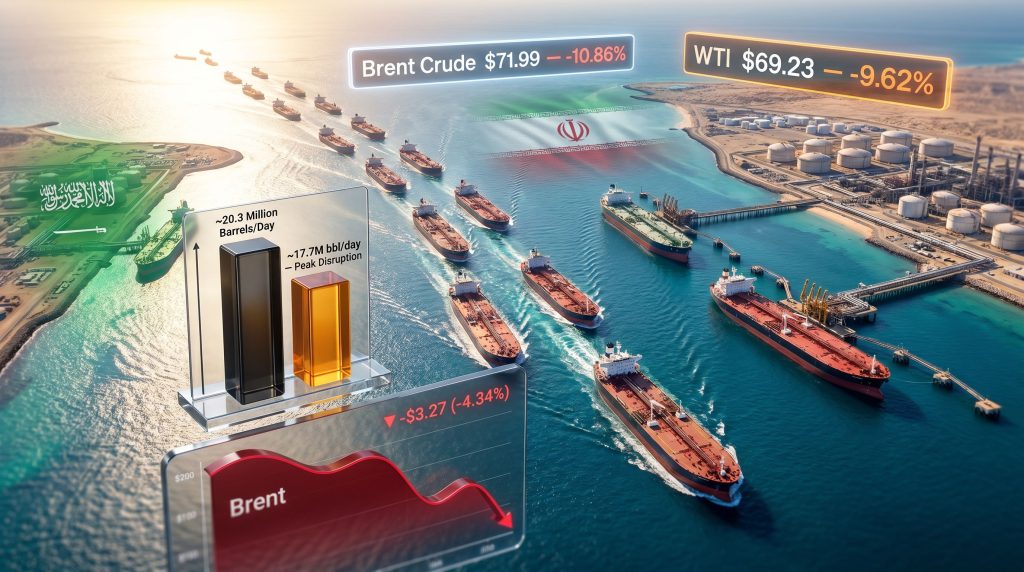
Under normal operating conditions, approximately 20.3 million barrels per day of crude oil and petroleum products transit this passage, representing close to 25% of the world's entire seaborne oil trade. To place that in context, removing Hormuz flows from global supply would be the equivalent of eliminating the entire oil production of the United States and Canada simultaneously.
During the height of conflict-related disruptions, an estimated 17.7 million barrels per day of flows were interrupted at peak stress. The compounding effect over the duration of the conflict resulted in a cumulative supply loss approaching 500 million barrels since hostilities began at the end of February 2026.
| Supply Metric | Estimated Figure |
|---|---|
| Normal daily transit volume | ~20.3 million barrels per day |
| Peak disruption to daily flows | ~17.7 million barrels per day |
| Total liquids lost since conflict onset | ~500 million barrels |
| Strait's share of global seaborne oil trade | ~25% |
Why Insurance Markets Are an Early Warning System for Crude Prices
One aspect of Hormuz risk that receives less attention than it deserves is the role of tanker war-risk insurance premiums as a leading indicator of crude price direction. When military incidents occur near the strait, specialist marine underwriters at Lloyd's of London and similar markets reprice vessel coverage within hours. This has cascading effects:
- Tanker operators factor elevated insurance costs into freight rates, effectively taxing every barrel transiting the waterway.
- Spot market buyers divert orders toward Atlantic Basin crudes from West Africa and the North Sea, bidding up alternative supply premiums.
- Very Large Crude Carriers (VLCCs), each capable of carrying 2 million barrels, begin avoiding the strait or demanding significant premium routing compensation.
- Futures markets embed a forward-looking risk premium that can persist for weeks beyond the triggering incident itself.
This insurance transmission mechanism helps explain why crude prices can spike sharply on a single incident and why the normalisation of tanker traffic — not just diplomatic statements — is what ultimately causes that premium to deflate. Furthermore, these geopolitical oil price drivers have been a recurring theme throughout the current conflict cycle.
What Drove Oil Prices Down More Than 10% in a Single Week
A Rapid Sequence of Bearish Signals
The crude oil selloff that concluded the week of June 28, 2026 was exceptional in its speed and magnitude. Brent crude futures, which had previously touched elevated levels during peak conflict headlines, closed at $71.99 per barrel, representing a weekly decline of 10.86%. WTI settled at $69.23 per barrel, down 9.62% for the same period. Within Friday's session alone, Brent shed $3.27 (4.34%) and WTI fell $2.69 (3.74%).
| Benchmark | Weekly Settlement | Weekly Decline | Single-Session Loss |
|---|---|---|---|
| Brent Crude | $71.99/bbl | 10.86% | $3.27 (4.34%) |
| WTI Crude | $69.23/bbl | 9.62% | $2.69 (3.74%) |
The scale of this move becomes more striking when set against the earlier peak: during the height of war-related headlines, July WTI futures had touched $97.91 per barrel, representing a 7.45% weekly gain at that stage of the conflict. The round trip from crisis premium to oversupply pricing compressed into a remarkably brief window. As reported by Hellenic Shipping News, oil subsequently fell to pre-Iran war lows as Hormuz flows normalised.
The Four Converging Forces Behind the Selloff
1. Tanker Traffic Through Hormuz Reached Its Highest Post-Conflict Volume
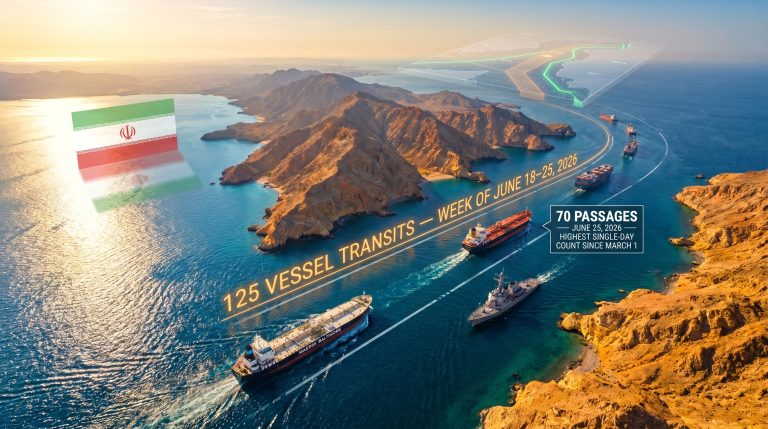
Shipping data confirmed that crude shipments through the Strait of Hormuz rose during the final week of June to their highest weekly volume since the US-Israeli conflict with Iran began at the end of February 2026. The physical movement of laden tankers provided direct market evidence that the waterway remained operational, stripping away the speculative component of the risk premium.
2. Saudi Aramco's Ras Tanura Terminal Resumed Loading
Saudi Aramco restarted crude oil loading operations at its Ras Tanura terminal on the Arabian Gulf coast after a halt lasting nearly four months. Shipping data confirmed two VLCCs actively loading at the facility, each taking on cargoes of approximately 2 million barrels, with a third vessel waiting nearby. Ras Tanura is one of the highest-capacity crude export terminals on the planet, and its return to operations materially altered near-term supply expectations.
3. A 60-Day Ceasefire Agreement Recalibrated Market Psychology
Prior to the ceasefire framework being established, futures markets had been pricing in the possibility of extended supply disruption. Once the 60-day agreement took hold, the dominant narrative flipped from scarcity to anticipated surplus. Analysts at PVM observed that the prevailing market view had shifted decisively toward an expectation of imminent oversupply conditions, a sentiment that accelerated the selloff rather than moderating it.
4. Chinese Demand Had Not Yet Stepped In to Absorb Increased Supply
As the world's largest crude importer, China's impact on oil markets functions as a critical pressure valve in global pricing dynamics. Analysts at Sparta Commodities noted that the general selloff directly reflected increased flows exiting the Strait of Hormuz combined with China not yet stepping up crude demand to absorb that additional supply. Without Chinese demand acting as a floor, the additional barrels entering the market had nowhere to go except into a bearish price move.
The Thursday Spike: When a Single Incident Temporarily Reversed the Trend
Anatomy of a One-Session Geopolitical Shock
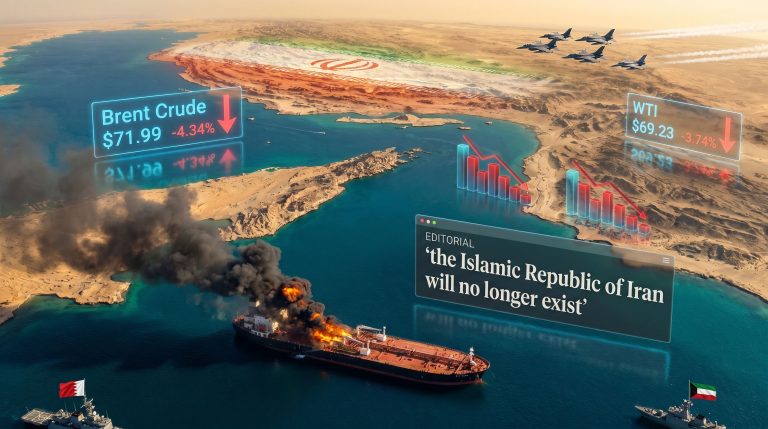
Before the week's dramatic selloff fully materialised, a single incident on Thursday briefly reintroduced risk premium buying. An unknown projectile struck a cargo vessel in waters near Oman, prompting the United Nations' shipping agency to suspend its voluntary evacuation scheme for the region. Both Brent and WTI jumped more than 2% in immediate response.
Two US officials confirmed to Reuters that Iranian forces had targeted the cargo ship as it attempted to navigate through the strait. Iranian authorities subsequently made clear that the security of vessels transiting outside designated Hormuz shipping routes could not be guaranteed, a statement that markets interpreted as a direct warning to tanker operators.
The incident was a reminder that diplomatic frameworks and physical shipping reality do not always move in lockstep. A ceasefire agreement may establish the conditions for normalisation, but it does not automatically eliminate the tactical risk of individual incidents in contested waters.
Despite the severity of the strike, the price spike proved short-lived. By the following session, the cumulative weight of improving physical supply data, resumed terminal operations, and shifting macro sentiment overwhelmed the geopolitical risk response. The failed spike itself became a signal: the market's conviction in the oversupply narrative was strong enough to absorb a genuine military incident without sustaining upward price momentum.
Iran's Continued Assertions and Their Structural Implications
Even as tanker flows improved, Iran formally reasserted its position regarding commercial shipping through the Strait of Hormuz. Gulf state governments received warnings against aligning with US strategic positioning in the region. These statements matter because they clarify the nature of the current normalisation: it is a functional improvement operating beneath a ceiling of ongoing political contestation, not a structural resolution.
Key structural risks that remain despite improved traffic:
- Total tanker volumes through the strait remain well below pre-conflict daily averages despite recent improvements.
- Tanker operators continue to price elevated war-risk premiums into freight rates on Hormuz routes.
- Terminal infrastructure at certain Gulf loading facilities requires inspection and recommissioning before reaching full operational capacity.
- The 60-day ceasefire framework, by its nature, establishes an expiry date beyond which uncertainty reasserts itself.
Russia's Diesel Export Situation: The Secondary Supply Shock Being Underestimated
Ukrainian Drone Damage and the Middle-Distillate Market
While the Hormuz narrative dominated crude oil headlines, a separate and less-discussed supply disruption was developing in global diesel markets. Russian state news agency TASS reported that authorities were evaluating a temporary diesel export ban lasting several months, a response to extensive damage inflicted on Russian oil refinery infrastructure by sustained Ukrainian drone strike campaigns.
Russia is a major global diesel exporter, supplying buyers across Asia, Africa, and parts of Europe that have historically relied on Russian middle-distillate products. Any meaningful restriction on Russian diesel exports would create tightness in the gasoil and diesel market at a moment when crude oil benchmarks were moving in the opposite direction. In addition, this oil market volatility compounds an already complex global pricing environment.
This creates a structurally complex scenario for energy analysts:
- Crude benchmark prices face bearish pressure from Hormuz normalisation and anticipated oversupply.
- Diesel and gasoil crack spreads could simultaneously face upward pressure from reduced Russian export availability.
- Refiners in Asia and Europe who process Middle Eastern crude into diesel could benefit from wider margins even as their raw material costs decline.
- Countries dependent on Russian diesel, including several Sub-Saharan African economies, may face fuel availability constraints regardless of crude price direction.
The Russia diesel situation is a secondary price support mechanism that the crude-focused market narrative is currently underweighting. Monitoring diesel crack spreads and Russian export policy announcements will be critical for a complete picture of the energy market trajectory in the months ahead.
Market Psychology and the Cycle of Geopolitical Oil Pricing
How Sentiment Drives Price More Than Fundamentals in the Short Term
The events of late June 2026 illustrate a well-documented pattern in how crude oil markets process geopolitical disruptions. Understanding this cycle is essential for investors and energy buyers attempting to navigate price volatility. Furthermore, OPEC's market influence adds another layer of complexity to how these cycles ultimately resolve:
- Conflict onset triggers supply disruption fears, driving sharp speculative buying and a rapid price spike.
- De-escalation signals such as ceasefire frameworks cause risk premium unwinding, often faster and more aggressively than the initial spike.
- Physical supply normalisation evidence, including tanker traffic data and terminal resumptions, shifts the narrative from scarcity to oversupply.
- Demand-side absorption lag keeps prices under pressure until major importers like China step up purchasing volumes to match increased supply availability.
- New equilibrium formation occurs as OPEC+ production discipline, geopolitical residual risk, and demand recovery interact to establish a price floor.
The current market sits in the transition between stages three and four, with Chinese demand trajectory and OPEC+ policy serving as the primary variables determining where oil falls as Strait of Hormuz flows ease supply fears find their next equilibrium.
Key Variables for Monitoring Future Oil Price Direction
| Variable | Bullish Signal | Bearish Signal |
|---|---|---|
| Strait of Hormuz tanker traffic | New incidents or closures | Continued normalisation |
| Saudi Aramco loading volumes at Ras Tanura | Terminal disruptions | Full operational resumption |
| Chinese crude import data | Accelerating purchases | Continued demand softness |
| Iran-US diplomatic framework | Deal collapse or tensions | Formal extended agreement |
| Russian diesel export policy | Export ban implemented | Ban avoided or lifted |
| OPEC+ production decisions | Output cuts extended or deepened | Production increases approved |
The next major ASX story will hit our subscribers first
What Investors and Energy Buyers Should Watch Next
The Incomplete Normalisation Problem
Perhaps the most important insight for market participants is that the current phase of Hormuz normalisation is partial, not complete. Traffic volumes have risen to their highest post-conflict levels, but they remain materially below pre-war daily averages. This gap between current flows and historical baseline represents both residual supply risk and the ceiling on how much bearish pressure physical supply improvements alone can generate.
Consequently, the conditions under which oil falls as Strait of Hormuz flows ease supply fears could quickly reverse if any of the structural risk factors outlined above crystallise into new disruption events. Market participants who interpret the current selloff as a definitive resolution rather than a cyclical normalisation phase risk being caught wrong-footed if the geopolitical environment deteriorates. As AA Energy has reported, oil slipping as Hormuz traffic normalises reflects diplomacy easing supply fears — but diplomacy alone rarely offers a durable resolution.
Disclaimer: The price figures and market analysis presented in this article reflect conditions as of June 28, 2026. Commodity markets are inherently volatile, and past price movements are not indicative of future performance. This article is intended for informational purposes only and does not constitute financial or investment advice. Readers should conduct independent research and consult qualified financial advisers before making investment decisions related to energy commodities.
For ongoing coverage of crude oil market developments, Hormuz shipping dynamics, and Middle Eastern energy sector analysis, ET EnergyWorld provides detailed reporting at energy.economictimes.indiatimes.com.
Want to Stay Ahead of the Next Major Commodity Market Shift?
Discovery Alert's proprietary Discovery IQ model delivers real-time alerts on significant ASX mineral discoveries, instantly translating complex market signals into actionable investment opportunities — explore the historic returns major discoveries have generated and begin your 14-day free trial today to secure a market-leading edge.