June 28, 2026
The World's Most Precarious Energy Corridor
Every barrel of oil that flows from the Persian Gulf to Asia, Europe, and beyond must pass through a stretch of water barely 33 kilometres wide at its narrowest navigable point. This is not a metaphor for fragility. It is a physical reality that shapes energy markets, military strategy, and diplomatic negotiations on a daily basis. The Strait of Hormuz tanker threats from Iran's Revolutionary Guard are not a new phenomenon, but the scale and institutional formality of the current crisis represent a significant escalation. The strait is a pressure valve for the global economy, and right now, that valve is being contested by armed force.
Understanding the current crisis requires stepping back from the daily incident reports and examining what makes this waterway so uniquely irreplaceable. There is no viable alternative pipeline network, no rerouting option, and no strategic reserve large enough to absorb a sustained closure. The strait's chokepoint geography is, in itself, a weapon, and Iran's Islamic Revolutionary Guard Corps has known this for decades.
When big ASX news breaks, our subscribers know first
From Geopolitical Leverage to Institutional Control
How the IRGC Transformed the Strait into a Governance Battleground
The Strait of Hormuz tanker threats from Iran's Revolutionary Guard did not emerge from nowhere. The IRGC Navy has historically treated the waterway as a sovereign enforcement zone rather than an international transit corridor. What has changed in 2026 is the degree of institutional formalisation behind that posture.
Tehran's establishment of a Persian Gulf Strait Authority, which mandates vessel coordination through Iranian-designated channels, represents a fundamental shift in how Iran is pursuing maritime control. This is no longer reactive harassment. It is a structured administrative framework designed to normalise Iranian gatekeeping as a permanent feature of strait governance, regardless of how the broader conflict resolves diplomatically.
Under UNCLOS, the Strait of Hormuz qualifies as an international strait used for international navigation, granting all vessels the right of transit passage. This right cannot legally be suspended by coastal states, even during armed conflict. Iran, a UNCLOS signatory, has advanced a competing interpretation, framing mandatory coordination requirements as a safety measure rather than a sovereignty claim. The proposed maritime service fees, if implemented, would almost certainly violate UNCLOS Article 44, which prohibits the imposition of charges on transit passage.
The Conflict Timeline and Its Maritime Consequences
From Closure to Cautious Recovery
The conflict that triggered the current crisis began on February 28, 2026, when US and Israeli strikes on Iran marked the outbreak of hostilities. The IRGC's response in the strait was swift and severe. Daily vessel transits, which had run at a pre-war average of more than 130 per day, collapsed toward zero as the Guard announced it had mined the passage and declared the strait closed. Furthermore, this geopolitical oil price analysis shows how rapidly armed conflict can translate into energy market disruption.
The following table maps the key moments in the strait's traffic disruption and partial recovery:
| Period | Event | Maritime Impact |
|---|---|---|
| February 28, 2026 | US and Israeli strikes on Iran | Strait traffic collapses; IRGC announces mining |
| Early March 2026 | IRGC declares strait mined and closed | Daily transits fall to near zero |
| Week prior to June 25 | 33 vessel transits for entire week | Traffic at roughly 25% of pre-war baseline |
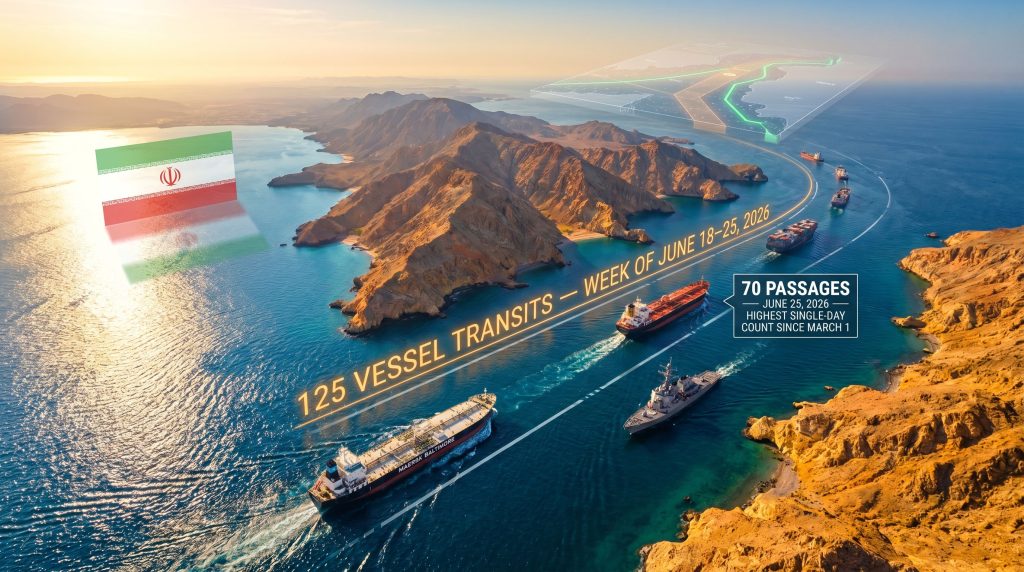
| Week of June 18-25 | 125 vessel transits recorded | Traffic recovers to approximately 96% of pre-war weekly volume |
| June 25, 2026 | 70 passages in a single day (Kpler data) | Highest single-day count since March 1, 2026 |
The recovery is real, but the gap from pre-war norms remains significant. A single-day peak of 70 passages compares to a pre-war daily average exceeding 130, meaning the strait is still operating at roughly half its historical throughput capacity on a per-day basis.
Iran's Enforcement Framework and the Verified Threat Record
What the IRGC Has Actually Done to Commercial Vessels
The IRGC's declared enforcement posture combines institutional assertions with documented hostile actions. The gap between its stated claims and independently verified reality is instructive, and tracking both helps investors and industry participants assess actual rather than perceived risk. BBC reporting has documented several of these incidents in detail, providing valuable independent verification.
| Incident Type | Details | Source |
|---|---|---|
| Drone strike on merchant vessel | Ever Lovely struck by Iranian drone off Oman coast; damage confirmed, no injuries | US official confirmation |
| Radio missile threat | IRGC personnel warned a tanker it was within missile range | Private security firm Ambrey |
| Course diversions | Three oil tankers reversed course into the Persian Gulf after IRGC radio warnings | Marine intelligence reports |
| Closure declaration | Strait declared closed; vessels attempting transit warned of lethal consequences | Iranian state media |
Comparing the IRGC's public positions against independent assessments reveals important nuance:
| IRGC Position | Independent Assessment |
|---|---|
| Strait fully closed to all vessels | US CENTCOM confirmed commercial ships continue to transit |
| Multiple vessels struck for unauthorised transit | Only the Ever Lovely strike independently confirmed |
| Only Iran-declared route is legally valid | IMO-promoted Omani coastal route successfully used by multiple vessels |
| Mandatory Channel 16 coordination required | Ships received warnings; traffic slowed but was not fully halted |
On June 25, 2026, the IRGC issued a formal statement condemning the IMO's newly promoted alternative route, describing it as unacceptable and completely dangerous, and reiterating that vessels operating outside Iranian-designated channels face serious consequences. Iranian Revolutionary Guard gunboats have previously fired on tankers in the region, and no elaboration was provided with this latest warning, but the message was unambiguous.
The IMO Alternative Route: Design, Logic, and Early Results
The Omani Coastal Corridor as a Practical Workaround
In coordination with the Sultanate of Oman, the International Maritime Organization designated an alternative transit corridor running close to Oman's coastline along the Musandam Peninsula. This route keeps vessels within Omani territorial waters for as long as geometrically possible, reducing their exposure to IRGC interdiction in the open strait.
The corridor runs south of the Traffic Separation Scheme, the pre-war standard transit lane through the centre of the strait. That central lane remains compromised by confirmed Iranian mine placement, making the Omani coastal route the only practically viable option for commercial shipping seeking to avoid US military escort dependency.
On June 25, 2026, several vessels successfully used the new route:
- Stoic Warrior led the first coordinated convoy along the IMO-promoted corridor, transiting along the UAE and Omani coastlines
- Maersk Baltimore, operated by the Danish shipping giant Maersk, completed the passage using the alternative route
- A second Maersk-chartered vessel also transited successfully the same day
The IMO's role here is worth understanding clearly. The organisation lacks enforcement authority. Its route designations are advisory rather than legally binding. What the IMO's involvement provides is multilateral legitimacy and a coordination framework, not physical protection. The distinction matters enormously for operators assessing risk.
Richard Meade, editor-in-chief at Lloyd's List, observed that commercially motivated operators, emboldened by a perceived reduction in transit risk, had begun pursuing the backlog of stranded cargoes that accumulated throughout the conflict period. (Lloyd's List, June 25, 2026)
This dynamic mirrors what the shipping industry witnessed during the 2023-2024 Red Sea Houthi crisis, when a cohort of operators willing to accept elevated risk in exchange for premium freight rates re-entered dangerous waters ahead of broader market normalisation.
US Diplomacy and the 5th Fleet's Deterrent Role
Rubio's Gulf Mission and Washington's Maritime Commitments
US Secretary of State Marco Rubio travelled to Bahrain on June 25, the island kingdom that serves as home to the US Navy's 5th Fleet, for consultations with foreign ministers from all six Gulf Cooperation Council member states. His central message was that no part of the US-Iran memorandum of understanding undermines the security, stability, or prosperity of Gulf partners.
On the question of Iranian maritime fees, Rubio stated that the US and its Gulf allies would ensure no tolls or charges are imposed on vessels transiting the strait. He also signalled directly that any interference with the IMO's alternative routing arrangement would constitute a problem requiring a US response — a warning that carries weight given the 5th Fleet's physical presence in the region.
The MOU signed the previous week established a 60-day negotiating window between Washington and Tehran to formalise a permanent ceasefire framework. However, its scope contains three critical gaps that GCC member states have formally flagged:
- No explicit restrictions on Iran's highly enriched uranium stockpile or nuclear enrichment programme
- No limitations on Iran's ballistic missile capabilities
- No formal resolution of competing maritime sovereignty claims over the Strait of Hormuz
Bahrain's Foreign Minister Abdullatif bin Rashid Al-Zayani acknowledged cautious optimism while stressing that Iran must demonstrably honour its stated commitments for the agreement to have lasting value. (Arab News, June 25, 2026)
The next major ASX story will hit our subscribers first
Lebanon: The Variable That Could Unravel Everything
How a Secondary Front Threatens the Broader Ceasefire
The Lebanon dimension introduces a destabilising variable that operates largely outside the US-Iran bilateral framework. Fighting between Israeli forces and Iranian-backed Hezbollah militants in Lebanon continued on June 25, with Israeli airstrikes killing two people in southern Lebanon on the preceding day. This was the first military action since a ceasefire took effect on the previous Saturday, raising the probability of broader re-escalation.
The casualty toll as of June 25, 2026 underscores the severity of the Lebanon conflict:
- At least 37 Israeli soldiers killed in Lebanon or northern Israel during the fighting
- More than 4,000 Lebanese civilians killed in Israeli strikes since the Israel-Hezbollah conflict began in March 2026
- Two Israeli civilians in northern Israel also killed
Any collapse of the broader ceasefire framework would almost certainly trigger a return to full IRGC maritime enforcement in the strait, reversing the traffic recovery that commercial shipping has cautiously begun to exploit. Consequently, the trade war oil impact of simultaneous geopolitical pressures across multiple regions compounds the risk profile considerably.
Global Energy Market Stakes and Scenario Analysis
Quantifying What Is at Risk
The scale of economic exposure embedded in the Strait of Hormuz cannot be overstated. Approximately one-fifth of the world's total oil and natural gas supply transits the corridor daily, along with a substantial share of Gulf LNG exports. In addition, global LNG supply chains face acute vulnerability should traffic disruption persist beyond the current partial recovery phase. A sustained closure translates directly into supply shocks across Asian, European, and North American energy markets with no viable alternative routing at equivalent scale.
| Metric | Figure |
|---|---|
| Share of global oil supply transiting daily | ~20% of world total |
| Pre-war daily vessel transits | 130+ per day |
| Peak post-conflict single-day transit count | 70 (June 25, 2026) |
| Weekly transits, week of June 18-25 | 125 vessels |
| Implied current daily throughput vs. pre-war baseline | Approximately 54% |
Three distinct trajectories are plausible from the current position:
Scenario 1: Diplomatic Stabilisation
The 60-day MOU window produces a formalised agreement covering maritime arrangements. IRGC enforcement activity de-escalates gradually. Strait traffic normalises within 60-90 days. War risk insurance premiums narrow as the risk premium dissipates.
Scenario 2: Sustained Partial Disruption
Negotiations stall on nuclear and ballistic missile issues. IRGC continues harassment and periodic vessel targeting. The IMO alternative route becomes a permanent operational standard rather than a temporary workaround. Traffic stabilises at 60-75% of pre-war baseline, and elevated insurance costs become structurally embedded in freight pricing.
Scenario 3: Full Closure Enforcement
Lebanon re-ignites broader Iran-Israel hostilities. IRGC moves from radio warnings to systematic vessel interdiction. The US 5th Fleet engages directly with IRGC naval forces. Global oil prices spike sharply and emergency strategic petroleum reserve releases are triggered across consuming nations.
Disclaimer: The scenario analysis above represents illustrative frameworks for understanding risk and does not constitute investment advice or a forecast of market outcomes. Energy markets are subject to significant uncertainty, and actual developments may differ materially from any projected trajectory.
What Investors and Shipping Operators Need to Watch
The Practical Risk-Reward Calculation in Real Time
War risk insurance premiums for Hormuz transits surged significantly after the conflict began, adding material cost to every cargo movement through the strait. The emergence of opportunistic operators willing to accept elevated physical and financial risk in exchange for premium freight rates has created a two-tier market. Furthermore, oil price movements have reflected this bifurcation in operator behaviour, with freight premiums feeding directly into benchmark pricing.
Risk-tolerant operators are chasing the stranded cargo backlog, while more conservative participants await clearer diplomatic resolution before re-entering the corridor. Several indicators deserve close monitoring in the weeks ahead:
- Weekly vessel transit counts from Lloyd's List Intelligence and Kpler as a barometer of commercial confidence
- IRGC radio incident frequency reported through private security firms such as Ambrey, indicating actual enforcement intensity
- Progress or breakdown of MOU negotiations within the 60-day window, particularly on nuclear and maritime sovereignty clauses
- Lebanon ceasefire durability, given its direct linkage to broader Iran-Israel tensions and IRGC operational posture
- GCC member state statements, which have historically provided early signals of regional diplomatic temperature
The OPEC market influence on broader supply decisions will also shape how consuming nations respond to sustained Hormuz disruption, particularly if producer nations elect to compensate through output adjustments. The Strait of Hormuz tanker threats from Iran's Revolutionary Guard represent the most acute near-term variable, but the structural tension between Iranian sovereign assertions and international transit law remains the underlying driver — one that no single diplomatic agreement is likely to fully resolve.
Want to Stay Ahead of the Resource Opportunities Emerging From Global Energy Disruptions?
When geopolitical crises like the Strait of Hormuz conflict reshape commodity markets overnight, Discovery Alert's proprietary Discovery IQ model delivers real-time alerts on significant ASX mineral discoveries — instantly translating complex market shifts into actionable investment opportunities. Start your 14-day free trial at Discovery Alert and explore how historic mineral discoveries have generated substantial returns even amid global uncertainty.