August 7, 2026
The Raw Material War Beneath the AI Revolution
Before a single AI model trains on a dataset, before a semiconductor fabricates a transistor, and before an electric vehicle charges its battery, something far more fundamental must happen: minerals must come out of the ground, be refined into usable form, and travel through supply chains that are increasingly contested terrain. The global race for artificial intelligence supremacy is, at its foundation, a race for geological assets and the industrial infrastructure to process them.
This reality is reshaping alliances, redirecting capital flows, and forcing governments to think about trade policy with the urgency once reserved for military strategy. The India-US AI and critical minerals partnership has emerged as one of the most structurally significant responses to this challenge, combining the world's largest democracy by population with the world's largest economy by GDP into a framework designed to compete at civilisational scale.
When big ASX news breaks, our subscribers know first
What Is Driving the India-US AI and Critical Minerals Partnership in 2026?
Three converging forces have made this partnership both urgent and necessary. First, AI infrastructure demand has reached a scale where compute capacity is constrained not by software engineering but by physical hardware, and physical hardware depends on refined minerals that are concentrated in very few hands globally. Second, semiconductor supply chain fragmentation, accelerated by trade tensions and export restrictions, has exposed the fragility of single-source dependencies.
Third, the geopolitical contest over critical mineral flows has intensified to the point where access to processed rare earths and lithium compounds has become a direct determinant of national technological capability. Furthermore, the critical minerals demand surge driven by the energy transition has compounded these pressures significantly.
India and the United States have recognised that operating independently within this environment creates structural vulnerabilities neither can absorb alone. The partnership they have constructed is not a single bilateral agreement but a layered architecture spanning multiple frameworks, multilateral coalitions, and industry-driven execution mechanisms.
From iCET to TRUST: How the Strategic Framework Evolved
The earlier Initiative on Critical and Emerging Technology, known as iCET, established the conceptual foundation for India-US technology cooperation. The TRUST Initiative, which stands for Transforming the Relationship Utilizing Strategic Technology, represents a meaningful elevation of that foundation into operational architecture. Jointly steered by the National Security Advisors of both nations, TRUST signals that this cooperation sits at the apex of bilateral strategic priorities rather than within the narrower domain of trade or commerce.
The scope is deliberately expansive. Under a single cooperation umbrella, TRUST encompasses:
- Artificial intelligence and AI infrastructure development
- Semiconductor design, fabrication, and supply chain integration
- Quantum computing and secure communications
- Defense technology collaboration
- Biotechnology and advanced energy systems
- Space technologies
This breadth is intentional. The technological domains listed are not independent verticals but deeply interconnected systems. Quantum computing affects cryptography, which affects secure AI communications, which depends on semiconductors, which require critical minerals. Treating them as a unified portfolio rather than isolated programmes reflects a more sophisticated understanding of how technology competition actually works.
The Pax Silica Alliance and India's Role in a 35-Nation Coalition
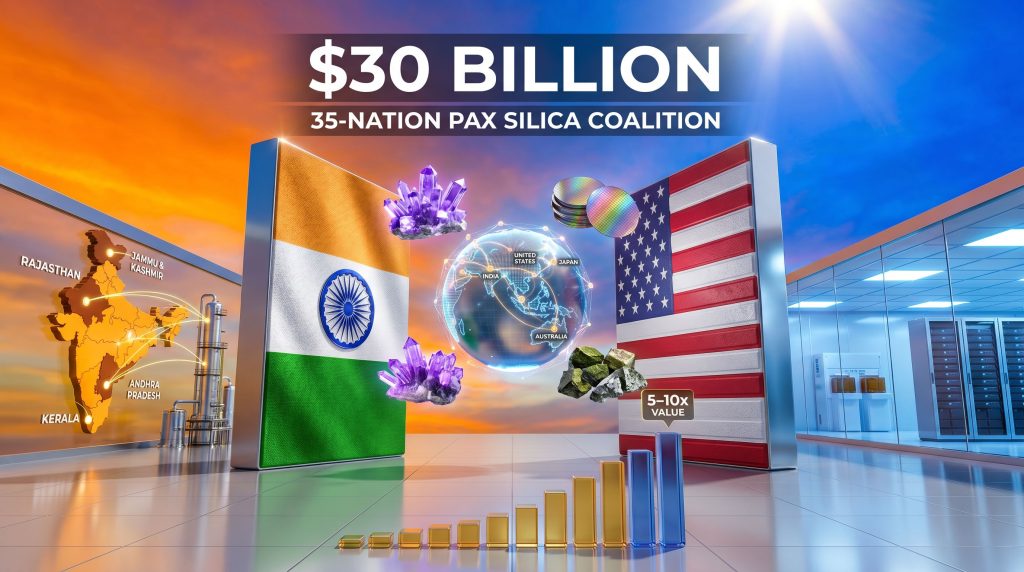
In December 2024, the United States launched Pax Silica, a coalition of 35 nations assembled to co-build trusted supply chains for AI chips, semiconductors, and critical minerals. India's formal inclusion in this coalition carries significance beyond diplomatic symbolism. It represents a structural repositioning of India from a technology consumer at the periphery of global supply chains to an active co-architect of the systems that will underpin the global AI economy for decades.
The critical minerals and semiconductors coalition complements the bilateral TRUST objectives by operating at a multilateral scale. Where bilateral agreements create deep ties between two parties, multilateral coalitions create the systemic redundancy and market depth needed to genuinely displace single-source dependencies rather than merely supplement them.
The Four Pillars of India-US Strategic Technology Cooperation
"The India-US partnership is not a single agreement. It is a layered architecture of bilateral frameworks, multilateral alliances, and industry-driven execution mechanisms spanning four distinct technology domains."
| Domain | Initiative | Core Objective |
|---|---|---|
| AI Infrastructure | AI Infrastructure Roadmap (TRUST) | Enable US-origin AI build-out in India by resolving financing, power, and connectivity bottlenecks |
| Critical Minerals | Bilateral Critical Minerals Framework (signed May 26, 2026) | Cover mining, processing, recycling, and investment for lithium and rare earths |
| Semiconductors | India Semiconductor Mission Phase 2 | Establish domestic fabrication capacity and integrate into trusted global supply chains |
| Multilateral Alignment | Pax Silica plus Quad Critical Minerals Initiative | Mobilise up to $20 billion across member nations for mining and recycling infrastructure |
AI Infrastructure: Building the Physical Backbone
The AI Infrastructure Roadmap, a flagship deliverable within TRUST, addresses three core bottlenecks that have historically limited large-scale AI compute deployment in India: financing access, reliable power supply, and high-capacity connectivity. Each of these is simultaneously a technical challenge and a policy challenge, requiring government action to create the enabling environment and private capital to build the actual infrastructure.
India's digital public infrastructure provides a uniquely compelling deployment environment. Systems such as the Unified Payments Interface, Aadhaar biometric identification, and the Open Network for Digital Commerce represent population-scale digital platforms that few other nations can match. These platforms create a ready-made substrate for AI deployment that compresses the time between infrastructure investment and economic returns.
India's Ministry of Electronics and Information Technology has communicated clearly that the country's ambition extends beyond domestic AI applications. The stated objective is to develop AI-driven solutions exportable to the Global South, a market representing several billion people with substantial unmet demand for technology-enabled services in healthcare, agriculture, finance, and education.
Semiconductors: From Assembly to Fabrication
India's electronics manufacturing sector has undergone a transformation that was not widely anticipated even five years ago. Smartphone assembly at scale, driven by production-linked incentive schemes, has created a manufacturing ecosystem that now serves as the foundation for more ambitious industrial goals. Phase 2 of the India Semiconductor Mission is designed to translate this ecosystem momentum into domestic fabrication capacity, moving India from component assembly toward integrated circuit production.
The strategic value of allied-nation fabrication capacity cannot be overstated in the current geopolitical environment. The global semiconductor industry is concentrated in a small number of geographic nodes, and any disruption to those nodes creates cascading failures across AI, defense, automotive, and consumer electronics supply chains simultaneously. India's emergence as an additional trusted fabrication node would materially reduce this systemic fragility.
Critical Minerals: The Bilateral Framework Signed May 26, 2026
The Bilateral Critical Minerals Framework, formalised on May 26, 2026, covers the full value chain from extraction through to recycling. According to the US Embassy announcement, its primary mineral focus is lithium and rare earth elements, the two categories most critical to AI hardware, EV battery systems, and defense electronics. The framework establishes mechanisms for mining investment, processing infrastructure development, and bilateral recycling pathways.
The strategic rationale is explicit: reducing vulnerability to monopolistic supply control. The US has mobilised over $30 billion in support for critical mineral and AI infrastructure projects within the broader partnership architecture. This figure encompasses government-anchored commitments designed to de-risk private sector participation rather than replace it.
However, understanding the rare earth processing challenges that both nations face is essential context for evaluating the framework's ambitions. Processing rare earths requires specialised industrial infrastructure, significant capital investment, and environmental management capability that must be built over years rather than months.
Quantum Technologies: The Next Frontier of Cooperation
Quantum computing represents the emerging fourth pillar within TRUST. Rather than developing parallel independent programmes, both nations have determined that co-development offers superior outcomes given the complementary nature of their assets. India possesses a research base with demonstrated strength in quantum physics and mathematics, while the United States has the world's most developed commercial quantum ecosystem.
The intersection of quantum and AI creates compounding strategic value. Quantum algorithms offer potential breakthroughs in optimisation problems central to logistics, drug discovery, and materials science. These are not theoretical futures but active research and early commercialisation fronts.
Can Government Frameworks Alone Deliver on India-US Technology Ambitions?
There is a structural limitation inherent to government-to-government agreements that must be acknowledged honestly. Frameworks establish enabling conditions. They create the legal architecture, the policy incentives, and the diplomatic credibility that make private investment viable. However, they cannot drive investment velocity, compress innovation cycles, or build operational facilities.
Senior officials from India's Ministry of External Affairs and MeitY have been explicit on this point at forums including the USISPF roundtable on US-India cooperation from minerals to microchips. The consistent message from both governments is that industry must own the execution layer. Capital deployment, talent mobilisation, research and development pipelines, and commercial scaling are functions that require private sector leadership.
The USISPF's president has characterised microchips and critical minerals as the defining economic inputs of the modern era, equivalent to oil and steel in earlier industrial epochs. This framing has practical implications for investment prioritisation: companies and funds that establish positions in these supply chains during the build phase may capture returns that are difficult to access once the architecture is established.
The Role of Industry Forums in Bridging Policy and Execution
The US-India Strategic Partnership Forum operates as a structured intermediary between government policy intent and private sector action. The significance of convening officials from the US Department of Commerce and the US Department of Energy alongside their Indian counterparts and industry leaders within the same room is not ceremonial. It creates direct communication channels through which regulatory concerns, investment barriers, and market access questions can be resolved at speed.
Private sector players engaging with this framework are expected to deliver across three distinct execution mandates:
- Capital investment in semiconductor fabrication and mineral processing infrastructure
- Innovation in AI applications specifically tailored to India's digital public infrastructure environment
- Supply chain integration into trusted global networks that meet allied-nation technology transfer and security requirements
Risk considerations for private sector participants include regulatory alignment between Indian and US technology export control regimes, intellectual property protection frameworks, data localisation requirements, and the workforce development investment needed to sustain fabrication operations at commercial scale.
India-US Critical Minerals Cooperation vs. Other Global Frameworks
| Framework | Members | Financial Commitment | Key Minerals | Governance Structure |
|---|---|---|---|---|
| India-US Bilateral Critical Minerals Framework | 2 nations | Part of $30B+ US mobilisation | Lithium, rare earths | National Security Advisor-led |
| Pax Silica | 35 nations | Not publicly disclosed | AI chips, semiconductors, critical minerals | US-led coalition |
| Quad Critical Minerals Initiative | 4 nations | Up to $20 billion | Broad critical minerals plus recycling | Quad foreign ministers framework |
| EU Critical Raw Materials Act | EU member states | Billions via European Investment Bank | 34 strategic raw materials | EU regulatory framework |
Where India's Comparative Advantage Lies in Global Critical Mineral Supply Chains
India's geological endowments are more significant than commonly understood in mainstream coverage. Lithium deposits have been identified in Rajasthan and Jammu and Kashmir, while rare earth reserves are concentrated in Andhra Pradesh and Kerala. The Geological Survey of India has reported lithium inferred resources in the Salal-Haimana area of Jammu and Kashmir estimated at approximately 5.9 million tonnes, though the economic extractability of these resources requires further technical assessment.
A critical but underappreciated distinction in critical mineral economics is the difference between extraction and processing. Raw mineral ore commands a fraction of the value of processed mineral compounds. Processed rare earth compounds can command 5 to 10 times the market value of equivalent raw ore. Consequently, the strategic and economic priority for India is not simply to identify and extract mineral resources but to build the refining and processing infrastructure that captures this value differential domestically. The broader rare earth supply chain importance extends well beyond any single bilateral framework.
The China Dependency Problem: What the Partnership Is Designed to Solve
The scale of China's dominance in rare earth supply chains is frequently cited but rarely internalised in its full strategic implications. China controls approximately 60% of global rare earth mining and over 85% of global rare earth processing capacity. This is not merely a market concentration issue. It represents a single point of failure embedded in the supply chains of virtually every advanced technology system in the world.
The pattern of how this leverage can be applied has become observable. Export restrictions on specific minerals or mineral compounds, applied selectively, can create supply shocks for targeted industries or nations without triggering the broad economic retaliation that conventional trade restrictions invite. Building processing capacity across allied jurisdictions is the structural response to this vulnerability, and it is precisely what the India-US bilateral framework and the Quad Critical Minerals Initiative are designed to accelerate. As Al Jazeera's analysis of the deal highlights, this framework carries implications that extend well beyond the two signatory nations.
How the TRUST Initiative Could Transform India's Industrial Economy
The Electronics Manufacturing Multiplier Effect
India's electronics export trajectory has shifted dramatically. Smartphone manufacturing has served as the leading indicator of a broader capability build, but its downstream effects extend well beyond handset assembly. As semiconductor fabrication comes online domestically, the value-capture equation changes fundamentally. India moves from earning assembly margin on imported components to capturing integrated circuit production margin on domestically produced chips.
The downstream industrial effects are substantial:
- Printed circuit board manufacturing capability deepens alongside chip supply
- Advanced packaging and chip design ecosystem development creates high-value engineering employment
- Domestic component availability reduces import dependency across consumer electronics, automotive, and industrial sectors
AI as an Economic Infrastructure Layer
The AI Infrastructure Roadmap's potential to position India as a hyperscale AI compute destination for the Indo-Pacific region depends on resolving the power and connectivity bottlenecks identified within TRUST. India's electricity grid capacity and the availability of reliable, high-capacity internet infrastructure in tier-2 and tier-3 cities remain constraints that require coordinated investment.
In addition, the lithium demand growth associated with AI data centre battery storage systems further underscores the urgency of securing domestic and allied-nation supply chains. Resolving these constraints creates co-benefits for India's broader digital economy that extend well beyond AI infrastructure specifically.
The ambition articulated by India's technology officials, that the country should develop solutions not just for its own population but for the world, reflects a market logic that is commercially sound. The Global South represents the largest underserved addressable market for digital services globally, and India's combination of cost-competitive engineering talent, existing digital public infrastructure, and AI capability positions it as a credible provider to that market.
The next major ASX story will hit our subscribers first
What Must Happen Next for the India-US Partnership to Deliver on Its Ambitions?
Three Critical Execution Gaps That Must Be Closed
-
Financing architecture: Multilateral development bank participation, blended finance structures combining concessional and commercial capital, and export credit agency alignment are needed to mobilise the private capital required for mineral processing plants and semiconductor fabrication facilities. These are capital-intensive, long-cycle assets that require patient financing structures to attract commercial investment at the required scale.
-
Regulatory harmonisation: US technology export control regimes, specifically the International Traffic in Arms Regulations and Export Administration Regulations, must be aligned with India's industrial ambitions. Data localisation policies and intellectual property protection frameworks must be robust enough to give US technology companies the confidence needed to transfer advanced manufacturing processes to Indian facilities.
-
Workforce pipeline: Semiconductor fabrication requires a specialised engineering workforce that takes years to develop. India's academic institutions and the US-India academic partnership network must be calibrated explicitly to this demand, with curriculum development, research collaboration, and industry placement programmes designed around the specific competencies that fabrication facilities require.
The Geopolitical Timeline Pressure
The window for constructing alternative critical mineral supply chains is narrow and closing. China's ongoing investment in processing capacity expansion and its demonstrated willingness to deploy export restriction tools as strategic instruments creates a competitive clock that allied-nation strategies must race. Infrastructure decisions made during the 2026 to 2030 period will establish the supply chain architecture that governs technology production for the following two decades.
India's democratic governance model, while sometimes slower in initial execution, provides a form of long-term strategic reliability that authoritarian alternatives cannot replicate. Supply chain partners, technology investors, and allied governments can reasonably expect policy continuity, contractual enforceability, and political accountability. This is a genuine competitive advantage in the contest for trusted supply chain status, not merely a diplomatic talking point.
"The India-US AI and critical minerals partnership represents one of the most consequential industrial alignment decisions of the 2020s. Its success will depend not on the sophistication of its frameworks, but on the speed and scale at which private sector actors convert diplomatic architecture into deployed capital, operational facilities, and integrated supply chains."
FAQs on the India-US Strategic Technology and Critical Minerals Partnership
What is the TRUST Initiative between India and the US?
TRUST, which stands for Transforming the Relationship Utilizing Strategic Technology, is the bilateral framework governing India-US cooperation across AI, semiconductors, quantum computing, critical minerals, defense, biotechnology, energy, and space technologies. It is jointly steered by the National Security Advisors of both nations and represents an evolution and expansion of the earlier iCET framework into a more operationally focused cooperation architecture.
What minerals are covered under the India-US Critical Minerals Framework?
- Primary focus: lithium and rare earth elements
- Scope: mining investment, processing infrastructure development, recycling pathways, and bilateral investment mechanisms
- Strategic objective: reducing dependence on single-source suppliers and building resilient, allied-nation supply chain architecture
What is Pax Silica and why did India join?
Pax Silica is a US-led 35-nation alliance launched in December 2024 to secure trusted supply chains for AI chips, semiconductors, and critical minerals. India's membership represents a strategic repositioning from technology consumer to co-architect of the global AI and semiconductor economy, providing access to allied-nation technology transfer, investment flows, and supply chain integration opportunities.
How much funding is the US committing to this partnership?
- The US has mobilised over $30 billion in support for critical mineral and AI infrastructure projects within the broader partnership
- The Quad Critical Minerals Initiative separately targets up to $20 billion across member nations for mining and recycling infrastructure
- Private sector capital is expected to multiply government-anchored commitments substantially, given that the government commitments are structured to de-risk rather than replace private investment
What role does India's semiconductor mission play in the partnership?
Phase 1 of the India Semiconductor Mission established the policy incentive architecture and attracted initial investment commitments. Phase 2 focuses on delivering operational fabrication capacity at commercial scale. Furthermore, the partnership provides India's semiconductor ambitions with access to US technology, manufacturing equipment, and trusted supply chain network integration, supporting India's goal of becoming a resilient allied-nation node alongside Taiwan, South Korea, Japan, and the Netherlands in the global semiconductor production landscape.
Disclaimer: This article contains forward-looking statements, projections, and analysis based on publicly available information as of the date of writing. Financial commitments, policy frameworks, and strategic timelines referenced are subject to change. This content is for informational purposes only and does not constitute investment advice. Readers should conduct their own due diligence before making investment decisions.
Want to Track the ASX Mineral Discoveries Powering the Critical Minerals Race?
Discovery Alert's proprietary Discovery IQ model delivers real-time alerts the moment significant ASX mineral discoveries are announced, transforming complex geological data into actionable investment insights for both short-term traders and long-term investors — start your 14-day free trial today and explore how historic mineral discoveries have generated extraordinary returns to understand what early positioning in critical commodities can mean for a portfolio.