August 6, 2026
The Hidden Architecture of European Steel Trade Defence
Global steel markets have spent decades absorbing the consequences of structural overcapacity, with production systems built for geopolitical ambition rather than demand fundamentals. When any single producing nation expands output beyond domestic consumption, the surplus invariably seeks export destinations, and the path of least resistance typically leads toward open, high-value markets. Europe, with its deep manufacturing base and relatively transparent procurement systems, has historically been a primary absorption point for displaced steel volumes. The cumulative effect of that dynamic is now visible in the EU's accelerating deployment of trade defence instruments, with the latest round of EU anti-dumping duties on cold-rolled coil imports representing one of the most comprehensive flat steel protection packages the bloc has assembled in recent memory.
When big ASX news breaks, our subscribers know first
Understanding Cold-Rolled Coil and Its Strategic Role in European Industry
Cold-rolled coil (CRC) is produced by passing hot-rolled steel through a series of rolling mills at room temperature, a process that achieves tighter dimensional tolerances and significantly improved surface finish compared to its hot-rolled counterpart. The room-temperature processing work-hardens the steel, increasing its tensile strength while reducing thickness to precise specifications, typically between 0.3mm and 3mm.
This precision makes CRC indispensable across a wide range of downstream applications:
- Automotive body panels and structural components, where surface consistency directly affects paint adhesion and panel fit tolerances
- White goods and domestic appliances, including washing machine drums, refrigerator casings, and oven panels
- Construction and industrial equipment, particularly in lightweight structural fabrications
- Electrical enclosures and precision engineering components requiring controlled mechanical properties
It is worth clarifying what CRC is not. The EU's anti-dumping measures target cold-rolled flat products of iron or non-alloy steel specifically. Stainless steel cold-rolled flat products fall under entirely separate EU regulations, with distinct measures already in force targeting imports from China and Taiwan. Electrical steel (both grain-oriented and non-grain-oriented) and certain thin black plate products used in packaging are also excluded from CRC anti-dumping scope.
The distinction between CRC and hot-dipped galvanised (HDG) steel is particularly relevant to understanding current European supply dynamics. HDG is produced by coating CRC with a zinc layer for corrosion resistance, commanding higher margins. European mills have been progressively redirecting capacity toward HDG production, reducing the available CRC supply base and creating structural dependencies on imported material that took years to build and cannot be reversed quickly.
The Five-Country Investigation: Why India, Japan, Taiwan, Turkey, and Vietnam?
Anti-dumping investigations in the EU do not begin with the European Commission acting unilaterally. Under the EU's trade defence framework, the process is complaint-driven. In this case, Eurofer, the European Steel Association, lodged a formal complaint on behalf of domestic producers, alleging that below-cost CRC imports from five origin countries were causing material injury to EU industry. The Commission assessed whether the complaint met the standing threshold, which typically requires the complainant to represent more than 25 percent of total EU production of the relevant product, before formally opening an investigation.
The investigation examined the period from 1 July 2024 to 30 June 2025, covering pricing behaviour, production economics, and export patterns from each of the five targeted jurisdictions. Importantly, the Commission also initiated import monitoring of CRC in early December, which created market speculation about the possible imposition of retroactive duties. That expectation ultimately proved unfounded. The EU determined that retroactive measures were not warranted, meaning all definitive duties apply only from the date of publication in the EU Official Journal.
Definitive Duty Rates by Country and Producer
The duty structure reflects the EU's lesser duty rule, a WTO-compliant methodology under which the definitive anti-dumping rate is capped at the lower of the dumping margin or the injury margin. This prevents the EU from imposing duties exceeding what is strictly necessary to eliminate harm to domestic producers.
| Country | Key Producer(s) | Dumping Margin | Injury Margin | Definitive AD Duty |
|---|---|---|---|---|
| India | JSW Steel; JSW Steel Coated Products | 9.5% | 25.5% | 9.5% |
| India (all other) | All other Indian imports | 9.5% | 25.5% | 9.5% |
| Japan | Nippon Steel; Daido Steel | 56.0% | 28.0% | 28.0% |
| Japan (all other) | All other Japanese imports | 56.0% | 28.0% | 28.0% |
| Taiwan | China Steel; Chung Hung Steel | 36.5% | 20.7% | 20.7% |
| Taiwan (all other) | All other Taiwanese imports | 59.6% | 27.0% | 27.0% |
| Turkey | Borcelik Celik Sanayi Ticaret | 9.7% | 12.9% | 9.7% |
| Turkey | Tatmetal Celik Sanayi ve Ticaret | 5.6% | 17.7% | 5.6% |
| Turkey (all other) | All other Turkish imports | 9.7% | 17.7% | 9.7% |
| Vietnam | Posco Vietnam | 16.0% | 25.8% | 16.0% |
| Vietnam (all other) | All other Vietnamese imports | 16.0% | 25.8% | 16.0% |
Japan's situation is instructive for understanding how the lesser duty rule operates in practice. Despite investigators calculating a 56.0% dumping margin for Nippon Steel and Daido Steel, the definitive duty is set at only 28.0%, because that lower figure represents the injury elimination level. The duty is calibrated to remedy harm, not to punish. Conversely, Turkey's Tatmetal benefits from the lowest rate across the entire measure at 5.6%, reflecting a calculated dumping margin that falls below even its own injury threshold of 17.7%.
The lesser duty rule is a structural constraint embedded in EU trade law that prevents anti-dumping measures from functioning as punitive tariffs. Even where dumping behaviour is severe, the duty ceiling is the minimum required to restore fair competitive conditions for domestic producers, not a proportional penalty for the degree of pricing below normal value.
Named Annex Companies and Cooperation Incentives
A critical but often overlooked feature of EU anti-dumping proceedings is the distinction between sampled producers and annex companies. Producers that fully cooperate with an investigation and provide complete data receive individually calculated duty rates. Non-cooperating producers face the highest applicable country-wide rate as a deterrent. Annex-listed companies receive the same rate as the primary sampled producers from their country.
India: JSW Steel; JSW Steel Coated Products (9.5%) | Annex: Tata Steel
Japan: Nippon Steel; Daido Steel (28.0%) | Annex: JFE Steel; Proterial
Taiwan: China Steel; Chung Hung Steel (20.7%) | Annex: Synn Industrial | All other: 27.0%
Turkey: Borcelik (9.7%); Tatmetal (5.6%) | Annex: Erdemir Group (Eregli Demir ve Celik Fab; Erdemir Celik Servis Merkezi San. ve Tic); Atakas Celik Sanayi Ve Ticaret Anonim Sirketi; Yildiz Entegre Agac Sanayi ve Ticaret; Gazi Metal Mamulleri Sanayi ve Ticaret
Vietnam: Posco Vietnam (16.0%) | Annex: China Steel and Nippon Steel Joint Stock; Hoa Sen Group Joint Stock
How the New Measures Sit Within the EU's Existing CRC Protection Architecture
These five-country measures do not arrive in isolation. The EU established its foundational CRC anti-dumping framework through Regulation (EU) 2016/1328, which imposed duties on imports from China and Russia. Those measures have remained in force and were formally reconfirmed in 2022, demonstrating the long-term, multi-cycle nature of EU trade defence instruments. Furthermore, the EU steel action plan signals that trade defence will remain a core pillar of European industrial strategy well beyond this investigation cycle.
| Origin Country | Regulatory Basis | Duty Rate Range | Status |
|---|---|---|---|
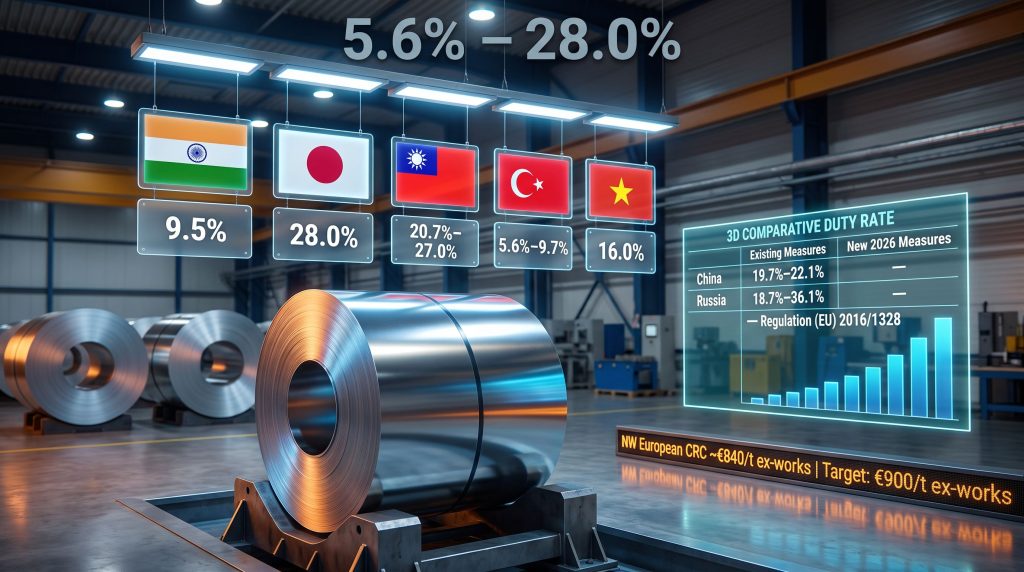
| China | Regulation (EU) 2016/1328 | 19.7% – 22.1% | In force |
| Russia | Regulation (EU) 2016/1328 | 18.7% – 36.1% | In force |
| India | New 2026 Measures | 9.5% | Pending Official Journal publication |
| Japan | New 2026 Measures | 28.0% | Pending Official Journal publication |
| Taiwan | New 2026 Measures | 20.7% – 27.0% | Pending Official Journal publication |
| Turkey | New 2026 Measures | 5.6% – 9.7% | Pending Official Journal publication |
| Vietnam | New 2026 Measures | 16.0% | Pending Official Journal publication |
The layering of new measures on top of the 2016 framework creates a comprehensive import shield covering the majority of the world's significant CRC exporting nations. With China, Russia, India, Japan, Taiwan, Turkey, and Vietnam now all subject to EU anti-dumping duties on cold-rolled coil imports, the pool of duty-free origin countries capable of supplying the European market competitively has contracted dramatically.
The EU Anti-Dumping Process: How a Five-Country Investigation Unfolds
For buyers and market participants unfamiliar with EU trade defence procedure, the timeline and decision architecture matter significantly for planning:
- A domestic industry group, such as Eurofer, submits a formal complaint to the European Commission with evidence of dumping and material injury
- The Commission evaluates whether the complaint meets standing requirements, typically a 25% production threshold
- A formal investigation is initiated, with a standard resolution window of 14 months
- Provisional measures can be applied within nine months if early evidence of injury is established
- Definitive measures are formally adopted and published in the EU Official Journal
- Legal enforceability begins from the date of Official Journal publication
The significance of the Official Journal publication step is frequently underestimated. Until that moment, no legal obligation exists for importers to pay the duties, even if the investigation outcome has been reported widely. The publication date is the actual enforcement trigger.
Market Impact: Prices, Supply Constraints, and Buyer Exposure
The market consequences of this investigation have been unfolding progressively since the probe was announced, not just from the date of the final determination. European CRC prices have climbed steadily throughout the investigation period, with mills actively leveraging the regulatory uncertainty and the anticipation of tighter supply to justify price escalation. This pattern aligns closely with the broader global crude steel outlook for 2025, where tightening trade conditions are amplifying domestic pricing power across multiple regions.
Current offer levels in the northwest European CRC market are reported at approximately €840 per tonne ex-works, with some market participants projecting a near-term ceiling of €900 per tonne ex-works as mills test buyer tolerance in a structurally tighter environment.
European CRC buyers are navigating a procurement environment that has fundamentally shifted. Five historically competitive import origins are being removed simultaneously, and domestic supply capacity has not expanded to compensate. The result is a market where European mills hold considerably more pricing power than they have for many years.
Several structural factors are amplifying the regulatory impact:
- European CRC production capacity was progressively eroded over years of import dependency, and that capacity cannot be rebuilt rapidly
- EU mills have prioritised HDG production for its superior margins, reducing the CRC supply base from within
- The EU's Carbon Border Adjustment Mechanism (CBAM) is simultaneously increasing the landed cost of imports, compounding the effect of anti-dumping duties for non-EU exporters
- Safeguard tariff-rate quotas (TRQs) operating in parallel with anti-dumping duties can create quota exhaustion scenarios where affected exporters face both duty burdens simultaneously
Downstream Cost Exposure by Sector
The cost implications do not terminate at the steel import level. Several downstream European manufacturing sectors carry significant CRC intensity:
- Automotive manufacturers face direct input cost pressure on body panel and structural component production, with limited short-term substitution options at the volume scales required
- White goods producers typically operate on thin margins where material cost movements directly compress profitability
- Construction and industrial equipment fabricators have secondary exposure through steel service centres and component suppliers
- Steel distributors and service centres holding pre-duty inventory may experience short-term margin benefits, while buyers on spot contract terms absorb the full price impact immediately
The next major ASX story will hit our subscribers first
CBAM, Carbon Intensity, and India's Strategic Response
The interaction between anti-dumping duties and CBAM represents one of the more complex regulatory dynamics facing non-EU steel exporters. Anti-dumping duties are price-based, applied as a percentage of declared import value at the EU frontier. CBAM charges are carbon-based, calculated according to the embedded emissions intensity of the specific production route used. Both can apply simultaneously to the same import consignment.
For Indian flat steel exporters, the combined burden is particularly instructive. Research published by climate think tank Sandbag in August 2026 assessed that India's overall CBAM exposure across all covered product categories could reach approximately €762 million by 2034 using national average emissions values, with iron and steel comprising the dominant share of that figure at roughly €735 million.
However, Sandbag's analysis identifies a strategically significant mitigation pathway. By channelling output from lower-emission production routes toward EU-bound shipments, while directing more carbon-intensive production to domestic or other export markets, India's aggregate CBAM liability could fall to approximately €407 million, representing a reduction of roughly 47 percent without requiring any new capital investment in steelmaking technology.
The production route distinction that underlies this strategy is technically important:
| Production Route | Emissions Intensity | Share of Indian Production |
|---|---|---|
| Gas-based DRI-EAF | 1.4 – 1.6 t CO₂/tcs | Minority share |
| Blast Furnace – Basic Oxygen Furnace (BF-BOF) | 2.2 – 2.6 t CO₂/tcs | More than 45% |
| Scrap-based EAF | Significantly lower | Smaller but growing share |
Sandbag's analysis points specifically to ArcelorMittal Nippon Steel's Hazira plant, which operates approximately 8.6 million tonnes per year of finished steel capacity and relies heavily on gas-based DRI-EAF steelmaking, as the likely primary source of EU-bound Indian flat steel exports under this reallocation scenario. For long steel, Tata Steel's 750,000 tonne per year scrap-based EAF in Ludhiana could supply EU-competitive volumes with substantially lower CBAM liability than BF-BOF alternatives.
The practical implication for Indian exporters navigating both the 9.5% anti-dumping duty and CBAM exposure simultaneously is that production route selection becomes a competitive variable, not merely an environmental consideration. In addition, the green steel pricing trends emerging across European markets suggest that lower-emission production routes will increasingly attract pricing premiums, further incentivising this strategic reallocation.
Geopolitical Dimension: Global Overcapacity and Trade Flow Diversion
A dimension of EU CRC trade defence that receives insufficient analytical attention is the cascade effect triggered by upstream protectionism in other major markets. The US steel tariffs impact on Asian export volumes is a key driver here, as Section 232 measures effectively redirect CRC flows that would otherwise reach American buyers toward alternative destinations. Consequently, the EU becomes an increasingly attractive target given its size, purchasing power, and relatively transparent procurement processes.
This dynamic means that EU anti-dumping investigations into Asian CRC origins are not simply responding to bilateral trade relationships. They are responding to the structural consequences of a globally fragmented tariff landscape in which each new trade barrier in one market increases import pressure on others. The China steel market pressures driving excess Chinese output further compound this diversion dynamic, as constrained Chinese access to some markets pushes volumes from competing Asian producers into the same displacement cycle.
The five countries targeted by the EU's new measures are likely to redirect affected CRC volumes toward alternative export destinations including Southeast Asia, the Middle East, and Africa. Some producers may also shift their product mix toward CRC grades or specifications not covered by EU measure scope, though the product coverage of the new duties is relatively comprehensive for standard CRC grades.
Longer-term, affected exporting countries retain legal recourse through both the WTO Dispute Settlement Body, where measures can be challenged for inconsistency with the WTO Anti-Dumping Agreement, and through the EU General Court, where individual companies can contest their specific calculated rates. The EU's expiry review and interim review mechanisms also provide structured pathways for reconsidering EU anti-dumping duties on cold-rolled coil imports once they have been in force, typically after five years. Those wishing to track active proceedings can consult the European Commission's TRON case database for up-to-date investigation status and documentation.
Key Reference Summary: EU CRC Anti-Dumping Duties
| Dimension | Detail |
|---|---|
| Affected product | Cold-rolled coil (CRC) flat steel |
| Countries targeted | India, Japan, Taiwan, Turkey, Vietnam |
| Duty range | 5.6% (Turkey/Tatmetal) to 28.0% (Japan) |
| Investigation period | 1 July 2024 – 30 June 2025 |
| Retroactive duties | Not applied |
| Enforcement trigger | Publication in EU Official Journal |
| Existing parallel measures | China (19.7%–22.1%) and Russia (18.7%–36.1%) under Regulation (EU) 2016/1328 |
| Current NW European CRC price | ~€840/t ex-works; projections targeting €900/t |
| Duty methodology | Lesser duty rule; ad valorem applied to declared EU frontier value |
| Parallel regulatory burden | EU CBAM charges apply simultaneously for carbon-intensive origin producers |
Disclaimer: This article is intended for informational purposes only and does not constitute financial, legal, or procurement advice. Duty rates and regulatory details are subject to change upon official publication in the EU Official Journal. Market price projections cited represent market participant views and should not be construed as forecasts. Readers should conduct independent verification before making commercial or investment decisions based on trade policy developments.
Want to Identify the Next Major Mineral Discovery Before the Broader Market Does?
While European steel trade policy reshapes global commodity flows, Discovery Alert's proprietary Discovery IQ model scans ASX announcements in real time, instantly alerting subscribers to significant mineral discoveries across more than 30 commodities. Explore historic discoveries and their exceptional returns, then begin your 14-day free trial at Discovery Alert to position yourself ahead of the market.