June 19, 2026
Why the Scarcity of U.S. Uranium Producers Changes the Investment Calculus
The uranium sector is populated almost entirely by companies that have never sold a single pound of nuclear fuel. Across North American exchanges, the overwhelming majority of listed uranium equities sit in exploration or development phases, consuming capital while waiting for permits, financing, and favourable market conditions. Against this backdrop, the rare company that has crossed into active, commercial extraction occupies a fundamentally different position in the investment landscape. The economics of enCore Energy profitable uranium production, once achieved, reframe virtually every risk metric that matters to long-term investors.
Understanding where enCore Energy (NASDAQ: EU | TSXV: EU) sits within this landscape requires appreciating just how thin the universe of genuinely operating U.S. uranium producers has become. The country generates roughly 18-20% of its electricity from nuclear power, yet the domestic uranium mining industry supplies only a fraction of the fuel that reactors consume. The structural dependency on imports, particularly from Kazakhstan, Canada, and until recently Russia, has created a supply vulnerability that the industry is only beginning to address at scale. The Russian uranium import ban has further accelerated this shift in procurement dynamics.
When big ASX news breaks, our subscribers know first
The ISR Extraction Method: Geology, Process, and Why It Matters Economically
How In-Situ Recovery Works at a Technical Level
In-situ recovery is not a new technology, but it remains poorly understood outside specialist circles. The process exploits a geological reality specific to certain sedimentary uranium deposits: uranium mineralisation sits within porous sandstone formations that are naturally water-bearing, which allows a chemical solution to circulate through the ore body without physical excavation.
The extraction sequence unfolds in four stages:
- A lixiviant solution, typically a mildly oxidising mixture of oxygenated groundwater or a dilute bicarbonate compound, is injected into uranium-bearing sandstone through a series of injection wells arranged in a geometric wellfield pattern.
- As the solution moves through the porous rock, it chemically dissolves uranium in place, forming a uranium-bearing liquid called pregnant solution.
- Recovery wells draw the pregnant solution back to the surface, leaving the physical rock formation largely undisturbed.
- The solution travels to a central processing plant where uranium is separated through ion exchange resins and then dried and packaged as yellowcake concentrate, or uranium oxide (U₃O₈), ready for delivery into the nuclear fuel cycle.
The geological suitability of South Texas for this approach is not coincidental. The region's uranium deposits formed through a process called roll-front mineralisation, where uranium-bearing groundwater encountered chemically reducing conditions in permeable sandstone units and precipitated uranium minerals at that redox boundary. These tabular, near-surface ore bodies are ideally suited to ISR because their permeability allows efficient solution flow and their geometry is compatible with systematic wellfield expansion.
Why ISR Fundamentally Alters the Cost Structure of Uranium Production
Conventional uranium mining, whether open-pit or underground, requires substantial capital expenditure on earthmoving equipment, haul roads, tailings facilities, and ventilation infrastructure. ISR eliminates most of these requirements. The result is a dramatically lower capital intensity and a per-pound operating cost that can remain competitive even when uranium prices soften. Furthermore, U.S. ISR uranium production has demonstrated that this model can be scaled efficiently within existing regulatory frameworks.
Technical Note: ISR wellfields can be expanded incrementally as production ramps, meaning capital deployment is staged rather than front-loaded. This is a significant advantage over conventional mines, which typically require full capital commitment before generating any revenue.
The practical consequence of this cost structure is visible in enCore's Q1 2026 operating data:
| Metric | Q1 2026 Value |
|---|---|
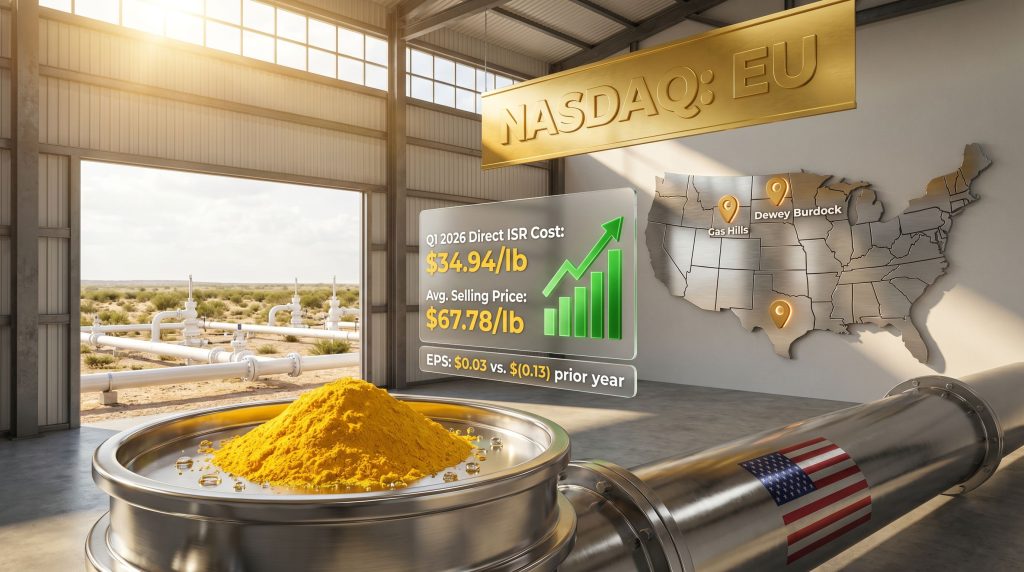
| Direct ISR extraction cost | $34.94 per pound |
| Average contract selling price | $67.78 per pound |
| Implied gross margin per pound | ~$32.84 per pound |
| Uranium extracted (organic) | ~90,000 lbs |
| Year-on-year extraction growth | ~22% (from 73,711 lbs in Q1 2025) |
| Pounds delivered into contracts | 270,000 lbs |
| Closing inventory | 153,956 lbs at $64.52/lb |
The gap between the $34.94 extraction cost and the $67.78 average contract price represents the core margin engine of the ISR business model. Importantly, this margin exists within a long-term contract framework, meaning the selling price is not determined by daily spot market movements but by pre-negotiated agreements with nuclear utilities. This distinction insulates operating cash flows from short-term uranium price volatility in ways that exploration-stage companies cannot replicate. Consequently, understanding the divergence between spot vs term prices is essential context for evaluating this margin structure.
enCore Energy's Q1 2026 Profitability: Dissecting the Year-Over-Year Turnaround
The Financial Inflection in Context
The shift from a loss to a profit across a single year is notable, but the composition of that improvement matters as much as the headline number. Investors evaluating whether enCore's Q1 2026 profitability is durable or transitory need to understand which components are structural and which are one-time contributors.
| Financial Metric | Q1 2025 | Q1 2026 | Change |
|---|---|---|---|
| Earnings Per Share | $(0.13) | $0.03 | +$0.16 swing |
| Uranium Extraction Volume | 73,711 lbs | ~90,000 lbs | +~22% |
| Average Contract Selling Price | N/A | $67.78/lb | N/A |
| Uranium Delivered to Contracts | N/A | 270,000 lbs | N/A |
| Cash on Hand (March 31, 2026) | N/A | $41.6 million | N/A |
| Total Available Liquidity (May 8, 2026) | N/A | $84.7 million | N/A |
Two contributors drove the swing from $(0.13) to $0.03 per share. The first was operational: a 22% increase in organic uranium extraction with only a marginal rise in per-pound cost. The second was financial: a contribution from the divestiture of New Mexico assets to Verdera Energy. The divestiture gain is a non-recurring item. The extraction volume improvement is not.
This distinction is critical for forecasting purposes. A company that achieves profitability primarily through asset sales has not necessarily solved its operating economics. A company that achieves profitability through higher production at controlled costs has demonstrated something more durable. enCore's Q1 2026 result contains elements of both, which is why management's ability to sustain and expand the organic extraction improvement over subsequent quarters will be the key variable to monitor.
The Blended Margin Consideration: Third-Party Uranium Procurement
One aspect of enCore's revenue model that deserves careful attention is the gap between uranium extracted and uranium delivered. In Q1 2026, the company extracted approximately 90,000 pounds but delivered 270,000 pounds into contracts. The difference reflects uranium purchased from third-party sources to fulfil contract obligations that exceed current organic production capacity.
Third-party uranium is typically purchased at prices above the company's own extraction cost of $34.94 per pound, which compresses the blended margin on delivered volumes. As organic extraction capacity grows through wellfield expansion and additional central processing plant throughput, the proportion of self-extracted uranium in total deliveries should increase, improving blended margins over time.
Investor Insight: The ratio of organically extracted uranium to third-party purchased uranium within total contract deliveries is one of the most important but least discussed metrics for evaluating ISR producers. A rising organic share signals improving margin quality, even if headline delivery volumes remain stable.
The South Texas Production Platform and the Capacity It Provides
Rosita and Alta Mesa: Two Processing Facilities, One Integrated Strategy
enCore's South Texas operations are anchored by two central processing plants: the Rosita facility and the Alta Mesa uranium project. Together, these plants carry a combined nameplate processing capacity of approximately 3.6 million pounds of uranium per year, though current extraction volumes are a fraction of that ceiling. Alta Mesa is on a ramp trajectory targeting 1.5 million pounds per year in processing capacity, while Rosita provides a complementary processing route within the same regional infrastructure network.
The strategic importance of maintaining two operating processing facilities in a single jurisdiction extends beyond redundancy. In ISR operations, satellite wellfields can feed uranium-bearing solution to whichever central plant offers the most efficient processing path at any given time, creating operational flexibility that single-plant operators cannot replicate.
The Permit-Stage Pipeline: Expanding Beyond a Single State
Current production is entirely South Texas-based, which concentrates both opportunity and risk within one regulatory jurisdiction and one geological setting. The pipeline beyond Texas represents the next phase of geographic diversification:
| Project | State | Status | Significance |
|---|---|---|---|
| Dewey Burdock | South Dakota | Awaiting regulatory approval | Adds Northern Plains production capacity |
| Gas Hills | Wyoming | Awaiting regulatory approval | Established Wyoming uranium district |
| Rosita / Alta Mesa | Texas | Active production | Current revenue-generating base |
South Dakota's Dewey Burdock project sits within the uranium-rich geology of the Edgemont district, a historically productive area with well-documented roll-front mineralisation. Gas Hills in Wyoming occupies a district with a long production history dating back to the 1950s, providing geological confidence in the resource base even before modern ISR methods are applied.
Permit timelines for ISR uranium projects in the United States involve multiple regulatory bodies including the Nuclear Regulatory Commission (NRC), the Environmental Protection Agency (EPA), and state-level environmental agencies. These processes are outside direct management control and represent a genuine source of timeline uncertainty. Each approval, however, adds a new production node that reduces single-site dependency and expands the total contracted delivery capacity available to the business.
The Macro Context: Why Domestic ISR Producers Carry Structural Scarcity Value
The Supply Chain Disruption That Changed the Procurement Landscape
The Prohibiting Russian Uranium Imports Act, signed into law in 2024, fundamentally altered procurement dynamics for U.S. nuclear utilities. Russia had been supplying a material share of enriched uranium products to American reactors, and the legislative restriction forced utilities to accelerate their search for alternative long-term supply agreements.
The alternative supply landscape is highly concentrated. Kazakhstan, through Kazatomprom, and Canada, through Cameco's Athabasca Basin operations, dominate global uranium production. Both carry their own geopolitical risk premiums in a post-2022 world. This creates a structural preference among U.S. utilities for domestically sourced uranium, particularly from producers operating under U.S. regulatory frameworks with established track records of delivery.
The consequence for companies like enCore is meaningful: they are not merely beneficiaries of high uranium prices, but potential preferred counterparties in a utility contracting process that now explicitly prioritises supply chain security alongside price.
The Nuclear Renaissance and Power Demand Amplification
The demand side of the uranium equation has shifted materially since 2020. Several converging forces are driving a genuine nuclear renaissance:
- Governments across the U.S., Europe, Japan, and South Korea are extending reactor lifetimes and advancing new build programmes in response to energy security concerns.
- Data centre power demand, driven by artificial intelligence infrastructure growth, is placing unprecedented pressure on electricity grids and making baseload generation, including nuclear, increasingly valuable.
- Corporate power purchase agreements with nuclear generators are becoming more common as technology companies seek reliable, low-carbon electricity at scale.
- The global uranium contracting cycle, which moves in multi-year waves, is shifting utilities from spot purchasing toward longer-term supply agreements, providing price floors for producers with existing contracts.
Macro Lens: Uranium spot prices and long-term contract prices can diverge significantly over time. Producers locked into long-term contracts are partially sheltered from spot market corrections, creating a more predictable cash flow profile than exploration equities with no revenue visibility whatsoever.
Management's Strategic Priorities for the Remainder of 2026
Four Execution Pillars Driving the Operational Agenda
Management has articulated a four-point execution framework governing the remainder of 2026:
- Cost compression: Targeting further reductions below the $34.94 per pound Q1 2026 baseline through wellfield efficiency improvements and plant throughput optimisation.
- Permit advancement: Engaging regulatory bodies on the Dewey Burdock and Gas Hills approval processes to reduce timeline uncertainty.
- Shareholder communication: Increasing transparency on production metrics, contract delivery schedules, and liquidity management to build investor confidence.
- Strategic M&A evaluation: Actively assessing potential transactions with other uranium companies to expand reserves or production capacity without greenfield construction timelines.
The M&A dimension is particularly noteworthy given the current state of the uranium sector. With many smaller ISR operators still in development phases and carrying depressed valuations relative to their resource bases, acquisition opportunities may be available at attractive prices. The holding of 23.8 million shares of Ur-Energy on the balance sheet is not merely a passive financial investment; it represents a strategic relationship with another active ISR uranium producer that could evolve in multiple directions.
The Significance of $84.7 Million in Available Liquidity
The total available liquidity figure of $84.7 million as of May 8, 2026, comprising $41.6 million in cash plus 23.8 million Ur-Energy shares and other marketable securities (excluding Verdera Energy shares), carries strategic significance beyond the raw number. Resource companies frequently dilute existing shareholders through equity raises to fund operations and permit advancement. A company with a substantial liquidity buffer can delay or reduce the size of any such raise, protecting the per-share value held by existing investors.
The closing uranium inventory of 153,956 pounds valued at $64.52 per pound adds a further dimension to this picture. This material represents forward delivery capability without requiring additional extraction activity, functioning as a buffer stock that can be deployed against future contract obligations.
The next major ASX story will hit our subscribers first
Key Risks That Investors Must Weigh Against the Opportunity
Evaluating enCore Energy profitable uranium production trajectory requires acknowledging the risks that could disrupt the current progress:
- Third-party procurement margin compression: Purchased uranium delivered into contracts carries higher input costs than self-extracted material, reducing blended margins when third-party volumes are large.
- Permit timeline uncertainty: Regulatory approval schedules at Dewey Burdock and Gas Hills remain outside management control and could extend well beyond current expectations.
- Uranium price sensitivity: Long-term contracts provide some stability, but uncommitted inventory and future contract negotiations will be influenced by prevailing uranium prices.
- Single-geography production concentration: All current production sits within South Texas, creating vulnerability to localised operational disruptions.
- Leadership transition risk: The arrival of incoming CEO Richard Little introduces an execution variable during a critical production ramp period. Leadership transitions in mining companies have historically created short-term operational uncertainty even when the incoming executive is well-credentialed.
However, for investors seeking broader context on positioning within this sector, reviewing considered uranium investment strategies can help frame these risks against longer-term structural opportunities.
This article contains forward-looking statements and projections based on publicly available information. It does not constitute financial advice. Investors should conduct independent due diligence and consider their personal risk tolerance before making any investment decisions.
A Monitoring Framework for Tracking Sustained Profitability
The Metrics That Separate Directional Progress from Structural Durability
| Watch Item | What to Monitor | Why It Matters |
|---|---|---|
| Per-pound extraction cost | Quarterly trend vs. $34.94 Q1 2026 baseline | Indicates cost discipline at scale |
| Organic vs. third-party uranium mix | Proportion of self-extracted vs. purchased material in deliveries | Higher organic share improves margin quality |
| Contract delivery volume | Quarterly pounds delivered and average contract price | Revenue visibility and contract book depth |
| Permit decisions | Dewey Burdock and Gas Hills regulatory updates | Each approval adds production diversification |
| Liquidity position | Cash and marketable securities | Dilution risk indicator |
| Ur-Energy stake value | Market value of 23.8 million shares | Liquid balance sheet asset with uranium sector exposure |
| Closing inventory | Current: 153,956 lbs at $64.52/lb | Forward delivery capability without extraction cost |
The Q1 2026 result positions enCore Energy profitable uranium production as a directional milestone rather than a confirmed steady state. The path toward durable positive earnings requires continued organic extraction growth, blended margin improvement as third-party volumes decline as a share of deliveries, cost compression at the processing plant level, and permit advancement across the multi-state pipeline.
What distinguishes enCore from the majority of uranium equities is not simply that it is producing, but that it is producing within a cost structure that generates positive margins at current contract prices, holds meaningful liquidity without immediate dilution pressure, and retains optionality across a three-state ISR pipeline that could materially expand output as regulatory approvals accumulate. For investors seeking measured exposure to the structural uranium supply deficit, those are not trivial distinctions. Furthermore, World Nuclear News has reported on the resumption of uranium production at Texas projects, providing additional third-party context for the operational progress being made in the region.
Further analysis of uranium market dynamics, ISR production economics, and U.S. domestic nuclear fuel supply trends is available at Crux Investor, which publishes ongoing coverage of uranium producers across the full development spectrum.
Want to Stay Ahead of the Next Major Uranium Discovery on the ASX?
Discovery Alert's proprietary Discovery IQ model delivers real-time alerts the moment significant mineral discoveries — including uranium — are announced on the ASX, translating complex data into actionable opportunities for investors at every level. Explore historic discoveries and the returns they generated, then begin your 14-day free trial to ensure you're positioned ahead of the broader market.