May 12, 2026
Understanding Endeavour Silver's Multi-Mine Production Strategy
The precious metals mining sector has witnessed significant operational evolution as companies seek to optimise production portfolios through geographic diversification and strategic asset allocation. Endeavour Silver's 2026 production forecast emerges within this context, representing a fundamental shift in operational philosophy that prioritises multi-jurisdictional exposure across Mexico and Peru rather than single-asset concentration.
The company's transition to a three-mine operational framework reflects broader industry evolution insights toward risk mitigation through asset diversification. By maintaining operations across different geological environments and regulatory jurisdictions, mining companies can potentially reduce exposure to single-point operational failures, regulatory changes, or geological uncertainties that could impact production continuity.
Three-Mine Portfolio Architecture
The operational foundation supporting Endeavour Silver production forecast 2026 centres on the integration of Terronera and Guanaceví mines in Mexico alongside the Kolpa operation in Peru. This geographic distribution creates operational synergies through different seasonal patterns, regulatory environments, and geological characteristics that can complement each other throughout the production cycle.
Terronera represents the portfolio's newest addition, entering its first full production year with significant infrastructure development requirements. The mine's 2,000 tonnes per day processing capacity targets epithermal vein systems that require specialised extraction and processing protocols. Initial production phases focus on lower-grade zones to establish operational stability before transitioning to higher-grade areas in the latter half of 2026.
Guanaceví operates as the portfolio's established producer, processing 1,050 tonnes per day from the Milache concession and Porvenir concession extensions. This operation provides operational stability and cash flow generation whilst Terronera completes its commissioning phase. The mine's proven processing capabilities and established infrastructure reduce overall portfolio risk during the transition period.
Silver Equivalent Production Methodology
Understanding Endeavour Silver production forecast 2026 requires comprehension of silver equivalent (AgEq) calculations that incorporate multiple metals produced from polymetallic ore deposits. Furthermore, these calculations convert gold, lead, zinc, and copper output into silver equivalent ounces using standardised metal price ratios and recovery rates.
The AgEq methodology provides investors with comprehensive production metrics that reflect total metal value rather than focusing exclusively on primary silver output. For Endeavour's operations, AgEq calculations incorporate significant base metal production from Kolpa, including lead (22,000-24,000 tonnes), zinc (16,000-18,000 tonnes), and copper (650-750 tonnes) alongside precious metals.
Industry standard conversion ratios typically utilise trailing metal price averages to establish equivalency factors. However, these ratios can fluctuate based on market conditions, treatment charges, and metallurgical recovery rates specific to each deposit's ore characteristics. Additionally, these polymetallic exploration dynamics often provide sensitivity analysis showing how AgEq production varies under different metal price scenarios.
When big ASX news breaks, our subscribers know first
Production Target Breakdown and Mine-Specific Analysis
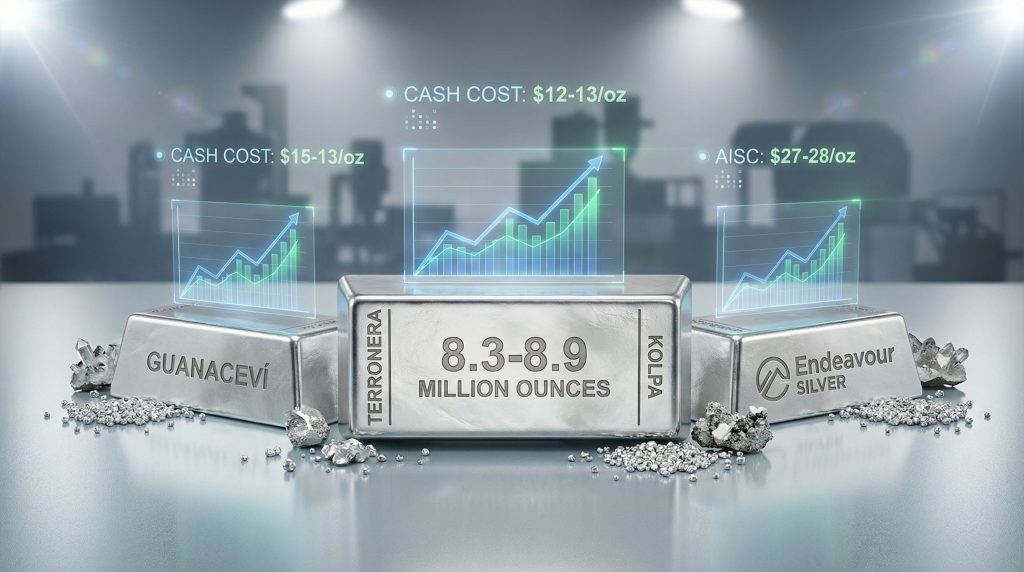
The Endeavour Silver production forecast 2026 projects consolidated output between 8.3 million and 8.9 million ounces of silver, supported by gold production ranging from 46,000 to 48,000 ounces. These figures represent the combined output from three distinct operations, each contributing different production profiles and operational characteristics.
Terronera Mine Commissioning Strategy
Terronera's production profile reflects a deliberately phased approach to operational ramp-up, with first-half 2026 production targeting lower-grade zones before accessing higher-grade areas in the second half. This strategy prioritises mill performance validation and operational stability over maximum short-term production rates.
The mine's 2,000 tonnes per day processing capacity requires successful commissioning of flotation circuits, grinding equipment, and concentrate handling systems. For instance, initial production from lower-grade zones allows operational teams to optimise metallurgical parameters, flotation chemistry, and recovery rates before processing higher-grade material that demands more precise control parameters.
Terronera's infrastructure development includes 9 kilometres of underground mine development supported by $56.7 million in sustaining capital allocation. This development work establishes access to multiple ore zones within the Terronera vein system, providing operational flexibility and grade control opportunities throughout the production life.
Base Metal Integration from Kolpa Operations
Kolpa's contribution to the Endeavour Silver production forecast 2026 extends beyond precious metals to include substantial base metal production that creates revenue diversification and by-product credit opportunities. The operation's 2,400 tonnes per day throughput processes polymetallic ore requiring complex flotation circuits for metal separation.
Lead production forecasts of 22,000-24,000 tonnes annually position Kolpa as a significant contributor to Peru's lead concentrate exports. Zinc output projections of 16,000-18,000 tonnes provide additional revenue streams, whilst copper production of 650-750 tonnes creates supplementary by-product credits that improve overall cost economics.
The Q1 2026 plant expansion involving new ball mill installation and flotation cell upgrades addresses processing capacity constraints identified during feasibility studies. Consequently, this expansion supports higher throughput rates whilst maintaining metallurgical recovery standards required for concentrate specifications demanded by smelting partners.
Production Distribution Analysis
| Mine | Silver (Moz) | Gold (oz) | AgEq (Moz) | Throughput (tpd) |
|---|---|---|---|---|
| Terronera | 3.2-3.4 | 28,000-30,000 | 5.6-5.8 | 2,000 |
| Guanaceví | 4.1-4.3 | 12,000-13,000 | 4.6-4.9 | 1,050 |
| Kolpa | 1.0-1.2 | 6,000-7,000 | 4.4-4.9 | 2,400 |
| Total | 8.3-8.9 | 46,000-48,000 | 14.6-15.6 | 5,450 |
Cost Structure Analysis and Industry Benchmarking
The financial framework supporting the Endeavour Silver production forecast 2026 demonstrates a complex relationship between cash costs and all-in sustaining costs that reflects the operational transition period across the portfolio. Understanding these cost dynamics provides insight into the company's competitive positioning and operational efficiency expectations.
Cash Cost Optimisation Through Volume Leverage
Consolidated cash costs projections of $12-13 per ounce of silver (net of by-product credits) represent a decline from previous levels, primarily driven by operational leverage effects from higher production volumes. This cost reduction illustrates the fundamental economics of mining operations where fixed costs are distributed across larger production bases.
The cash cost calculation methodology incorporates by-product credits from gold, lead, zinc, and copper sales that offset direct mining and processing costs. These credits depend on sustained market access for concentrate sales and maintained metallurgical recovery rates across all operations. However, copper supply forecasts indicate that base metal price volatility can significantly impact cash cost calculations, creating sensitivity to commodity market fluctuations beyond silver pricing.
Mining cost structures typically include direct labour, consumables, energy, equipment maintenance, and administration costs that vary with production levels. Furthermore, higher throughput rates can reduce unit costs through economies of scale, particularly for energy-intensive processes like grinding and flotation that represent major cost components in silver production.
All-In Sustaining Cost Components
All-in sustaining costs (AISC) projections of $27-28 per ounce reflect the capital-intensive nature of the operational transition period, with costs rising despite lower cash operating expenses. This apparent contradiction highlights the distinction between operating leverage and capital investment requirements during growth phases.
AISC calculations include sustaining capital expenditures, exploration costs, administrative expenses, and other costs necessary to maintain current production levels. The $91 million sustaining capital allocation across three operations represents substantial investment in mine development, equipment replacement, and infrastructure maintenance required for continued operations.
| Cost Category | Allocation (USD Million) | Purpose |
|---|---|---|
| Terronera Development | $56.7 | Mine development and infrastructure |
| Kolpa Expansion | $26.5 | Plant expansion and equipment |
| Guanaceví Sustaining | $24.5 | Ongoing mine development |
| Pitarrilla Project | $65.8 | Feasibility and development |
Capital Investment Strategy and Resource Allocation
The capital expenditure framework supporting the Endeavour Silver production forecast 2026 totals approximately $157.8 million when including both sustaining and growth investments. This allocation reflects management's prioritisation of operational stability whilst advancing development projects for future production growth.
Terronera's $56.7 million allocation for 9 kilometres of mine development represents approximately $6.3 million per kilometre of underground infrastructure. This development cost includes access drives, ventilation systems, ore passes, and support infrastructure required for sustained production from epithermal vein deposits that typically require extensive underground workings.
The Pitarrilla project investment of $65.8 million signals transition from exploration to pre-development phases, with $15 million allocated to feasibility studies and $48 million for capital expenditures including mining equipment and 1,300 metres of underground development. Consequently, this allocation suggests management confidence in Pitarrilla's potential contribution to future production profiles.
Strategic Asset Optimisation Through Bolañitos Divestiture
The strategic decision to divest the Bolañitos mine reflects portfolio optimisation principles that prioritise capital allocation toward higher-return opportunities rather than maintaining operations across all available assets. Furthermore, this transaction demonstrates management's willingness to rationalise the asset portfolio in support of focused growth strategies, aligning with broader mining consolidation trends across the industry.
Transaction Structure and Value Creation
Bolañitos' sale to Guanajuato Silver Company for up to $50 million creates immediate capital generation whilst maintaining upside participation through contingent payment mechanisms. The transaction structure includes $40 million upfront consideration ($30 million cash, $10 million in Guanajuato Silver shares) plus potential additional payments tied to production milestones.
Contingent payments of $5 million each trigger at 2 million and 4 million ounces AgEq production levels, creating aligned incentives between seller and buyer whilst providing Endeavour with continued exposure to asset upside potential. This structure demonstrates sophisticated transaction design that balances immediate value realisation with future participation rights.
The asset's proven and probable reserves totalling 379,000 tonnes containing approximately 940,000 ounces of silver and 21,900 ounces of gold provided quantifiable value that supported transaction negotiations. However, management determined that capital deployment toward Terronera and Kolpa development offered superior risk-adjusted returns.
Portfolio Concentration Benefits
Asset portfolio optimisation through divestiture allows management to concentrate technical expertise, capital resources, and operational focus on fewer operations with greater individual impact on overall company performance. This concentration strategy can improve operational efficiency, reduce administrative overhead, and enhance management attention to critical operational details.
The elimination of Bolañitos from the operational portfolio removes a 1,200 tonnes per day operation processing low-sulfidation epithermal vein deposits that required separate management attention, technical expertise, and capital allocation. Concentrating operations on three larger-scale mines potentially creates administrative efficiencies and improved operational oversight.
Market Positioning and Competitive Analysis
The production profile established through the Endeavour Silver production forecast 2026 positions the company within the primary silver producer category, competing against established operations across North and South America. Understanding this competitive positioning requires analysis of production scale, cost structure, and asset quality relative to industry peers.
Production Scale and Industry Rankings
Annual silver production of 8.3-8.9 million ounces positions Endeavour among mid-tier primary silver producers globally, though specific industry rankings depend on peer company performance and production guidance. The combined AgEq production of 14.6-15.6 million ounces provides a more comprehensive measure of operational scale when including base metal contributions.
Primary silver producers typically differentiate themselves from diversified mining companies through focused expertise in epithermal and polymetallic deposit development, specialised processing technologies, and concentrated geographic exposure to silver-rich mining districts. This specialisation can create operational advantages but also increases exposure to silver market dynamics and price volatility.
The three-mine portfolio spanning Mexico and Peru provides geographic diversification within established silver mining jurisdictions whilst maintaining operational expertise in similar geological environments. This geographic spread can reduce single-country regulatory risk whilst leveraging management experience in epithermal deposit development.
Asset Quality and Resource Characteristics
Epithermal vein deposits typically host silver mineralisation in structural controls that can provide high-grade zones but require careful mine planning and grade control to optimise extraction sequencing. Terronera's planned progression from lower-grade to higher-grade zones demonstrates this approach to resource optimisation.
Polymetallic deposits like those at Kolpa offer revenue diversification through base metal by-products but require more complex processing circuits and concentrate handling systems. The successful integration of lead, zinc, and copper flotation circuits demands specialised metallurgical expertise and careful attention to concentrate specifications required by smelting partners.
Resource sustainability depends on successful exploration programmes that replace depleted reserves through new discoveries or resource extension programmes. The continued investment in mine development across all three operations suggests confidence in resource continuity, though specific reserve life calculations would require detailed reserve reporting analysis.
Risk Assessment and Operational Challenges
The successful execution of the Endeavour Silver production forecast 2026 faces multiple operational, technical, and external risks that could impact production achievement. Understanding these risk factors provides context for evaluating the probability of guidance achievement and potential downside scenarios.
Terronera Commissioning Risk Factors
First-year production operations at newly commissioned mines frequently encounter technical challenges related to equipment performance, metallurgical optimisation, and workforce training that can impact throughput and recovery rates. Terronera's planned 2,000 tonnes per day processing rate requires successful integration of grinding, flotation, and concentrate handling systems.
Metallurgical challenges in epithermal deposit processing can include variable ore mineralogy, flotation chemistry optimisation, and concentrate grade specifications required by purchasers. The planned transition from lower-grade to higher-grade ore zones during 2026 may require flotation circuit adjustments and recovery rate optimisation as ore characteristics change.
Underground mine development at 9 kilometres annually requires sustained productivity from development crews, equipment availability, and ground condition management in epithermal vein systems that can present challenging rock mechanics conditions. Development delays could impact ore access and production sequencing.
Operational Integration Complexity
Managing three separate mining operations across two countries requires specialised technical expertise, supply chain coordination, and administrative systems that can handle diverse operational requirements. Each operation requires distinct metallurgical approaches, equipment specifications, and concentrate handling protocols.
Currency exposure across Mexican peso and Peruvian sol denominated costs versus US dollar revenues creates foreign exchange risk that can impact cost projections and profitability. Hedging strategies and natural currency hedges through local cost structures help mitigate but cannot eliminate these exposures.
Labour availability and cost inflation in mining regions can impact operational costs and production schedules, particularly during periods of high mining activity that create competition for skilled workers. Remote mine locations may face additional challenges in workforce recruitment and retention.
External Risk Mitigation Strategies
| Risk Category | Specific Risks | Mitigation Approaches |
|---|---|---|
| Technical | Metallurgical optimisation | Phased ramp-up protocols, expert consultation |
| Operational | Equipment availability | Preventive maintenance, spare parts inventory |
| Financial | Currency volatility | Natural hedging, cost control programmes |
| Regulatory | Permit compliance | Regular auditing, government relations |
The next major ASX story will hit our subscribers first
Investment Implications and Future Growth Trajectory
The financial implications of achieving the Endeavour Silver production forecast 2026 extend beyond immediate production metrics to encompass long-term value creation potential, cash flow generation capacity, and strategic positioning for future growth opportunities. Understanding these broader implications helps evaluate the investment thesis supporting current operational strategies.
Cash Flow Generation Potential
Production levels of 8.3-8.9 million ounces of silver at projected cash costs of $12-13 per ounce create substantial operational cash flow generation potential, dependent on silver price realisations above breakeven levels. Base metal by-product credits from Kolpa provide additional revenue streams that can enhance overall profitability margins.
All-in sustaining costs of $27-28 per ounce establish the minimum silver price levels required for long-term operational sustainability, including capital replacement and exploration investment necessary to maintain production levels. These cost levels provide context for evaluating operational viability under different silver price scenarios.
The substantial capital expenditure programme totalling $157.8 million represents significant near-term cash outflow requirements that must be balanced against operational cash generation and external financing availability. Successfully managing this capital deployment whilst maintaining operational performance represents a key execution risk.
Long-Term Development Pipeline
The Pitarrilla project investment of $65.8 million signals management's commitment to developing future production sources that can extend the company's operational life and production profile beyond current mine plans. Furthermore, Endeavour Silver recently provided updated guidance that positions potential future production growth through this project's advancement.
Exploration potential at existing properties could extend mine life and increase reserve bases, though specific exploration programmes and target areas would require detailed analysis of geological potential and exploration expenditure allocations. Successful exploration can significantly impact long-term value creation through reserve replacement and resource expansion.
The strategic focus on Mexico and Peru provides opportunities for additional acquisitions or joint venture arrangements within established mining districts where the company has operational expertise and infrastructure presence. In addition, mining industry analysts note that this geographic concentration could create synergies for future expansion opportunities.
Disclaimer: This analysis is based on publicly available information and company guidance. Mining operations involve inherent risks including operational challenges, commodity price volatility, regulatory changes, and technical factors that could impact actual production results. Investors should conduct independent research and consider professional advice before making investment decisions.
Ready to Discover High-Potential Mining Opportunities?
Discovery Alert's proprietary Discovery IQ model delivers instant notifications on significant ASX mineral discoveries, providing subscribers with rapid insights into actionable trading opportunities whilst the market is still catching up. Begin your 30-day free trial today and position yourself ahead of the broader market with real-time alerts that transform complex mineral data into clear investment insights.